Asphalt and Attitude: The Drive-In Roughie and the Cinema That Played After Dark
As we plumb the depths of trash cinema, there is a whole raft of "made for Drive-in" films that defined a generation, and so many back seat necking sessions. This is near and dear to my Gen-X heart

There is a moment in almost every drive-in roughie where the film reveals what it is actually about, and it is almost never what the poster promised.
The poster promised skin, or violence, or both — a woman in torn clothing, a motorcycle gang mid-rampage, some combination of threat and transgression rendered in the lurid color palette of a carnival barker's dream. The distributor sold it on that promise. The theater owner booked it on that promise. The audience showed up, fogged the windows, and got — if they were paying attention, which was not always the case and was not always the point — something considerably stranger than the promise implied.
The drive-in roughie, roughly located between the late 1950s and the mid-1970s, is the most disreputable and the most sociologically interesting branch of the exploitation tree. It's disreputable because it was designed to be — transgression was the product, not the wrapper. It's interesting because the filmmakers working in it, constrained by budgets that made Corman look lavish and distribution networks that required certain deliverables, kept finding ways to say things that the mainstream cinema of the same period was actively avoiding.
They said them badly, often. They said them cheaply, always. They said them with varying degrees of self-awareness and craft and sincerity. But they said them, and that counts for something.
The taxonomy
"Drive-in roughie" is an umbrella that covers a lot of ground, and it helps to know the subgenres before walking in, because each had its own conventions, its own audience expectations, and its own specific flavor of transgression.
The nudie cutie was the earliest and most innocent variant — essentially a burlesque picture dressed up as a nudist-colony documentary, featuring non-sexual nudity and comic situations designed to give theater owners something they could argue was educational. Russ Meyer's early work lives here: The Immoral Mr. Teas (1959) is the founding text, a comic fantasy about a man who hallucinates women without clothing, made for $24,000 and returned enough money to fund Meyer's subsequent career. The nudie cutie is charming in the way that something trying very hard to be naughty while remaining technically inoffensive is charming. It didn't last long before the market demanded more.
The roughie proper arrived in the early 1960s as the nudie cutie's meaner sibling — same nudity, now combined with menace, crime, and suggestion of genuine danger. The roughies acknowledged that desire and threat occupy adjacent territory in ways the nudie cuties had carefully avoided. They're uncomfortable to watch now in ways that have nothing to do with their technical limitations, and that discomfort is itself informative.
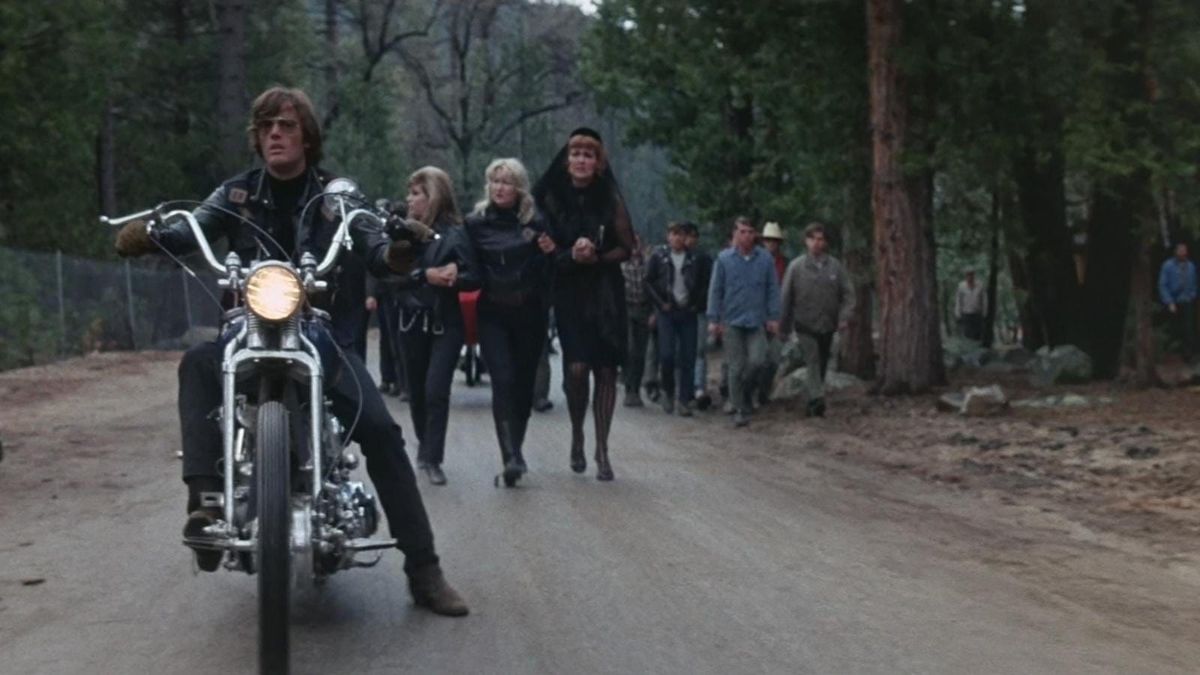
The biker film emerged as its own genre after The Wild Angels (1966), which Corman made for AIP with Peter Fonda and Nancy Sinatra and which became one of the highest-grossing AIP pictures ever. The biker film's subject was freedom — specifically, the freedom of people who had opted out of the social contract and what that opt-out looked like from the outside. The answer, in film after film, was: chaotic, violent, intermittently exhilarating, and ultimately doomed.
The women-in-prison picture — WIP in the trade shorthand — was its own complete ecosystem within the roughie category, running from Corman's early 1970s New World Pictures productions through a parallel Italian cycle and never entirely going away. The WIP picture had a fixed grammar: incarceration, hierarchy among the prisoners, a sadistic authority figure, solidarity, rebellion, escape or death or both. Within that grammar, individual films had surprising room to maneuver.
Russ Meyer and the outer limit of the form
Any serious account of the drive-in roughie has to reckon with Russ Meyer, and reckoning with Meyer is a more complicated proposition than his reputation suggests.
Meyer is easy to caricature: the breast-obsessed former military photographer who built a career on maximalist female physiques and comic-book sexuality. The caricature is not wrong, exactly, but it misses the filmmaker. Meyer was a genuine stylist — his cutting rhythms, borrowed from his military training in rapid-assembly editing, are unlike anyone else's, a kind of percussive montage that treats the image as something to be struck rather than lingered over. His compositions are bold to the point of aggression. His films move.
Faster, Pussycat! Kill! Kill! (1965) is where the caricature breaks down entirely and what emerges is something that belongs in any serious account of 1960s American cinema. Three go-go dancers — Varla, Rosie, and Billie — tear through the California desert in sports cars, kill a young man in a road race, kidnap his girlfriend, and descend on an old man's ranch looking for money. Varla, played by Tura Satana in a performance of almost frightening physical authority, is the engine of the film: violent, intelligent, contemptuous of everyone around her including her own allies, operating on a code that has nothing to do with any social norm the film's world endorses.
The film was made for under $50,000 and shot in two weeks in the Mojave Desert. It failed commercially on release — Meyer thought it was too aggressive for his usual audience and too disreputable for anyone else. It was rediscovered in the 1980s and is now correctly understood as one of the stranger and more genuine feminist documents in American cinema, which is a sentence that would have baffled everyone involved in its production. Varla doesn't represent female liberation in any programmatic sense. She represents female will operating without apology and without limit, which turns out to be a more radical proposition than most films with explicitly feminist intentions have managed.
Satana's performance is the thing. She was a Japanese-American woman who had been interned during World War II as a child and who, by her own account, was assaulted as a teenager and subsequently trained in martial arts to ensure it didn't happen again. She brought all of that to Varla — the history, the discipline, the specific quality of a person who has decided that the world's claims on her behavior are no longer operative. You can see it in every frame she occupies.
The biker film and the question of freedom
The Wild Angels (1966) established the template and is itself a better film than its reputation as an exploitation product suggests. Corman was interested in the Hell's Angels as a social phenomenon — Hunter S. Thompson had published his account of riding with them the same year — and the film treats its subjects with more anthropological curiosity than moral judgment. Peter Fonda's Heavenly Blues is not a villain and not a hero. He's a man who has chosen a way of life and is discovering that the way of life doesn't deliver what it promised, which is a fairly honest thing for a film to say about freedom as a consumer proposition.
The films that followed had less interest in the anthropology and more in the template, which is how genres work. AIP produced biker pictures with the same industrial logic it applied to everything else: find what's selling, reproduce it efficiently, move on. The biker pictures of the late 1960s and early 1970s are a remarkable archive of the period's surface anxieties about counterculture: the squares feared the bikers, but the biker films were mostly being watched by people who wanted to be the bikers, or who wanted to spend ninety minutes in a world where the social contract was optional.
Billy Jack (1971) is where the biker-adjacent action picture crossed into something genuinely strange — a film about a half-Native American Green Beret who protects a hippie school on an Arizona reservation, produced, directed by, and starring Tom Laughlin in what can only be described as a vanity project that accidentally captured something real about the early 1970s mood of aggrieved righteousness. Laughlin self-distributed the film after the studio release failed, pioneering four-walling — renting theaters outright and keeping all the receipts — in a way that influenced independent distribution for a decade. The film made an improbable fortune. Its politics are a muddle. The roundhouse kick scene, in which Laughlin informs a villain that he is going to put his foot on the right side of his face and there is nothing the villain can do about it, and then does exactly that, remains one of the most unexpectedly satisfying moments in exploitation cinema.
The women-in-prison picture and what it was actually doing
The WIP cycle is the roughie subgenre that rewards closest attention, partly because its conventions are so fixed that variations from those conventions become legible as deliberate choices, and partly because the films kept returning to questions about institutional power and female solidarity that were genuinely live in the early 1970s.
Corman's New World Pictures produced the foundational American WIP pictures: The Big Doll House (1971) and The Big Bird Cage (1972), both directed by Jack Hill in the Philippines, both starring Pam Grier before she became Pam Grier. Hill understood the WIP grammar precisely and worked within it while consistently pushing the material toward something more. His films acknowledge the exploitation requirements — the shower scenes, the sadistic guards, the catfights — and then spend their remaining energy on the prisoner dynamics, which are written with more specificity and psychological texture than the genre required.
Pam Grier in these early films is doing something similar to what Satana does in Faster, Pussycat — occupying the frame with a kind of physical authority that the genre doesn't quite know what to do with and that commands the viewer's attention regardless. She was being deployed as exploitation product. She was also clearly, even in these early performances, an actress of real gifts, which Hill recognized and which is why he cast her as the lead in Coffy (1973) and Foxy Brown (1974), which are nominally blaxploitation pictures but which belong in the same conversation about what happens when a filmmaker and a performer find each other in a genre that gives them room to work.
Doris Wishman and the cinema of pure accident
No account of the drive-in roughie is complete without Doris Wishman, who may be the most genuinely surreal filmmaker in American exploitation history and who is vastly underappreciated relative to her male contemporaries.
Wishman made nudie cuties and roughies in Florida through the 1960s and into the 1970s on budgets that made her contemporaries look flush. She frequently shot without sound and dubbed everything in post, which produces a dissociative quality in her films — the dialogue doesn't quite match the mouth movements, the ambient sound doesn't match the visible environment, characters seem to be occupying slightly different versions of the same space. In a conventional film this would be a technical failure. In a Wishman film it becomes a kind of accidental style, a floating unreality that makes her work feel more dreamlike than anything she intended.
Her camera has a peculiar relationship with the human body — she frequently shoots feet, hands, decorative objects, anything other than the faces of the people speaking, and then cuts to the face as a kind of revelation or afterthought. Film scholars have proposed various theories for this (she was avoiding having to match lip movements; she liked decorative surfaces; she was drawn to fragmentation as an aesthetic). The honest answer is probably that she was improvising constantly under extreme constraint and that the improvisation produced results she didn't plan and couldn't entirely account for. That the results are interesting is the important thing.
What the roughies knew
The drive-in roughie operated in a space that mainstream cinema, for most of the period in question, couldn't enter. The combination of institutional disrepute, low budgets, regional distribution, and an audience that came specifically for transgression created conditions in which filmmakers could — had to — deal with subjects the majors were avoiding.
Female agency and female desire. The experience of institutions as systems of control. Race and sexuality in combinations the Production Code had explicitly prohibited. Class resentment, social alienation, the specific American frustration of people who have been told the contract is fair and have figured out that it isn't.
None of this was delivered with the polish or the intentionality that a more resourced cinema would have brought to it. It was delivered cheap, fast, sometimes exploitatively in the literal sense — trading on the same bodies and experiences it claimed to be representing. The critique of the genre is real and shouldn't be waved away.
But the record is also real. The drive-in roughie, at its best, said things that needed saying in the only venue available for saying them. The venue was a speaker hanging on a car window in a field outside town. The message got through anyway.
Next: Blaxploitation — the cycle that gets the most complicated legacy in the entire exploitation tradition, and the one that most clearly demonstrates what the form was capable of when real filmmaking talent met real cultural urgency.