Five Grams
D.A.R.E. didn't work, its founder wanted casual users shot, and the 1986 drug law was written in a few months after one death. The war on drugs, 1982 to 1990.

Series: The Fulcrum, Book Two: The Performance, Act Three: The Presidency, Episode 4
On the evening of September 14, 1986, the Reagans spoke to the country together from the West Hall of the White House residence. The president opened and closed. Nancy spoke in between. The subject was drugs, and the president's word for what he wanted was a crusade, one that "should become our national crusade."
The speech laid out six goals: drug-free workplaces, drug-free schools, treatment for people who were dependent, international cooperation, tougher law enforcement "building on efforts begun" by Vice President Bush and Attorney General Meese (yes, that Meese, and he will be back), and public awareness. Treatment was on the list. It was point three. Remember that.
Forty-three days later the president signed the Anti-Drug Abuse Act of 1986. This is the story of what went into it, what was left out, and the odd way the country's alarm kept climbing after the thing it was alarmed about had started to fall.
The Surrender Flag
The war was declared in 1982. The budget had already picked a side.
Nixon had named the thing a "war" in 1971. Reagan gave it an army. In 1981 Congress loosened the Posse Comitatus restrictions so the military could help with drug enforcement. On January 28, 1982, the South Florida Task Force went live in Miami, pooling agents from DEA, Customs, the FBI, ATF, IRS, the Army and the Navy, and it became the template for the multi-agency task forces that followed (Carlisle/DTIC). That October, Reagan told radio listeners that his administration had taken down the surrender flag and run up the battle flag.
The rhetoric was a war on demand, a moral campaign for the nation's children. The money went the other way. In fiscal 1982, 61 percent of the federal drug budget went to reducing supply and 39 percent to reducing demand. By fiscal 1987 supply reduction had climbed to 71 percent, and total drug spending had nearly tripled since 1981, to roughly $4 billion. The 1984 Comprehensive Crime Control Act broadened asset forfeiture. By October 1984, Reagan was bragging on the radio about $1.2 billion for enforcement, up 75 percent, with 1,200 new Justice Department agents and prosecutors and more customs agents.
Here is the part that tends to get skipped. Drug use was already falling. Marijuana use among high school seniors had peaked in 1979 at 51 percent and was down to about 40 percent by the early 1980s. The war escalated into a decline it did not cause and then collected the credit.
Just Say No, With a Curriculum
The demand-side half of the war had a slogan, a mascot and a very confident evaluation record, which is to say none.
Nancy Reagan's campaign did have a real origin story. During a visit to an Oakland elementary school, a student asked what to do if someone offered her drugs, and Nancy answered with three words that became a national brand. The clubs followed by the thousands, and the Girl Scouts and Kiwanis signed on. The administration's accompanying literature was less poetic. One pamphlet listed warning signs that a teenager was using marijuana, among them not cutting grass.
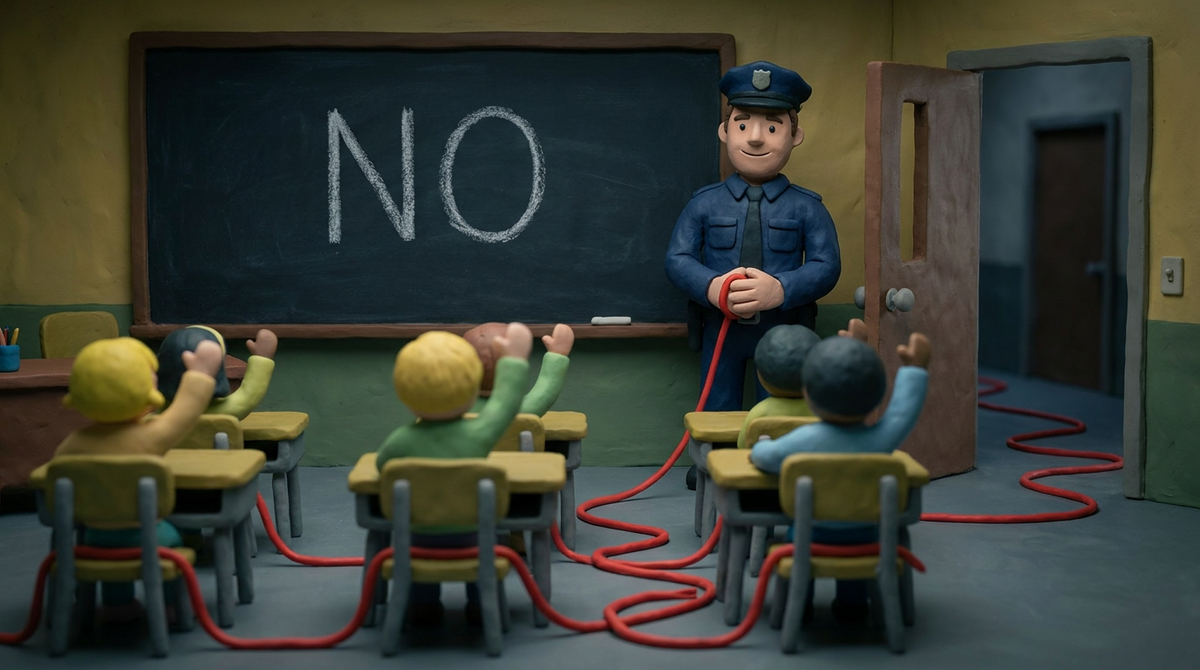
The program with real reach was D.A.R.E. Founded in Los Angeles in 1983 by LAPD Chief Daryl Gates1 and school superintendent Harry Handler, it put a uniformed police officer at the front of a classroom to teach kids how to resist drugs, and it spread to roughly three-quarters of American school districts. The evaluations arrived on a schedule. A 1994 meta-analysis found the program had "little or no impact on students' drug use." The Surgeon General's 2001 report classified it as an ineffective primary prevention program. The GAO's 2003 review found no significant differences in drug use between graduates and everyone else. In 2012, after nearly three decades, D.A.R.E. quietly swapped in an externally designed curriculum.
It is worth pausing on the man who started it. In September 1990, Gates told a Senate committee that casual drug users ought to be "taken out and shot". He later described the testimony as calculated hyperbole. The founder of the nation's gentlest anti-drug program for children wanted the adults who bought the stuff executed. It is hard to find a better single sentence for the distance between the stated program and the operating logic.
A Death in June
A 22-year-old athlete died of an overdose of the wrong drug, and Congress legislated about the right panic.
On June 17, 1986, the Boston Celtics drafted Len Bias second overall. Two days later he was dead of a cardiac arrhythmia tied to cocaine. The cocaine was powder, not crack, though crack was in the headlines that summer and his death fed the coverage anyway. Another young athlete, the Cleveland Browns' Don Rogers, died of a cocaine overdose that same month. Speaker Tip O'Neill moved the House to act.
What followed is among the more bipartisan episodes in modern lawmaking. The House passed the bill 392 to 16 on September 11. The Senate passed its version 97 to 2 on September 30. Reagan signed it on October 27, a week before the midterms. The law set mandatory minimum sentences by drug quantity for the first time, and it created a separate offense, nicknamed the Len Bias Law, with a 20-year minimum for distribution that results in a death (1986 Act). Only about a quarter of the money went to education and treatment, the item that had been point three of the president's speech.
Sweaty's Corner doesn't have a marketing budget or an algorithm pushing it into anyone's feed. It has readers who share it. If this one landed, sending it to someone who'd get something out of it — or subscribing so the next one finds you directly — genuinely moves the needle.
Five Grams
The ratio is the whole story, and it fits on a nickel.
A U.S. nickel weighs five grams. Under the 1986 Act, possessing that much crack cocaine triggered a mandatory five-year sentence with no parole. To trigger the identical sentence with powder cocaine, you needed 500 grams, a bit over a pound. That is the 100-to-1 ratio, and it is one of the most consequential numbers in the history of American sentencing.
The speed of the bill matters here. A death in June, a bill written in the summer, passage by overwhelming margins in the fall. No sentencing study that anyone has pointed to produced the number 100. What the law did afterward is documented. According to the Sentencing Project, within four years of the Act the sentencing gap between Black and white federal drug offenders had grown from 11 percent to 49 percent. Average federal drug sentences rose from under two years to about seven by 2005. The 2010 Fair Sentencing Act, the first real correction, cut the ratio to 18 to 1, which cut the disparity by more than four-fifths and still left it at 18 to 1.
Nancy Reagan stated the moral architecture in February 1988: "If you're a casual drug user you're an accomplice to murder." It is a statement about supply and demand: the buyer is responsible for the harm of the market. It is also a statement the administration's own conduct made awkward, as the next section shows.
The Other Supply Line
The government that wanted to jail casual users also had a drug problem inside its own Central American policy.
This is a cameo, and the full production runs a few episodes from now. In 1989, the Kerry Committee concluded that Contra-aligned figures were involved in drug trafficking and that elements of the Contras knowingly accepted money and material from traffickers, in some cases after indictment. In 1998, the CIA's own Inspector General, Frederick Hitz, confirmed that the agency had not moved quickly to cut off relations with people faced with trafficking allegations. He also documented an agreement, reached in 1982, between Reagan's Attorney General and the CIA that exempted the agency from reporting drug allegations involving non-employee assets, a category that included pilots and Contra officials, until congressional funding resumed in 1986.
So the same year the president raised the battle flag, the government set up a reporting carve-out for the people at the edge of its own payroll.
What was and wasn't shown matters. Gary Webb's 1996 series went further than the record did, claiming CIA aircraft carried cocaine to the U.S. and that the agency blocked prosecutions, and his paper later distanced itself from the conclusions. The direct involvement of the CIA in the drug trade was never conclusively proven. What was proven is narrower and more damning for a crusade: knowledge, delay, and a rule that kept the knowledge off the books.
The Officer at the Front of the Room
D.A.R.E. did not invent police in schools. It supplied the job description that made them routine.
Police had been in schools before. The first documented school resource officer program started in Flint, Michigan, in 1953, as a relationship-building liaison, and Los Angeles had a school police unit going as early as 1948. What D.A.R.E. changed was the shape of the presence. Instead of an officer who responded when something went wrong, the program put one at the front of the room as an instructor, teaching a curriculum, a standing part of the school day. That is a preventive, proactive posture rather than a reactive one, and nobody objected, because the stated purpose was protecting children from drugs.
The enforcement-heavy version arrived afterward, and it arrived with federal money. In 1991 the National Association of School Resource Officers was founded around a "triad" concept of the officer as teacher, informal counselor and law enforcer. The 1994 Gun-Free Schools Act pushed districts toward zero-tolerance discipline. The COPS in Schools program, launched in 1999 after Columbine, awarded about $750 million over roughly a decade, funding about 6,500 officers. By 2015-16, about 42 percent of U.S. public schools had one.
What do they do? In a 2019 federal survey, 94 percent of school resource officers reported patrolling, 93.5 percent made arrests and 88.4 percent issued criminal citations. Research on grant-funded officers has found disciplinary rates rising, driven by low-level offenses, with the largest increases in referrals to law enforcement for Black and Latino students. In 2017-18, Black students were about 15 percent of enrollment and about 32 percent of school-related arrests.
The drug war did not put police in schools. It made a uniformed officer at the front of a classroom an ordinary and uncontroversial thing, and a decade later the money and the fear made the rest of the job easy to add.
The Panic Left Early
Public alarm over drugs peaked in 1989. By the summer of 1990 almost nobody was worried. The machinery stayed.
The 1988 Anti-Drug Abuse Act created the Office of National Drug Control Policy, the drug czar's office. In an October 1988 radio address, Reagan said the war was "not yet won, not by a long shot." And then the public did something no one in Washington had planned for. After George H.W. Bush's September 1989 televised address, 64 percent of respondents in a New York Times/CBS poll named drugs the nation's top problem. By July 1990, the number was 10 percent. Cocaine use, according to the survey data, had been dropping since 1986, so the country's concern had risen for three years while the thing itself declined, and then it collapsed to nothing as the Gulf War and the Soviet Union's disintegration took over the news.
The panic had a life of about four years. The law outlived it by decades. It is still being unwound: in 2025, about 2,500 people serving time for nonviolent drug offenses, many of them under crack-powder sentences, received commutations.
In February 1988, the first lady asked the country to hold itself accountable for the harm done to other people by its private habits. It was an interesting moral position, and the administration was about to have the chance to apply it to a very different epidemic, one that had been killing Americans since 1981 and that the White House was slow to address in public. That is next.
1 - Daryl Gates deserves the full This Fucking Guy treatment. Stay tuned for that!