Peeking Behind the Curtains - AI in corporate America
AI is the râison du jour for wave after wave of layoffs, but is it really to blame, or is it feckless executive wanking? You be the judge.

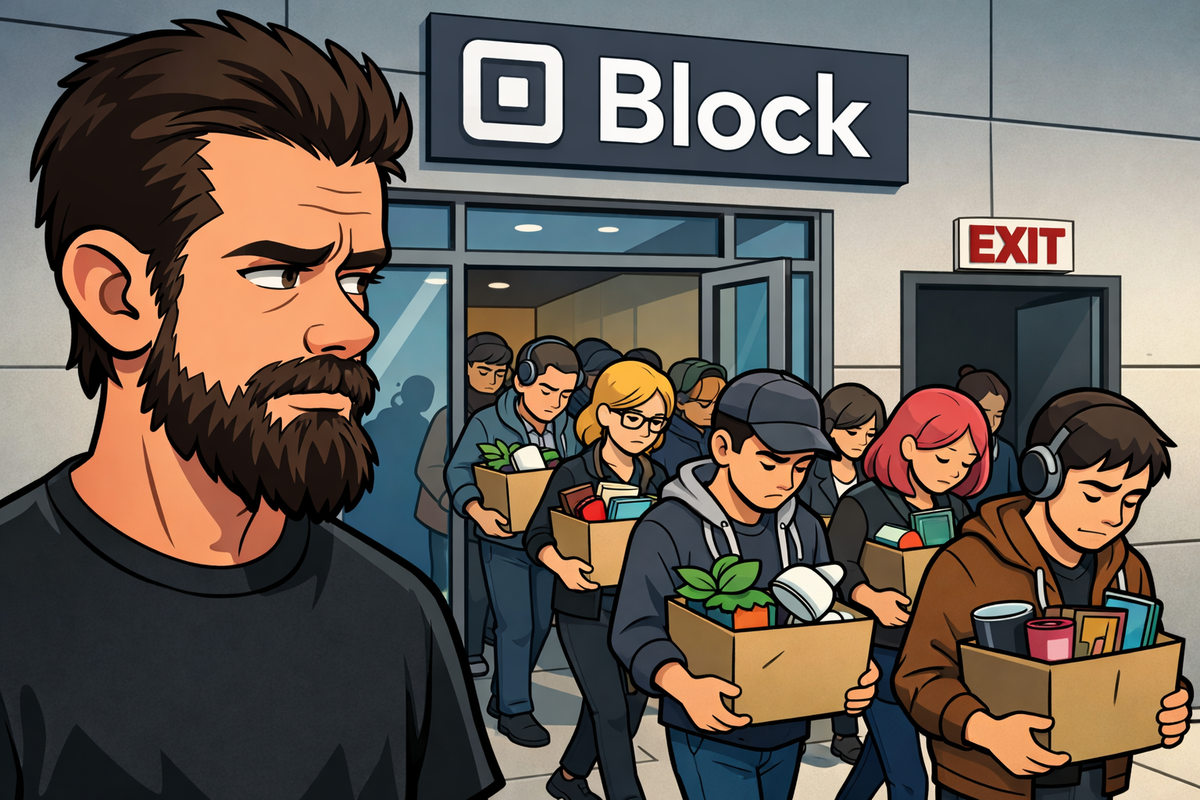
Early last week, FinTech company Block (formerly known as Square) the Jack Dorsey (ex Twitter Founder/CEO) started to sorta compete with Paypal, announced that they were cutting more than 4,000 jobs (40% of their 10,000 staffers) and that was due to "AI efficiencies".
This is a theme in the recent past, as companies are facing intense pressure to justify their gargantuan spending on AI googaws being peddled by the likes of Clammy Sammy Altman, we have seen a trend of companies announcing layoffs with the justification being that AI is making them sooooo efficient, that AI is taking the jobs:

But there have been some counter opinions to that.
First, the case that AI is the causus belli of the latest rounds. If you are in the halo of tech companies in 2025, it was wave after wave of staff reductions at the majors (and not so major) companies. IBM, Microsoft, and others slashed staff throughout the year, tipping the hat to AI being so damned good that it makes it a no-brainer to just use more and more of it.
Layoffs have been a defining feature of the job market in 2025, with several major companies announcing thousands of job cuts driven by artificial intelligence.
In fact, AI was responsible for almost 55,000 layoffs in the U.S. this year, according to consulting firm Challenger, Gray & Christmas.
There were in total 1.17 million job cuts through 2025, the highest level since the Covid-19 pandemic in 2020 when there were 2.2 million layoffs announced by the end of the year.
In October, U.S. employers announced 153,000 job cuts, and there were over 71,000 job cuts in November, with AI being cited for over 6,000 for the month, per Challenger.
That sounds pretty bad, about a third of the total listed job cuts were due to AI becoming so good, that you could just replace people with it, and instead of a 10 person team that writes marketing copy, you can just use AI, and have one senior person to the the Human in the Loop to provide quality control and just pay for a commercial license to crank out the base copy, and do light touches to "polish" it.
And sometime in late 2025, a pretty significant improvement in the quality of AI coding tools has caused a wave of worry.
You may have heard of the term "vibe coding" and/or seen that demo of a 3D game created with just a prompt (that caused stocks for gaming companies to drop for a while - god, are Wall Street traders dumb fuckers). But that isn't what this is. If you are in the world of this sort of work and tech, look up "Spec Driven Development" and you get a glimpse of what is coming. A colleague is exploring it, and I have to say I was impressed. Seriously blown away by what he was able to accomplish in a very short time.
Then there's the belief that AI was going to bring efficiency that was unprecedented. And this is where the Block announcement comes into play.
It is no surprise that senior executives are looking at what GenAI does for them in their workflow[1] and think that it will be the miracle tool for their teams, they then try push it down to the lower echelons of their organization.
AI mandates, enforced usage, and IT systems monitoring are validating that the rank and file are using these expensive tools that the executives are (benevolently) showering on them. This is costing real money, and to executives, that means one thing: productivity goes up. Forget all the research that says that isn't the case, they have to believe in the pixie dust.
Thus, what do we see here? From the HR Digest
 Anuradha Mukherjee
Another puff piece, taking this at face value.
Payment company Block is treading down the well-worn path of layoffs in 2026, a road that has been paved and maintained by other tech giants in the U.S., in preparation for the organization’s next “phase of long term growth.” CEO Jack Dorsey recently announced the decision to bring down Block’s headcount from over 10,000 employees to just under 6,000, meaning that about 4,000 workers will now be asked to leave directly or enter into consultation.
Doing layoffs - ✔️
Claiming AI is making people redundant - ✔️
Likely fucking it all up - ✔️
Of course, this is par for the course, from that same article:
While Block’s workforce reduction plans were tough on its own employees, the company warned that those at other businesses could see a similar fate within the next year, as other companies also submit to this need for structural change. These warnings are unsurprising and align with the AI-driven layoffs that have transformed workplaces with great zeal over the last two years.
Note: the ghoulish "zeal" comment. If you ever thought HR was there to be on your side, you need to disabuse yourself of that shit right now, HR is there to protect in this order:
- The Executives (especially the C-suite)
- The company
- You
There's a myth that HR is there to be your voice, that is 100%, uncut bullshit.
Of course, there have been other companies making these claims. Klarna in particular made a huge splash about terminating 700 staffers because AI was doing their jobs (this does seem to be something that FinTech in particular likes to do, as financial services is a customer support heavy operation).
But is it all that? What is the counter claims?
The other side of the coin
Many of the large cuts have been in industries with a lot of direct customer interaction, places where people need support. And customer support roles have been on a rollercoaster the last few decades, as US based call centers were first consolidated, then outsourced to countries with lots of english speakers (first India, then the Philippines) and finally they are being replaced by chat-bots. At first, they were simple, with a machine learning response engine to handle simple things (account balances, make payments, etc) before handing off to a live agent.
Generative AI makes the bots far more "real" feeling to users, but they can be frustrating. And early on there were hilarious accounts of clever techies jail breaking them and getting the bots to do, uh, bad things.
That is largely handled now with sophisticated overlay rules, but at the end of the day, the one axiom of Generative AI remains in charge: All the AI out there today is just super sophisticated autocomplete. If you're like me, you get tired of the autocorrect turning "Fuck" into "Duck" and "Fucking" into "Ducking". I swear I have never once used the word ducking in a sentance or text, for fuck's sake.
But I digress.
Mentioned above was the case of Klarna. Klarna is one of those "Buy now, pay later" (BNPL) services that let you stretch payments over a number of weeks to feed your immediate gratification[2].
A while back, they announced with great fanfare that they were eliminating 700 staff members who provided online support with chatbots. This was hailed as innovation, and the future. All these low skill[3] roles can be iced, replaced with a pot of tokens and a trained monkey of the AI prompts.
Funny thing though, Klarna backtracked and rehired a lot of people (and probably lost a lot of talent that told them to fuck right off).
 Rachel Dobkin
Oops:
Klarna CEO Sebastian Siemiatkowski has announced plans to beef up its human customer service team after artificial intelligence replaced 700 workers.
The “buy now, pay later” company’s use of AI to cut jobs came after the company has seen its valuation drop to $6.7 billion, despite peaking at $45.6 billion in 2021.
But now, Siemiatkowski has suggested that the AI job cuts have led to “lower quality” customer service and is backpedaling by vowing to hire more humans.
You don't fucking say... I dunno, losing like $40B (85%) of your market value seems bad.[4]
And an insider from Block has taken to the Gray Lady to talk about this (gifted link):
Aaron talks about the RIF, the hype, and the reality.
The question on minds everywhere: Is A.I. a terrifying new reality in which the work they do might no longer be viable? Or is Block’s announcement just a convenient and flashy new cover for typical corporate downsizing?
I am sure there will be job losses that can be directly attributable to AI tools being able to do more and more things. And my biggest fear is the junior level positions in white collar fields that were springboards for solid middle class careers.
I am a product manager, and have been one for almost three decades. That makes me a jack of all trades, and I have at times been the creator of marketing copy (small company, and I have the knowledge as well as an ability to write).
But that entry position into a corporate marketing team is the lowly copy writer. Typically a fresh out, they crank out bland pablum that gets refined by the more senior folks, and as time goes on, they "get" what works, and improve so that they need less supervision, and ultimately they are the senior people.
Those jobs are getting slaughtered by AI.
And sadly the same is true for basic graphic design.
Any function that can be distilled into a formula is at risk. And that includes the entry level coder, the holy grail of the last 20 years.
Back to the OpEd...
Wher Aaron is spot on is in his insight that Silicon Valley is led by engineers:
Silicon Valley is led by engineers. Jack, like many engineers-turned-leaders, sees the world largely through that lens. At a time when some A.I. coding tools have rapidly improved to become a real game-changer, it’s not a big logical leap for an engineering-minded leader to conclude that A.I. will rip through the rest of our work as well. Jack, who also co-founded what was then called Twitter, has long placed big bets based on a read of early signals. These layoffs, like his early adoption of Bitcoin and his decision to close offices at the onset of Covid before everyone else, show a tendency to identify patterns, see enormous growth as an inevitability and go all in with conviction.
I work with a lot of these sorts of people (not Jack per se, but people who put all their trust in code) and this resonates. The mantra "Move fast, break things" is not just hyperbole, it is how they live. (read up on Musk's strategy for playing poker to understand this more fully)
But Aaron goes on to state what is truly the likely issue:
A.I. may provide a new justification for layoffs, but the playbook is familiar. Silicon Valley executives have argued that tech companies are overstaffed because they expanded too much during the pandemic. Block itself had gone through rounds of layoffs in 2024, 2025 and again in February to fix the predictable fallout from earlier executive turf wars that led to teams being duplicated all over the organization. (This, in my view, is what led Block to triple its head count in four years.) Look closer at specific cuts — like shrinking the policy team and eliminating diversity and inclusion roles, former colleagues told me — and Block’s latest reorganization reads like standard prioritization and cost management, not an A.I.-driven reinvention.
In summary: same ol, same ol'. Lather, rinse, repeat.
If you aren't in this environment (the valley), it is impossible to understand how much hiring these Magnificent 7 choads did during the Covid era. The belief was that the lockdowns, and the increased usage of their platforms was going to be the new norm. Google, Facebook (sorry, Meta), Amazon and others were offering dot-com era perks to hire more and more engineers and warm bodies, often starting bidding wars for talent. To a similar extent that is also playing out again now with AI companies.
And some companies had a natural fit for AI. Salesforce, Adobe and other SaaS products rushed to integrate AI bits and bobs, and for some use cases, it is magical. Others, like Microsoft's Copilot are less so. And the new coding tools (like Cursor) are almost magical. But not all companies have that natural fit. And Block isn't one of them (financial services have lots of regulations, and also a lot of high-touch customer service expectations. People who give you their money want to be able to talk to you. Funny huh?).
It makes sense for companies to show Wall Street that they understand the assignment: adapt or die. It matters less whether a company knows how to deploy A.I. and more whether investors believe it is on track to do so. In that respect, it doesn’t matter whether a company’s stated rationale is sincere or not. Once it announces it is cutting jobs for A.I., the remaining workers have no choice but to buy into that vision.
I experience some of this in my day to day. My use of our AI tools is monitored, so I use it more[5] than I would naturally. I will admit that it can be very useful for big threads. Where it falls apart is in the details. But, as I mentioned, I have most of three decades of experience, so it is trivial for me to patch it up.
I will leave it with this last pull:
Generative A.I. can get you 80 percent of the way to a company blog post with decent prompting. But a chatbot can’t meet with the mayor, cast commercial actors or negotiate with the Securities and Exchange Commission. Not all the roles I’ve heard that Block is eliminating can be handled by A.I., yet executives are treating it as equally useful today to all disciplines.
Betting big before seeing all the cards is classic Silicon Valley. It puts the company’s employees in a race to make A.I. productive before the gutted teams buckle under the workload and performance deteriorates. The transition to an A.I.-first world may be inevitable, but the path is still being paved with the heavy lifting of the very people being phased out.
All spot on, but leaders are spending beaucoup bucks on these tools, and they want to see that ROI, and to them ROI is juiced by reducing headcount.
My last word is: This is going to get worse before it gets better, hang on and weather the storm. Do what you need to do to get along with these edicts.
1 - Executives are first and foremost story tellers. They are the weavers of the high level strategy, and their value is in their ability to tell a compelling story that rallies the troops. This is something that even the worst GenAI tool does with aplomb.
2 - Actually, I hate these BNPL services, as the people likely to use them really need better financial literacy. These things take so much friction out of the process, people can get into a LOT of trouble before they realize how fucked they are...
3 - Anyone who has worked as a customer facing role will tell you that it in-fucking-sane to call these jobs low skill. They require tact, poise and knowledge to do well, and anyone who thinks those are "disposable" jobs, from mid level manager to senior leader needs to get their knuckles rapped by all the Nuns at a Catholic high school.
4 - One would expect to see boards fire their executives for such complete cock-ups, but it seems that CEO's are the latest protected class.
5 - the interesting thing is not that they are tracking it for how to do my job, just that I am using it. So every day I do at least one prompt. Once I asked it for good chord progressions for a 12 bar blues, or what is a good strumming pattern for a I-IV-V progression) and it happily spits out ideas. Or I have it explain to me temperment, or the circle of fifths...