The Court and the Machine
Mar-a-Lago may be MAGA's headquarters. But Florida's Republican establishment was there long before Trump arrived, and it has no intention of leaving when he's gone.


It's the morning after the 2026 midterms, and the Republican Party has some serious soul-searching to do.
Yeah, I know. I laughed when I typed that, too.
Texas, that supposedly impregnable fortress of Republican politics, just elected a Democratic governor, lieutenant governor, attorney general, and U.S. senator. Greg Abbott is out. Ken Paxton is out. After more than three decades of statewide Republican dominance, Texas voters have apparently decided to try something different.
Meanwhile, in Florida, the Republicans managed to hold on. Barely.
Byron Donalds, Trump's handpicked successor to Ron DeSantis, defeated David Jolly by roughly 1.3 percentage points. Ashley Moody held her Senate seat against Angie Nixon by about three points.
In a state Donald Trump carried by thirteen points just two years ago.
That's a hell of a comedown.
Now, before we start writing obituaries for the Republican Party, let's remember that midterms can be brutal for the party holding the White House. One election isn't a permanent realignment. Florida remains a heavily Republican state, with a registration advantage of more than 1.5 million voters.
But these results have me thinking about something else.
For years, we've watched the center of Republican political gravity drift toward Florida, specifically a certain garish resort in Palm Beach. Mar-a-Lago has become the place where ambitious Republicans go to kiss the ring, kiss the ass, and occasionally open their checkbooks for the privilege of doing both.
It certainly looks like the headquarters of MAGA.
But is it really?
Or is it simply the place where everyone who wants something from Donald Trump has learned to congregate?
Because those are two very different things.
Welcome to the Court of King Donald
Mar-a-Lago has become something of a political Versailles, if Versailles had a breakfast buffet, golf carts, and a merchandise counter.
The comparison is more apt than it first appears.
At Versailles, Louis XIV brought France's nobility together under his watchful eye. Access to the king became currency. Being invited into the right room, participating in the right ceremony, and gaining a few precious minutes of royal attention could make or break a political career.
Palm Beach operates on a somewhat less dignified version of the same principle.
Republican politicians, lobbyists, donors, and assorted influence seekers travel there because proximity to Trump has value.
And that value is measurable.
An October 26 investigation by the Washington Post found that Republican campaigns and political organizations spent approximately $2.9 million at Trump-owned businesses between January 2025 and September 2026.
Spending at Mar-a-Lago alone had more than tripled, adjusted for inflation, compared with the corresponding period of Trump's first administration.
This wasn't some spontaneous outbreak of enthusiasm for the club's banquet facilities.
The Republican National Committee and National Republican Congressional Committee defended the spending, explaining that donors wanted to attend events there and that the fundraisers generated more money than they cost.
Fair enough. If Republican donors want to spend their evenings in a gilded ballroom, that's their business.
But there's a rather extraordinary arrangement here. Republican political organizations are spending substantial sums at businesses owned by the sitting president, whose political influence is part of what attracts their donors.
The president benefits from the spending. The organizations benefit from his proximity. The donors benefit from access to the people who might be able to do something for them.
Everyone gets something.
Well, almost everyone.
The ordinary Republican voter in Nebraska probably isn't getting a particularly good deal on the shrimp cocktail.
Still, the important distinction is that this is Trump's court, not necessarily MAGA's institutional foundation.
A court depends on the monarch.
And while Trump has shown an extraordinary ability to maintain control over Republican politics, including during the four years he was out of office, that influence isn't necessarily transferable.
What happens when he can no longer deliver the access, endorsements, appointments, and political protection that make Mar-a-Lago such an attractive destination?
The people genuinely devoted to Trump may continue making their pilgrimages.
The people looking for the next source of influence will have other considerations.
Funny how that works.
Florida Was Republican Before Trump Discovered It
Here's the thing about Florida.
It didn't need Donald Trump to become a Republican political powerhouse.
Republicans have controlled the governor's office since 1999. They've controlled the state legislature since the late 1990s.
That's nearly three decades of uninterrupted Republican control of state government.
Jeb Bush, Rick Scott, and Ron DeSantis built political organizations, cultivated donors, appointed officials, developed legislative relationships, and established a governing apparatus that has survived multiple administrations.
You can dislike the policies, and believe me, there is plenty to dislike, but you can't ignore the institutional durability.
The Florida Republican establishment knows how to operate the machinery of government.
Trump didn't build that machinery.
He moved in next door, attracted a crowd, and hung a considerably more expensive chandelier.
And the people already running Florida politics weren't necessarily thrilled to discover that their new neighbor expected everyone to fall in line.
The DeSantis story illustrates this particularly well.
DeSantis won the governorship in 2018 with Trump's endorsement. But once in office, he began building his own political identity.
Then COVID arrived.
While other states imposed extended restrictions, DeSantis turned Florida's comparatively permissive pandemic policies into a political brand.
The "Free State of Florida."
It was brilliant political marketing, whatever one thinks of the public-health consequences.
Florida was already attracting people from elsewhere in the country. DeSantis gave politically conservative migrants another reason to consider the move.
And the electorate changed.
According to Florida's official voter-registration figures, Democrats held a modest registration advantage in 2020. By September 2026, Republicans outnumbered Democrats by roughly 1.55 million.
Migration wasn't the only explanation. Party switching, new registrations, deaths, and voter-roll maintenance all contributed.
But Florida had become something more than a retirement destination.
It was increasingly a place where people went because they liked and wanted the politics.
DeSantis didn't simply inherit a Republican constituency. He helped cultivate a political identity around the state itself.
And then he made the unforgivable mistake of imagining he might become president.
Sweaty's Corner doesn't have a marketing budget or an algorithm pushing it into anyone's feed. It has readers who share it. If this one landed, sending it to someone who'd get something out of it — or subscribing so the next one finds you directly — genuinely moves the needle.
Two Roosters, One Henhouse
The 2024 Republican presidential primary was a fascinating demonstration of what happens when two ambitious politicians discover that their supporters aren't automatically interchangeable.
DeSantis had developed a national conservative reputation, a substantial fundraising operation, and the backing of people who believed the Republican Party needed someone capable of advancing Trump's political agenda without quite so much Trump.
Trump, naturally, took exception to the suggestion that MAGA might be better off without its namesake.
The ensuing political knife fight was not especially subtle.
DeSantis had governing accomplishments to point toward. Trump had the personal loyalty of a substantial share of the Republican primary electorate, an enormous media presence, and a talent for turning every disagreement into a test of personal allegiance.
Trump prevailed.
DeSantis returned to Tallahassee, presumably having learned something about the dangers of believing your own presidential campaign advertising.
But here's what didn't happen.
The DeSantis political operation didn't disappear.
His allies remained in Florida. His donors didn't evaporate. His appointees continued administering state government. His legislative accomplishments remained on the books.
And Florida's Republican establishment continued doing what it had done for decades.
Governing, raising money, cultivating influence, and occasionally stabbing one another in the back.
Which brings us to something even more entertaining than the Trump–DeSantis feud.
Florida Republicans fighting Florida Republicans.
The Machine Has a Mind of Its Own
In 2025, Florida House Speaker Daniel Perez and Senate President Ben Albritton began pushing back against DeSantis.
The disputes involved immigration enforcement, budgets, legislative authority, and the governor's increasingly contentious relationship with lawmakers from his own party.
In one revealing episode, DeSantis announced a special legislative session on immigration after an unsuccessful attempt to reach Perez. The legislature subsequently asserted its own priorities rather than simply executing the governor's preferred approach.
The Miami Herald documented the growing confrontation.
These were not Democrats obstructing a Republican governor.
These were Republicans challenging a Republican governor over who actually got to run Florida.
And then came Hope Florida.
Casey DeSantis had championed the Hope Florida initiative, which presented itself as a way to connect people needing assistance with charitable and community resources.
The associated foundation became embroiled in controversy after a $10 million donation connected to a settlement involving Centene, a Medicaid contractor, was distributed to two nonprofit organizations. Those organizations subsequently directed money to a political committee opposing recreational marijuana legalization.
The arrangement drew scrutiny from Republican legislators, including Representative Alex Andrade.
And yes, this was all happening inside a state government run by Republicans.
The legal details deserve care. In October 2026, a Florida appellate court ordered a grand jury report on the affair expunged, criticizing its conclusions and its release without indictments. No criminal charges resulted from the investigation.
The court's opinion documents the financial transfers while rejecting the grand jury's authority to make certain accusations of misconduct.
But we don't need to invent criminal convictions to appreciate the political spectacle.
A charitable foundation connected to the governor's signature initiative became entangled in a controversial flow of money to political advocacy organizations, and members of the governor's own party helped investigate it.
This isn't exactly a portrait of ideological brothers marching arm in arm toward the promised land.
It's a reminder that political organizations contain people with competing ambitions, institutional loyalties, and interests.
Some want to advance policy.
Some want to protect legislative authority.
Some want to control appointments.
Some want to raise money.
And some would probably sell tickets to the knife fight if they thought they could get away with it.
The Florida Republican machine didn't spend thirty years accumulating power just to surrender every decision to whoever happens to be the most popular conservative politician this week.
Enter Byron Donalds
Which brings us to Florida's next governor.
Byron Donalds was Trump's preferred candidate to succeed DeSantis, receiving his endorsement well before the 2026 election.
The relationship between Donalds and DeSantis was less than cordial.
Donalds had supported Trump against DeSantis in the 2024 presidential contest. The two had also clashed over Florida's controversial Black history education standards.
DeSantis criticized Donalds's political credentials and his connection to Florida's Republican successes.
Yet in September 2026, DeSantis endorsed Donalds.
A touching reconciliation.
Or, more plausibly, two politicians recognizing that their interests would be better served by cooperating than by continuing to beat each other over the head.
That's politics.
And it's precisely why I wouldn't assume Florida Republican infighting necessarily means the party is coming apart.
Political machines are quite capable of absorbing rivals, negotiating accommodations, and finding ways for everyone important to get something out of the arrangement.
Donalds enters office in January with Trump's endorsement, DeSantis's eventual blessing, and a Republican governing establishment that has spent decades learning how to protect its interests.
He also enters office after winning by roughly 108,000 votes out of more than eight million cast, according to Florida's unofficial results.
That's not exactly an overwhelming mandate to remake the state.
So what happens when Donalds wants something that the legislative leadership opposes?
What happens when Trump wants Florida to pursue a national political objective that its business establishment considers undesirable?
What happens when the old DeSantis allies decide that maintaining their influence matters more than satisfying the latest instructions from Palm Beach?
I don't know.
But we have plenty of evidence that Florida Republicans are capable of disagreeing quite enthusiastically with one another.
And I suspect the next four years will provide opportunities to observe how those disagreements are resolved.
The Old Guard Has Something Trump Doesn't
Here's where I think the distinction between the court and the machine becomes important.
Trump's political influence is intensely personal.
His endorsements matter because they carry his approval. His political events attract attention because he attends them. His ability to reward loyalty and punish dissent has made him the central figure in Republican politics for more than a decade.
Even during his years outside the White House, he retained considerable influence over Republican candidates, donors, and voters.
We should not underestimate that.
But the Florida Republican establishment is something different.
It is embedded in institutions that continue functioning when individual politicians leave.
The legislature doesn't disappear when a governor retires.
Donor relationships don't automatically dissolve because a presidential candidate loses.
Lobbyists don't pack up their offices because one Republican faction becomes less fashionable than another.
And the thousands of people who moved to Florida because they preferred its politics aren't going to reverse their moving vans because Trump eventually leaves the stage.
The state's Republican registration advantage remains substantial, despite the narrow statewide victories this week.
Those voters aren't all personally devoted to Trump. Some are DeSantis conservatives. Others are conventional Republicans, business-oriented conservatives, religious voters, or people who simply prefer Republican economic policies.
Treating them as one homogeneous MAGA congregation obscures more than it explains.
Which brings us back to the question of succession.
There is no obvious mechanism by which Trump's personal political influence automatically transfers to another politician.
A successor can inherit his endorsement, but not necessarily the loyalty of his voters.
A successor can adopt his policy agenda without acquiring his ability to dominate media coverage.
A successor can visit Mar-a-Lago without becoming the person everyone came to see.
That's the problem with building a movement around one extraordinarily dominant personality.
At some point, that personality leaves.
And then everyone who has been competing for second place gets to find out what happens when first place becomes available.
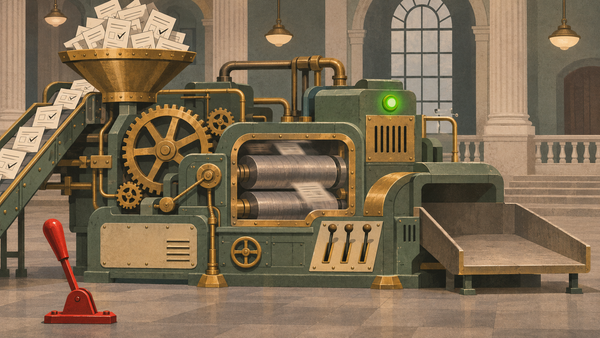
The Machine Might Swallow the Court
There's a tempting story here about the collapse of MAGA.
Trump eventually loses his grip on Republican politics. The hangers-on abandon Mar-a-Lago. The Republican establishment breathes a sigh of relief, puts on a fresh suit, and returns to normal.
I wouldn't bet on that tidy an ending.
For one thing, what exactly is normal Republican politics anymore?
The party that existed before Trump was hardly free of ideological extremism, donor influence, culture-war politics, or cynical appeals to resentment.
Trump didn't invent those things.
He exploited them, amplified them, and rearranged the party around his own personality.
Florida's Republican establishment has been perfectly comfortable embracing much of that agenda.
DeSantis didn't spend his governorship trying to restore the moderate Republicanism of Nelson Rockefeller. He advanced an aggressive conservative political program, frequently using the power of state government to pursue cultural and ideological objectives.
The distinction between DeSantis and Trump was never that one was conservative and the other wasn't.
It was, in considerable part, about who got to lead.
So perhaps the future isn't a dramatic civil war between MAGA and the Republican establishment.
Perhaps it's something more mundane.
The Florida machine absorbs the portions of MAGA that remain politically useful, discards some of the personal baggage, and carries on.
The donors find new politicians to support.
The consultants redesign their PowerPoint presentations.
The politicians discover that the policies they supported under Trump remain perfectly acceptable when promoted by someone else.
And Mar-a-Lago goes back to being an extremely expensive private club.
Maybe with a few more nostalgia dinners.
Of course, the alternative is a protracted fight between competing Republican factions, particularly if electoral setbacks make Trump's personal endorsements less valuable or encourage politicians to establish independent power bases.
We've already seen some of that competition.
But I wouldn't confuse conflict with collapse.
The Florida Republican establishment has survived Jeb Bush, Rick Scott, Ron DeSantis, and multiple national political upheavals. It has demonstrated an ability to adapt.
Trump's personal political operation has demonstrated extraordinary influence, but it has yet to navigate a genuine post-Trump succession.
Those are very different institutional histories.
So Who Actually Owns Florida?
The 2026 election provides an interesting moment to ask.
Texas, another pillar of modern Republican politics, has just delivered a stunning Democratic statewide sweep.
Florida held for the Republicans, but by margins that would have seemed implausibly narrow two years ago.
The movement that appeared to have consolidated so much national influence around Palm Beach suddenly has reason to reconsider the durability of its electoral foundation.
But Florida's Republican establishment hasn't gone anywhere.
It still controls the governorship, the legislature, and a vast network of political relationships.
And unlike the collection of access seekers orbiting Mar-a-Lago, it has already demonstrated that it can survive changes in leadership.
This doesn't mean the establishment is destined to defeat MAGA, or that MAGA will quietly disappear.
It means we should distinguish between the political power organized around Trump personally and the Republican institutions that have embraced, accommodated, and sometimes resisted him.
The former depends heavily on one man's continued relevance.
The latter has spent decades figuring out how to remain relevant regardless of who occupies the governor's mansion.
The court and the machine have enjoyed a mutually beneficial relationship.
But when their interests diverge, whose priorities prevail?
And when Trump eventually leaves the political stage, who inherits the movement he built?
We don't know yet.
What we do know is that Florida's Republican establishment was powerful before Donald Trump made Palm Beach the center of his political universe.
It has no intention of surrendering that power.
And while the courtiers at Mar-a-Lago may be wondering who they'll be sucking up to next, the people who actually know how to run the Florida Republican machine are probably rather less concerned about where the next royal dinner will be held.
They've got a state to run.
And they intend to keep running it.
Sweaty's Corner doesn't have a marketing budget or an algorithm pushing it into anyone's feed. It has readers who share it. If this one landed, sending it to someone who'd get something out of it — or subscribing so the next one finds you directly — genuinely moves the needle.