The Fever Won't Break. We're Just at the End of Page One
MAGA isn't a political moment. It's the opening chapter of a very long, very ugly book — and Hari Seldon isn't returning our calls.

Here's the article of faith in the Never Trump Podcast Industrial Complex™: Trump is a one-man weather event. He's the central sun around which the entire MAGA solar system orbits. Without him, the cult disperses, the fever breaks, and <cue the hopeful music> reform becomes possible. Slow, yes. Painful, sure. But possible. The theory goes that no one else in the orbit — not JD Vance with his aw-shucks grift, not Rubio doing his best impression of a man who at one time had a spine — can command the allegiances required to keep the movement alive.
This is, to put it with appropriate delicacy, wishful thinking dressed up in a blazer and booked on a podcast. The evidence that MAGA is a one-man show is thin. The evidence that it has hardened into a fully actualized institutional movement — one with its own media ecosystem, think-tank infrastructure, cultural networks, and brand loyalty that frankly puts the NFL to shame — is overwhelming. The specific figures in elected office may be inadequate successors. But the movement isn't organized around elected officials anymore. It's organized around Tucker Carlson's audience metrics, Charlie Kirk's (may he rest in peace) campus machine, the Heritage Foundation's policy apparatus, and a podcasting layer that reaches more people than most senators have ever shaken hands with. The brand is America First. Brands outlast founders all. The. Time. That's, like, the entire history of brands.
And even if we grant the Never Trumpers their premise — even if MAGA as an electoral majority-building machine degrades without its north star — we should be deeply suspicious of what comes next. Because "MAGA loses its grip as a governing coalition" does not automatically cash out as "institutions recover." It might cash out as something considerably worse: a movement too strong to be defeated and too leaderless to actually govern, producing a permanent state of institutional paralysis. Which, congratulations, is the worst of all possible outcomes and also where we appear to be heading.
Now, I can get geeky with my teenage SciFi addiction...
We are on page one of Foundation. Act accordingly.
If you want a framework that actually fits this moment — one that doesn't require you to perform optimism you don't feel — I'd suggest setting down the podcast app and picking up Isaac Asimov.
The Foundation trilogy[1] begins with a mathematician named Hari Seldon who has developed "psychohistory" — a discipline that can model the behavior of civilizations at massive scale. His conclusion, which he cannot share publicly without triggering the very collapse he's predicting, is simple and devastating: the Galactic Empire is already finished. The rot is too deep, the structural decay too far advanced, the hollowing-out of institutional competence too complete. The fall cannot be prevented. The only question is the length of the interregnum — the dark ages between collapse and recovery. Without intervention, Seldon calculates 30,000 years of barbarism. His life's work is an attempt to compress that to 1,000.
Seldon doesn't try to save the Empire. He accepts that it cannot be saved. He focuses entirely on shortening the suffering that follows.
The Never Trumpers are, bless their hearts, still trying to save the Empire. They believe that removing the bad emperor restores the system. Asimov would find this, as the kids say, deeply unserious. The Galactic Empire doesn't fall because of one bad emperor. It falls because the complexity that sustained it has been quietly hollowing out for generations — because the senators stopped believing in the Senate, because the institutions became performances of themselves, because the epistemic culture that made collective self-governance possible had been eroding for decades before anyone gave it a name.
Sound familiar? Because it should. Trump didn't corrupt the Republican Party. He revealed how hollow its institutional resistance had already become. The speed of the collapse — how few people actually held the line — was the tell. When the moment came, what looked like a party turned out to be a collection of individuals calculating their career survival odds. The Foundation scenario isn't a metaphor we're approaching. It's a description of where we already are.
The Mule problem, and why it's worse here than in the books
Asimov was honest enough to acknowledge the limits of his own model. The great villain of the second Foundation book is the Mule — a mutant whose powers of emotional manipulation fell entirely outside the parameters of psychohistory. The Mule is Asimov's admission that even rigorous long-range planning shatters against genuine complexity. A black swan actor, sufficiently anomalous, can derail the best-laid civilizational recovery.
In our situation, the Mules are not hard to spot — and they are not arriving one at a time. Ecological disruption creates exactly the resource stress conditions under which authoritarian movements historically consolidate. AI is reshaping the information environment faster than any democratic institution was designed to process, and the epistemological crisis that MAGA both exploited and deepened gets worse, not better, in a high-AI-content media landscape. The post-WWII international order that provided external stabilizers for American democracy is being actively dismantled, partly by Americans. Any one of these would be a serious Mule-level complication. All three simultaneously is genuinely uncharted territory, and anyone who tells you their model handles it is selling something.
And here's the disanalogy that should genuinely keep you up at night: Asimov's Empire, at peak decay, was still a functioning information-preserving civilization. The Library at Trantor existed. The Encyclopedia could be compiled. Knowledge could be transmitted across the interregnum. The First Foundation's task was to preserve the accumulated learning of civilization against the coming dark ages.
Our crisis is different in a more unsettling way. We are not at risk of losing technical knowledge. The risk is losing epistemic culture — the habits of mind, the institutional norms, the social agreement to reason from shared premises — that make democratic self-governance possible. You can rebuild a library in a generation. It is not obvious how you rebuild a political culture that has agreed to share reality. Nobody is working on that reconstruction project at scale. There is no Hari Seldon. There is no Second Foundation hiding on the other side of the galaxy running the long game. There's a lot of very smart people on podcasts, which is not the same thing.
So yes. The Never Trumpers are right that something is ending. They're wrong about how quickly it recovers, wrong about the mechanism of recovery, and dangerously wrong about the absence of unforeseen pitfalls. The recovery, to the extent it happens, will be generational — longer, harder, and more contingent than their "reform is coming" liturgy suggests. We are not at the hopeful denouement. We are on page one.
A note on source material...
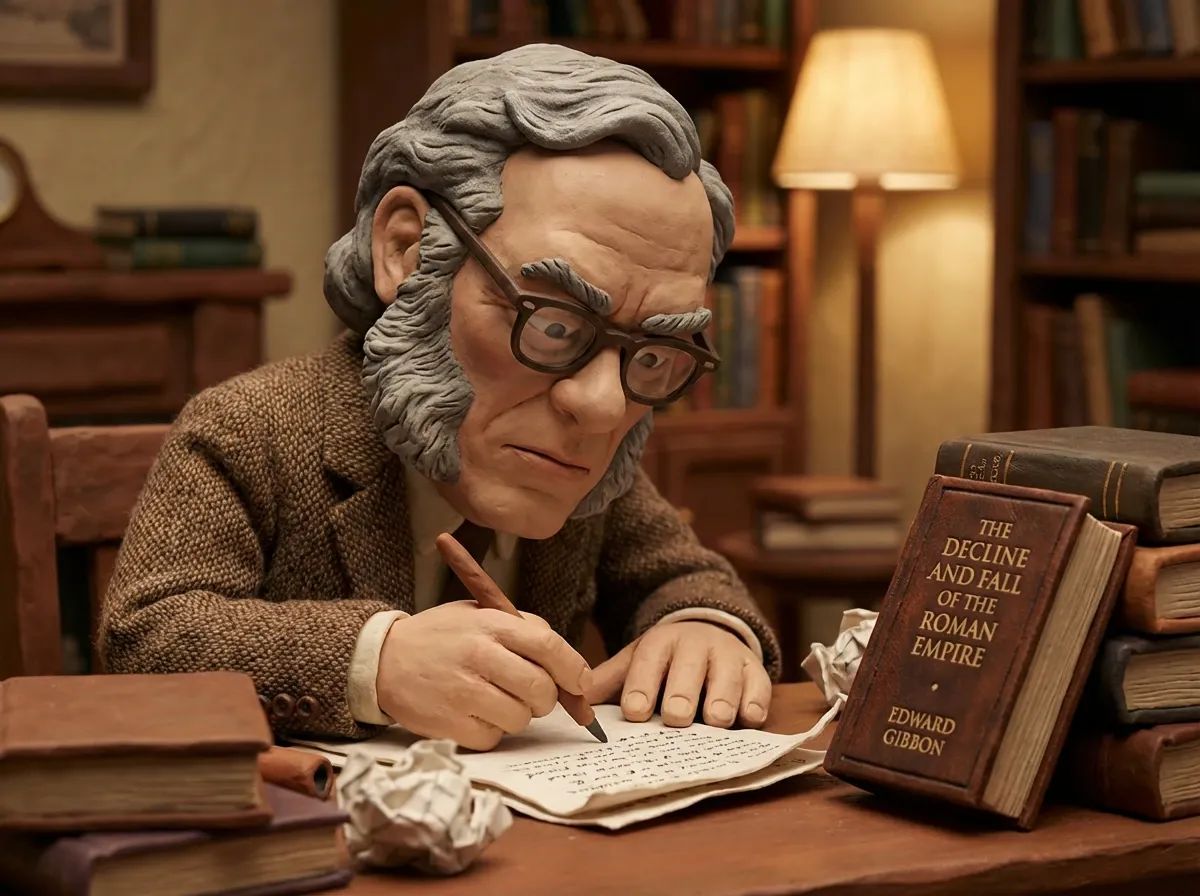
Asimov was not making things up when he constructed this framework. The inspiration for the Foundation trilogy — something he acknowledged directly — was his immersive reading of Edward Gibbon's The Decline and Fall of the Roman Empire. Gibbon spent his life documenting how a civilization that appeared permanent and self-sustaining managed, over centuries, to hollow itself out so completely that the collapse, when it came, was less a dramatic event than an exhausted trailing off.
That book inspired me to finally pick up my own copy. It is, as advertised, a heavy tome. It is also, given current events, increasingly difficult to read as ancient history. Highly recommended if you enjoy having your worst suspicions confirmed at length, by a very good writer, about events that happened 1,500 years ago.
1 - Do not watch the Apple TV+ show and think you get the Foundation universe, the books are not optional, and you should think about grabbing a copy. I re-read it every other year or so
 Share on Bluesky
 Share on Threads
 Share on Facebook
 Share on Mastodon
 Share on Reddit
 Share on Email