The Wrong Voters (or why Rural voters are unreachable)
Thirty years of Real American outreach has produced one durable result: a very comfortable living for the people doing the outreach.

The Autopsy Is In
The body has been dead longer than anyone wanted to admit.
A new piece in The Atlantic (gift link) from researchers who spent months embedded with conservative Trump voters in Wyoming, Michigan, and South Carolina arrives at a conclusion that is genuinely useful and almost comically overdue: the "save democracy" framing doesn't work with these voters, has never worked with these voters, and cannot work with these voters because it is structurally incompatible with how they think.
The researchers are careful and respectful. I will be somewhat less so, because we are past the point where politeness is doing anyone any favors.
What they found is this: these voters have built a fully coherent alternative theory of political legitimacy, organized around faith, family, freedom, and local community. When institutions failed them -- and institutions did fail them, with real receipts -- those institutions lost moral authority. When you then ask someone to defend the institutions that failed them, you are not misunderstood. You are heard precisely. The answer is no, and the answer comes with a philosophical framework attached.
That's the diagnosis. And the diagnosis matters because a lot of people have spent a lot of money and a lot of years ignoring it.
The Loop That Won't Break From Outside
This isn't irrationality. It's a closed system.
Here's what the researchers are too polite to say plainly: the harm absorption isn't a bug in these voters' logic. It's a load-bearing feature.
This coalition has taken real, documented damage and held. They absorbed the 2018 tariff retaliation that gutted soybean export markets. The opioid epidemic hitting rural communities at disproportionate scale while Purdue Pharma kept shipping. Farm bankruptcies hitting eight-year highs in 2019. Rural hospital closures that turned a cardiac event two counties from nowhere into a death sentence. And the coalition held.
Not because these voters are stupid or masochistic. Because every one of those losses got metabolized as evidence of hostile forces rather than evidence that the president's policies were producing harm. China retaliates on soybeans: Chinese aggression. Coal keeps declining despite every promise: decades of Democratic regulatory sabotage finally showing up on the ledger. You cannot break a closed epistemological system with outcomes data. The system was designed to survive outcomes data. Every bad result is processed as further confirmation of the original premise.
"The 'Trump as protector against hostile forces' framing doesn't just survive policy failure. It feeds on it."
That's not an argument for giving up on these communities as human beings. It's an argument for giving up on them as persuasion targets. Those are two different things. Conflating them has cost the Democratic Party a decade of wasted strategy and a hell of a lot of donor money.
The Church Problem Nobody Wants to Name
Democrats don't have a messaging problem in rural America. They have a thirty-year infrastructure deficit.
The Atlantic piece circles around something important without quite landing on it: the reason institutional arguments don't resonate with these voters is that their actual institutional experience is the church, and the church delivered in ways the federal government didn't.
Sarah, one of the study's subjects, grew up poor in rural Wyoming. Her church fed her family. When her son had recurring seizures and neurologists dismissed her concerns, a network of church-connected mothers crowdsourced a diagnosis and treatment that worked. When COVID policies arrived top-down from Washington, designed for urban populations, applied without local consent, her church community was the thing that held. She's now aligned with the Freedom Caucus, which is the predictable trajectory when the institution that materially sustains you is also the institution doing the political organizing.
Democrats have no equivalent civil society infrastructure in rural America. The union model, which once played a partial version of this role, has been systematically dismantled over four decades. Community organizing exists but it's thin, parachuted in around election cycles, and gone by December. It doesn't replicate the daily relational texture of a congregation that feeds your family, listens to your kid's medical problems, and then hands you a voter guide on the way out.
And here's the trap: you cannot disaggregate the church's social function from its political function in these communities without sounding like exactly the coastal secularist these voters already distrust. The Johnson Amendment, theoretically preventing churches from operating as partisan campaign infrastructure, is a dead letter -- rarely enforced before, completely unenforced now. The current administration has zero interest in changing that. The firewall is gone.
So what Democrats are competing against isn't a political party. It's a community support network, an information ecosystem, and a political mobilization operation fused into a single institution that meets people every week and feeds them when they're broke. Good luck countering that with a better slogan.
The Diner Safari Must Be Stopped
At some point, the Times is going to need a dedicated travel correspondent for the Ohio exurbs.
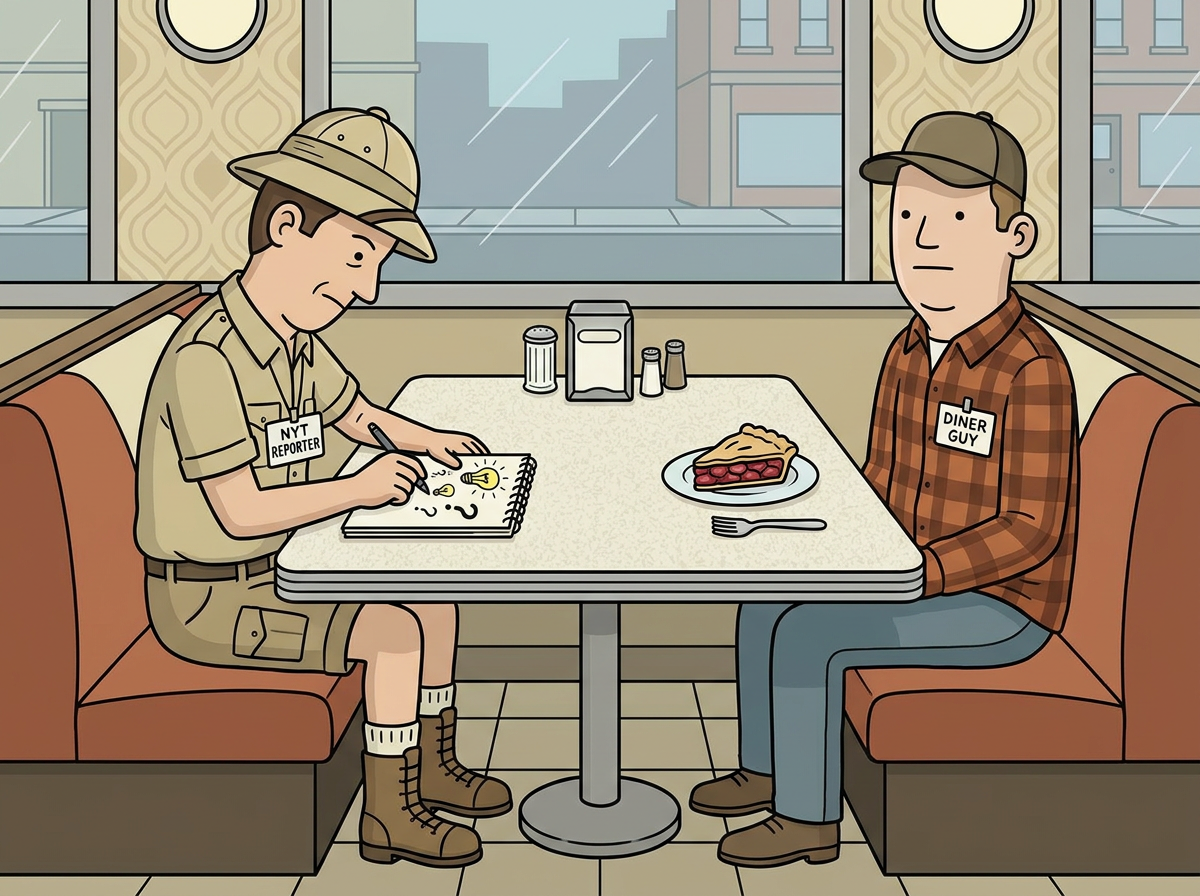
Now we get to my personal favorite genre of American political journalism, which is the Pilgrimage to the Real America. You know the format. A reporter from New York or DC travels to a diner in Youngstown or a VFW hall in rural Michigan or a church parking lot in South Carolina, orders something with gravy, and proceeds to have a series of reverent conversations with Real Americans about their hopes, fears, and complicated feelings about Donald Trump.
The resulting piece is always the same piece. There's a guy named Dale or Randy or something one syllable and working-class. Dale/Randy is worried about inflation and the border and something about a factory that closed fifteen years ago that he traces back to some trade deal. He doesn't love Trump's personality, but he likes that Trump fights. He's never met a Democrat. The reporter wraps up by noting that Democrats need to do a better job of meeting people where they are – advice that has been dispensed continuously since November 2016 and has produced no observable electoral results whatsoever.
This is not journalism. It is a genre ritual. The function it serves is not illuminating politics. It's soothing the conscience of the professional class that consumes it. We went there. We listened. We tried to understand. The subtext is always identical: someone should really do something about these people.
The Times has run some version of this piece so many times that they've essentially built a franchise around it. There is a certain Youngstown diner that has achieved more column inches than some small nations. The regulars there must be utterly exhausted.
And it's not just the broadsheet safari operations doing this shit. The Never Trump apparatus has spent – conservatively – hundreds of millions of dollars on ads, outreach, and constitutional argument-making aimed at voters who do not watch the channels these ads run on, do not read the arguments being made, and have a fully developed philosophical reason for finding those arguments illegitimate before the first word is spoken. The Lincoln Project produced devastatingly clever ads that won effusive praise from Twitter users in Brooklyn and moved approximately zero persuadable Trump voters. But they looked great in the reel, and the invoices cleared.
The center-left version is slightly less flashy but equally futile. It's the "we need to talk to rural voters about kitchen table issues" strategy, articulated in some form by every Democratic consultant who survived 2010, 2014, 2016, and 2020 without losing their billing rate. They show up with healthcare talking points and broadband promises and occasionally a Democrat who hunts, and they are received politely, and then the returns come in, and it's the same damn number.
Because here's what everyone doing the diner safari knows and won't say: these are not movable votes. They are not undecided. They are not waiting to be listened to more carefully. They have arrived, through lived experience and community and a coherent worldview, at a political conclusion. Treating them as perpetually persuadable voters who just need the right message is condescending as hell and factually wrong.
The diner safari exists to maintain one fiction: that there is a persuasion play available if someone were clever enough to find it. There isn't. Admitting that forces a conclusion the entire genre was constructed to avoid.
The Correct Answer and Why It Makes People Uncomfortable
The math is not subtle. The resistance to it is.
The electoral path – for Democrats, and more broadly for anyone who'd prefer not to live in a competitive authoritarian state – runs through urban and suburban voters, college-educated voters, and turnout in the Democratic coalition's existing base. It does not run through rural Wyoming, rural South Carolina, or any diner in the Mahoning Valley.
This is not abandonment. These communities exist, their problems are real, and governance should address them. But "address their problems through policy" and "target them as persuadable voters in a national election strategy" are two different things. Confusing them has been ruinous. Every dollar spent on a diner safari or a Lincoln Project ad trying to peel off a Trump voter in rural Ohio is a dollar not spent on voter registration in Fulton County, turnout infrastructure in Milwaukee, or organizing among Latino voters who have been drifting toward Republicans in numbers that should have set off alarms while everyone argues about who the real America is..
The suburban realignment since 2018 is real and underexploited. College-educated voters, particularly women, have moved toward Democrats in measurable ways. Turnout operations in high-density urban areas remain underdeveloped relative to their potential. These are actual leverage points. They exist. Nobody is doing a prestige media pilgrimage to cover them, but they exist.
"Every movable vote that doesn't get moved because resources went elsewhere is a strategic choice. It is a choice being made continuously and with great rhetorical cover."
Texas Is Not a Test Case. It Is a Warning.
Beto lost. Then Beto lost again. At some point the lesson lands.
I want to be clear that I have nothing personal against James Talarico. He appears to be a genuinely compelling candidate – young, sharp, running a serious race for Senate in Texas against Ken Paxton, who is by any objective standard a cartoonishly corrupt figure who has survived impeachment, federal investigation, a $3.3 million settlement paid by Texas taxpayers to cover his own misconduct, and roughly six concurrent legal jeopardy situations with his electoral coalition largely intact and apparently unbothered.
The optimism around this race follows a familiar structural pattern. Talarico is a good candidate. Paxton is genuinely vulnerable. Texas demographics are shifting. This could be the year.
This is the same case that produced Beto O'Rourke in 2018, when he ran the most impressive Texas Democratic Senate campaign in a generation, raised an ungodly amount of money, nationalized the race to an extraordinary degree, and lost by 2.6 points to Ted Cruz – a man whose own Senate colleagues find him somewhere between exhausting and actively loathsome, and who had spent the preceding year performing an extended display of spinelessness that should have been politically fatal. Then Beto ran for governor in 2022 and lost by eleven points. The structural case for Texas being in play had not changed. The structural reality had not changed either.
Paxton is most likely going to win in November. I'll go ahead and say it. Not because Talarico isn't capable, but because the structural conditions that produce these outcomes don't care about candidate quality. Paxton's misconduct isn't a vulnerability to his base – it's evidence of how viciously the establishment has tried to destroy a fighter on their behalf. You know the pattern by now. You've been reading about it for the last several minutes.
The Part Where It Actually Gets Worse
The electoral map isn't the deepest problem. The constitutional architecture is.
None of this – not the diner safari, not the unfalsifiable loop, not the church infrastructure asymmetry – is the darkest part of the picture. Here it is:
We are not going to elect our way out of this.
Even a durable Democratic electoral majority – achievable, but not guaranteed – runs into structural constitutional constraints that the rural and red-state coalition will correctly identify as threats to their power and block with every tool available to them. Senate malapportionment gives Wyoming roughly seventy times the Senate representation per capita of California. The Electoral College systematically overweights rural states. The Supreme Court has already gutted the Voting Rights Act and is not finished. Any constitutional remedy – abolishing the Electoral College, restructuring the Senate, expanding the Court – requires the cooperation of the states that benefit most from the current arrangement. They will not cooperate. They don't have to. They know it.
The hard sort of the parties is not a temporary misalignment that self-corrects when Trump leaves the scene. It is a durable geographic and cultural realignment sixty years in the making. The roughly 40% irreducible floor of structural Trump support doesn't go anywhere when Trump does. It transfers to whoever runs the next iteration of this coalition because the coalition was never about Trump. He was a vessel for something that had been looking for a vessel for a long time. The vessel will be replaced.
So what are we actually looking at? A large, philosophically coherent bloc of the electorate in a closed epistemological loop, embedded in community institutions that reinforce that loop daily, constitutionally amplified well beyond their raw numbers, and serviced by a political and media class that has found extremely profitable ways to perform concern about this without actually addressing it.
The people running the democracy-saving operations are mostly fine. The safari reporters still have their expense accounts. The consultants who designed the outreach programs that didn't work are still consulting on the next round of outreach programs. The rural communities that have been told help is coming for thirty years are still waiting.
Knowing this clearly isn't despair. It is the mandatory precondition for a strategy that might actually function – one that accepts some votes are gone, that the constitutional path is blocked for the foreseeable future, and that winning means building something durable in the constituencies that are genuinely in play. That is deeply unsatisfying, but it is the truth.
Whether the Democratic Party is capable of executing that strategy is a separate and somewhat bleaker question. Based on available evidence, I have my doubts. Lots of doubts. But that's a post for another day.
Like what you've read, but not able to switch to paid? Why not buy me a coffee instead! All money goes to help defray the expense of running the site.