A Bit of a Thud
Anthropic went public, the stock face-planted through its IPO price in four sessions, and somewhere in San Francisco an OpenAI board meeting got very quiet. The thud is the sound of a private valuation meeting a public market.

So. Last Thursday, Anthropic went public.
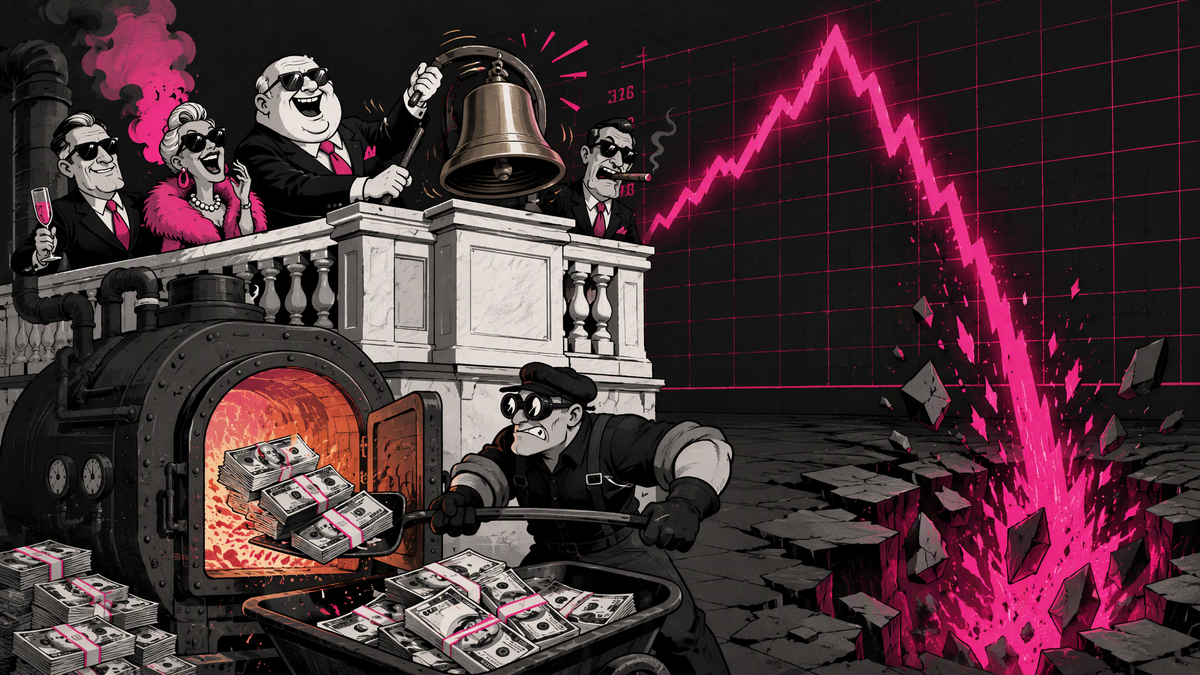
Priced at $83 a share, opened at $111.50 because retail FOMO is a hell of a drug, then gravity clocked in for its shift. The stock closed its first two days in the $90s, face-planted through the IPO price on Tuesday (closed at $81.91, after kissing $75.61 intraday), and as I write this it's printing fresh lows around $73.85. A trillion-dollar company, getting marked down in real time, in its first week of public life.
Buckle up. The schadenfreude gets better.
First, the throat-clearing, because it matters: Anthropic itself is fine. Better than fine. The IPO raised $93.5 billion once the underwriters exercised the greenshoe — call it $107 billion counting the $26 billion side deal from Google, Nvidia, and Microsoft — and the company is now sitting on north of $200 billion in cash. The seven co-founders each sold roughly $280 million of stock at the offer price, per their SEC filings, so nobody on Folsom Street is eating ramen. Boo fucking hoo if you bought the open. Employees actually got an unusually generous deal: non-founder staff could dump 10% of their shares on day one. Anyone who hit the bid at $111.50 Thursday morning is a genius. Anyone who held out for "the story to develop" is getting a graduate seminar in lockup regret.
No, the outfit having the bad week is the one that wasn't on the podium.
The thud
Somewhere in San Francisco, OpenAI's board is reading this tape through their fingers. Anthropic — the boring sibling, the one that wasted all those years on enterprise contracts and coding tools instead of building a proper hype machine — just got priced at roughly a trillion dollars by the most skeptical audience on the planet: public investors with sell buttons.
Here's the part that should have Sam Altman freebasing Tums. OpenAI's current fundraise started life as a $30 billion ask at a $1.4 trillion valuation. It got trimmed to $20 billion at $1.25 trillion. It finally closed somewhere in the $11–15 billion range, depending on whose math you believe. One investor told the FT that every previous OpenAI round was a frenzy, but "this time is a bit of a thud."
A thud. That's the technical term, apparently.
And the delicious part: those same investors said, out loud and on the record, that they wanted to see Anthropic's public price before writing OpenAI any more checks. Gee, you are just figuring this shit out? Well, the price arrived. It's a falling knife with a lockup calendar attached — 303 million shares unlock December 15, another 303 million on January 5, then 353 million twice more by early February — and every downtick is a live, public markdown on OpenAI's private $1.25 trillion fantasy. The whole valuation fuckery now has a ticker symbol, and the ticker is red.
OpenAI's numbers have never passed the sniff test, and public-market math is about to make that everyone's problem. "Annualized revenue" in AI-land means "last month times twelve." Thirty years in product management, and watching grown adults in fleece vests call that ARR still grinds my gears. No contracts, no renewals, no entitlement. Just vibes, multiplied by twelve.
And even the vibes stalled. The run-rate plateaued around $25 billion from February through April, while the WSJ was reporting missed monthly targets and CFO Sarah Friar was worrying internally about how to pay for the data centers. ChatGPT's share of the assistant market fell below 50% this spring — turns out last year's model is good enough for most people, and the savvy ones route around the premium stuff entirely. That's not a moat. That's a habit.
Meanwhile, the burn. $1.4 trillion in compute commitments — trillion, with a T — against a run-rate somewhere between $50 and $70 billion. They lost $13.5 billion in the first half of 2025 and roughly $12 billion more in Q3 alone. The projection is $278 billion of negative free cash flow through 2030. That's not a cash furnace. That's a cash foundry with the doors welded shut.
Sweaty's Corner doesn't have a marketing budget or an algorithm pushing it into anyone's feed. It has readers who share it. If this one landed, sending it to someone who'd get something out of it — or subscribing so the next one finds you directly — genuinely moves the needle.
The backstop that wasn't
Which brings us to the most revealing thirty seconds in recent corporate history. Last November, Friar mused out loud at a WSJ event about the government providing a "backstop" for AI infrastructure financing. The backlash was instant and glorious, and within 24 hours Altman was on X doing emergency cleanup:
"We do not have or want government guarantees for OpenAI… Taxpayers should not bail out companies that make bad business decisions."
Uh-huh. Elizabeth Warren then spent January mailing him letters about "privatizing profits while seeking ways to let the public defray the costs." When a CEO has to publicly promise he won't take taxpayer money, somebody in that building already priced the bailout.
Yeah. Fuck that guy.
The wedding nobody wants to pay for
So who catches OpenAI when the private marks finish collapsing? There is exactly one checkbook big enough, and it's in Redmond. But Microsoft is running its own furnace: $45 billion of capex last quarter, free cash flow squeezed down to $18.6 billion, $170 billion planned for the calendar year. And in October they offered voluntary buyouts to roughly 60,000 employees — a quarter of the company.
Here's the tell, and it's a beauty. The buyout excluded data center, sales, and security teams. The Copilot and "AI experiences" teams? Eligible. The org chart of Microsoft's own flagship AI product is being thinned while the GPU budget gets guarded like a newborn. Satya is hedging. Against OpenAI.
So no rescue. What you get instead is the pre-packaged wedding: Microsoft steps in just before the distress becomes a diaspora — and it becomes one fast, because these assets have legs, and Meta was waving nine-figure offers at OpenAI researchers back in 2025 — with retention grants for the twenty researchers who actually matter. Everyone else gets fucked at estate-sale prices. They rehearsed the whole thing in November 2023, when the board fired Altman and the entire workforce signed a walk-out letter in a single weekend. Next time, Microsoft doesn't send him back. They send a van.
Meanwhile the tortoise is sitting on $200 billion of actual, permanent, public-market cash, watching the hare's cap table deflate. Anthropic took the money while the window was open — even a saggy, below-IPO-price window — because a saggy window beats a closed one, and the closed one is where OpenAI is headed.
Anyway. Somewhere Dario Amodei is pretending not to check his stock price, and Sam Altman is pretending not to check his own future in it.
Go ahead, make my day and subscribe. Always free.