Too Important to Fire
When Silicon Valley decides a founder is indispensable, accountability becomes somebody else's problem.

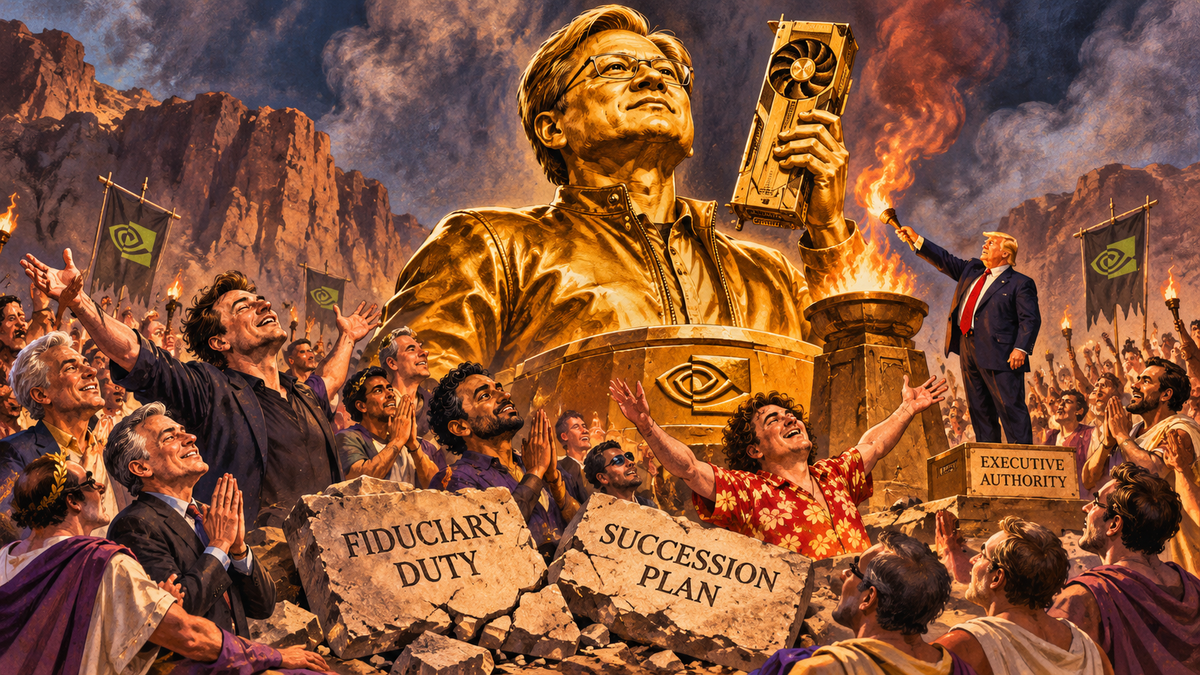
Table of Contents
Six days. That's all it took.
On November 17, Nvidia chairman Harvey Jones made it perfectly clear that Jensen Huang would not be returning as CEO. The board had accepted his resignation over revelations about his personal conduct — including an affair with a woman U.S. intelligence suspected of ties to Chinese espionage — plus ongoing investigations into whether advanced Nvidia chips were being diverted to China in violation of export controls.
These were legitimate concerns. Questions about Huang's candor with his directors and Nvidia's export compliance weren't going to disappear just because the stock price was falling.
So the board said no.
Six days later, Jensen was back.
What a difference a weekend makes. Trump decided Huang's return was essential to the American economy and enlisted JD Vance to supply the national-security assurances Nvidia's directors apparently needed. According to reporting in the Washington Post, Trump personally orchestrated the effort — the White House confirmed it. Nvidia's November 23 announcement acknowledged its directors had received input from senior government officials and concluded that reinstating Huang posed no national-security risk.
Well, that's reassuring. The administration responsible for enforcing the export restrictions supplied the assurances needed to put the CEO back in charge. The independent investigation wasn't finished, but the president was satisfied.
And the board? Unanimous.
The markets responded by adding roughly a trillion dollars to Nvidia's valuation. Wall Street celebrated, Silicon Valley rejoiced, and the billionaire cheering section took a victory lap. Nobody resolved the underlying investigations. But the stock went up, so that's nice.
The founder-worshippers assemble
The entertaining part has been watching Silicon Valley's wealthiest and loudest explain why Nvidia simply couldn't survive without Huang.
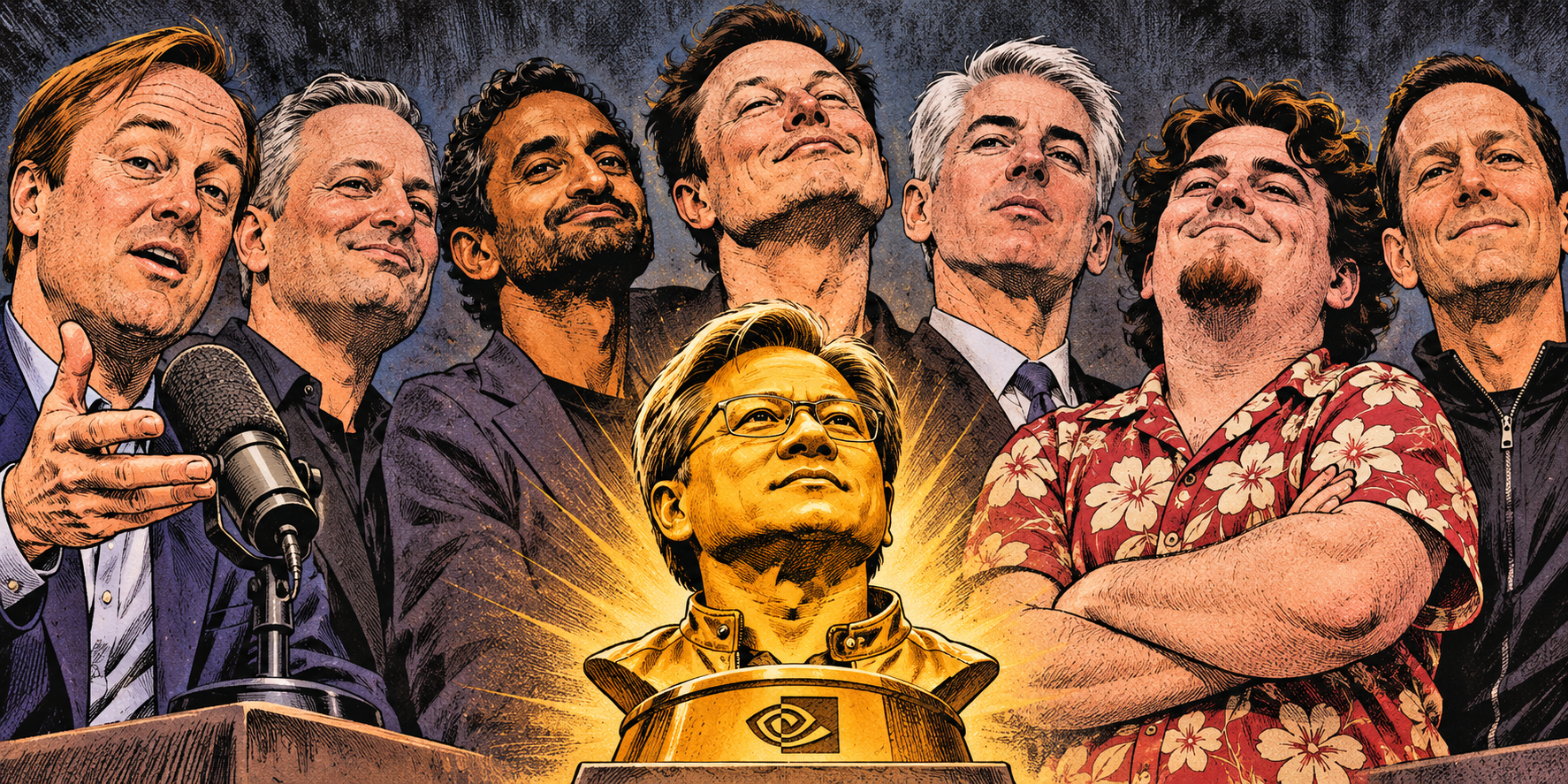
Elon Musk, naturally, compared removing Huang to kicking Michael Jordan off the Bulls during a winning streak. A perfectly reasonable analogy, provided you believe a publicly traded corporation is a basketball team and its board of directors is the coaching staff.
Bill Ackman went further, accusing Nvidia's directors of failing their fiduciary obligations by letting Huang depart. Never mind the substantial questions about their CEO's conduct and the company's national-security exposure. Apparently the real governance failure was that the stock price went down.
Anduril's Palmer Luckey argued nobody could replace Huang at such a critical moment because his personal relationships were essential to the business. Hold that thought. We're coming back to it.
Then there's Jason Calacanis. Ah, Jason. On his November 13 episode of This Week in Startups, he predicted Huang's return and riffed on the trend of founders reclaiming companies from professional management — Steve Jobs, Michael Dell, the usual saints. The argument: founders possess a special understanding of the company's DNA and a courage ordinary executives lack.
There is something to that. But there's a huge leap between believing founders bring unique strengths and believing those strengths should insulate them from accountability. The former is a sensible observation. The latter is where things start getting fucked up.
David Sacks at least concedes that breaking the law should have consequences. Good. I'll be curious how firmly the founder-first crowd holds that principle if enforcement threatens Nvidia's stock price or the broader AI boom.
Because none of this was spontaneous affection. It was a campaign by people with enormous financial, commercial, and professional interests in Nvidia's continued success. Nothing improper about shareholders lobbying a board — but let's recognize self-interest instead of mistaking it for a grand philosophy of leadership.
Sweaty's Corner doesn't have a marketing budget or an algorithm pushing it into anyone's feed. It has readers who share it. If this one landed, sending it to someone who'd get something out of it — or subscribing so the next one finds you directly — genuinely moves the needle.
Congratulations, you've built a single point of failure
Let's establish something. Jensen Huang is an extraordinary entrepreneur. He founded Nvidia in 1993 and spent three decades transforming it from a graphics-chip company into the dominant supplier of the AI revolution. Nobody serious disputes that.
Now consider what his defenders are telling us. Huang is irreplaceable. Without him, Nvidia faces disaster — the customer relationships, the strategy, the technological leadership, all of it. After 33 years, apparently nobody else can run the damn company.
And this is presented as evidence of his greatness.
Really?
As Steven Levy argued in his excellent Wired essay, "Don't Bring Jensen Back," Huang's failure to prepare Nvidia for his departure is itself a serious leadership problem. The man is 63. He has had three decades to build an executive bench, delegate critical responsibilities, and prepare the organization for his inevitable exit. Yet when he resigned, Nvidia parked longtime CFO Colette Kress in the interim seat — CFO since 2013, ex-Microsoft, hardly some random accountant found wandering the hallways — and the entire ecosystem lost its mind.
Are we seriously supposed to believe that among Nvidia's thousands of engineers, researchers, and executives, nobody can operate the business without Jensen standing over their shoulders?
Anyone who has worked with complex systems knows the term single point of failure: a component whose failure brings down the entire system because there's no redundancy. Engineers work very hard to eliminate these. And when we find one, we don't throw a party celebrating how incredibly important that component is.
We fix the architecture.
Yet here are some of the wealthiest technology experts on Earth celebrating the world's most expensive single point of failure.
The indispensability argument turns back on the people making it. They think they're telling us how great Huang is. They're telling us how vulnerable Nvidia has become — and who's supposed to guard against that. The owners of a public company are its shareholders, not the founder, not the VCs, not the podcast billionaires. Directors exist, in part, to make sure the company survives a leadership transition. The board isn't supposed to be the CEO's fan club.
But the founder-first crowd increasingly treats accountability as an obstacle to greatness: the founder knows best, and if the board disagrees, the board must be wrong. Nvidia shows where that reasoning leads. The directors accepted Huang's resignation and publicly said he wasn't returning. Then investors, industry celebrities, and the president of the United States decided the board needed to reconsider. And reconsider it did — unanimously.
Apparently the boardroom needed a little outside supervision. From the White House.
For fuck's sake.
We've seen this movie before
Remember November 2023? OpenAI's board fired Sam Altman over concerns about his candor. Within days, Microsoft, employees, and investors mobilized, Altman returned, and the board that removed him was reconstituted. OpenAI's odd nonprofit governance distinguishes it from Nvidia, but the shape is identical: directors exercised their formal authority, powerful outsiders decided the executive was too important to lose, and the decision collapsed.
Nvidia adds a remarkable twist. The president inserted himself into a corporate leadership dispute and helped deliver the outcome the founder's supporters wanted — while unresolved export and intelligence questions remained under investigation. The government stopped being the regulator and became a participant in deciding who runs the business.
Wonderful.
And spare me the Steve Jobs story the founder-worshippers never tire of telling. Yes, Jobs returned in 1997 and produced one of the great turnarounds in corporate history. They're less enthusiastic about the sequel: Jobs died, Tim Cook took over, and Apple kept going — building products, printing money, rewarding shareholders. Microsoft survived Gates stepping away. Amazon survived Bezos handing the keys to Jassy. The companies changed. They didn't evaporate.
That's the point. A successful founder builds an institution capable of outliving him.
Otherwise, what exactly has been built?
One last distinction. Arguing that Nvidia should have retained Huang isn't inherently irrational — a director could reasonably conclude the business benefits outweigh the risks after a serious, independent examination. That's not the same as arguing his removal is unthinkable because he's the only person alive who can run the company.
That argument should terrify shareholders. It says their investment depends on one 63-year-old executive, and that the directors they elected can't manage a transition. That's not a healthy institution. It's a warning. The board's new compliance committee and its "continuing investigations" had better be more than corporate decoration while everyone gets back to making the stock go up.
Huang is back. The market celebrated. His admirers insist Nvidia cannot function without him, and they think that makes him indispensable.
I think it raises a rather more uncomfortable question.
If Nvidia is so dependent on Jensen Huang that losing him threatens the entire enterprise, what the fuck has its board been doing for 33 years?
Go ahead, make my day and subscribe. Always free.