Building the Machine
Reagan didn't build the coalition that elected him. Four other machines finished construction first, and he was simply the candidate all of them could live with.

Series: The Fulcrum — Book Two: The Performance, Act Two: Interregnum, Episode 3
A man alone in a den with a legal pad is not a movement. Give him four years and a mailing list, and see what happens.
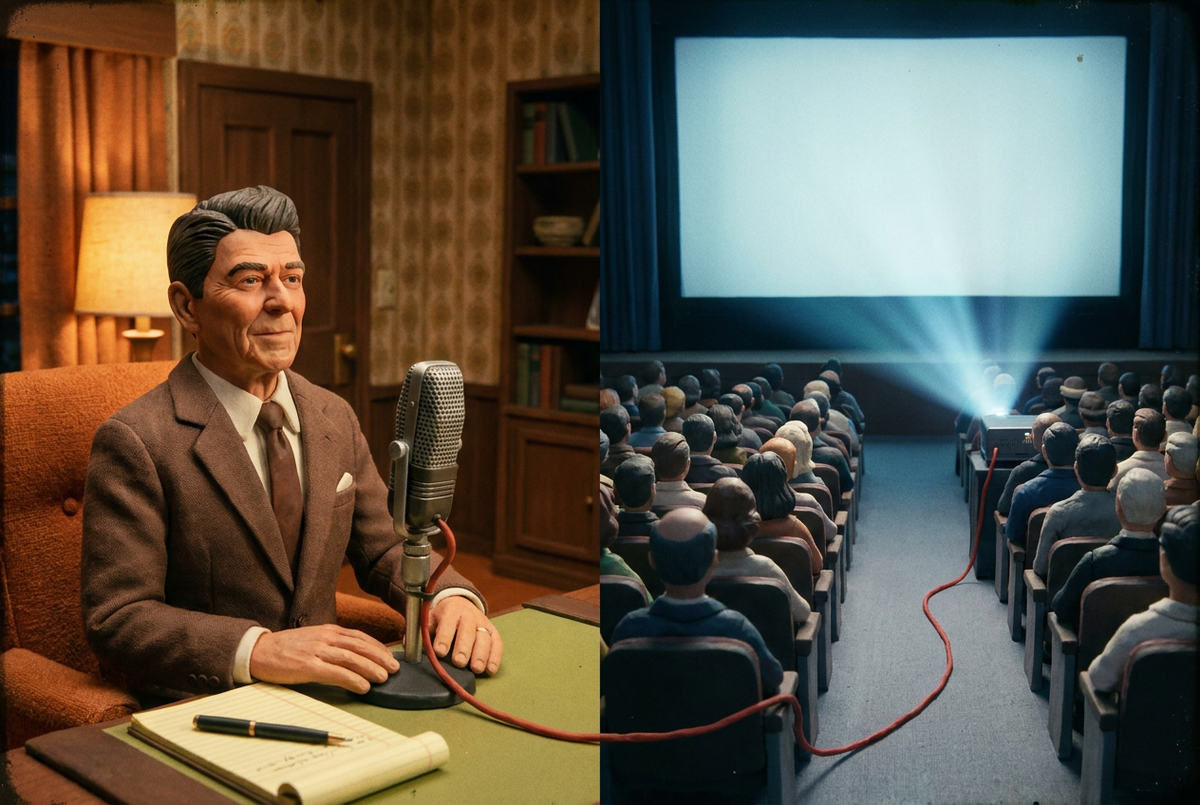
In the spring of 1975, Ronald Reagan sat down in a studio and started talking into a microphone, the same way he had for General Electric a generation earlier, except now there was no plant tour attached and no company signing the checks. He wrote most of the scripts himself, in longhand, on legal pads, dense with his own cross outs and margin notes, a habit the Hoover Institution's archive of the broadcasts documents in detail. The result went out five days a week on just over three hundred radio stations, three minutes at a time, folded into drive time next to farm reports and call-in shows. By the time the commentaries wound down in 1979, Reagan had recorded more than a thousand of them, on topics ranging from the Panama Canal to inflation to, with some regularity, the Soviet Union's bad faith.
No single person planned what came together underneath those broadcasts. Four more or less independent machines got built between 1976 and 1980, by people with different grievances and different funding, who did not coordinate with each other so much as discover they were going the same direction at the same time. Reagan's radio show was one of them. It was not the biggest.
Reagan's own apparatus
The losing candidate still had a Rolodex, and a Rolodex is a start.
The radio deal ran alongside Citizens for the Republic, the political action committee Lyn Nofziger set up in 1977 out of the leftover 1976 campaign treasury, officially to support conservative candidates and keep Reagan's name in front of a donor base that had just watched him lose a nomination fight he was supposed to win. CFTR functioned less as a kingmaking operation and more as a holding pattern: a mailing list, a newsletter, a fundraising apparatus that kept several hundred thousand names warm for four years with nowhere else to go. The radio commentaries did the same work in a different register, three minutes a day of Reagan's own voice in living rooms and pickup trucks, unmediated by a convention floor or a press pool that had already decided he was yesterday's story.
Neither of these was new money or new infrastructure. It was existing Reagan infrastructure, repurposed to survive an off year. The real construction was happening elsewhere, among people who had never been on his payroll.
The boardroom mobilizes
A memo nobody was supposed to see became the most effective fundraising pitch business conservatism ever got.
In August 1971, two months before his appointment to the Supreme Court, Lewis Powell wrote a confidential memorandum for the U.S. Chamber of Commerce arguing that the American business community had gone soft in the face of a rising consumer and regulatory movement, and that the response needed to be organized, well funded, and sustained. Powell's own words were blunt about the stakes:
Political power is necessary and must be used aggressively and with determination.
The memo circulated quietly for years before anyone outside the Chamber knew Powell had written it, but its diagnosis matched what corporate executives were already feeling after a decade of Ralph Nader-era consumer protection law, OSHA, and the EPA. What followed was less a single campaign than a buildout, documented in the numbers: corporate public affairs offices in Washington went from about a hundred in 1968 to over five hundred by 1978, registered corporate lobbyists went from 175 in 1971 to nearly 2,500 by 1982, and corporate PAC spending on congressional races grew almost fivefold between the late seventies and late eighties. The Business Roundtable organized in 1972 to give CEOs themselves a direct advocacy vehicle, and the Heritage Foundation opened its doors in 1973 to supply the policy paper the money would need.
Tucked inside this same current was a narrower argument that would matter more to Reagan specifically: Jude Wanniski and Jack Kemp's supply-side case that cutting the top marginal rate would pay for itself through growth, the doctrine that eventually became Kemp-Roth and, four years later, the first Reagan tax bill. That fight belongs to its own episode. What matters here is that business conservatism arrived at Reagan's doorstep already organized, already funded, and already convinced it had found its moment, well before Reagan's campaign had any reason to believe the same thing.
The schoolhouse grievance
Paul Weyrich kept trying to recruit the religious right around abortion, and kept getting nowhere, until the IRS gave him something that actually worked.
Direct-mail strategist Richard Viguerie and activist Paul Weyrich had spent years building the New Right's fundraising and organizing infrastructure, the same direct-mail machine that helped deliver North Carolina for Reagan in 1976. Weyrich in particular wanted evangelical voters inside that coalition, and later insisted that abortion alone never moved them. What moved them was money, specifically the IRS.
Beginning in 1970, the agency had moved to strip tax-exempt status from schools founded to dodge desegregation, a fight that reached the Supreme Court over Bob Jones University, which barred Black students outright until 1971 and still restricted interracial dating into the 1970s. In 1978 the IRS proposed tougher rules requiring private schools founded or substantially expanded around the time of local desegregation orders to affirmatively prove they were not discriminating, and Christian school administrators and parents, many of whom had no connection to segregation academies at all, read the rule as the federal government reaching into church schools generally. The protest, as one retrospective account puts it, buried the agency in well over 400,000 letters.

This is contested terrain, and worth being precise about rather than flattening into a single story. Some of the schools caught in the IRS's net were founded explicitly to resegregate after court-ordered integration, Bob Jones chief among them, and that history is real and documented. It is also true that most evangelical Christian schools founded in this period were not segregation academies and that painting the entire movement as motivated by racism erases the parents and administrators who read a vague, broadly worded federal rule as a genuine threat to religious education generally, whatever its drafters intended. Both things happened. Geoff has covered the IRS's broader role in American secularization in detail elsewhere, including how the tax code did more to reshape the relationship between church and public life than any Supreme Court ruling, which is worth reading alongside this one.
What matters for this episode is narrower: Weyrich had a donor list and a direct-mail apparatus built for one purpose, and the IRS handed him a second purpose that reached an audience the first one never touched.
Sweaty's Corner doesn't have a marketing budget or an algorithm pushing it into anyone's feed. It has readers who share it. If this one landed, sending it to someone who'd get something out of it — or subscribing so the next one finds you directly — genuinely moves the needle.
Shock jock to morning drive
Nobody was supposed to show Christian conservatives the pictures. Then somebody did, and the coalition's quiet part got loud.
If the IRS fight was slow-burning bureaucratic anger, the Schaeffer-Koop production was a gut punch delivered on purpose. In 1979, theologian Francis Schaeffer and pediatric surgeon C. Everett Koop released "Whatever Happened to the Human Race?", a book and five-part film series that argued legalized abortion was the leading edge of a broader civilizational collapse, infanticide and euthanasia supposedly next. Schaeffer and his son Franky toured it through twenty American cities, screening graphic footage to packed evangelical audiences who had, by Koop's own later account, mostly never been asked to think about abortion as a moral or political issue at all. Koop put it plainly:
I think it was the first time that most Christians even knew what the issue was.
Call it what it actually was: a horror movie with an altar call at the end, and it worked exactly the way horror movies work, on the nervous system first and the argument second. Weyrich had spent years trying to get evangelical pastors to care about a tax rule in Washington. Schaeffer and Koop skipped the paperwork and went straight for the gut, and the gut, it turns out, converts a lot faster than a direct-mail letter does. This is the part where the coalition's stated motive, protecting religious schools from federal overreach, and its actual emotional fuel, a visceral anti-abortion mobilization dressed up afterward as a tax grievance, stopped being the same story and nobody much cared, because the second story filled auditoriums.
Koop would go on to a long and genuinely complicated career as Reagan's Surgeon General, including a 1986 AIDS report that broke sharply from the administration's own silence on the epidemic. That fight is its own episode, later in this book. What matters here is that the man who helped light this fuse was not yet anyone's culture-war caricature. He was a respected pediatric surgeon who believed, sincerely, that he was raising an alarm nobody else would raise.
The Roundtable convenes
The Southern Baptist Convention did not get recruited into politics from outside. It recruited itself first, and the campaign showed up after.
While Schaeffer and Koop were touring auditoriums, the Southern Baptist Convention was fighting its own internal war. A faction led by Paige Patterson and Judge Paul Pressler had spent years organizing what they called the Conservative Resurgence, a campaign to move the SBC's seminaries and leadership away from moderate theology and toward strict biblical inerrancy, run with the same ground-game discipline as a political primary. The strategy worked in June 1979, when Adrian Rogers, their candidate, won the SBC presidency behind a fifteen-state rally and bus campaign that had packed the convention hall with Pressler-Patterson delegates.
That same year, Ed McAteer, a former Colgate-Palmolive sales executive and lay Southern Baptist organizer, founded the Religious Roundtable, an organization built specifically to run political training seminars for pastors, teaching them how to register congregants to vote and talk about public policy from the pulpit without losing their tax exemption. McAteer brought in Jesse Helms, Howard Phillips, and Paul Weyrich himself as trainers. The SBC's internal takeover and the Roundtable's external organizing were not the same project, but they were feeding the same pipeline: a denomination realigning itself toward political conservatism from the inside, and an organization built to teach its pastors how to act on it.
The payoff to all of this, the August 1980 rally in Dallas where this same coalition got its direct audience with Reagan, belongs to the next episode. What had been built by the end of 1979 was groundwork only: a denomination newly captured by its most political wing, and a training apparatus ready to activate it, with no campaign yet attached.
The Billings handoff
Four separate machines, and the one man who had a hand in two of them.
The clearest point where these tracks actually touched came through a single personnel move. In 1979, Robert Billings, a Christian school administrator who had spent years lobbying against the IRS's tax-exemption rules, co-founded the Moral Majority alongside Jerry Falwell, becoming its first executive director. Billings brought the schoolhouse grievance and the direct-mail infrastructure into the same room as Falwell's television ministry and national pulpit. The following year, Reagan appointed Billings to his 1980 campaign as a religious advisor.
That hire did not create a three-legged coalition engineered in advance by anyone. It connected two things that already existed, business conservatism's money and organizing muscle on one side, the New Right's direct mail and an awakened evangelical bloc on the other, through one man who happened to have a foot in both rooms. Reagan's own operation did not build the business mobilization or the religious one. It absorbed them, late, once they had already proven themselves against a target that had nothing to do with him.
By the end of 1979, four machines were running that nobody in 1975 could have predicted would end up pointed the same direction: a business lobby radicalized by its own reading of the Powell Memo, a direct-mail apparatus built on a tax dispute that had nothing to do with abortion, an evangelical base shocked into political consciousness by a film tour, and a denomination that had just finished conquering itself from within. Reagan's radio commentaries and his leftover campaign committee were real, but they were the smallest of the four, and the least structurally important. He did not build this coalition. He was standing in the right place when four other people's projects finished construction at roughly the same time, and discovered, correctly, that he was the only candidate all four of them could live with.
Keep the lights on
Like what you've read, but not able to switch to paid? Why not buy me a coffee instead! All money goes to help defray the expense of running the site.