
The IRS Did More for Secularism Than Any Court Ruling
Turns out you don't need barbed wire and a snake dungeon to fight integration. You just need a church, a tax exemption, and about eight years to find a better word for what you're actually defending. The IRS didn't create the religious right. It just gave it a reason to organize.

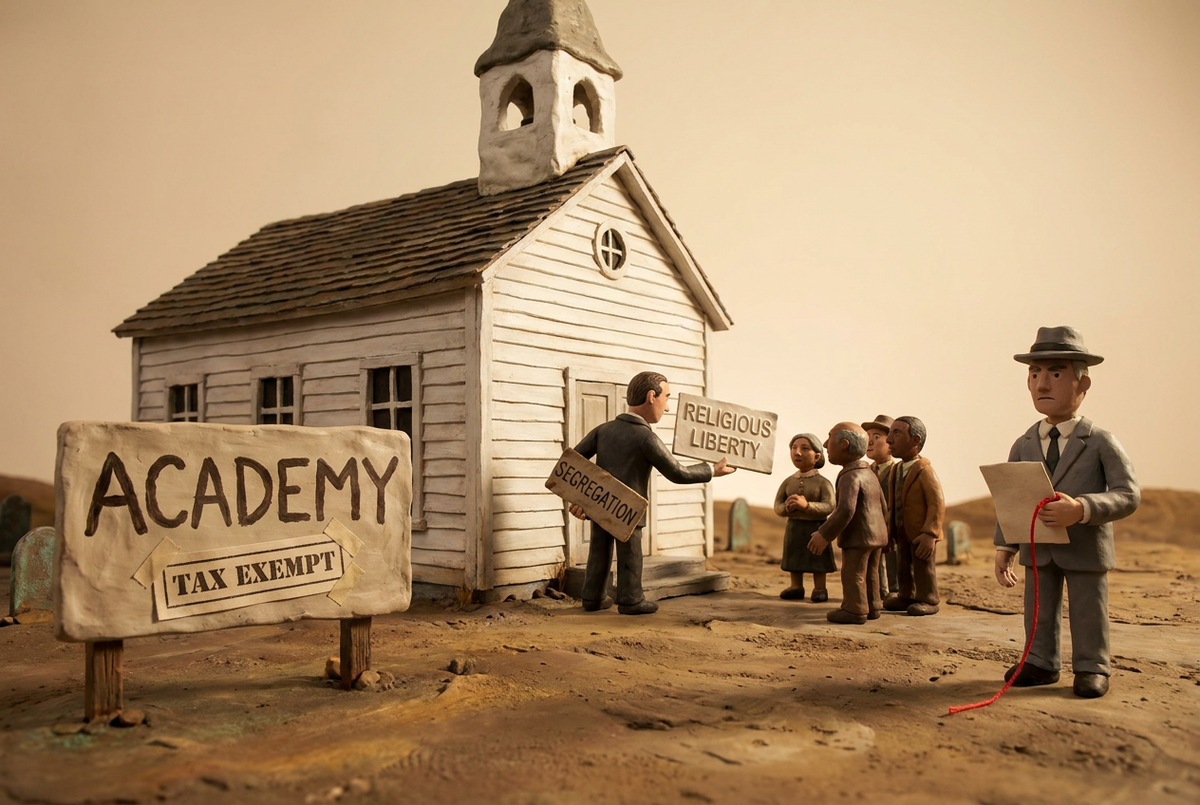
Leander Perez needed a barbed-wire fort and a courthouse to run his machine. This installment covers a version of the same instinct that didn't need either. It just needed a church basement, a diploma mill's worth of paperwork, and a tax-exempt status nobody thought to question closely enough, for a while. Segregation didn't die with the Sovereignty Commissions or Perez's collapsing dynasty. It changed vessels, moving out of public schools and statehouses and into private ones with a cross on the letterhead, and it's the reason a fight over classroom seating quietly rewired American religious politics for the next half century.
The Academies
After Brown, the South didn't just resist integration through legislatures and spy agencies. It built an entire parallel private school system, church-affiliated almost across the board, existing for the express purpose of letting white families opt their children out of integrated classrooms. These "segregation academies" weren't a fringe handful of holdouts. They were infrastructure, hundreds of schools across Mississippi, Louisiana, Alabama, and beyond, often founded by the same social networks, sometimes the same organizers, we've already met in this series.
The legal cover was the church affiliation itself. A private religious school got to claim it was making decisions on doctrinal or associational grounds, not racial ones, even when the racial intent was, to put it gently, not particularly hidden.
The Case That Started It
In 1971, a federal court decided Green v. Connally, ruling that an organization practicing racial discrimination cannot, by definition, qualify as a tax-exempt charity. The Supreme Court affirmed it the following year in Coit v. Green.
Here's the detail that gets flattened in a lot of retellings, and it's worth keeping intact: the IRS was the defendant in this case, not the instigator. Black parents in Mississippi sued to force the IRS to stop granting tax-exempt status to schools that were openly, functionally segregated. The federal government wasn't hunting for a fight with Christian schools. It got dragged into one, reluctantly, by the families the schools were built to exclude.
Once the ruling landed, the IRS started sending compliance letters asking schools about their admissions policies. Most schools took the path of least resistance: admit a token nonwhite student or two, keep the exemption, move on. Bob Jones University and Jerry Falwell's Lynchburg Christian Academy didn't. Bob Jones lost its tax exemption in 1976. The fight escalated all the way to the Supreme Court, which ruled against the university 8 to 1 in 1983.
Where Weyrich Comes In
This is the part of the story that historian Randall Balmer built into a genuinely influential thesis about the actual founding of the religious right as a political force. Balmer says Paul Weyrich, one of the movement's chief architects, told him directly that abortion wasn't the spark. According to Balmer, Weyrich had spent years trying other issues, pornography, school prayer, opposition to the ERA, without ever getting evangelical voters to organize at scale. What finally worked was the threat to Christian schools' tax exemptions.
The abortion pivot came later, and according to this account, deliberately. "We're fighting to protect our schools" wasn't a message built for a national coalition. "We're defending the unborn" was. The timeline lines up cleanly with the theory: evangelical political organizing visibly picks up right after Bob Jones loses its exemption in 1976, and the abortion-centered messaging solidifies a few years later with the founding of the Moral Majority in 1979.
The Honest Rebuttal
A series built on catching institutions dressing up ugly motives in respectable language owes its subject the same scrutiny, so here's where Balmer's version gets pushed back on, by serious historians, not just partisans defending the religious right's honor.
The evidentiary base is thin. Balmer's central claim rests substantially on one recalled private conversation with Weyrich in 1990, not contemporaneous documentation from the actual period in question. That's a real problem for a thesis this load-bearing. A recollection of what someone told you two decades after the fact is a different category of evidence than a memo, a recording, or a public statement made at the time.
The "IRS came after us" framing also undersells its own origin story. The schools were reacting to a lawsuit brought by Black parents seeking basic enforcement of an existing legal principle, not to unprompted federal aggression looking for a target. That's a meaningfully different starting point than the version of the story where a hostile government simply decided to pick a fight with churches.
Balmer's defenders don't have a smoking gun to answer this with, but they do have the timeline, and it's a fair point on its own terms: organizing accelerates right after the exemption fight, then pivots to abortion messaging within a few years. Correlation isn't proof. It's also not nothing.
The honest version of this section, and the one worth publishing, treats this as a live, unresolved argument between serious historians rather than a case either side has definitively won. That said, Occam's Razor applies as well.
What This Adds to the Machine
Wilson hid the harm behind appointees. The Sovereignty Commissions hid it behind file cabinets and bureaucratic language. Perez didn't bother hiding it at all. This one is the case where the vocabulary shift is the whole story: "religious liberty" and "protecting our schools" doing the same work "efficiency" did for Wilson's cabinet a half century earlier, letting people who understood exactly what they were defending avoid ever having to say it plainly, quite possibly including to themselves.
Where this one differs from everything else in the series so far is that nobody here needed a fort, a file cabinet, or a courthouse. They needed a tax code, a lawsuit that arrived from the other direction, and about eight years to find a better word for it.
This is Part 4 of The Backlash Machine*, tracing a hundred-plus years of the same recurring move: American institutions, progressive and reactionary alike, managing racial hierarchy through mechanisms diffuse and technocratic enough that nobody involved ever quite has to say the quiet part.*
Part 1, on Woodrow Wilson, is here. Part 2, on the Sovereignty Commissions, is here. Part 3, on Leander Perez, is here. Next up: the Panthers, the Weathermen, and the difference between two grievances that got flattened into one.