
How the Right Built a Media Machine Nobody Can Turn Off
The audience became the editorial board. And the editorial board only votes for more.

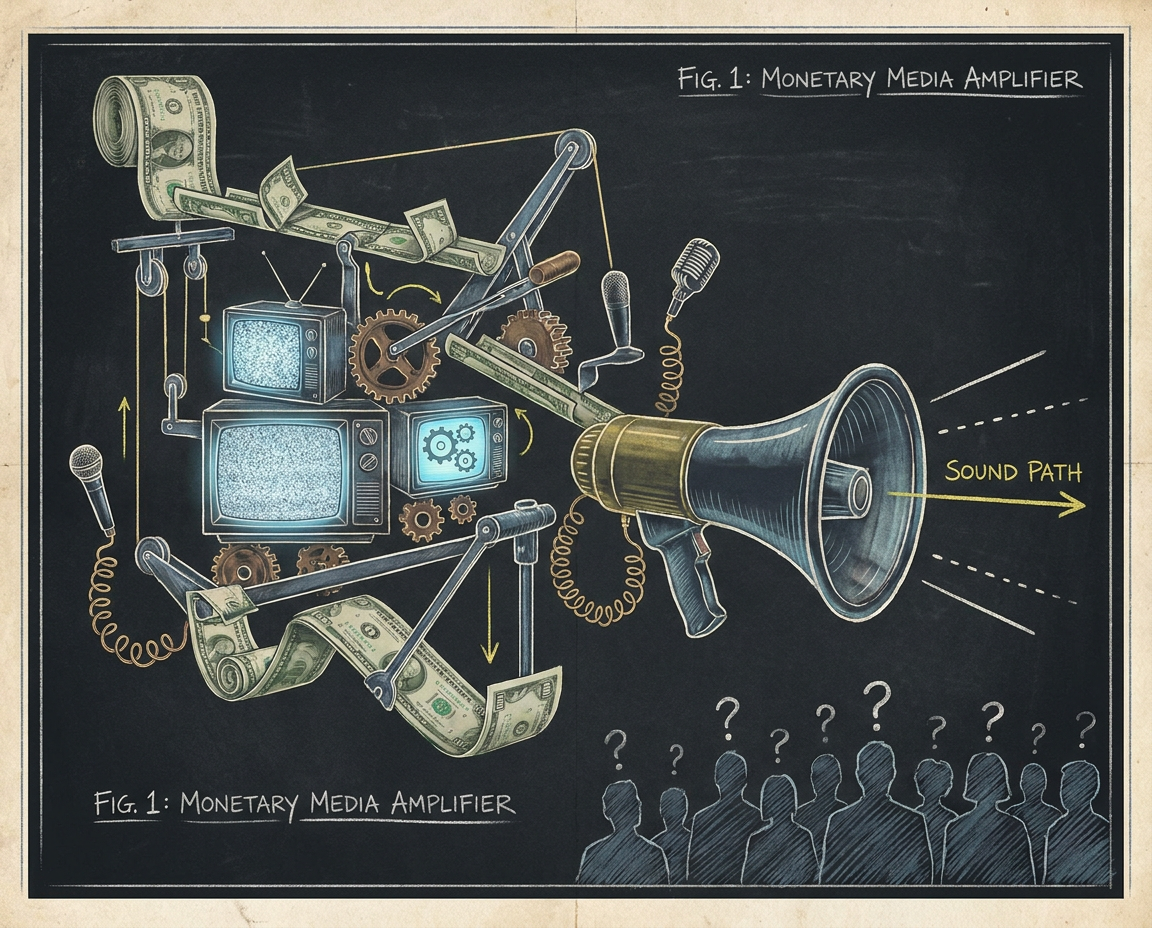
The right-wing media ecosystem looks, from the outside, like chaos — a hundred streaming shows, podcasters, Substacks and niche news outlets all screaming over each other, each claiming to be the only one willing to tell the truth. It is chaos. But it's also the intended result of a forty-year infrastructure project, turbocharged by cheap money, and now running on logic that nobody controlling it fully understands anymore.
To understand how it got here, you need to understand the three distinct inputs that built it, because they operate at different layers and get confused for each other constantly.
The Platforms Built the Stadium
The first input is ZIRP — the Federal Reserve's zero interest rate policy that ran roughly from 2008 to 2022, with a COVID-era extension. Cheap capital meant platforms could scale aggressively and lose money for years while doing it. YouTube, Spotify, and the podcast infrastructure they spawned weren't profitable strategies — they were bets made with nearly free money that audiences would eventually be worth something.
The side effect of building that infrastructure was the creator economy. YouTube's Partner Program began distributing ad revenue at a scale that turned "making videos" into a career. By 2019 a meaningful fraction of American high school students, asked what they wanted to do with their lives, said they wanted to be like MrBeast. Not a teacher, not a doctor — a fuckin' content creator. ZIRP had bought a wholesale cultural shift in what counted as a legitimate livelihood.
This matters because the platform ecosystem that ZIRP built was, by itself, politically neutral. MrBeast isn't ideological. But what it produced was a large population of people who understood how to build parasocial relationships with audiences, how to perform authenticity on camera, how to project "I'm just a regular person talking to you" while running what is functionally a media operation. That skill set was sitting there, available, when the second input arrived.
The Donors Pointed the Money
The billionaire infrastructure predates ZIRP by decades. The Kochs were funding Heritage and Cato in the 1970s. DonorsTrust — memorably described as "the dark-money ATM of the conservative movement" — has funneled over $45 million to conservative media nonprofits since 2015 alone. The Wilks brothers, Texas fracking billionaires, seeded The Daily Wire with $4.7 million and turbocharged PragerU before that. These weren't loans. They were ideological investments made by people with surplus capital and no expectation of financial return.
What ZIRP did for this existing infrastructure was lower the cost of everything adjacent to it. Building a streaming platform, launching a podcast network, funding a content startup — all of it got cheaper. The donors didn't change their strategy. They just got more for their money.
The Foreign Money Found the Gaps
The Tenet Media case is the most dramatic illustration of the third input: foreign capital finding the seams. The DOJ's 2024 indictment alleged that two RT employees funneled nearly $10 million through a Tennessee-based shell company to pay right-wing content creators — Tim Pool, Dave Rubin, Benny Johnson among them — for content aligned with Kremlin interests. The influencers claim they were duped about the funding source, and the indictment doesn't charge them with wrongdoing.
But the operational structure is instructive regardless of what the influencers knew. RT didn't have to build a creator ecosystem — ZIRP did that. They didn't have to train the talent or build the audience — the platform economy did that. They didn't have to launder the ideology — the billionaire donor network had been doing that for decades. They just had to find the existing infrastructure and plug into it. A content startup raising outside money to fund audience growth was so normal by the early 2020s that nobody blinked.
The Equilibrium Nobody Chose
Here's where the story gets genuinely strange. The right-wing media ecosystem is now large enough and competitive enough that it operates on its own logic, and that logic belongs to the audience, not the funders.
After Fox News accurately called Arizona for Biden in 2020, it nearly destroyed them. Newsmax and OANN immediately positioned themselves as the outlets that would never betray the faithful. Fox had to lurch right to reclaim the audience. The accurate call became a liability. This is the dynamic in miniature: once you've established yourself as the "real" MAGA outlet, you cannot moderate without losing the audience to whoever is willing to go further.
The result is an arms race with no off-ramp. The outlets are not racing to the bottom in the sense of abandoning standards — they never claimed to have standards in the conventional sense. They're racing to establish authenticity with an audience that treats any move toward the center as betrayal. Each challenger positions itself against the previous occupant of the most-extreme slot. Newsmax versus Fox. OANN versus Newsmax. Whoever is next versus all of them.
The perverse consequence is proliferation without diversification. There are more outlets, more voices, more volume than at any point in the history of conservative media. The actual range of acceptable positions has never been narrower. You get a hundred channels all saying approximately the same thing with escalating intensity.
The audience has become the editorial board, and the editorial board only votes for more.
What Democrats Are Actually Competing Against
The left's standard response to all of this is to note the asymmetry — the donor networks, the dark money, the platform advantages — and treat it as a funding problem. It isn't, or it isn't only that.
The right built an ecosystem that provides its audience with a coherent daily narrative. Trump is the protagonist. The enemies are consistent. The story makes sense of the world in a way that feels satisfying. Hosts build parasocial bonds with listeners who feel understood, not condescended to.
The left runs into structural problems that money doesn't straightforwardly solve: a fragmented coalition with competing priorities, a tendency toward in-group argumentation that is fascinating to participants and alienating to observers, and the absence of a single galvanizing protagonist to paper over the divisions. Internal debates that the right papers over with Trump-as-unifying-force play out in public on the left, because there is no equivalent figure to rally behind.
The right-wing media machine was built in layers over decades. The ZIRP era supercharged it. The outside money lit it on fire. And the audience it captured is now writing the script.
Nobody's turning it off.