Say It Loud: Blaxploitation and the Cinema That Couldn't Be Ignored
I am going to admit that I missed this genre. Oh, I heard about it, but it wasn't my jam. Now, I am totally diggin' it.

There is no other cycle in the exploitation tradition that generates as much argument as blaxploitation, and the argument has never been settled because it was never really about the films. It was about who gets to own a story, who profits from it, and whether a flawed vehicle delivering something real is better or worse than a polished vehicle delivering nothing at all.
The answer, depending on who you ask, is still contested. What isn't contested is that the blaxploitation cycle — roughly 1971 to 1976, though the edges are fuzzy in both directions — produced some of the most vital American popular cinema of the decade, launched careers that reshaped the industry, created a visual and musical vocabulary that the culture has never stopped borrowing from, and did all of this while being simultaneously celebrated as liberation and condemned as exploitation by people who were not always wrong.
That's a complicated legacy. The films can handle it.
How it started, and why then
The conditions that produced blaxploitation were specific and would not have combined the same way at any other moment.
By 1970 the major studios were in genuine financial crisis. The late-1960s pivot toward big-budget roadshow pictures had produced a string of catastrophic failures — Hello, Dolly!, Tora! Tora! Tora!, Waterloo — that left the studios overleveraged and desperate for anything that would bring audiences back. Meanwhile, urban theaters in Black neighborhoods were hemorrhaging attendance because the product being shown — white faces, white stories, white anxieties — had nothing to say to the people buying the tickets.
Sweet Sweetback's Baadasssss Song (1971) arrived into this vacuum like a controlled explosion. Melvin Van Peebles wrote it, directed it, scored it, and starred in it — a picaresque about a Black man on the run from the police after killing two officers who were beating a Black Panther — and self-financed it by every means available, including, by his account, shooting hardcore pornographic scenes with a different crew to qualify for a union waiver. He distributed it himself, got it rated X, marketed the X rating as an asset rather than a liability, and watched it gross $15 million against a production budget of $150,000.
Van Peebles was not working within the exploitation tradition exactly. He was using its infrastructure — the independent distribution network, the willingness to handle transgressive content — while making something that was less interested in genre entertainment than in rage and survival. Sweetback is not a comfortable film. It was not designed to be. It was designed to demonstrate that a Black filmmaker could make a Black film for a Black audience and control every step of the process, and it demonstrated that with a vehemence that made everyone in the industry uncomfortable, which was also the point.
MGM watched Sweetback's grosses and immediately greenlit Shaft.
Shaft, and what the studios thought they were buying
Shaft (1971) is the film the studios thought they understood, and they were half right.
Gordon Parks — a photographer, documentarian, and novelist who had come up through Life Magazine and was the first Black director to make a major Hollywood studio picture (The Learning Tree, 1969) — directed it for MGM with Richard Roundtree in the lead as John Shaft, a Black private detective operating in Harlem. Isaac Hayes scored it. The result was a film that satisfied the genre requirements of the private-eye picture completely while being set in, cast from, and sonically rooted in a world that Hollywood had been content to pretend didn't exist.
What the studios thought they were buying was a formula: Black protagonist, urban setting, action beats, commercial music, profit. What they got was also that, but the formula was running on something they hadn't budgeted for — the specific pleasure of watching a Black man move through the world with absolute competence and absolute cool, answering to nobody, desired by everybody, and operating by a code that had nothing to do with white institutional approval.
Roundtree's Shaft is not a revolutionary. He's not making political arguments. He's just doing his job, brilliantly, on his own terms. In 1971, for the audience that made the film a hit, that was political enough. The fantasy of the blaxploitation hero — the person who has found a way to be fully themselves inside a system designed to prevent it — was not escapism in the pejorative sense. It was a very specific and very earned wish fulfillment.
Hayes' score deserves its own sentence: it is one of the great film scores in American cinema history, period, without the exploitation qualifier. The opening theme announced a new sonic vocabulary for the genre picture that the industry spent the next decade trying to replicate.
Jack Hill, Pam Grier, and the films that went further
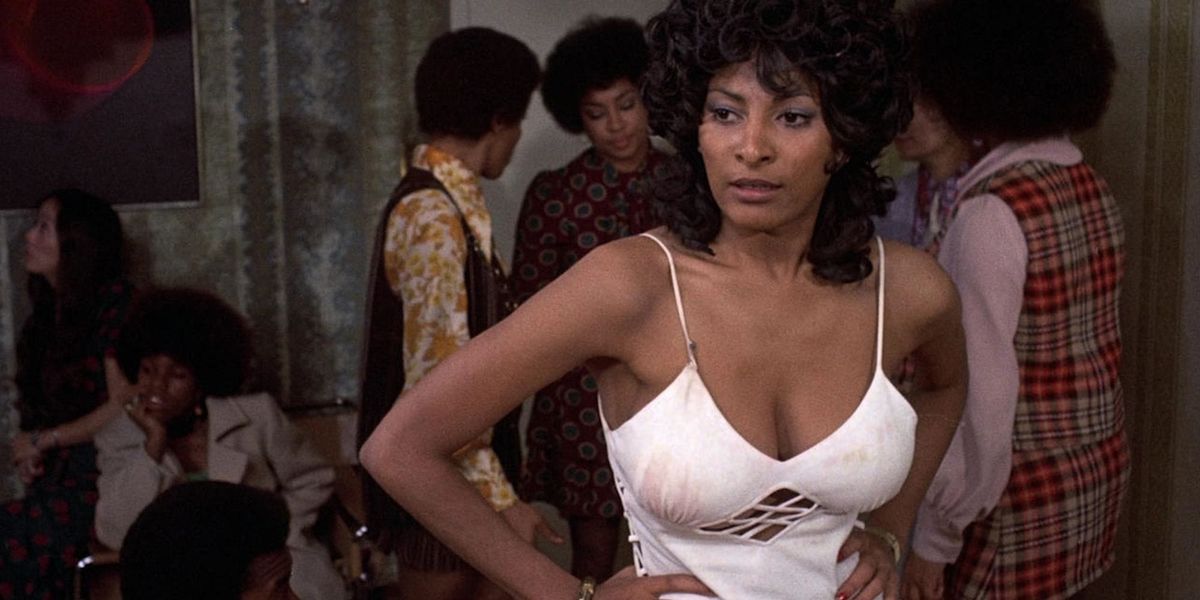
If Shaft is the cycle's commercial peak, the films that hold up best as cinema are the ones Jack Hill made with Pam Grier at AIP: Coffy (1973) and Foxy Brown (1974).
Hill had been working in exploitation since the early Corman days — he'd directed the WIP pictures in the Philippines, he'd done biker films, he understood genre grammar the way a jazz musician understands chord changes. With Grier he found a collaborator who could do things with those chord changes that neither of them could have done separately.
Coffy is the better film. Grier plays a nurse who moonlights as a vigilante, systematically dismantling the drug network that addicted her younger sister, moving through the criminal hierarchy one rung at a time. The plot is not the point. The point is Grier's presence — the intelligence she brings to a character who has decided that the legal system has nothing to offer her and who is right about that, the physical authority with which she occupies every scene, the emotional register she maintains beneath the genre surface that makes Coffy's violence feel like grief expressed sideways rather than action-movie catharsis.
Foxy Brown is more overtly stylized and slightly less coherent, but it contains the sequence where Grier castrates the man who killed her boyfriend and delivers the severed organ to his girlfriend in a jar, which is a choice so committed and so audacious that it momentarily reorganizes everything around it. Hill plays it straight. Grier plays it straight. The film doesn't apologize. The refusal to apologize is the point.
The Grier films were being marketed as product — the posters are what the posters are — and they delivered the exploitation requirements. They also delivered a protagonist who was smarter than everyone around her, who understood the systems operating against her with analytical clarity, and who responded with a combination of strategic intelligence and controlled fury that had no real precedent in American genre cinema. The fact that she was doing it in a blaxploitation picture, for AIP, with a budget that wouldn't cover a week of catering on a studio production, is not a caveat. It's the context that made it possible.
Gordon Parks Jr. and Super Fly
Super Fly (1972) is the cycle's most argued-about film, which is saying something in a cycle defined by argument.
Gordon Parks Jr. — the director's son, making his feature debut — told the story of Youngblood Priest, a Harlem cocaine dealer trying to make one last score and get out. Curtis Mayfield wrote and recorded the soundtrack before the film was finished, working from the script, and produced what may be the greatest marriage of music and film in the exploitation tradition: the songs don't accompany the narrative, they interrogate it, offering a moral commentary on Priest's choices that the film itself is too in love with its protagonist to provide.
This is where the critique lands most squarely. Super Fly makes cocaine dealing look glamorous because Priest is glamorous — the car, the women, the clothes, the cape that no reasonable person would wear and that Ron O'Neal makes look inevitable. The film acknowledges the cost of the life without dwelling on it. For the organizations that formed to protest the blaxploitation cycle — the NAACP, CORE, the Los Angeles Urban League — this was the indictment: that these films were selling Black audiences images of Black criminality and calling it representation.
The counterargument, which Mayfield's score embodies more clearly than any critical essay, is that Super Fly is not endorsing Priest's life. It's depicting a man who has looked at his available options and made a rational calculation, and the calculation is depicted with enough clarity that the viewer can make their own assessment. Mayfield's "Pusherman" is not a celebration of drug dealing. It's an elegy for the conditions that make drug dealing the best option available. Whether a film that delivers that message inside a package designed to look like celebration is doing a net positive or negative — that's the argument, and it's a real one.
The women, again
The blaxploitation cycle's treatment of women is where the genre critique and the genre defense become most entangled.
On one side: the cycle is full of films that treat women as furniture, as prizes, as motivation for male protagonists. This is true of most genre cinema of the period but is not a defense.
On the other side: the cycle produced, in Grier and in Tamara Dobson (Cleopatra Jones, 1973), female protagonists with more agency, more competence, and more screen presence than anything playing in the mainstream at the same time. Cleopatra Jones is a DEA agent. She drives a Corvette and knows karate and is played by a former model who is six feet two inches tall and who moves through the film as if the concept of being underestimated has simply never occurred to her. The film around her is uneven. Dobson is not uneven for a single frame.
The Grier and Dobson pictures were made because the male-protagonist blaxploitation films were making money and the studios wanted product. The female-protagonist pictures made money in turn. The cycle's logic was commercial at every step. The films it produced were, at their best, something more than commercial. That's the exploitation tradition in a sentence.
The musicians
One of blaxploitation's most durable legacies has nothing to do with the films themselves: the soundtracks permanently changed what American popular music understood about the relationship between orchestration and street-level reality.
Hayes. Mayfield. Willie Hutch (The Mack, 1973). James Brown (Black Caesar, 1973, and its sequel Hell Up in Harlemthe same year, because Larry Cohen was not a man who wasted time). Roy Ayers (Coffy). Bobby Womack (Across 110th Street, 1972 — also one of the most honest and least glamorous films of the entire cycle, a precursor to the crime realism of the following decade).
These composers were given something unusual: the license to score films about Black urban life with music that came from Black urban life, without the translation layer that Hollywood's standard scoring process would have imposed. The resulting soundtracks were records in their own right, selling independently of the films, crossing over to audiences who never set foot in the theaters showing the pictures. Hip-hop has been sampling this catalog for forty years and has not come close to exhausting it.
Where it ended and what it left
The blaxploitation cycle wound down by the mid-1970s for the same reasons it started: money. The studios had stabilized their finances, the superhero and blockbuster model was arriving with Jaws (1975) and Star Wars (1977) to absorb the industry's risk appetite, and the urban theater market that had sustained the cycle was itself beginning to deteriorate.
What it left behind was substantial. A generation of filmmakers and actors who had learned their craft in the cycle's compressed, fast-moving productions. A musical vocabulary that outlasted everything. A set of questions about representation and exploitation and who profits from whose story that the industry is still arguing about, in somewhat different language, right now.
And the films themselves, which reward watching with more attention than they were designed to receive. Coffy and Foxy Brown and Shaft and Super Fly and Across 110th Street and The Mack and Cleopatra Jones — they're not museum pieces. They're alive in the way that films made with urgency and constraint and genuine cultural stakes tend to stay alive, because the urgency doesn't expire just because the cycle did.
The window was narrow. What came through it was real.
Next: The gore merchants — Herschell Gordon Lewis, the splatter film, and the question of whether cinema about visceral disgust can be art, a question Lewis answered mostly by not caring whether it could.