The Billionaire Victims Club, Season Two
A group chat, a tax, and the men who'd like you to know they're the real victims here


Last July, JVL ran a Triad item with a headline I haven't stopped thinking about: "Marc Andreessen and the Billionaire Victim Club."(sorry - paywalled link) It was about one guy and one text chain — the racial-grievance group text that got leaked to the Post, the one where Andreessen explained to his fellow Trump White House travelers that DEI and immigration had conspired to rob "Trump voters" of access to college. I wrote up my own version of that story here, with the actual receipts on what Andreessen's "struggle" cost in 1989 dollars versus what it costs now, and how much of his success ran through federally funded research infrastructure he didn't pay for and rarely mentions.
Turns out that wasn't an isolated incident. It was a genre. And this spring, the genre got an ensemble cast.
I. The Chat
In the fall of 2025, a coalition of healthcare unions started collecting signatures for a ballot initiative that would tax the roughly 200 wealthiest Californians 5% of their net worth, one time, to help backfill a state healthcare funding gap that's projected to hit $100 billion this year. Somewhere in the weeks after, a Signal chat assembled. The membership reads like a cap table for the entire Silicon Valley right: Sergey Brin, Marc Andreessen, Mark Pincus, Michael Moritz, Garry Tan, Max Levchin, Shaun Maguire, Patrick Collison, Chris Larsen, Brian Armstrong, Ron Conway, Neil Mehta, David Friedberg, Steve and Genevieve Jurvetson — dozens of names, some constantly posting, some lurking, the chat itself apparently growing faster than anyone could track who was actually in it.
The opening moves were, by reporting, "mostly kvetching." But at some point the conversation graduated from venting to scheming, and somebody floated an idea that I want you to sit with for a second: what if they just bought the signature-collection firm the unions were using, and shut off its ability to gather any more names? Not lobby it. Not outbid it for a contract. Buy the company outright, as a kill switch on a citizen ballot initiative. That's the level of casual the chat operated at — civic participation treated as a vendor relationship, solvable the way you'd solve a supply chain problem.
It got pettier from there. When the main chat splintered into smaller private groups in January, Ron Conway — a longtime Democratic donor who'd been the first of the bunch to actually put money down against the tax — got quietly left off the new one, reportedly for being too gentle on Gavin Newsom. At one point two of the donors tried to organize a Zoom call where every rival anti-tax group could pitch its strategy with cameras off, like an episode of Shark Tank performed entirely in silhouette, so nobody's identity would leak to the press. They scrapped that one too, for fear it would leak to the press. The threat they were managing, in other words, was never really the tax. It was visibility.
II. The Public Face
In private, the chat kvetched. In public, the same people performed something closer to siege footing. When Rep. Ro Khanna — a Silicon Valley Democrat who'd previously taken money from several people in that very chat — tweeted in support of the tax and sarcastically said he'd miss the billionaires fleeing the state, the floodgates opened. Garry Tan, CEO of Y Combinator, tweeted that passing this tax would destroy innovation in California. Jason Calacanis called it confiscation, illegal, certain to be overturned. His "All-In" co-host David Friedberg replied to Khanna by goading him to keep going — why stop at billionaires, why stop at 5% — as if the bill in front of the legislature proposed anything beyond a one-time 5% excise tax on two hundred people.
Sit with the scale for a second. This is a single-digit percentage, applied once, to the wealthiest two hundred residents of a state of forty million people, to keep emergency rooms and hospitals funded after federal cuts gutted the budget that used to cover them. The response from the group chat was to treat it as an extinction event. Khanna's office got buried in calls and texts — some polite, plenty not — including, according to his chief strategist, offers to fund a primary opponent against him specifically to punish the tweet. Multiple tech financiers reportedly dangled upward of $15 million to recruit a credible challenger. A sitting member of Congress, in other words, got a bounty put on his seat for saying a sentence in support of a tax bill. That's not lobbying. That's a tantrum with a checkbook attached.
III. The Luck Audit
I did this math once already, on Andreessen — the out-of-state tuition that cost less in real dollars than a used Honda, the NSF-funded supercomputing lab he happened to be standing in when Mosaic got built, the AOL check that arrived before he turned 30. People got mad about that piece, mostly people who'd never bothered to look up what a 1989 UIUC dorm cost. So let's do it again, four more times, because apparently it needs repeating: none of these men is the protagonist of the story they tell about themselves.
Brin and Page. PageRank — the actual idea, the math that makes Google Google — got built by two Stanford PhD students inside a research apparatus paid for, in significant part, by the National Science Foundation's Digital Library Initiative. That's not a footnote, that's the origin story: federal grant money, university infrastructure, and a captive population of advisors and grad students that no garage in Palo Alto could replicate. They didn't drop out and bootstrap anything. They were funded academics who happened to monetize a publicly subsidized research project into a trillion-dollar ad company, and then spent the next two decades being coy in interviews about how it all just sort of happened upon them. It did. Just not in the way they mean.
Bezos. The Amazon myth is "garage in Bellevue, just a guy with a vision." The actual seed money was $245,573 of his parents' retirement savings, wired into the company before it shipped a single book. That's not "bet on himself" — that's "convinced his parents to bet their retirement on him," which is a different and much less interesting story, except it's the true one. He then rode the most explosive infrastructure build-out in commercial history — the early commercial internet, dirt-cheap capital, a USPS relationship he'd spend the next twenty years quietly leaning on — and emerged on the other side as the patron saint of "just work hard and disrupt something." His parents disrupted nothing. They just had savings and a son they trusted, which is a privilege roughly nine layers up from where the people listening to his commencement-speech version of events are standing.
Zuckerberg. Harvard handed him two things no amount of hustle manufactures: a dorm full of future engineers and investors, and a sealed pipeline directly into the venture capital ecosystem. Peter Thiel — and we'll get back to him — wrote the first check, $500,000, before the product had proven anything beyond "horny undergrads will rate each other's photos." The actual coding-genius-alone-in-a-room version of the story conveniently skips the part where Eduardo Saverin funded the servers and the Winklevoss twins were already building a near-identical product down the hall. Zuckerberg won a network effect and a lawsuit, in roughly that order of importance.
Ellison. Save the best for last. Oracle's first real customer — the contract that kept the company alive before it was Oracle, when it was a no-name shop called Software Development Laboratories — was the CIA. A no-bid intelligence agency contract for a relational database, codenamed, I shit you not, "Oracle." That's where the company's name comes from. The man who built a personal brand on disruptive-outsider energy, who owns most of a Hawaiian island and built himself an office shaped like a fucking octagon, started as a government contractor selling database software to spies. There's no universe where this guy gets to lecture anyone about the free market doing the picking.
Run the tape on all four and the pattern isn't subtle: federal grants, parental retirement accounts, Ivy League social capital, intelligence-agency procurement contracts. Not one of these men built what he built without an institution — public or familial — absorbing the risk first. That's the part that gets edited out of the keynote. And it's the part that matters most when you watch them turn around and explain to a roomful of 24-year-olds at a demo day that the only thing standing between them and the same outcome is grit.
IV. The Chorus
None of this works without the apparatus that repeats it back as independent thought. That's the actual job of the "All-In" podcast at this point — Sacks, Calacanis, Friedberg, Chamath Palihapitiya, taking donor-class anxiety and laundering it into commentary, four guys agreeing with each other at volume and calling it analysis. Chamath is the best example of the type, because his whole public identity runs on "scrappy immigrant outsider," delivered from a position about as far from outsider as Silicon Valley allows, while the SPAC boom he rode left a trail of retail investors holding losses he wasn't exposed to the same way.
Then there's the layer that turns the grievance into actual legislation. Joe Lonsdale's Cicero Institute — funded in part by Lonsdale, his Palantir co-founder Peter Thiel's broader network, and the Koch infrastructure — wrote model legislation criminalizing homelessness that's since been adopted across multiple states, and that fed directly into City of Grants Pass v. Johnson, the Supreme Court case that expanded local governments' power to arrest people for sleeping outside. That's the genre at its most consequential: a billionaire's free-floating resentment about who gets to occupy public space, converted into a legal brief, converted into case law.
V. The Kicker
Here's where it stops being metaphor. David Sacks's run as Trump's AI and crypto czar wrapped up this March — he hit the 130-day cap that applies to special government employees, having delivered the stablecoin-focused GENIUS Act but leaving the bigger crypto market-structure bill, the CLARITY Act, unfinished enough that a Cardano founder publicly called for his resignation over it. Falling short of your own stated agenda would, in most lines of work, be a reason not to get promoted. Sacks got promoted. He's now co-chairing the President's Council of Advisors on Science and Technology (PCAST) — a thirteen-member federal panel that also seats Mark Zuckerberg, Marc Andreessen, Larry Ellison, Sergey Brin, Jensen Huang, Michael Dell, and Lisa Su.
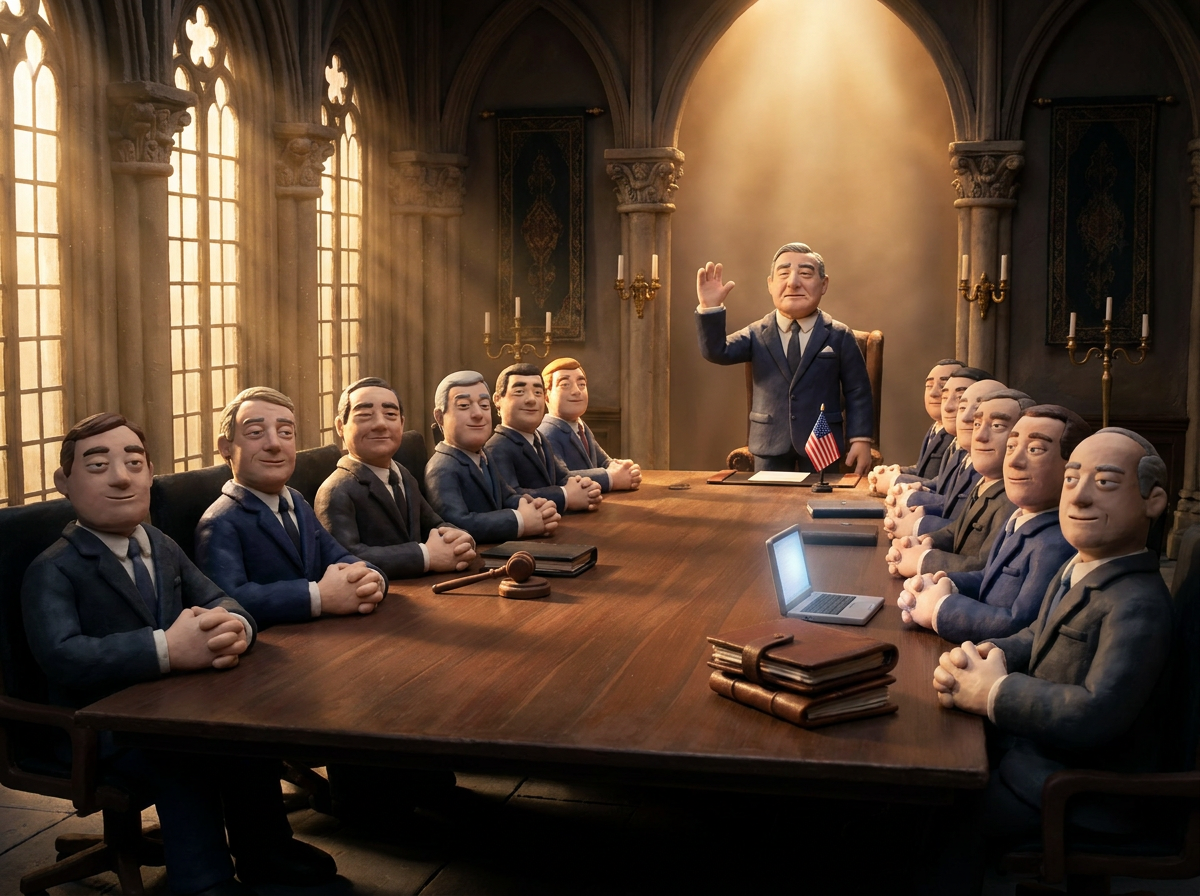
Read that roster again. It's not a coincidence-adjacent list of separately important people. It's most of the cast of this piece, the Signal chat and the luck audit both, now holding actual seats on a body whose stated job is shaping science and technology policy for the federal government. The persecution complex didn't cost these men anything. It got them tenure.
VI.
So that's the shape of it: a private group chat full of men commiserating over a 5% tax, a public chorus insisting that tax amounts to civilizational sabotage, a luck-erased origin story underneath every one of them, an ideological pipeline turning their grievances into law, and a federal advisory council waiting at the end of the road for the ones who stick the landing — or, apparently, the ones who don't. The myth they're selling downward, to every 24-year-old grinding toward a demo day, is that this is a meritocracy with room at the top for anyone willing to hustle hard enough. The actual record says otherwise: it's a closed loop, and the door at the end of it opens from the inside.
Standalone entries on Musk, Thiel, Bezos, and Brin are coming. Each of them earned one.
Thanks for reading Sweaty Spice. Subscribe for free to receive new posts and support my work.