The Fulcrum
In 1954 Mississippi built a segregationist club so extreme even its own founders told one guy to tone it down. Then the state gave him a job application for a spy agency. This is how a Supreme Court ruling armed both sides of a war.

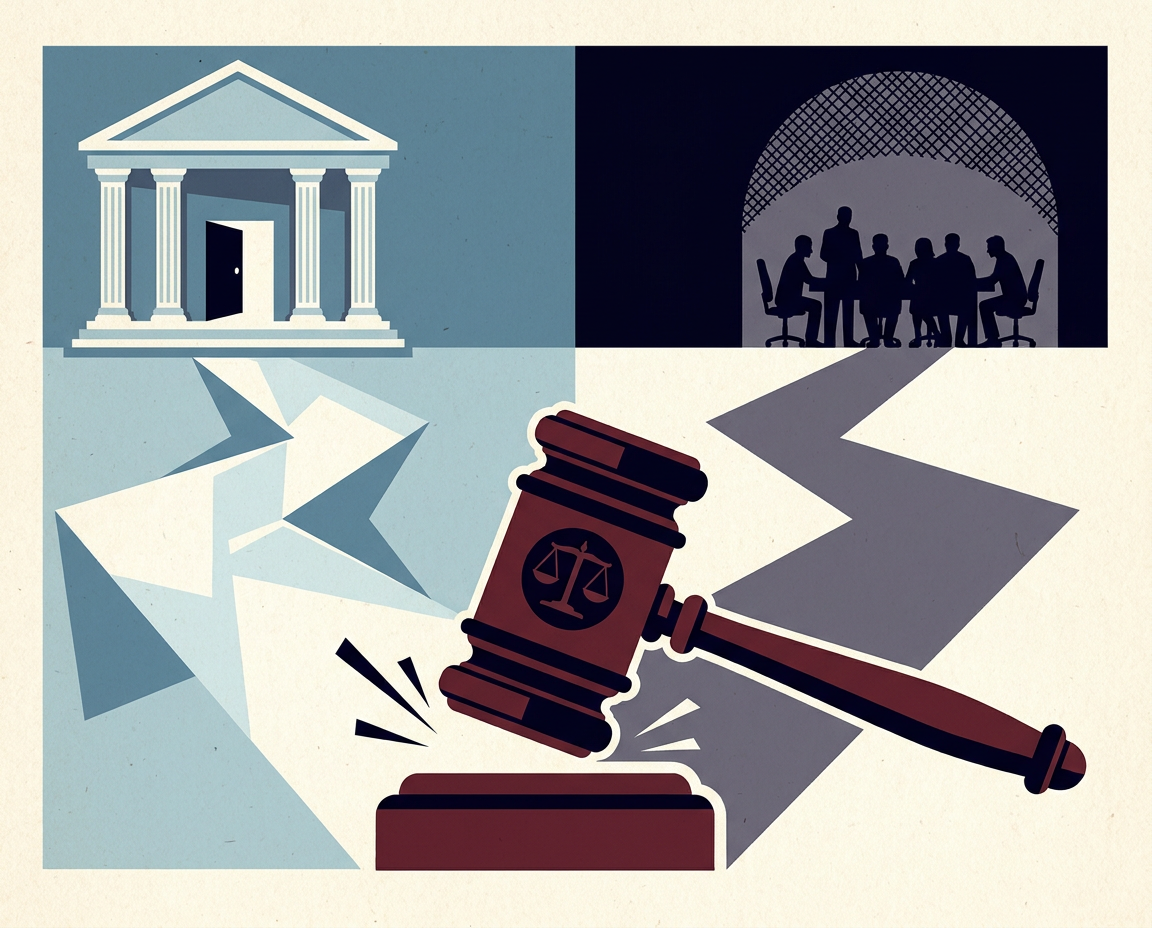
One Supreme Court ruling, one summer in Mississippi, and the exact moment America's reactionary machinery proved it was already fully assembled.
I've been chewing on an episode of the podcast Weird Little Men for a couple weeks now, specifically the two-parter on Byron De La Beckwith, the man who put a bullet in Medgar Evers' back in 1963 and then walked around free for thirty years because two juries of his neighbors couldn't be bothered to convict him. Go listen to it. It's good. It's also the reason I went down a rabbit hole that ended somewhere I didn't expect: not with Beckwith the murderer, but with Beckwith the joiner.[1]
Because before Beckwith picked up a rifle, he picked up a membership card. And the group that issued it wasn't the Klan.
II. The recruiter who was too racist for the racism factory
In 1954, the year the White Citizens' Council was founded in Mississippi, Beckwith signed up. Immediately. He wasn't a reluctant convert who got radicalized over years of resentment. He was there on day one, and according to a 1963 Time profile, he threw himself into recruitment with such manic enthusiasm that the Council's own leadership had to ask him to cool it off. One of his fellow church members told Time: "If you talked about Noah and the Ark, he'd want to know if there were any Negroes in the Ark."
Sit with that for a second. This was an organization built from the ground up to resist racial integration by any means short of violence, and even they looked at this guy and thought, buddy, maybe pump the brakes.
That's not a character quirk. That's a preview of the whole goddamn decade.
III. The ruling that started it
Let's back up to what actually happened in 1954, because the "Brown v. Board ended school segregation" version you got in tenth grade history undersells what a genuinely radical piece of legal reasoning this was.
Brown v. Board of Education overturned Plessy v. Ferguson's "separate but equal" doctrine, the fig leaf the entire Jim Crow legal architecture had been hiding behind since 1896. Chief Justice Earl Warren didn't just want a majority, he wanted unanimity, and he spent real political capital getting all nine justices on board specifically so the South couldn't point to a dissent and claim the ruling was contestable, partisan, up for debate. He got it. 9-0. One justice, Robert Jackson, showed up to the reading of the decision against doctor's orders after a heart attack, apparently just to be seen agreeing with it.
The Court also leaned on social science, the Kenneth and Mamie Clark doll studies showing Black children internalizing feelings of inferiority from segregated schooling, cited in the famous Footnote 11. That single footnote is, depending who you ask, either the moment American law caught up with lived reality or the founding sin of "judicial activism" as a conservative legal complaint. That fight is still running seventy years later. We'll leave it there for now, but keep it in your back pocket.
IV. The fulcrum tips both ways at once
Here's the thing that actually earns this piece its title. Brown didn't just crack something open in one direction. It's the rare historical event where you can watch the same shockwave accelerate two completely opposed forces in the exact same calendar year.
The reactionary acceleration: the White Citizens' Council, founded in Mississippi in 1954, explicitly and directly in response to Brown. Not eventually. Not after a slow burn. That same fucking year.
The movement acceleration: Brown validated Thurgood Marshall and the NAACP Legal Defense Fund's entire incrementalist litigation strategy, proving that the courts could be a real lever against Jim Crow rather than a dead end. It fed directly into the Montgomery Bus Boycott, which kicked off barely eighteen months later.
One ruling. One year. It armed both sides of the same fight at exactly the same moment.
One decision. Same summer. It handed the Citizens' Councils their founding pretext and handed the civil rights movement its founding proof of concept. That's not a coincidence of timing, that's what a fulcrum does. It doesn't push in one direction, it's the point everything else pivots around.
V. De facto becomes de jure
Here's where it stops being a story about attitudes and starts being a story about infrastructure.
In 1956, the Mississippi state legislature created the Sovereignty Commission, a literal, funded, official state spy agency whose entire purpose was combating court-ordered desegregation.
Beckwith applied for a job there. In his application, he was explicit that he wanted to help eliminate the forces behind the NAACP.
This is the part that should piss you off more than the Citizens' Council does, honestly. A civic club with bad ideas is a civic club with bad ideas. A state government standing up a formal surveillance apparatus to spy on its own citizens, with a job application process, an org chart, a budget line, all in service of stopping Black kids from going to a decent school, that's not "the way things were back then." That's a bureaucracy. Someone had to design the letterhead.
Segregation in the pre-Brown South ran plenty on custom, on unwritten rules everybody understood, on the soft violence of "that's just how it is." Brown forced the issue into the open, and the South's answer wasn't to quietly maintain the status quo. It was to build state infrastructure to fight a Supreme Court ruling. De facto became de jure in about two years flat.
VI. What this actually proves
Beckwith's own arc, Council in '54, frustrated with the Council's comparative restraint by the early sixties, drifted to the Klan, murdered Medgar Evers on June 12, 1963, walked free after two hung all-white juries in 1964, wasn't finally convicted until 1994, is a preview of a piece I want to write next about how "respectable" reactionary institutions function as pipelines rather than moderating forces. That's for next time.
What I want to land here is this: the organizational muscle that mobilized instantly in 1954, the Citizens' Councils, the state surveillance apparatus, the political defiance, was already fully formed and battle-ready a full decade before the Civil Rights Act of 1964. By March of 1956, 101 of the South's 128 congressional delegates signed the Southern Manifesto, a formal declaration that Brown was an illegitimate abuse of judicial power that the South had no obligation to obey.
That matters because there's a comfortable story a lot of people tell about how the modern GOP's relationship with racial grievance politics is a post-1964 invention, a Nixon Southern Strategy retrofit bolted onto an otherwise unrelated party coalition. Brown says otherwise. The muscle was there in 1954. It didn't need Nixon to teach it how to flex. It needed a pretext, and the Supreme Court handed it one on May 17, 1954, and by the end of that same year a fully operational, well-funded, socially respectable resistance apparatus was already up and running, with an unhinged true believer inside it that even the true believers thought was a bit much.
That's not realignment. That's a standing army that had been waiting for a war.
Like what you've read, but not able to switch to paid? Why not buy me a coffee instead! All money goes to help defray the expense of running the site.
1 - I learned about the Brown v. Board of Education ruling in my high school US history class (1979-83) in California, when we were a strong education state, but it was very superficial.
I have recently done a deeper dive, and I am shocked at how deficient my formal education was, and now, considering how much different the education standards would alter even my superficial knowledge if you were a high school student in the deep south. Yikes!