This Fucking Guy: John Roberts Has Never Once Been Talking About Trump
Forty-five years of paper trail, and exactly one time he found the discretion to swing the other way.

This is a secondary TFG that spawned from my post on the cretinous Trent Lott where in the middle part, one up and coming Republican lawyer named John Roberts got his grubby fingers into the shitshow around segregation. I put a pin in that for the future, and now that Roberts has penned the dissent in the recent decision to let the Ballroom to continue to be built, it is time to unpin that and to give Chief Justice John Roberts his own This Fucking Guy award.
Table of Contents
On August 31, 2026, the Supreme Court voted 5 to 4 to let construction keep tearing through the East Wing of the White House, and the one Republican appointee who thought that was a bad idea was John Roberts. Ten days earlier, Roberts himself had personally issued an administrative stay keeping the demolition alive while the full Court decided what to do, so this wasn't a reflex. He sat with it. When the Court ruled, the other five Republican appointees held that a historic preservationist objecting to the design didn't have standing to sue in the first place, this on an emergency docket application, not even a full merits case, an eight page unsigned order pausing a lower court's injunction while the government raced to finish a $400 million ballroom before anyone could make them stop. The government's own filings described the project as an "integrated military complex," and argued the above-ground shell's size was crucial to the security of the below-ground military installation, which is a genuinely unhinged way to argue in federal court that your ballroom is bunker camouflage with a cash bar.
Roberts didn't buy any of it. He wrote six pages, joined only by the Court's three Democratic appointees, arguing the preservationist's aesthetic injury was exactly the kind of concrete harm the Court has long recognized, and closed by quoting Churchill: we shape our buildings, and afterwards our buildings shape us. A Chief Justice, breaking from his own goddamn side, over architecture.
The instinct is to read that as growth. Bullshit. Forty-five years of paper trail says otherwise.
The official story
What this dissent is being read as, and the line it's supposedly proving wrong.
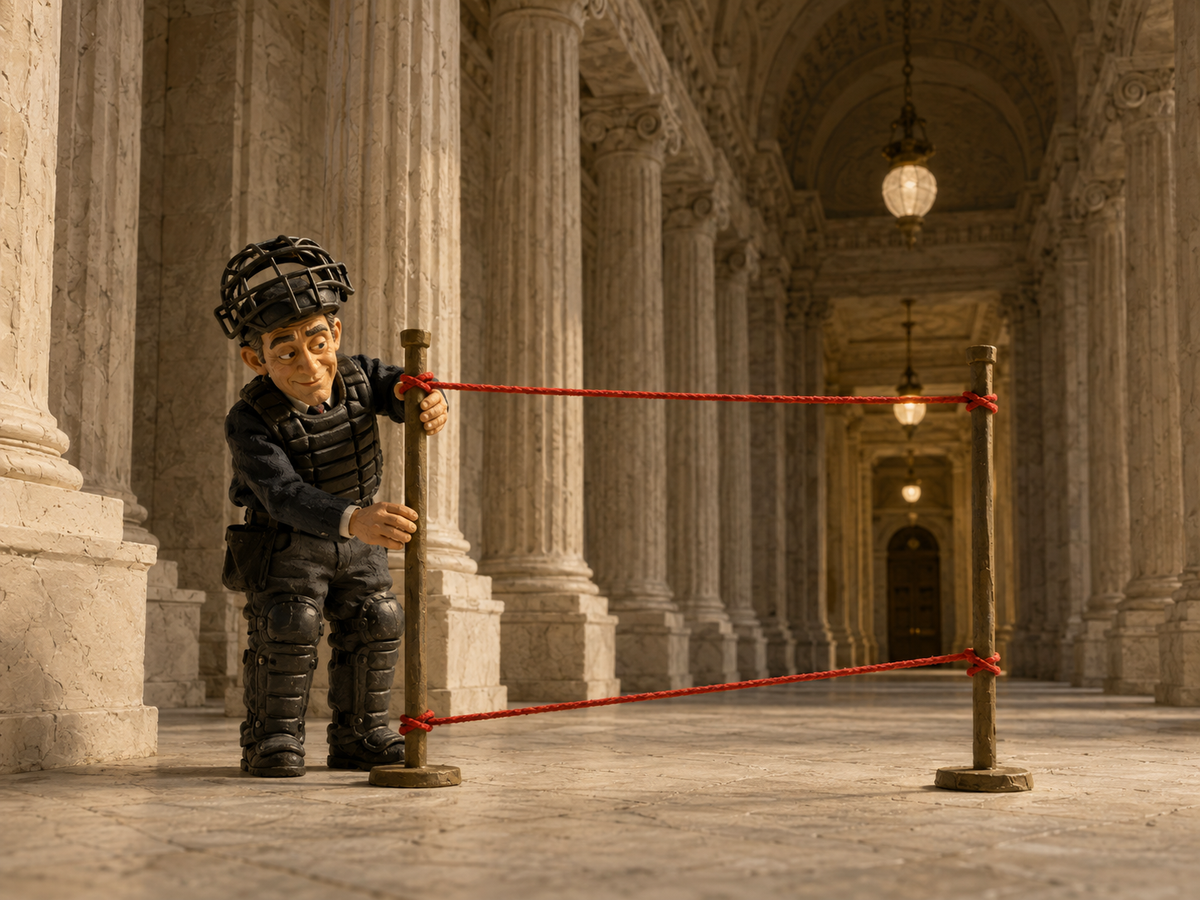
At his 2005 confirmation hearing, John Roberts gave American civics the analogy it's been stuck with ever since. Judges are like umpires, he said, and my job to call balls and strikes, and not to pitch or bat. It was the entire sales pitch for the conservative legal movement's decades-long project of stocking the federal bench with judges who swore up and down they were just reading the text, not making policy from the goddamn chair. It's why "legislating from the bench" became the all-purpose insult for any ruling the right didn't like, and why an umpire suddenly finding a reason to protect a building from the president he helped keep in power reads, on its face, like the umpire growing a conscience.
Except the umpire has called this same fucking game for forty-five years, and the strike zone has moved in exactly one direction until last week.
The DOJ desk, 1981 to 1983
Same building, same year, two projects. Bob Jones University got the fuller treatment in the Trent Lott piece. Here's what Roberts was doing at his own desk.
Roberts was 26 years old and a Special Assistant to Attorney General William French Smith from August 1981 to November 1982, the exact window Trent Lott was writing letters to the IRS and the Solicitor General trying to preserve Bob Jones University's tax exemption for banning interracial dating. Roberts wasn't some innocent bystander to that shitshow either. In January 1984, while at the White House Counsel's office, he handled a complaint from Bob Jones III himself, who was leaning on the administration over an unrelated matter and, per Roberts's own memo, made what Roberts called a thinly veiled threat about how the administration's treatment of fundamentalist Christians would not be forgotten.
But Roberts's actual assignment that year, the one with his name on the paperwork, was different: keeping the Voting Rights Act weak. Congress was debating whether to amend Section 2 from requiring proof of discriminatory intent, a nearly impossible bar for plaintiffs to clear, to a plainer test of discriminatory effect. In December 1981, Roberts wrote a memo titled, per The Nation's review of his own archived files, "Why Section 2 of the Voting Rights Act Should Remain Unchanged." He lost his ass. Congress passed the effects test in 1982 anyway, over his own administration's objection.
He got a second try thirty-one years later, and this time nobody was around to stop him.
Sweaty's Corner doesn't have a marketing budget or an algorithm pushing it into anyone's feed. It has readers who share it. If this one landed, sending it to someone who'd get something out of it — or subscribing so the next one finds you directly — genuinely moves the needle.
Standing as a weapon, 1990 to 2007
The doctrine he spent a career narrowing, before it suddenly widened for a ballroom.
Three data points, spread the hell out, all pointing the exact same direction. In 1990, as Deputy Solicitor General under the first Bush administration, Roberts personally argued and won Lujan v. National Wildlife Federation before the Supreme Court, convincing the justices that an environmental group challenging a Bureau of Land Management mining decision didn't have standing to sue. In 1993 he wrote the doctrinal defense of that whole approach, "Article III Limits on Statutory Standing," 42 Duke L.J. 1219, arguing for keeping the standing bar high. In 2007, as Chief Justice, he dissented in Massachusetts v. EPA when the majority held that Massachusetts had standing to challenge the EPA's refusal to regulate greenhouse gases. Same position, on the bench this time, still on the restrictive side.
That's three separate moments across seventeen years where Roberts made it harder to get into federal court to challenge the government. Not softer. Harder, every single fucking time, on the record.
Finishing the fight he lost, 2013
Thirty-one years after the Section 2 memo, Roberts got to relitigate the Voting Rights Act as Chief Justice, and this time he won.
Shelby County v. Holder, decided 5 to 4 in 2013, Roberts writing for the majority, struck down the coverage formula that determined which states needed federal preclearance before changing voting laws. The reasoning: our country has changed, and Congress couldn't keep using 1960s data to regulate today's South. Mississippi, Trent Lott's home state and one of the jurisdictions the formula covered, was freed from federal oversight on the spot. Ruth Bader Ginsburg's dissent compared the decision to throwing away your umbrella in a rainstorm because you are not getting wet, which remains the tidiest one-line rebuttal anyone has produced.
The kid who lost the Section 2 fight in 1982 became the Chief Justice who won the adjacent fight in 2013. Not a change of heart. A rematch he was patient enough, and petty enough, to wait three goddamn decades for.
The tortured per curiam, 2024
Trump needed to stay on a ballot. The Court found a way that even its own intellectual authors called flimsy.
Trump v. Anderson was fully argued, not shadow docket, decided March 4, 2024, three and a half weeks after oral argument, one fucking day ahead of Super Tuesday. The bottom line was 9 to 0: Colorado couldn't unilaterally remove Trump from its ballot under the Fourteenth Amendment's Section 3 disqualification clause. But only five justices, Roberts among them, joined the full opinion, which went further and held that Section 3 isn't "self-executing," meaning it has no practical force against a federal candidate unless Congress first passes enforcement legislation, legislation that would require the cooperation of the very body a would-be insurrectionist's own party might control. Amy Coney Barrett broke off from that broader holding, joining only the narrow result and writing that she would decide no more than that. The three liberal justices went further, warning the majority had turned a narrow case into one of sweeping consequence. The opinion itself was per curiam, unsigned, issued by the Court as an institution rather than under any one name.
Here's the detail that actually lands. William Baude and Michael Stokes Paulsen, the conservative originalist legal scholars whose own law review article built the intellectual case that Section 3 disqualifies Trump automatically, wrote afterward that the Court had produced a flimsy decision in a high stakes, high profile, high intensity case instead of confronting the actual question. Not the left crying foul. The right's own scholars, the guys who wrote the book, calling it a chickenshit dodge.
Roberts didn't even need his own goddamn name on this one to get the outcome he needed.
The rotating cast, 2025 to 2026
This term, Roberts hasn't commanded a majority against Trump. He's negotiated one, case by case, and the ballroom is the one time nobody came.
Look at this term's record against Trump and the coalition is never the same fucking twice. On tariffs, Roberts pulled both Gorsuch and Barrett, 6 to 3. On birthright citizenship, he got Barrett alone, 5 to 4, while Gorsuch and Kavanaugh stayed with Thomas and Alito. On the removal of Federal Reserve governor Lisa Cook, he got Kavanaugh alone, 5 to 4, this time without Barrett or Gorsuch. On the National Guard case, he got both Kavanaugh and Barrett. Four different cases, four different lineups, and in every one it took exactly one or two of the same three seats agreeing to cross over.
On the ballroom, not one of these cowards showed up. Roberts alone with the three liberals, no fourth vote, the majority holding for the administration.
It's worth remembering what that costs a justice who does cross over. After the birthright citizenship ruling, Vice President JD Vance publicly called Barrett's vote a mistake, and Representative Nancy Mace called for impeaching "rogue, activist judges." That's the going rate for breaking ranks once, on a case about the plain text of the Fourteenth Amendment. A ballroom dispute landing in that climate was never going to pull a fourth vote, and it didn't.
The ballroom, again
Same instinct, pointed wherever it protects the thing he's inside of.
Put Trump v. Anderson and the ballroom dissent next to each other and they stop looking like a contradiction and start looking like the same goddamn move twice. In 2024, the stated worry was "chaos and inconsistency in the electoral process," so the Court reached past what the case required to keep the leading candidate on the ballot and make Section 3 nearly impossible to enforce against a sitting president's party. In 2026, the worry was the physical and historical continuity of a two-hundred-year-old building. Different outcomes, same value underneath both: protect the stability of the institution, whichever direction that happens to cut. Not once across either case is the operative question what the text plainly says or who the ruling protects. It's whether the existing order holds together.
Return to the umpire, one more time. An umpire is supposed to run one strike zone for both teams, all game, regardless of the score. What the record actually shows is forty-five years of discretion over where that zone sits, narrowed against environmentalists and voting rights plaintiffs for three decades, widened exactly once, for a preservationist worried about sightlines at the goddamn White House, and even then he couldn't get another umpire in the building willing to call it with him. That's not a conscience. That's a guy who got lucky, once, that protecting the furniture and protecting the Constitution happened to point the same fucking direction.
Keep the lights on
Like what you've read, but not able to switch to paid? Why not buy me a coffee instead! All money goes to help defray the expense of running the site.