
The Longest Game: John Roberts and the Quiet Murder of Voting Rights
This didn't happen last week. This took fifty years of careful, deliberate work. And the man who did it went to his office every day in a nice suit and called it jurisprudence.

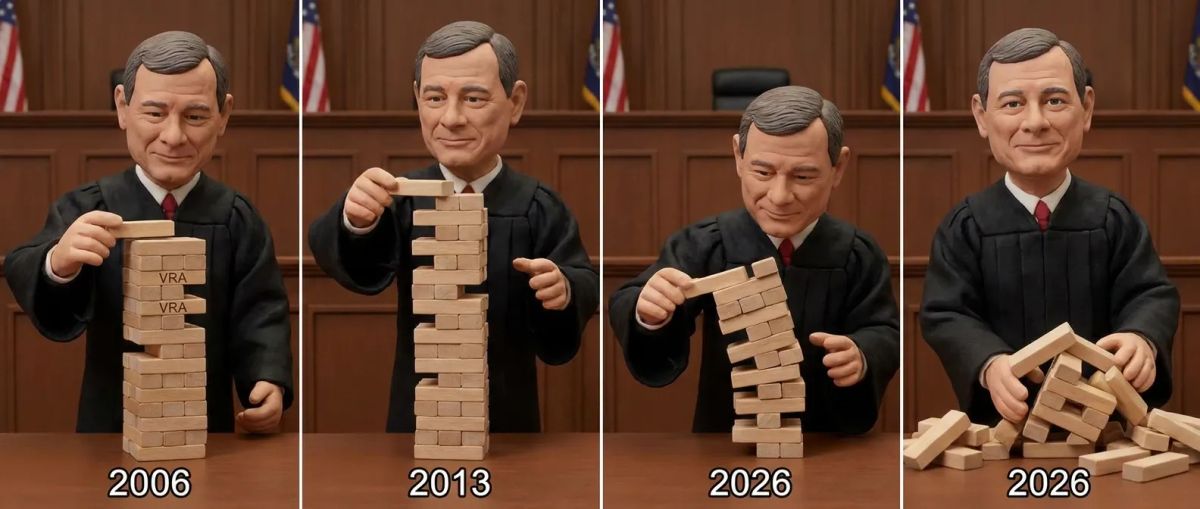
I need to be clear about something before I dive into the legal weeds: what happened on April 29th, when the Supreme Court handed down its 6-3 decision in Louisiana v. Callais, was not a surprise, it was completion of a life's work. The culmination of a career arc so focused, so relentlessly directional, that if it were a business strategy you'd have to admire the goddamn discipline even as you hated everything it produced.
The man at the center of this is John Roberts, Chief Justice of the United States, and it is long past time we stopped treating him as a reluctant institutionalist occasionally outvoted by the crazies. He is not a moderate being dragged rightward by Alito and Thomas. He is the architect. Alito wrote the Callais opinion. Roberts provided the four decades of infrastructure that made it possible.
A Career Built on One Idea
Roberts came up in the Reagan Justice Department in the early 1980s, where he worked specifically on voting rights and civil rights legislation. His memos from that period are not particularly subtle. He argued against expansions of the VRA, pushed back against Congress's authority to legislate on racial discrimination, and consistently advanced the position that the Fourteenth and Fifteenth Amendments were prohibitions on racial classification rather than guarantees of racial protection.
That is a very specific and very consequential legal interpretation. And he never let it go.
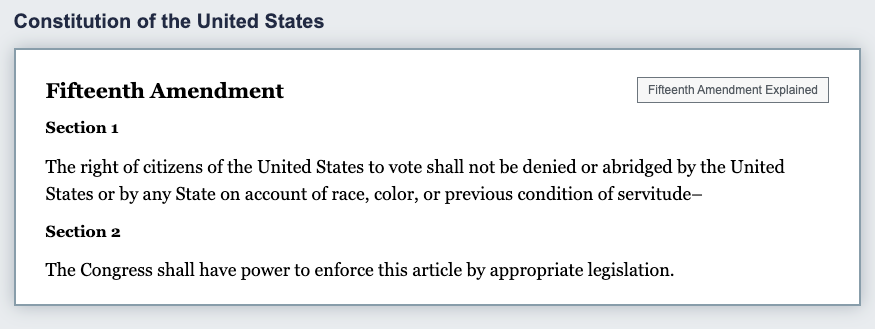
As a Supreme Court advocate and then as Chief Justice, the throughline is unmistakable. The "colorblind Constitution" framing Roberts has advanced over his career turns the Reconstruction Amendments on their head. Those amendments were written, ratified, and passed by a Congress that had just fought a war specifically about race, and whose explicit intent was to give the federal government authority to protect Black Americans from state-sponsored discrimination. The plain text of the Fifteenth Amendment gives Congress "power to enforce this article by appropriate legislation." Full stop. It's not ambiguous. It's not complicated. It says what it says:
But in the Roberts framework, using race to remedy racial harm is itself a racial classification, which triggers strict scrutiny, which the remedy then almost certainly fails. It is, in plain English, a legal structure specifically designed to make undoing racist outcomes illegal. The circularity of this would be amusing if the consequences weren't so fucking catastrophic and depressing.
The Pattern: Shelby, Then Callais
The Roberts court's project on voting rights has moved in deliberate stages. Shelby County v. Holder in 2013 gutted Section 5 of the VRA, which was the preclearance requirement. Under Section 5, states with a history of voting discrimination had to get federal approval before changing their voting laws. Roberts wrote the majority opinion himself, and his argument was essentially: things have gotten better, so the emergency measures put in place because things were terrible are no longer necessary.
The ink on that decision was barely dry before Texas, North Carolina, and Alabama immediately moved to implement voting restrictions they had previously been blocked from enacting. Which rather proved the dissent's point, but never mind that.
Section 2 was supposed to be the backstop. Unlike Section 5, which was prospective, Section 2 allows lawsuits after discriminatory maps or laws are put in place. It was the remaining enforcement mechanism. Callais has now made Section 2 effectively a dead letter by requiring plaintiffs to prove intentional discrimination and to clear a series of evidentiary hurdles that the majority, as Kagan's dissent noted with barely contained fury, conjured entirely out of its own ass.
Justice Kagan called it "the latest chapter in the majority's now-completed demolition of the Voting Rights Act." Not weakening. Demolition. Completed.
The Tell Is in the Speed
Here is where the "colorblind Constitution" argument collapses, not in theory but empirically, right in front of your face.
If the argument is that the legal constraints of the VRA are no longer necessary because racial discrimination in voting has been sufficiently addressed, you would expect the removal of those constraints to produce ... approximately nothing. States that weren't discriminating would keep not discriminating. Progress achieved, mission accomplished, everyone goes home.
Instead, what happened in the 72 hours after Callais came down tells you everything you need to know about the intent that was being suppressed.
Louisiana Governor Jeff Landry declared an emergency and suspended the state's May 16th primary, an election that was actively in progress, with over 100,000 ballots already cast, to allow the legislature to immediately redraw the congressional map to eliminate the majority-Black district the VRA had required. The state told its own voters that their ballots didn't count anymore. Extraordinary.
Alabama filed an emergency petition the very next day to reinstate the racially discriminatory maps that had been struck down in Allen v. Milligan. Tennessee convened a special session. Mississippi's governor called legislators back to redraw state Supreme Court districts. Several states rushing simultaneously into special redistricting sessions within days of a ruling that supposedly just made a minor procedural tweak to evidentiary standards.
You don't move that fast unless you've been waiting with baited breath. Unless the plan was already drawn up, the legislation already drafted, the sessions already contemplated, pending only the legal green light. The speed is not incidental, it is the confession.
The Court Helping Itself Along
The Supreme Court then did something that should have generated a great deal more outrage than it did. It waived its own standard 32-day waiting period before effectuating a ruling, and immediately finalized Callais at Louisiana's request. The Court that has spent years invoking the "Purcell principle" to block election-related court orders made too close to an election didn't mention Purcell once in the Callais opinion, and then actively helped a state disrupt an ongoing election. Not adjacent to one. Not upcoming. One that was happening.
That is not calling balls and strikes. That is picking up the bat and playing for one of the teams. And the bat? It is definitely corked. And the side of the Court that used to at least pretend about institutional neutrality, up to and including Roberts, let it happen.
What Was Actually Accomplished
To understand what just got destroyed, you need to understand what the VRA actually did. The 1965 Act wasn't a gift or a preference. It was a structural correction for a century of systematic exclusion. After the Civil War ended, after the Reconstruction Amendments were ratified, Southern states spent ninety years building an elaborate architecture of suppression: poll taxes, literacy tests, grandfather clauses, white primaries, violence, and terror, all designed to ensure that the formal legal right to vote translated to exactly zero practical political power for Black Americans.
The VRA tore that architecture down, not completely, not without a fight, but substantially. The result was the growth of Black political representation at every level, the pipeline of candidates and officials and institutional networks that constitute actual political participation. The majority-minority districts that states are now racing to eliminate aren't racial preferences. They're the correction for a century of deliberate exclusion.
The Roberts argument that correcting for racial harm is itself racial discrimination is not a legal finding. It's a laundering operation. And Callais is its completion.
What you have is this: a project begun in Reagan-era memos, advanced through Shelby County, finished with Callais, and ratified in the first week of May 2026 when the Court helped Louisiana throw out 100,000 ballots in real time. All of it cloaked in the language of constitutional neutrality. All of it producing outcomes that the pre-VRA South would have found entirely familiar.
The suit was nicer. The language was more refined. The result is the same shit.
On tap next: Why what worked in the 1960s is unlikely to be our path out. It's going to be depressing as fuck folks.