
The Reagan Revolution Is Dead. Long Live the Reagan Revolution.
The political coalition Reagan helped assemble may be falling apart. That doesn't mean the economic order it built is going anywhere.

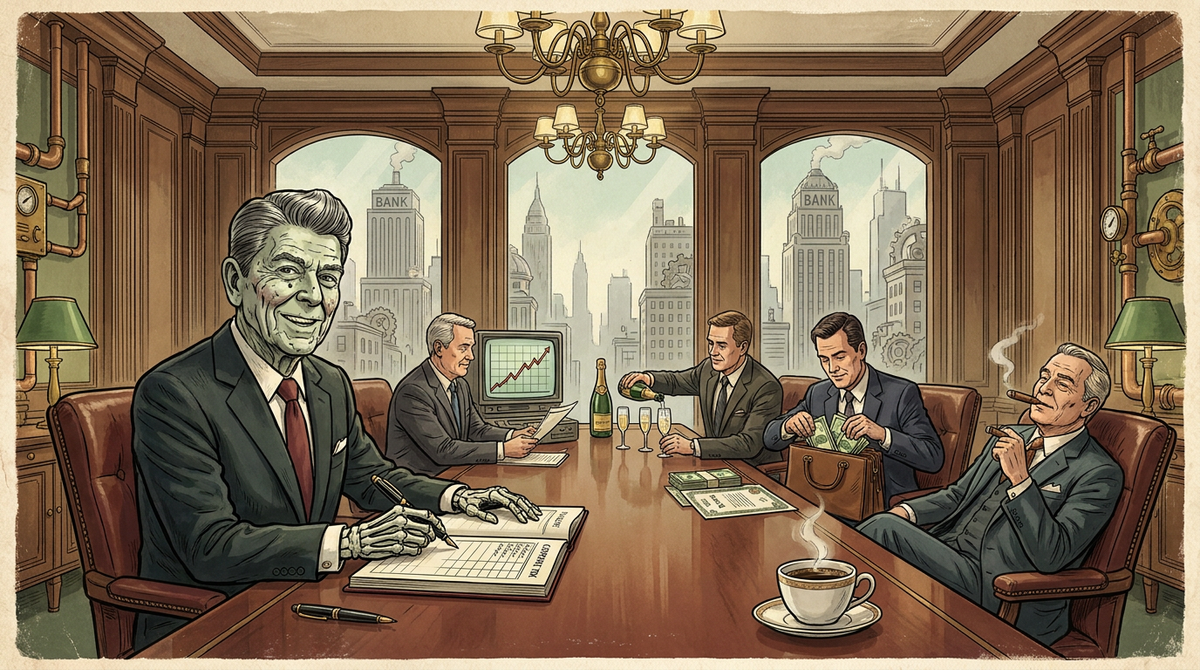
The Democrats delivered one hell of a beating to the Republican Party on November 3. Both chambers of Congress flipped, Republican strongholds elected Democrats, and suddenly we're hearing suggestions that the Reagan era might finally be coming to an end.
Heather Cox Richardson opened her November 4 newsletter by declaring that one era had passed and another was beginning. She went on to describe the election as a rejection of the Republican ideology that has driven American politics since the 1980s.
It's an appealing interpretation.
And maybe she's right.
But I've been thinking about what, exactly, we'd be burying.
Joshua Tait, writing in The Bulwark, offered four possible futures for the Republican Party after Trump. One of them he christened "Zombie Zombie Reaganism," the possibility that Republicans might attempt to resurrect the traditional conservative ideology Trump spent the last decade dismantling.
I rather like the name.
At this point we're approaching one of the later Resident Evil movies, where the franchise has somehow located another decomposing corpse to throw onto the screen long after everyone thought the undead supply had been exhausted.
And honestly, Milla Jovovich appears to be the only person involved who hasn't aged since The Fifth Element.

But I think there's another zombie wandering around here.
Not Reaganism as a collection of political slogans, or the old Republican coalition that delivered him to the White House.
I'm talking about the economic arrangements that coalition helped establish.
Because Reaganism as a political identity and Reaganism as a distribution of economic power are two very different things.
And one can die without taking the other with it.
Reagan wasn't the beginning
I've been working through Reagan's history in The Fulcrum, a series exploring his transformation from actor to conservative political figure and ultimately the patron saint of modern Republicanism.
There's an enormous amount of history there, and I'm not going to repeat it all here. The finished series may run to something approaching twenty posts.
But one point matters enormously to this discussion.
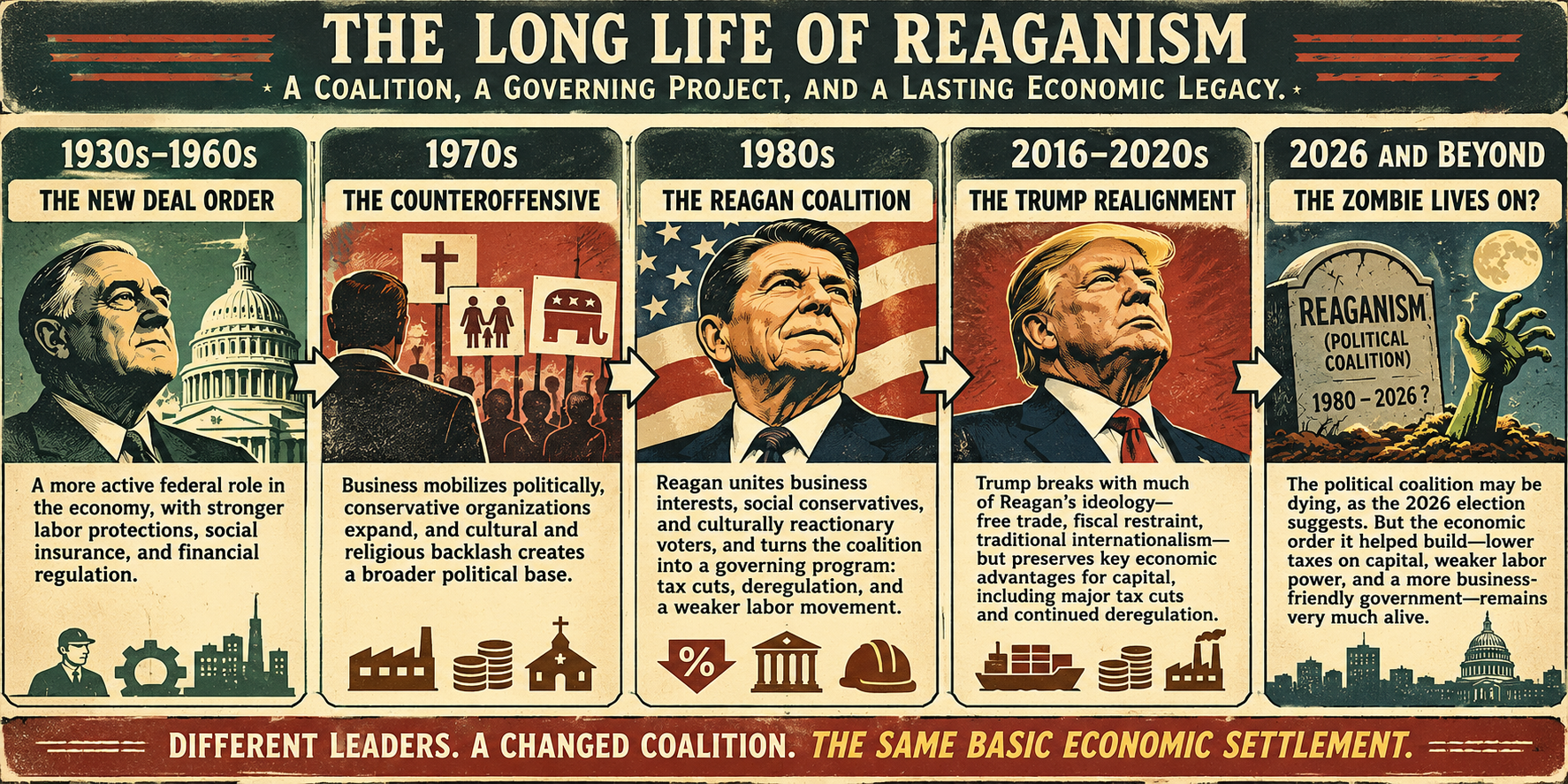
Reagan didn't invent the conservative counteroffensive against the New Deal.
By the 1970s, American business interests were increasingly organized around challenging the economic and regulatory arrangements that had developed during the New Deal and postwar years. The 1971 Powell memorandum, the formation of the Business Roundtable in 1972, and the expansion of conservative think tanks and advocacy organizations were all parts of that growing mobilization.
Meanwhile, the New Right was discovering the political possibilities of joining business conservatism to the backlash against civil rights, feminism, changing sexual norms, and the perceived displacement of religion from public life.
The emerging religious right brought organizational reach and committed voters. Conservative media and sophisticated fundraising operations helped turn those constituencies into a national political force.
By the late 1970s, the pieces were coming together.
The wealthy executive seeking lower taxes and the evangelical voter concerned about school prayer weren't necessarily motivated by the same things.
But they could support the same candidate.
And Reagan became the fellow capable of making the whole arrangement look like a unified political movement.
This wasn't simply a trick played on gullible voters. Religious and cultural conservatives had priorities of their own, and Republican political power offered them opportunities to pursue those priorities.
But the constituencies didn't receive identical benefits.
The cultural conservatives gained political influence, appointments, and the prospect of reshaping social policy.
Organized business gained an administration receptive to lowering taxes, reducing regulatory constraints, and shifting the balance of economic power away from labor.
That was a pretty consequential bargain.
Sweaty's Corner doesn't have a marketing budget or an algorithm pushing it into anyone's feed. It has readers who share it. If this one landed, sending it to someone who'd get something out of it — or subscribing so the next one finds you directly — genuinely moves the needle.
The economic revolution was real
Reagan's 1981 tax legislation reduced the highest marginal individual income-tax rate from 70 percent to 50 percent. The 1986 tax overhaul eventually brought the top statutory rate down to 28 percent, while also broadening the tax base and eliminating numerous preferences.
His firing of striking PATCO air traffic controllers in 1981 sent a powerful signal about the federal government's attitude toward organized labor.
And his administration pursued a deregulatory agenda that changed the way important parts of the federal government approached business.
None of this happened in isolation.
Deregulation had begun under Jimmy Carter. Organized labor was already experiencing structural difficulties. Globalization, industrial restructuring, technological change, and inflation were reshaping the economy independently of Reagan's policies.
And Reagan didn't simply dismantle the New Deal. Social Security, Medicare, and much of the regulatory state survived.
But he helped change the assumptions governing American economic policy.
Government intervention increasingly had to justify itself against the presumption that markets should be given greater freedom. Taxation was increasingly discussed in terms of incentives for investment and economic growth, rather than its role in distributing income and economic power.
Organized labor found itself operating in a considerably less hospitable political environment.
The longer-term change is striking.
According to the Bureau of Labor Statistics, 20.1 percent of American wage and salary workers belonged to unions in 1983, the first year with comparable data.
By 2025, that figure had fallen to 10 percent.
In the private sector, union membership was down to just 5.9 percent.
It would be ridiculous to attribute that entire decline to Reagan. But it would be equally ridiculous to pretend that the changing political and legal environment was irrelevant.
And here's where things get uncomfortable for Democrats.
Bill Clinton's New Democrats didn't simply reject the economic assumptions that had taken hold during the Reagan years. They accommodated significant parts of them.
Financial deregulation, welfare reform, and trade liberalization became important elements of Democratic governance in the 1990s.
Those policies had their own rationales, and Democrats also pursued measures that departed from conservative economic priorities.
But the larger point remains.
The political center of gravity had moved.
And the new arrangements proved durable enough to survive changes in party control.
Trump killed the furniture. The building is still standing.
Now consider what Trump did to Reaganite conservatism.
Free trade? Fuck it, chuck it out the window.
Traditional Republican internationalism? Frequently subordinated to an America First approach to alliances and foreign commitments, and a very chummy relationship with autocrats and strongmen around the globe.
Fiscal restraint? Apparently something Republicans rediscover whenever Democrats occupy the White House.
The old Republican establishment's ability to choose candidates and dictate ideological priorities? Trump demonstrated rather decisively how little authority those people actually possessed over their own voters.
To conservative intellectuals who grew up venerating Reagan, this represented an extraordinary departure.
And in important respects, it was.
Trump's tariffs aren't an extension of traditional Republican free-trade policy. His approach to foreign affairs differs substantially from Reagan's. His willingness to deploy federal power against perceived enemies sits awkwardly alongside the limited-government rhetoric of the old conservative movement.
But look at what happened to the economic inheritance.
In 2017, Republicans permanently reduced the federal corporate income-tax rate from 35 percent to 21 percent.
In 2025, Trump signed legislation that made permanent or extended major provisions of the 2017 tax law, including individual rate reductions and the deduction for qualifying pass-through business income. It also restored or expanded significant business-investment tax preferences.
The Congressional Research Service's analysis makes the continuity between the two tax laws clear.
The Republican tax agenda hadn't exactly become a workers' revolution.
Nor did the party's longstanding skepticism toward organized labor and substantial portions of economic regulation suddenly disappear.
Trump's economic nationalism introduced real conflicts with business interests, particularly companies dependent on international supply chains, foreign markets, and immigrant labor.
And capital isn't one unified constituency. Technology firms, manufacturers, banks, retailers, and energy companies frequently have conflicting priorities.
Still, the wealthy donors, corporate lobbyists, and business organizations that exercised influence in the old Republican coalition didn't evaporate when Trump took control of the party.
They adapted.
Some resisted particular policies. Some embraced Trump enthusiastically. Others negotiated for whatever advantages they could secure.
The hierarchy of the Republican coalition changed.
The economic interests that benefited from the old hierarchy remained very much in the game.
And that brings us to the peculiar durability of Reaganism.
Trump didn't need to preserve Reagan's entire philosophy to preserve substantial parts of its economic inheritance.
He could reject the slogans, attack the establishment, and rearrange the political coalition while retaining policies that favored many of the same economic interests.
The zombie didn't need its original brain.
Apparently it could keep walking without one.
Sweaty's Corner doesn't have a marketing budget or an algorithm pushing it into anyone's feed. It has readers who share it. If this one landed, sending it to someone who'd get something out of it — or subscribing so the next one finds you directly — genuinely moves the needle.
What would actually have to die?
This brings us back to the 2026 election.
Democrats won a sweeping victory. Republican incumbents were defeated across the country, and Trump's standing suffered a substantial political blow.
That's consequential.
But what, precisely, did voters reject?
Trump's conduct? His tariffs? The war in Iran and its economic consequences? Rising prices? The administration's immigration policies? The Republican Party's broader governing philosophy?
Probably some combination, differing considerably among voters.
It would be a mistake to interpret the election as a single, unambiguous referendum on the economic policies of the last forty-five years.
And an even bigger mistake to assume that defeating Republican candidates necessarily reverses the economic arrangements their party helped establish.
If we're going to declare the Reagan era over, I'd like to see some evidence of what replaces it:
- Does organized labor regain meaningful bargaining power?
- Does the tax system change the relative burdens placed on work, wealth, and capital?
- Does government become more willing and effective at constraining concentrated corporate power?
- Do healthcare, housing, retirement security, and other basic elements of economic life become less dependent on the bargaining power of individual workers?
Those would be meaningful indications that the balance of economic power was changing.
I'm not suggesting that every market-oriented policy is bad, or that every one of these changes must occur before we can acknowledge a new political era.
But an economic settlement doesn't end simply because politicians stop using the language associated with it.
And here we encounter another complication.
The Democrats have won control of Congress, but Trump still occupies the White House, with veto power and substantial executive authority.
The Democratic Party also has its own complicated relationship with wealthy donors, organized business, and the economic assumptions that have shaped American politics since the 1980s.
Progressives, labor advocates, business-friendly moderates, and the party's various other constituencies don't necessarily agree about what should replace the existing economic order.
Winning an election doesn't resolve those disagreements.
Nor does it eliminate the influence of the people and organizations that benefited from previous policy decisions.
Corporations don't stop lobbying when Republicans lose. Wealthy individuals don't lose their resources because their preferred candidates were defeated. Organizations built over decades don't simply pack up their offices and go home.
They seek influence with whoever holds power.
And the institutions themselves have considerable inertia.
That's something I explored in The System Doesn't Fix Itself, where the question was whether elected officials are willing to change political arrangements that have benefited them.
The economic version of that problem may be even more stubborn.
Wealth, ownership, bargaining power, and established institutional relationships can persist through multiple changes of government.
The coalition that helped consolidate those advantages might fragment without substantially changing the advantages themselves.
Reaganism as an ideology requires people to keep believing in its political principles. Reaganism as an economic inheritance can endure because the arrangements are already in place.
And undoing those arrangements requires considerably more than electing a different set of politicians.
The corpse is looking surprisingly healthy
Maybe the Republican Party will eventually abandon Reaganism altogether.
Perhaps the Never Trump conservatives hoping for a restoration of traditional constitutional conservatism will discover that there isn't much of an audience left for the old sermons about free trade, fiscal restraint, and America's indispensable role in the world.
Perhaps Joshua Tait's muddling-through scenario will describe a Republican Party that remains competitive without recovering anything resembling a coherent Reaganite philosophy.
And perhaps Democrats will use their electoral victory to begin constructing a different economic settlement.
All of those are possibilities.
But none has been established by what happened on November 3.
Reagan helped assemble a political coalition that brought business conservatives, religious voters, and cultural reactionaries into an effective national alliance.
That coalition changed American politics.
More importantly, it helped change the distribution of economic power.
Trump spent a decade rearranging the Republican Party and tearing up portions of its ideological inheritance.
Now voters have delivered a substantial defeat to the party he remade.
That may mark the beginning of another political era.
But the beneficiaries of the economic changes that began before Reagan, accelerated under his administration, and continued through his successors haven't disappeared.
The political identity may be dying.
The economic inheritance is another matter.
At this point, Reaganism resembles one of those Resident Evil zombies that has been shot, burned, dismembered, and run over by a truck, only to stagger back into the next installment.
Perhaps the Reagan Revolution really is dead.
Somebody should probably tell its beneficiaries.
They seem to be doing just fine.


