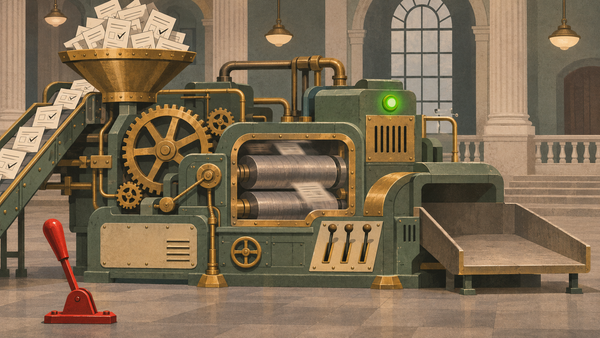
The System Doesn't Fix Itself
Everybody has ideas for repairing American democracy. Getting the people who benefit from its defects to cooperate is another matter.

Well, the voters certainly did their part.
On November 3, Democrats won control of both houses of Congress, delivering a substantial rebuke to Donald Trump and the Republican Party. They flipped seats that Republicans had considered secure, captured governorships, and performed considerably better than many political observers expected.
Naturally, this has generated plenty of speculation about the death of Trumpism, the future of the Republican Party, and whether we're witnessing the end of one political era and the beginning of another.
Maybe.
But I've been thinking about something considerably less exciting than the Republican Party's upcoming family feud.
What happens after the Democrats take power?
In The Reckoning That May Never Come, I examined why American democracy doesn't necessarily impose electoral consequences severe enough to force a political party to reconsider what it has become.
The Electoral College, the Senate, congressional redistricting, and the incentives of safe electoral districts complicate the relationship between public sentiment and political power.
And even when a party suffers substantial electoral defeats, there's no guarantee its members will learn the lesson their critics believe they should.
The obvious response is to fix the system.
Independent redistricting commissions. Ranked-choice voting. Expanding the House. Multimember districts. Campaign-finance reform. Better congressional oversight. Constraints on executive power.
There are plenty of perfectly reasonable proposals for making American democracy more representative and accountable.
Some would require constitutional amendments. Others could be enacted through ordinary legislation or state-level changes.
So why don't we just do those things?
Well, there's a rather inconvenient problem.
The people who would have to approve many of these changes are the same people who have prospered under the existing arrangements.
And they're not always terribly enthusiastic about surrendering their advantages.
The easy fixes that aren't easy
Let's start with gerrymandering.
There's no shortage of recognition that allowing politicians to draw their own electoral districts creates enormous opportunities for abuse.
When a legislature controlled by one party can construct districts that maximize its own representation and minimize that of its opponents, the temptation is obvious.
This isn't a recent innovation. American politicians have been manipulating electoral boundaries since the early republic.
The obvious solution is to remove politicians from the process.
Several states have established independent or citizen-led redistricting commissions intended to reduce partisan manipulation.
No federal constitutional amendment required.
Problem solved, right?
Allow me to introduce you to Ohio.
In 2015 and 2018, Ohio voters overwhelmingly approved redistricting reforms intended to constrain partisan mapmaking.
The subsequent implementation was a mess.
Following the 2020 census, Ohio's redistricting authorities repeatedly produced maps that the state Supreme Court found violated constitutional protections against partisan gerrymandering.
So reformers tried again.
In 2024, the Citizens Not Politicians coalition proposed a constitutional amendment that would replace the existing system with a 15-member citizen commission responsible for drawing congressional and state legislative districts.
The idea was to take the process away from elected politicians.
Then the Republican-controlled Ohio Ballot Board approved language describing the proposal as requiring a commission to engage in gerrymandering.
Yes, really.
Supporters challenged the language, arguing that it fundamentally misrepresented their proposal. The Ohio Supreme Court required two changes but allowed most of the disputed wording to remain.
The amendment failed, with approximately 46 percent voting in favor.
Now, there were legitimate questions about the proposed commission's accountability, its selection process, and how its partisan proportionality requirements would operate.
A reform proposal doesn't become perfect simply because someone calls it reform.
But Ohio provides a useful illustration of the problem.
Voters approved changes intended to constrain partisan manipulation. Those changes failed to produce a stable, broadly accepted process. And when reformers sought to remove politicians from the system altogether, the existing political institutions remained deeply involved in presenting the proposal to voters.
At some point, this begins to resemble a municipal road crew repeatedly digging up the same stretch of pavement.
Alaska provides a different example.
In 2020, voters adopted an election system combining open top-four primaries with ranked-choice general elections.
This was a significant institutional change accomplished without amending the United States Constitution.
Naturally, it generated opposition.
In 2024, opponents tried to repeal the system. The effort failed by just 743 votes after a recount.
And in November 2026, they tried again.
As I write this, the latest returns show the repeal effort trailing, with roughly 52 percent voting to preserve the existing system. The count remains incomplete1.
I don't want to pretend ranked-choice voting is a magical solution to everything wrong with American politics. It isn't. There are legitimate questions about complexity, voter understanding, and whether a particular alternative voting system actually addresses the problems its supporters want to solve.
But Alaska demonstrates that even when voters successfully enact electoral reform, the argument doesn't necessarily end.
Adopting reform is one battle.
Keeping it is another.
And neither guarantees the political outcomes its advocates hope to encourage.
Sweaty's Corner doesn't have a marketing budget or an algorithm pushing it into anyone's feed. It has readers who share it. If this one landed, sending it to someone who'd get something out of it — or subscribing so the next one finds you directly — genuinely moves the needle.
The Marquess of Queensberry meets the chessboard pigeon
This is where things get particularly interesting, because the problem isn't confined to Republicans.
California established its independent Citizens Redistricting Commission through voter-approved reforms in 2008 and 2010.
The intention was straightforward: take congressional and legislative redistricting away from politicians who have every incentive to choose their voters rather than let voters choose their representatives.
For years, California Democrats operated under that arrangement.
Then Texas Republicans pursued mid-decade congressional redistricting in 2025, seeking to improve their party's prospects in the House.
California Democrats faced an unpleasant choice.
Preserve their commitment to independent congressional redistricting and potentially hand Republicans an advantage in the national contest for the House.
Or respond in kind.
Governor Gavin Newsom and the Democratic legislature chose the latter.
They put Proposition 50 before California voters, temporarily replacing the commission's congressional maps with maps drawn by the legislature.
Voters approved it.
The independent commission wasn't abolished. Under the measure's provisions, it will resume congressional mapmaking following the 2030 census.
But for the remaining elections of this decade, California set aside a reform its voters had deliberately adopted.
And here's the uncomfortable part.
I understand why.
There's an old expression about fighting under the Marquess of Queensberry Rules, the conventions that helped establish modern boxing.
Those rules work reasonably well when both fighters agree to observe them.
They're considerably less useful when one fellow arrives carrying a baseball bat.
Or, to borrow another familiar political metaphor, when one player is carefully considering the next move on the chessboard while the other is busy knocking over the pieces and crapping on the board.
There's a widespread perception among Democrats that they've been expected to observe institutional conventions while Trump and his Republican allies treat those same conventions as obstacles to be overcome.
And that perception isn't entirely invented.
Trump's attempts to overturn the 2020 election, culminating in January 6, demonstrated what happens when a political leader refuses to accept the obligations that accompany electoral defeat.
But we need to distinguish violating the law from exploiting opportunities the law permits.
Mid-decade redistricting isn't automatically unconstitutional. Neither is a voter-approved constitutional amendment changing the way a state draws congressional districts.
The question isn't simply whether a maneuver is legal.
It's whether a political system can sustain meaningful institutional restraint when its participants believe their opponents will exploit every available advantage.
And that's the problem California exposes.
Democrats can sincerely believe in independent redistricting while also believing that practicing it unilaterally would be politically disastrous.
Republicans can defend partisan redistricting in Texas while denouncing California's response.
Both parties can insist that they're merely reacting to the behavior of the other.
And the original principle—that politicians shouldn't get to draw districts to maximize their own partisan advantage—becomes negotiable.
California's voters made an understandable strategic decision.
But it's worth acknowledging the cost.
An institution designed to remove partisan self-interest from congressional redistricting was temporarily sidelined because partisan self-interest became sufficiently compelling.
That's quite a dilemma. I struggled, but I did pull the lever for it.
And it doesn't disappear merely because we can identify who started the latest round.
The two-party self-preservation society
Republicans and Democrats disagree about a great many things, often fundamentally.
But both parties operate within the same electoral structure, and both contain officeholders whose careers benefit from the way that structure works.
Safe seats protect incumbents. Party organizations control access to resources. Established fundraising networks reward relationships cultivated over decades. Congressional procedures give leadership considerable authority over what legislation receives attention.
These arrangements aren't all inherently improper.
Political parties need mechanisms for organizing legislative activity, recruiting candidates, and building coalitions.
But those same mechanisms create incentives for institutional self-preservation.
A reform that looks wonderful when it constrains your opponents may become considerably less attractive when it threatens your own political position.
And this isn't necessarily a story about politicians lying about their principles.
Sometimes it's more complicated.
A politician can sincerely support independent redistricting while believing unilateral adoption would produce an unacceptable electoral disadvantage.
A legislator might support stronger congressional oversight until those powers are exercised against an administration from their own party.
A party might favor restrictions on executive authority when the opposition occupies the White House, then discover the considerable convenience of executive discretion when its own president takes office.
Political circumstances change the perceived costs of principle.
And that produces a collective-action problem.
If both parties believe restraint is something the other side should demonstrate first, neither has much incentive to move.
The result is an endless game of institutional chicken, with everyone explaining why their latest departure from principle is merely a necessary response to the other side.
Meanwhile, the underlying rules remain unchanged.
The voters have just demonstrated that they can impose substantial political consequences.
The harder question is whether the politicians who benefit from those consequences are willing to change the rules governing the next contest.
Accountability isn't a television program
This brings us back to the new Democratic congressional majority.
Democratic leaders are already talking about affordability, healthcare, lowering costs, and conducting extensive investigations into the Trump administration.
All reasonable priorities.
But I've watched enough Democratic administrations to remain skeptical that promises of accountability will necessarily produce meaningful institutional change.
And there's some history behind that skepticism.
Consider the response to the 2008 financial crisis.
The subprime mortgage catastrophe and resulting financial collapse exposed an extraordinary collection of institutional failures, reckless financial practices, and regulatory deficiencies.
The Obama administration did enact substantial reform.
The Dodd-Frank Act strengthened financial supervision, imposed new requirements on major financial institutions, and established the Consumer Financial Protection Bureau.
Whatever its shortcomings, that was a consequential legislative response.
Personal accountability was another matter.
Major financial institutions paid enormous settlements. Yet senior executives at the institutions central to the crisis largely escaped criminal prosecution for crisis-related conduct.
There were legitimate evidentiary difficulties in proving individual criminal responsibility. Not every disastrous business decision constitutes a crime.
But there's an enormous difference between imposing a financial settlement on an institution and imposing personal consequences on the people who directed its activities.
One can become another cost of doing business.
The other is considerably harder to distribute among shareholders.
Then there's the Biden administration.
Following January 6, the Justice Department prosecuted large numbers of people who participated in the attack on the Capitol.
Those prosecutions were real, and dismissing them as mere theater would be wrong.
But the federal criminal proceedings against Trump himself never reached trial.
Merrick Garland appointed Jack Smith in November 2022. Federal indictments followed in 2023.
Then came prolonged litigation, the Supreme Court's presidential-immunity ruling, and Trump's victory in November 2024.
The federal cases were dismissed under the Justice Department's longstanding position that a sitting president cannot be prosecuted.
There are reasonable disagreements over Garland's decisions, the pace of the investigation, the courts' role, and whether a different strategy would have changed the outcome.
We cannot simply assume that greater prosecutorial aggressiveness would have produced convictions.
But the result is undeniable.
The federal criminal process never reached a verdict on Trump's alleged offenses.
And after returning to the White House, Trump issued sweeping clemency to January 6 defendants.
These are different episodes, involving different legal and institutional circumstances.
But both illustrate the distance between identifying a problem, pursuing accountability, and actually delivering durable consequences.
Which is why I'm not prepared to assume that the new Democratic congressional majority has somehow learned all the necessary lessons.
The early rhetoric is already making me twitchy.
I vented about it over at The Shitpost Dude, where I have considerably less interest in keeping my blood pressure under control.
The Democratic leadership is already emphasizing the need to govern responsibly, address affordability, and avoid turning oversight into political revenge.
None of those objectives is inherently objectionable.
People have every reason to expect their government to address the cost of living. Healthcare, housing, groceries, and energy costs aren't distractions from democracy. They're important reasons people participate in it.
And accountability should never mean inventing crimes or using government power to punish political opponents for lawful conduct.
But there's a difference between refusing to pursue revenge and refusing to pursue consequences.
That distinction shouldn't be particularly difficult.
The Democratic coalition is a notoriously complicated collection of constituencies, priorities, and personalities. Holding it together requires negotiation, compromise, and constant attention to competing interests.
That's politics.
But institutional reform frequently requires taking risks that aren't immediately popular with every part of a governing coalition.
It can mean limiting powers your next president would appreciate having.
Constraining agencies your supporters want to use.
Or accepting an electoral disadvantage in exchange for a fairer set of rules.
Those choices can be considerably harder than promising an investigation.
And here's where I worry about the congressional oversight agenda.
Congress can subpoena witnesses, collect documents, question officials, hold hearings, and publish reports.
Those activities can uncover important information. They can establish an evidentiary record and inform legislation. Congressional oversight is not an optional decoration of our system of government.
But a congressional hearing isn't a criminal trial.
A referral doesn't compel a prosecutor to file charges. A subpoena doesn't automatically produce documents. And legislation addressing abuses can be blocked by a presidential veto or other institutional barriers.
The Democrats will have both chambers of Congress, but Donald Trump will still occupy the White House.
That matters.
There are real limits to what a congressional majority can accomplish without control of the executive branch.
But those limits don't excuse Congress from using the powers it actually possesses.
The danger is that investigations become a substitute for accountability instead of a mechanism for achieving it.
Endless hearings. Outraged speeches. Carefully edited confrontations for social media. Another devastating report that tells everyone watching what they already believe.
Democracy porn.
Very satisfying for the audience.
Not necessarily productive.
Worse, investigations that promise consequences they cannot deliver create opportunities for their targets to portray the entire exercise as political harassment.
That doesn't make the evidence disappear. It doesn't make substantiated allegations false.
But it can reinforce the conviction among committed supporters that the proceedings are nothing more than another partisan attack.
None of this means Democrats should avoid investigations.
Quite the opposite.
It means the investigations need objectives beyond producing the next viral video.
And the first six months of the new Congress should tell us quite a bit about the seriousness of those objectives.
- Are investigators pursuing specific evidence and using the enforcement mechanisms available to them?
- Are congressional leaders introducing legislation addressing institutional weaknesses exposed by their investigations?
- Are those proposals being advanced through the legislative process, even when presidential vetoes make enactment difficult?
- And, perhaps most important, are Democrats willing to support reforms that would constrain future Democratic administrations as well as Republican ones?
Six months won't be enough to complete every investigation or enact every reform.
But it will be enough to see where leadership is investing its political capital.
Because there's a world of difference between being angry about abuses of political power and being willing to limit that power when your own party might someday exercise it.
Don't let us down.
The Constitution isn't especially accommodating
Even assuming we have politicians willing to pursue meaningful reform, some proposals encounter barriers considerably more formidable than party politics.
And we should distinguish the things that actually require constitutional amendments from those that don't.
Expanding the House of Representatives doesn't require rewriting the Constitution.
Neither does changing the federal law requiring single-member congressional districts, opening the possibility of alternative systems for electing House members.
Independent congressional redistricting commissions can be established through state law, and Congress has substantial constitutional authority over the manner of congressional elections.
Those are genuine possibilities, even though each presents political and legal challenges.
But changing some of the Constitution's fundamental arrangements is another matter.
Abolishing the Electoral College in favor of direct national presidential elections would require a constitutional amendment.
And Article V establishes a formidable threshold: two-thirds of Congress to propose an amendment through the congressional route, followed by ratification in three-fourths of the states.
Thirty-eight states.
That's a substantial hurdle even when a proposal doesn't threaten the political advantages of the states whose cooperation is required.
Then there's the Senate.
Wyoming and California each receive two senators, despite their vastly different populations.
Article V goes further than establishing a difficult amendment process. It explicitly protects each state's equal representation in the Senate unless that state consents to losing it.
Good luck with that.
There were reasons for the constitutional design, including concerns about stability, federalism, and protecting smaller states against domination by larger ones.
But those protections also make it extraordinarily difficult to alter arrangements that have substantial consequences for democratic representation.
And remember, the supposedly easier reforms still need to survive ordinary politics.
Which, as Ohio and California demonstrate, isn't exactly a trivial obstacle.
Sweaty's Corner doesn't have a marketing budget or an algorithm pushing it into anyone's feed. It has readers who share it. If this one landed, sending it to someone who'd get something out of it — or subscribing so the next one finds you directly — genuinely moves the needle.
And then there's the Supreme Court
I have a difficult time looking at the present Supreme Court and assuming that ambitious electoral reforms will receive an especially sympathetic reception.
But the Court's actual record deserves a little care.
In Rucho v. Common Cause, the Court ruled in 2019 that partisan-gerrymandering claims under the federal Constitution present political questions beyond the reach of federal courts.
Chief Justice Roberts wrote the majority opinion, pointing toward state law, state institutions, and Congress as possible avenues for reform.
Which is rather convenient, given the political difficulties associated with all three.
Four years later, however, the Court reached a different result in Moore v. Harper.
In a 6–3 decision, it rejected the broad independent-state-legislature theory that would have substantially insulated state legislative decisions about federal elections from ordinary state constitutional review.
Roberts, Kavanaugh, and Barrett joined the majority.
So it would be inaccurate to describe the six Republican-appointed justices as an automatic voting bloc against every electoral reform.
Nevertheless, the Court possesses enormous authority to determine which reforms survive constitutional challenges and which institutional actions remain subject to judicial review.
And the cases reveal another difficulty.
Federal courts can decline to adjudicate certain disputes while directing citizens toward political remedies.
But the courts can't supply the congressional votes, legislative majorities, or political cooperation required to enact those remedies.
The judicial system can establish boundaries.
It cannot manufacture the political will to change what happens inside them.
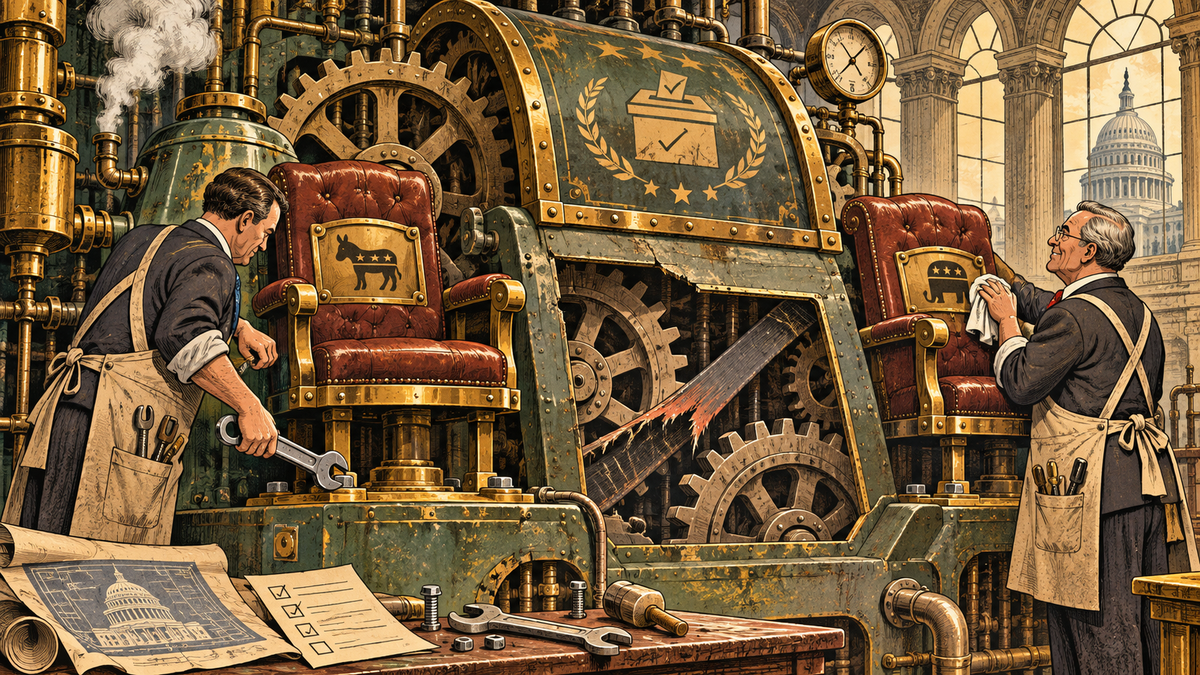
The people in the machine
There's one final problem with the expectation that our political system will eventually fix itself.
The people we elect to operate it are, almost by definition, people who have invested considerable effort in acquiring political power.
They've built careers around winning elections, advancing their agendas, persuading voters, and negotiating with other ambitious people.
Some are genuinely principled. Some entered politics because they wanted to solve problems. Some are perfectly capable of admitting mistakes and changing their minds.
I'm not suggesting that every politician is a narcissist or that public service is merely a cover for personal ambition.
But the skills required to acquire political power aren't necessarily the skills required to surrender it gracefully.
And political institutions don't consistently reward self-reflection.
A politician who acknowledges a serious mistake may face a primary challenger promising never to make the same concession.
A legislator who supports a reform threatening an incumbent advantage may discover that colleagues have become considerably less enthusiastic about helping with the next election.
A party that voluntarily constrains its own authority may discover that its opponents have no intention of reciprocating.
Trump didn't invent zero-sum politics.
But he has made that understanding of political competition unusually explicit, demonstrating how successfully it can be incorporated into a political identity.
Victory becomes more than achieving a policy objective. It becomes the humiliation of an opponent.
Compromise becomes evidence of weakness.
Restraint becomes something the other side exploits.
And if that's the political environment in which reform must occur, the incentives are obvious.
Why surrender an advantage when your opponent won't?
Why accept limits on power when your successor may disregard the same principle?
Why risk losing an election in the name of fairer rules when you believe the other party will use the resulting victory to dismantle the institutions you're trying to protect?
These aren't entirely unreasonable questions.
That's what makes the problem so difficult.
California's redistricting decision demonstrates that politicians and voters can face a genuine conflict between institutional principle and immediate political necessity.
But if every commitment to reform contains an unstated exception—unless following it means we might lose—then we shouldn't be surprised when reform proves remarkably fragile.
The system cannot depend indefinitely on unilateral acts of political restraint.
It needs enforceable rules, institutions capable of applying those rules, and participants willing to accept the consequences even when those consequences are inconvenient.
And establishing those arrangements requires political leaders willing to change rules that may have helped put them in power.
There's the rub.
The 2026 election demonstrated that voters can impose substantial consequences on a governing political party.
That's important.
But electing new people isn't the same thing as changing the institutional arrangements under which they govern.
And these problems don't end with elections. Political institutions can preserve advantages long after the circumstances that created them have changed. Economic arrangements can do the same.
A political coalition can lose power without the interests that benefited from its policies losing theirs.
Winning an election may be necessary to change those arrangements.
It is rarely sufficient.
We have plenty of ideas for making American democracy more representative and accountable.
Some are straightforward. Others are complicated. Some have worked in particular states, while others have encountered determined resistance.
But none escapes politics.
The Democrats have just won a substantial opportunity to demonstrate whether their commitment to accountability extends to changing the institutions that govern both parties.
They don't have unlimited authority, and they won't accomplish everything they promise.
But they'll have to decide what matters enough to pursue seriously, even when the rewards aren't immediate.
The people operating the system have careers to protect, constituencies to satisfy, and another election to win.
Perhaps significant reforms will come.
There's no reason to assume they're impossible.
But there's also no reason to assume they'll arrive simply because enough people recognize that something is wrong.
Democracy doesn't repair itself.
It requires people with power to change the arrangements that gave them that power in the first place.
And that's going to take more than a feeling.
Musical interlude:
1 - I drafted this on Thursday, November 5th, 2026. Alaska was about 74% of votes tallied.