The Wave, the Wall, and the 40 Percent
The pundit class' insistence that 2026 will be a wave year, and that Trump's flagging approval is a lock is not that comforting.

Since last fall, a certain strand of political commentary has been selling the same product: Donald Trump is losing his grip on the base that delivered his 2024 victory, his approval numbers are in genuine freefall, economic anxiety is turning swing voters against him, and November 2026 is shaping up to be a Democratic wipeout. Some forecasters have been willing to put numbers on it, citing an 85% probability of a Democratic House takeover.
That's a confident number. It's also probably wrong, and three things happened in the last two weeks that make it harder to defend.
Trump's hold on his base is not slipping in any way that matters for November. His approval floor is more durable than the cherry-picked polls the pundits love to cite. And the structural map for November has been literally redrawn, in ways that could swamp a genuine wave before it reaches shore. Let's take them in order.
Indiana Said the Quiet Part Out Loud
On May 5th, Indiana held its state Senate primaries. This would ordinarily be local news, notable mainly to statehouse reporters and the families of the candidates. Trump made it a referendum.
The backstory: Indiana's Republican-controlled legislature defied Trump's push for mid-cycle redistricting, designed to eliminate the state's two remaining Democratic congressional seats. The legislature killed the bill 31-19, siding with Senate Democrats in a rare display of institutional backbone. Trump responded by endorsing primary challengers against the legislators who blocked it, called them RINOs on Truth Social, and deployed the full machinery of his political operation against incumbent state senators in a part-time legislature.
Six of the seven challengers he backed won. All of them won with at least 56% of the vote. These were not squeakers.
The Never Trump pundit class will tell you this proves nothing about general election dynamics, because primary electorates are not general electorates. They're not wrong about that in isolation. But they're missing what actually matters. This was a test of whether Trump's endorsement still functions as a political death sentence for Republican officeholders who cross him. The answer was unambiguous. And every Republican legislator in every state with redistricting still on the table just watched six of their colleagues get destroyed, and drew the appropriate lesson about the cost of defiance.
As U.S. Senator Jim Banks, who helped coordinate the operation, put it: "President Trump is the single most popular Republican among Hoosier voters." That's not spin. That's an accurate description of Republican primary political reality. And that reality is the one that governs whether incumbents cooperate with Trump's agenda between now and November.
The 40 Percent Floor
Here is how a lot of political media uses polling, and why it should bother you more than it does.
A single poll showing Trump at 34% approval drops. It gets cited everywhere. It anchors a news cycle. It becomes the number in the tweet. The problem is that it almost certainly comes from a survey of U.S. adults, which includes tens of millions of people who will not vote in a midterm election. When you look at the aggregators that weight polls by methodology, pollster track record, and sampling universe, the picture looks meaningfully different.
The RealClearPolitics average for late April through early May has Trump at 40.5% approval. Nate Silver's Silver Bulletin, which does the most rigorous public weighting, has Trump's net approval at a second-term low of -18.9 — genuinely bad, but not a collapse through 40%. The gap between a single adult-sample poll at 34% and an aggregated likely-voter-weighted average at 40.5% is not noise. It is a systematic consequence of who gets counted and how.
Trump's coalition skews heavily toward people who actually vote, particularly in off-year elections. Measure the whole adult population and you get a lower number. Screen for likely voters in November and you get a higher one. The pundit citing 34% isn't lying. They're just choosing a number that serves the narrative they're already committed to.
The honest working number is around 40%. And the history here is worth taking seriously, because that floor has survived things that should have destroyed it. A pandemic response that killed hundreds of thousands of Americans while he was in office. Two impeachments. A criminal conviction. January 6th. After all of it, in 2020, he lost the popular vote by 4.5 points and came within roughly 43,000 votes across three states of winning the Electoral College. In 2024 he won the popular vote outright, the first Republican to do so in twenty years. That floor didn't crack. It calcified.
Some of that 40% is openly MAGA, happy to tell any pollster exactly how they feel. But some of it is parked in the Independent column because the social cost of claiming Trump support in their community is real. Their stated approval doesn't always match their ballot behavior. That gap has shown up in every cycle, consistently directional, since 2016. Assuming it has closed now, with no structural evidence that it has, is hope dressed up as analysis.
The Iran war is the variable that deserves honest acknowledgment. Nine weeks in, it is enough to affect approval numbers but not enough to have a resolution trajectory. Wars historically burn soft supporters before they touch the floor. If it produces a visible failure, a prolonged stalemate, or a casualty event that breaks through the noise, the soft ceiling could drop further. The floor is a harder thing to move, but the Iran war is the one development that could test that assumption in ways the other headwinds haven't.
The Map Is Already Being Built
Here is where the structural argument overtakes the atmospheric one, and where the blue tsunami narrative has the most catching up to do.
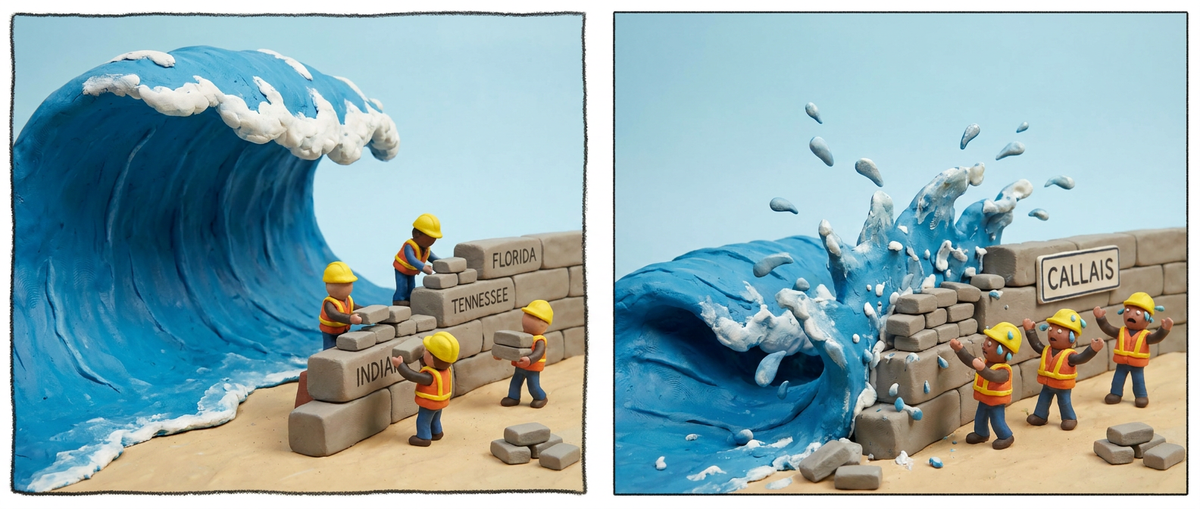
On April 29th, the Supreme Court handed down Louisiana v. Callais, a 6-3 decision written by Justice Alito that gutted Section 2 of the Voting Rights Act. Justice Kagan's dissent put it plainly: Section 2 is now "all but a dead letter." In practical terms, the decision removed the primary legal constraint that had been preventing Republican state legislatures from drawing maps that eliminated majority-minority districts. What happened next was immediate and coordinated.
Florida had already moved, signing a new congressional map the same day Callais dropped, projected to shift the state's House delegation from 20-8 Republican to 24-4. Tennessee convened a special legislative session on May 5th and eliminated the state's only Democratic congressional seat. Alabama filed emergency motions to overturn a court-imposed map. South Carolina began moving against the district held by 17-term congressman James Clyburn. Louisiana suspended its own primary, with early ballots already cast, to redraw its map in real time.
The numbers from Democracy Docket: combined, the Republican redraws could net the GOP 16 to 18 House districts. Democrats responded in California and elsewhere, picking up roughly six. Net Republican structural advantage: 10 to 12 seats. Before a single November vote is cast.
Let that number sit and marinate. Democrats need a net gain of roughly five seats to take the House. Republicans may have already banked a structural cushion of twice that, in the map itself. A wave can be real — genuine voter anger, genuine disapproval translating into genuine turnout — and still fall short because the terrain it has to cross has been regraded. That is the bet Republicans are making. It is not a stupid bet.
There is a litigation caveat worth acknowledging. Multiple lawsuits have been filed against Florida's map, against the emergency sessions used to pass these maps, against Louisiana's suspension of its primary with 104,000 ballots already cast. Some of this will end up back at the Supreme Court on emergency dockets. Given that the same court that handed down Callais will be ruling on most of those appeals, the odds of a significant rollback before November are not high. I am not holding my breath.
What This Actually Means
The conditions that normally produce a wave election are present. A president with a 40% approval rating, a grinding war, economic anxiety, a restless electorate. Those are real. The structural interventions that would blunt or absorb that wave are also real, and they are further along than most of the optimistic pundit commentary acknowledges.
The honest framing is a toss-up that leans Republican on structure. Not a Democratic sweep. Not a guaranteed hold. A toss-up where the Republicans have quietly been doing the work to make sure the map doesn't cooperate with the sentiment.
The pundit class has been confidently wrong about Trump every time it has predicted his demise. They were wrong in 2016. They underestimated him badly in 2020. They missed 2024 entirely. At some point the track record should produce at least a little institutional humility about the current round of confident predictions.
The wave may be real. The wall to hold it back is already under construction. And 40 percent of America, give or take, ain't going anywhere.