The Wrong Side of the Street: Poverty Row Noir and the Beauty of Having Nothing to Lose
Noir is a deep genre, and while it is by definition gritty, there is a sub-class that truly embodies the grittiness, and the ethos. Poverty Row is an apt description.

There's a paradox at the heart of film noir that film scholars have been circling for seventy years without quite landing on it: the best noir pictures were often not the expensive ones.
Double Indemnity is great. Laura is great. The Big Sleep is great. But they're great in the way that well-resourced craftsmanship is great — you can feel the budget working for them, the production design, the A-list cinematographers, the stars whose faces the audience already trusted. What they don't have, quite, is the specific quality of desperation that makes the cheapest noir pictures feel so alive. The quality that comes from making a film about doom and entrapment when you are yourself doomed and entrapped by a six-day shooting schedule and a budget that wouldn't cover catering on a major studio production.
The Poverty Row noir pictures — made at PRC, Monogram, Republic, and a collection of outfits so small they barely qualified as studios — have that quality in abundance. They have it because they had no choice.
What Poverty Row was
Poverty Row was not a single studio. It was a district — a stretch of Gower Street in Hollywood where the cheapest production companies clustered, sharing resources, poaching each other's crew members, occasionally sharing sets. The name started as an insult and became a descriptor that the inhabitants wore with something approaching pride.
The major studios — the Big Five, as they were: Paramount, MGM, Warner Bros., RKO, Fox — operated on a different planet. They had contract players, standing sets, costume departments, orchestras for their scoring sessions. They had time. Poverty Row had none of these things. What it had was the ability to move fast, take risks the majors couldn't afford to take, and fill the bottom half of double bills with pictures that asked very little of their audience except ninety minutes of attention.
The bottom of a double bill sounds like a marginal position. It was, commercially. Culturally, it turned out to be one of the most generative positions in American cinema history, because the pictures that filled it had no reputation to protect and no Production Code enforcement unit looking over their shoulder with the same vigilance reserved for major releases. They could go places the A-pictures couldn't.
The economics that created the aesthetic
Poverty Row noir didn't choose its visual style. The visual style was imposed by necessity and then, retroactively, turned out to be exactly right for the material.
You shoot at night because locations are free after dark and because you can't afford the lighting equipment to make daytime interiors look convincing. Night shooting produces shadow, which produces menace. You use a single room for multiple scenes because you can only afford one location, which produces claustrophobia. You shoot in close-up because a tight frame hides the empty space behind your actors that a wider shot would reveal to be a barely dressed set. Close-ups produce intimacy and intensity.
The result, across dozens of pictures made in the mid-to-late 1940s and into the 1950s, is a body of work that looks like it was made by expressionist artists making deliberate choices about darkness and compression. Some of it was. Most of it was producers counting dollars and directors improvising solutions, and the improvised solutions happened to produce expressionist aesthetics because expressionism and desperation have a lot in common formally.
John Alton understood this better than anyone. Alton was a cinematographer who worked extensively in the B-picture market and who shot light as if he were a painter working in negative space — not as illumination but as the strategic absence of illumination. His 1949 book Painting with Light is still the clearest technical account of what noir cinematography was actually doing and why. When he got the chance to work on bigger productions — he shot An American in Paris for Vincente Minnelli and won the Oscar for it — he was capable of gorgeous color work. But his soul was in the darkness. The B-pictures were where his soul lived.
Edgar Ulmer and Detour
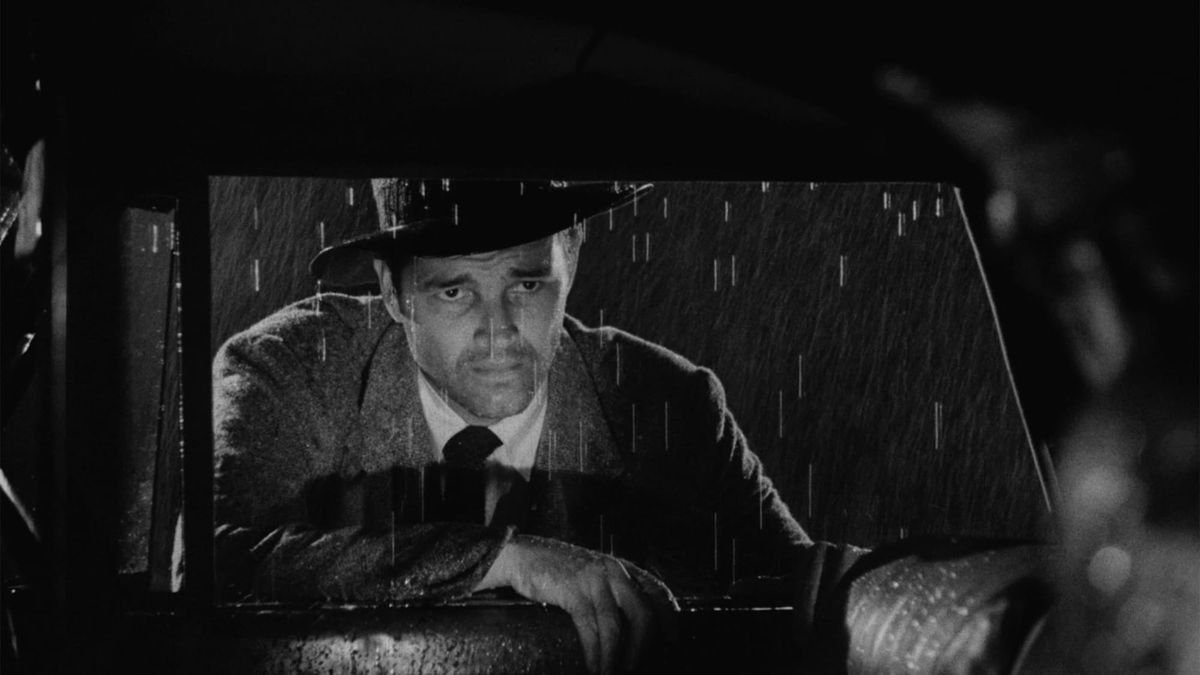
If you want to understand what Poverty Row noir was capable of at its absolute ceiling, the film is Detour (1945), directed by Edgar G. Ulmer for PRC on a budget that has been estimated at various points between $20,000 and $30,000, shot in six days, and running 68 minutes.
Detour is one of the great American films. I'm not hedging that with "for its budget" or "considering what they had to work with." It is a great American film, period, and the constraints that produced it are inseparable from its greatness.
The story is simple almost to the point of abstraction: a hitchhiker, Al Roberts (Tom Neal), is trying to get from New York to Los Angeles to reunite with his girlfriend. He catches a ride with a man who dies unexpectedly, and Al, fearing he'll be accused of murder, assumes the dead man's identity. He then picks up a hitchhiker of his own, a woman named Vera (Ann Savage), who quickly figures out what happened and proceeds to blackmail him. Things deteriorate from there.
Ulmer shot the film almost entirely in interiors — a few car inserts, some stock footage for the road sequences, and otherwise a succession of cheap hotel rooms and diners and roadside stops. The confinement is total. It mirrors Al's psychological state perfectly, because Detour is fundamentally a film about a man who has no good options and knows it. Every room he enters becomes a trap. Every decision forecloses other decisions. The film's logic is deterministic in a way that the more expensive noirs, with their plot machinery and resolution requirements, couldn't quite commit to.
Ann Savage's performance as Vera deserves specific attention because it is one of the most committed pieces of acting in 1940s Hollywood, regardless of budget tier. Vera is not a femme fatale in the conventional sense — she's not seductive, not glamorous, not playing on anyone's desires. She is hostile, suspicious, relentless, and absolutely certain of her own leverage. Savage plays her without a single softening instinct. The character is genuinely frightening because she has nothing to lose and knows it, which makes her the mirror of Al's own position.
The ending — I won't describe it for the uninitiated, but it involves fate delivering consequences through a mechanism of pure accident — has the feeling of a Greek tragedy compacted into a B-picture. Ulmer understood something that the major studios' script departments tried to edit out of their films: that doom is most convincing when it arrives not through anyone's malice but through the accumulated weight of bad choices and worse luck.
Monogram and the working-class noir
PRC had Ulmer. Monogram had a different specialty: the procedural, the working-class crime picture, the noir set not among wealthy socialites and private detectives but among people who needed the money.
Monogram's Charlie Chan and Bowery Boys series are better known but less interesting than the crime pictures the studio churned out in the same period. Films like Dillinger (1945), The Enforcer (without Bogart — the other one), and a parade of gangster pictures and police procedurals that took seriously the proposition that crime was not primarily a glamorous enterprise but an economic one.
This is the aspect of Poverty Row noir that gets undervalued: its class consciousness. The A-picture noir, even when it featured working-class protagonists, tended to frame them through a lens of individual moral failure — the bad choice, the weak moment, the fatal attraction. The B-picture noir was more likely to frame its criminals and victims as people operating inside a system that had already made certain outcomes probable. The fix was often in before the picture started. The point wasn't whether the protagonist would get away with it. The point was watching how the trap closed.
Republic Pictures occupied the slightly higher end of this tier and occasionally produced pictures that crossed into genuine ambition. Strangers in the Night (1944), The Locket (1946, actually RKO but spiritually Poverty Row), Anthony Mann's early crime pictures — Desperate (1947), Railroaded! (1947), Raw Deal (1948) — all made for small studios with small budgets and all carrying more psychological weight than most of their A-picture contemporaries.
Anthony Mann is the figure here who most clearly parallels Corman in the exploitation-cinema ecosystem: a director of genuine talent who learned his craft in the B-picture market, who used the constraints productively rather than fighting them, and who eventually crossed over into prestige production (his 1950s westerns with James Stewart are among the best pictures of that decade) without ever losing the edge the low-budget years had put on his work.
What they couldn't do, and why it didn't matter
The Poverty Row noirs couldn't afford the things that gave the A-pictures their surface sheen. They couldn't afford Humphrey Bogart or Barbara Stanwyck. They couldn't afford Bernard Herrmann composing the score. They couldn't afford the retakes that sand down the rough edges and produce the seamless professionalism that the major studios treated as their brand.
What they could afford was the essential subject matter of noir, which costs nothing: the wrong choice, the closed exit, the character who can see exactly what's coming and cannot stop it. Fate is cheap. Doom is cheap. The specific quality of exhaustion that settles over a person who has been making bad decisions long enough to understand they're bad — that's free. You just have to find actors willing to carry it, and in the Poverty Row ecosystem, those actors were everywhere, because they were living versions of it themselves.
Tom Neal, who played Al Roberts in Detour with such convincing defeated fatalism, was convicted of involuntary manslaughter in 1965 for the shooting death of his third wife. He served six years. He died a year after his release. The line between the performer and the performance, in the Poverty Row noir, was sometimes thinner than anyone involved would have preferred.
That's the thing about making movies with nothing. The nothing shows through. And sometimes what shows through is more honest than anything a studio system, with all its resources and all its incentives toward reassurance, could produce on purpose.
Next: The drive-in roughies — biker pictures, women-in-prison films, and the surprising moral complexity hiding inside the most disreputable corner of the exploitation ecosystem.
 Share on Bluesky
 Share on Threads
 Share on Facebook
 Share on Mastodon
 Share on Reddit
 Share on Email