Blood Simple: Herschell Gordon Lewis and the Cinema of Pure Visceral Fact
A branch of the glorious garbage that I am not so much a fan of, but you can't deny that it is influential. The Gore Merchants really pushed the boundaries of propriety

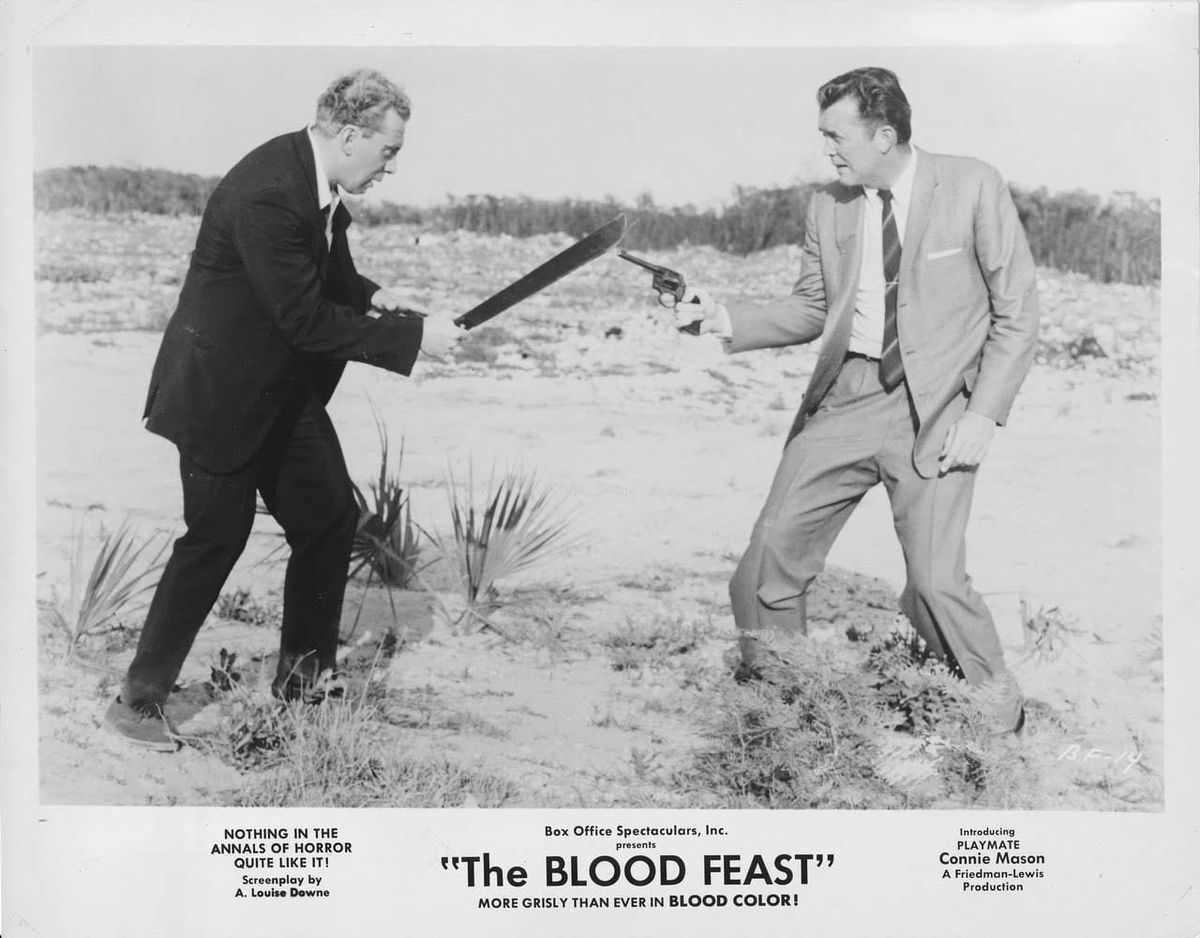
There is a moment in Blood Feast (1963) where an Egyptian caterer named Fuad Ramses tears the tongue out of a woman's mouth.
The tongue is a sheep's tongue, purchased from a butcher. The actress is holding it in her own mouth, cheeks puffed, waiting for her cue. Herschell Gordon Lewis, directing, was aware that the effect was unconvincing. He was also aware that it didn't matter, because nothing in the history of American cinema had prepared an audience for the sight of a tongue being torn from a human mouth on screen, and the shock of the category — they are showing us this — would overwhelm any concern about technical execution.
He was right. Blood Feast grossed somewhere between $4 million and $7 million against a production cost of $24,500. The gore film was born, Lewis became its patron saint, and American cinema acquired a new frontier it has been expanding ever since, for better and worse and occasionally for both simultaneously.
Before Lewis, and why before Lewis matters
To understand what Lewis did, you have to understand what he was working against.
Hollywood had operated under the Production Code since 1934, and the Code's treatment of violence was specific: it could be implied, it could be consequential, it could be present in the frame as long as it was not dwelt upon. What it could not be was graphic. The wound could not be shown. The blood could not flow. Death was permitted as a narrative event but not as a physical fact.
This was not purely censorship in the political sense — it was also an aesthetic assumption so deeply embedded in mainstream filmmaking that it had become invisible. Violence in classical Hollywood cinema happens at a remove. The gun fires, the man falls, we cut. The body is present but the process of dying is elided. The audience knows what happened; it has not been shown what happened.
Lewis was not interested in this distinction. He was interested in showing what happened, specifically and literally, with as much physical detail as the makeup budget permitted. His insight — which sounds simple and was genuinely radical — was that the human body under extreme duress is itself a spectacle, and that there was an audience willing to pay to see that spectacle if someone would provide it.
The question of whether this constitutes art is one Lewis found faintly boring. He was making product for a market. The product was shock. The market existed. Everything else was philosophy.
Herschell Gordon Lewis: the man and the method
Lewis arrived at filmmaking sideways. He had a master's degree in English literature from the University of Mississippi, had taught college English, and had worked in advertising and marketing before drifting into the exploitation film business in the late 1950s as a producer of nudie cuties in Chicago.
The advertising background is not incidental. Lewis thought about his films the way a marketer thinks about a campaign: what does the audience want, what is nobody else providing, how do you deliver the thing that is being promised. The nudie cuties were providing nudity, which was already a crowded market. Lewis looked at the landscape in the early 1960s and identified the gap: nobody was providing graphic violence. Nobody was showing the audience the physical reality of what violence does to a human body.
He made Blood Feast in 1963 to fill that gap. He shot it in nine days in Miami Beach, using a motel whose owner hadn't been told what kind of film was being made. The plot — Egyptian caterer harvests body parts to resurrect the goddess Ishtar — is a delivery mechanism and nothing more, designed to provide occasions for gore set pieces at regular intervals. The acting is what it is. The dialogue is functional at best. The color cinematography, which Lewis insisted on because he wanted the blood to read as blood and not as the gray smear it would have been in black and white, is occasionally striking in spite of itself.
What the film has, inarguably, is commitment. Lewis shows you the tongue. He shows you the leg being hacked off. He shows you the brain being scooped from the skull. He shows you these things with a directness that has no precedent in American commercial cinema and that even now, sixty years later and in a culture thoroughly acclimated to screen violence, retains a faint quality of transgression. Not because the effects are convincing — they are not, by any standard — but because the intention is so nakedly apparent. Lewis wants you to see this. He has decided you should see this. The act of showing is itself the statement.
The Blood Trilogy and what it established
Blood Feast was followed by Two Thousand Maniacs! (1964) and Color Me Blood Red (1965), completing what Lewis called his Blood Trilogy, though the label was retrospective — he was making product, not planning a thematic arc.
Two Thousand Maniacs! is the best of the three and the one with the strongest claim to being an actual film rather than a series of gore set pieces held together by connective tissue. A group of Northern tourists is lured to Pleasant Valley, a Southern town, and murdered by the townspeople in elaborately staged set pieces — a man rolled down a hill in a barrel studded with nails, a woman torn apart by horses pulling in opposite directions. The conceit, revealed at the end, is that Pleasant Valley is a ghost town, its inhabitants the Confederate dead risen to exact centennial revenge on the North.
This is not nothing as a premise. The Civil War subtext gives the film something to say beyond the immediate spectacle, and Lewis, with his English literature background, was aware of what he was doing. Whether Two Thousand Maniacs! constitutes social commentary or merely uses social commentary as a scaffold for gore is a question the film itself declines to answer, which is either its sophistication or its evasion depending on your tolerance for the genre.
Color Me Blood Red is the weakest of the three — an artist-discovers-blood-as-medium picture that runs out of ideas before it runs out of runtime — but it established the template for a subsequent subgenre of art-world horror pictures that runs from Lewis through to considerably more accomplished work.
The Godfather of Gore and his unlikely influence
Lewis made roughly thirty films between 1963 and 1972, when he left filmmaking to focus on his direct-mail marketing business, in which he became genuinely successful and about which he wrote several well-regarded books. He returned to filmmaking in 2002 for Blood Feast 2: All U Can Eat, with undiminished enthusiasm and no apparent interest in updating his methods.
The influence he exerted on subsequent horror cinema is both enormous and difficult to trace cleanly, because most of the people he influenced were reluctant to admit it.
George Romero is the key figure. Night of the Living Dead (1968)[1] is a film with genuine ambitions — the racial politics, the institutional critique, the formal austerity — that Lewis's work entirely lacks. But the willingness to show the dead eating the living, the commitment to graphic physical detail as a narrative element rather than a shock tactic, the insistence that the audience not be protected from the physical consequences of the story's events: all of that comes from a tradition Lewis established. Romero understood what Lewis had proven and built something serious on top of it.
Wes Craven acknowledged Lewis more directly. The Last House on the Left (1972), Craven's debut, is in direct conversation with the Lewis pictures — it uses graphic violence not for titillation but as a tool of audience implication, forcing the viewer to examine their own response to what they're watching in ways that Lewis never attempted. The formal ambition is entirely Craven's. The permission to put these images on screen came from Lewis.
Tobe Hooper's The Texas Chain Saw Massacre (1974) extends this further — a film that is considerably less graphically violent than its reputation suggests but that creates an atmosphere of dread and physical threat that makes the audience feel violated regardless of what is actually shown. Hooper understood that Lewis had opened a door and that you didn't have to walk all the way through it to benefit from the opening.
The Italian connection
Simultaneously with and partially inspired by the Lewis pictures, Italian cinema developed its own gore tradition that eventually fed back into the American market through the grindhouse distribution network.
Mario Bava was the progenitor — his Blood and Black Lace (1964) brought a visual sophistication to the kill set piece that Lewis never aspired to, treating the murder sequence as an aesthetic object as well as a shock delivery mechanism. Bava's camera moves, composes, and lights its violence with the same care a fashion photographer brings to a product shot, which is both gorgeous and deeply unsettling and probably the point.
Dario Argento took Bava's aesthetic elaboration and pushed it into genuinely operatic territory. Suspiria (1977) uses color — saturated, expressionistic, completely disconnected from any naturalistic palette — as an emotional instrument, and its violence is staged with a theatricality that transforms disgust into something closer to awe. Whether this constitutes art cinema or extremely accomplished exploitation is a question Argento would reject as a false binary, and he would be right.
Lucio Fulci arrived later and went further in the direction of pure visceral assault — his Zombie (1979) and The Beyond (1981) are interested in decomposition and physical corruption as subjects in themselves, with a dreamlike narrative logic that makes them feel less like genre pictures than like horror films made by someone who genuinely found the rotting human body philosophically interesting. Which Fulci did. He was a more serious filmmaker than his reputation in the American market suggested, operating in a tradition of Italian literary pessimism that the grindhouse context stripped of its cultural scaffolding.
These films arrived in the American market retitled, recut, occasionally redubbed into incoherence, and played in theaters that showed them alongside Lewis pictures and early slasher films as interchangeable product. The distribution network didn't distinguish between Argento's visual poetry and the cheapest domestic gore picture. The audience, largely, did — the Italian films developed their own devoted following who sought them out specifically, trading bootleg prints and tracking down uncut versions years before home video made that practical.
The slasher film and the mainstream arrival
The gore tradition reached its commercial peak — and its aesthetic nadir, mostly — with the slasher cycle that exploded after the success of John Carpenter's Halloween (1978) and Sean Cunningham's Friday the 13th (1980).
Halloween is, in this context, an anomaly: a film that achieves its effects almost entirely through implication, atmosphere, and Carpenter's precise widescreen compositions, which owe more to Hitchcock than to Lewis. The violence is restrained by the standards of what followed. The dread is total. Carpenter understood that what the audience's imagination will supply is more frightening than anything a makeup department can produce, which is the opposite lesson from the one Lewis had taught, and Halloween's success convinced a generation of imitators that they had learned the wrong lesson.
The slasher cycle that followed — Friday the 13th and its sequels, A Nightmare on Elm Street, Prom Night, My Bloody Valentine, Sleepaway Camp, and a hundred others — applied the Lewis model of gore set pieces to the Carpenter model of teen-in-peril narrative and produced a genre machine of remarkable efficiency and diminishing returns. The set pieces escalated because escalation was the only formal development available: if last year's installment showed this, this year's installment must show more of this, or something worse than this, or this in a new location with new implements.
Tom Savini is the key technical figure of this period — a makeup and special effects artist who had served as a combat photographer in Vietnam and whose work on Dawn of the Dead (1978), Friday the 13th (1980), and Maniac (1980) brought a physical specificity to screen violence that Lewis had aspired to and never achieved. Savini's effects are convincing in a way that changes the register of the films they appear in. The Lewis pictures ask you to accept a convention — this represents viscera. The Savini pictures show you viscera, or something close enough that the distinction stops mattering.
What the gore film was doing
The easiest critique of the gore film — that it is sadistic, that it degrades its audience, that it has no purpose beyond the stimulation of disgust — is not wrong exactly but it's not complete either.
The body horror that Lewis initiated and that the subsequent tradition developed is also, at its most serious, a confrontation with mortality in a culture that goes to considerable lengths to avoid such confrontations. American life in the postwar decades increasingly sequestered death — from the hospital to the funeral home to the closed casket to the cemetery — and increasingly treated the physical fact of bodily dissolution as something to be managed away from public view. The gore film put it back in front of you. It insisted on the physical reality of what violence does, what death looks like, what the body is when the person has left it.
This is not an argument that Lewis was making consciously. He was filling a market gap. But the gap existed for a reason, and the reason was that the sanitized mainstream cinema was providing audiences with a version of the world from which a fundamental fact — that bodies are fragile and temporary and subject to catastrophic failure — had been carefully excised. The gore film, whatever its intentions, was telling the truth about something the culture preferred to lie about.
Whether that truth needed to be told quite this graphically, quite this frequently, and with quite this much enthusiasm for the craft of artificial dismemberment is a question the tradition never really paused to ask. It was too busy making the next picture.
Lewis would have approved. He always had another picture to make.
Next: The imported product — spaghetti westerns, kung fu pictures, and the grindhouse distribution network that turned European and Asian genre cinema into American exploitation fare, usually by changing the title and occasionally by changing everything else.
1 - I grew up watching Creature Features, a local phenomenon on KTVU, the local FOX affiliate, hosted by Bob Wilkins, it instilled a love for this schlock in a six - 12 year old me. Night of the Living Dead was a staple, and you know I bought a copy of the recent hi-quality scan of the original 16mm film on Bluray Disc, and it is still glorious.