M. Appeal: How Diana Rigg Invented the Modern Action Hero and Nobody Bothered to Pay Her for It
Before Emma Peel, television heroines waited to be rescued. After her, the ones who couldn't throw a punch were the boring ones. Also, the BBC paid her less than the cameraman. Of course they did.

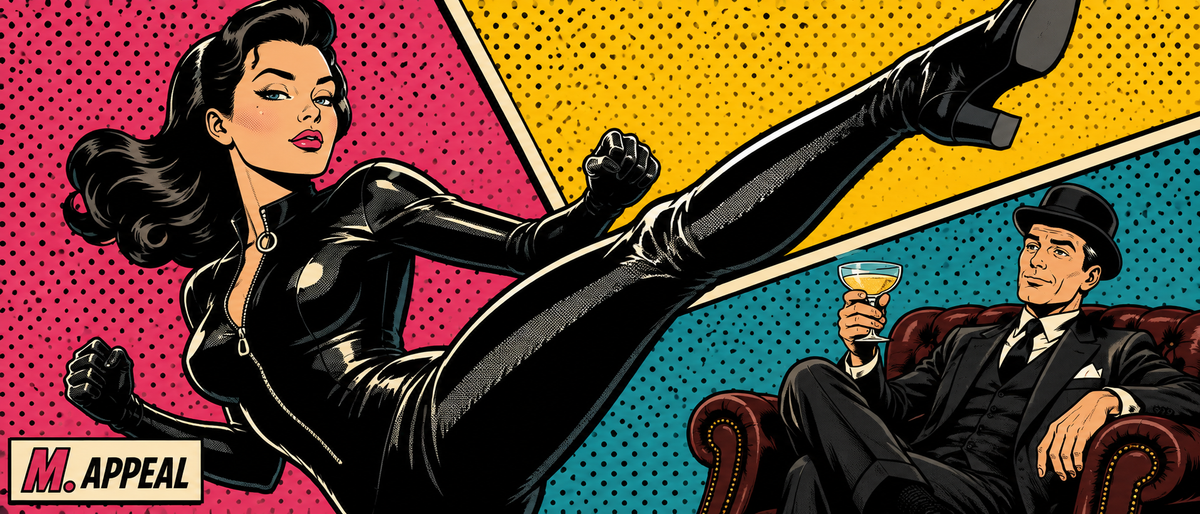
The origin story of Emma Peel's name is the best kind of television footnote: a little grubby, completely of its era, and somehow productive of its own opposite.
Before Diana Rigg was cast, before "Emma Peel" existed as a name, the production team working out Honor Blackman's replacement kicked around a working title: Samantha, or "Mantha" for short. Nobody loved it. According to the more detailed production histories, it was publicity officer Marie Donaldson who landed on the fix, took the phrase "Man Appeal," the character's whole reason for existing according to the brief, shortened it to "M Appeal," and got Emma Peel.
They asked for a sex object. They built the template for every competent, unconventional woman on television for the next sixty years. Television has always been good at that particular trick.
Before Rigg, a Word About What She Was Replacing
By 1964, The Avengers was already a genuinely strange show. It was about to get considerably stranger.
Honor Blackman's Cathy Gale had already done the hard work of establishing the template: a female lead who was Steed's intellectual equal, physically more capable than him, and defined entirely by her own identity rather than her relationship to a man. For 1962 British television this was borderline radical. Blackman was actually doing her own fight choreography, which is why the leather existed in the first place. It was functional before it was iconic.
When Blackman left for Goldfinger, which tells you everything about her cultural standing in 1964, the show had a hole to fill.
The first attempt didn't work. Elizabeth Shepherd was cast, and production actually began on "The Town of No Return," the intended series opener. But the chemistry with Macnee wasn't landing on camera, and Shepherd was reportedly pushing hard on aspects of the character's style that the production didn't want. She was quietly let go. Her scenes were reshot with Rigg. Most casual fans have never heard of this. It got buried fast, which is what happens when the replacement works.
Emma Peel, the Character
She wasn't a better Cathy Gale. She was something the show hadn't quite figured out it was building toward.
The specific genius of Emma Peel is easy to take for granted now, sixty years and a hundred imitators later. A widowed scientist and industrialist, brilliant and restless, who does this work because she's good at it and finds it interesting. No dead loved one to avenge. No institutional loyalty holding her in place. No romantic dependency on Steed as her motivation for showing up. She shows up because the work is worth doing and she's the best person in the room for it.
That doesn't sound revolutionary in 2026. In 1965, it damn well was.
The Rigg/Macnee chemistry worked because it ran on absolute equality. Steed never condescended. Emma never deferred. Neither was ever staged as subordinate to the other, and that dynamic isn't something you can manufacture through casting alone. Either it's there or it isn't. It was there.
Rigg's training with the Royal Shakespeare Company mattered more than people give it credit for. She could deliver absurdist material with total conviction, which is a harder trick than it sounds. The show needed its leads to play dialogue that was aware of its own wit without becoming smug about it, and to inhabit increasingly deranged plots without ever breaking the frame to wink at the audience. Rigg never winked. She just was Emma Peel, completely, and the show built itself around that certainty.
The Move to Film, and the American Money
Money changes everything. In this case it changed the show's entire visual grammar.
The Blackman era was shot on videotape in studio, intimate but technically constrained. The Rigg era moved to film, opened up to real locations, and brought a genuine budget increase, largely on the back of a 1965 deal with the American Broadcasting Company. ABC paid a then-unheard-of sum, reportedly around $2 million, for the first 26 episodes, and The Avengers became one of the first British drama series to land a prime-time American network slot.
That money is what let the show build the visual universe its increasingly surreal plots demanded. The Cybernauts, the mind control episodes, entire villages built as social experiments. None of that runs on a videotape studio budget.
The visual palette that emerged was thoroughly of its cultural moment: Op Art sets, bold geometric design, a pop sensibility that sat comfortably beside Carnaby Street, the Bond franchise, and the whole Swinging London aesthetic complex. The show was of its moment without straining for it.
Which brings up the camp question, because people consistently get this wrong.
Stylization Is Not Camp. This Distinction Actually Matters.
Camp winks at you. The Emma Peel era never winks. It looks you dead in the eye and throws someone through a window.
Susan Sontag's definition of camp turns on a particular ironic distance, sincerity that knows it's excessive, performed for an audience that's in on it. The Emma Peel era isn't that. It's self-aware stylization, which is a different animal entirely. The show knows it's absurd and wears that absurdity elegantly instead of flagging it for the cheap seats. Nobody in these episodes is nudging you. Nobody breaks the frame. The plots are ridiculous on their face and the show plays every one of them completely straight.
That's why it holds up. Camp dates badly because the wink goes stale. Conviction doesn't.
The slide toward actual camp starts in the color Series 5 episodes, and you can feel the American network's fingerprints on it. Batman was a massive hit in 1966 and the networks wanted that energy replicated. The Avengers was never Batman and couldn't become Batman without cannibalizing itself. The color Rigg episodes are still good television. But they're the first crack.
The Pay Thing
She was co-lead of an internationally sold hit show. She was making less than the cameraman. Sit with the actual numbers for a second.
This one has real specifics, and the specifics make it worse, not better. Rigg told The Times in 1991 that after twelve episodes into her run, she discovered she was earning £90 a week while the cameraman on set was making £120.
"I made a bit of a stink about it. At the time, it was considered very bad form to suggest that you were not getting enough."
She said her agent hadn't equipped himself to negotiate a fair rate for her. She pushed back, quietly, without theatrics by her own account, and got her rate doubled to £180. Still not a fortune. But it was the principle, and the principle was that she was carrying half of an internationally syndicated hit show and being paid beneath the crew photographing her.
What the actual fuck, ABC Weekend TV. Sincerely.
The Exit
She left at the peak. That takes a kind of discipline most people in this industry never develop.
Rigg's reasons for leaving were practical and principled in roughly equal measure. Stage actress first, always. She had no interest in calcifying into Emma Peel at 29. She could see where the color episodes were heading creatively, and she got out ahead of it rather than riding it into decline.
On Her Majesty's Secret Service (1969) reads less like a career pivot and more like a victory lap. Tracy di Vicenzo remains arguably the most fully realized Bond woman the franchise has produced, a real character with an actual interior life, complicated by her relationship to Bond rather than defined by it. Her death at the end of the film, played with unusual emotional weight for the series, turned the whole thing into something closer to a genuine artistic statement than a contractual obligation. It was a goodbye to the entire 1960s pop cultural moment, delivered on her own terms, at full power.
She went back to the stage. In 1994 she won the Tony for the title role in Medea, in the Almeida production that transferred to Broadway. She became one of the great classical actresses of her generation. Decades later she'd play the magnificent Mrs. Bradley, in a series that deserved three times as many episodes as it got. The Avengers was one chapter in a very long career.
It was one hell of a chapter.