Capitalism Never Had a Conscience
Sarah Longwell remembers a golden age of responsible capitalists. What she's actually remembering is what happened when we made them behave.

Yesterday, I was listening to The Secret Podcast, “Fight the Future,” with Sarah Longwell and Jonathan V. Last (JVL), and they wandered into a discussion about capitalism, particularly the obscene wealth being accumulated by the founders and employees of AI companies.
Sarah, who describes herself as a capitalist and an anti-monopolist, was wrestling with something that has increasingly bothered her: the concentration of wealth at the very top, and the possibility that AI will allow the wealthy to become even wealthier while eliminating the need for much of the workforce.
Fair enough. These are genuine concerns, and I'm glad she's thinking about them.
But then she started reminiscing about the good old days of capitalism.
She described an era when the titans of industry employed enormous numbers of people, and therefore had a vested interest in good public schools, decent roads, and thriving communities. Capitalists understood that their own prosperity depended upon the prosperity of the society around them.
And I nearly spit out my coffee.
Sarah, what the hell version of American economic history were you taught?
The kindly robber barons
Let's talk about Andrew Carnegie.
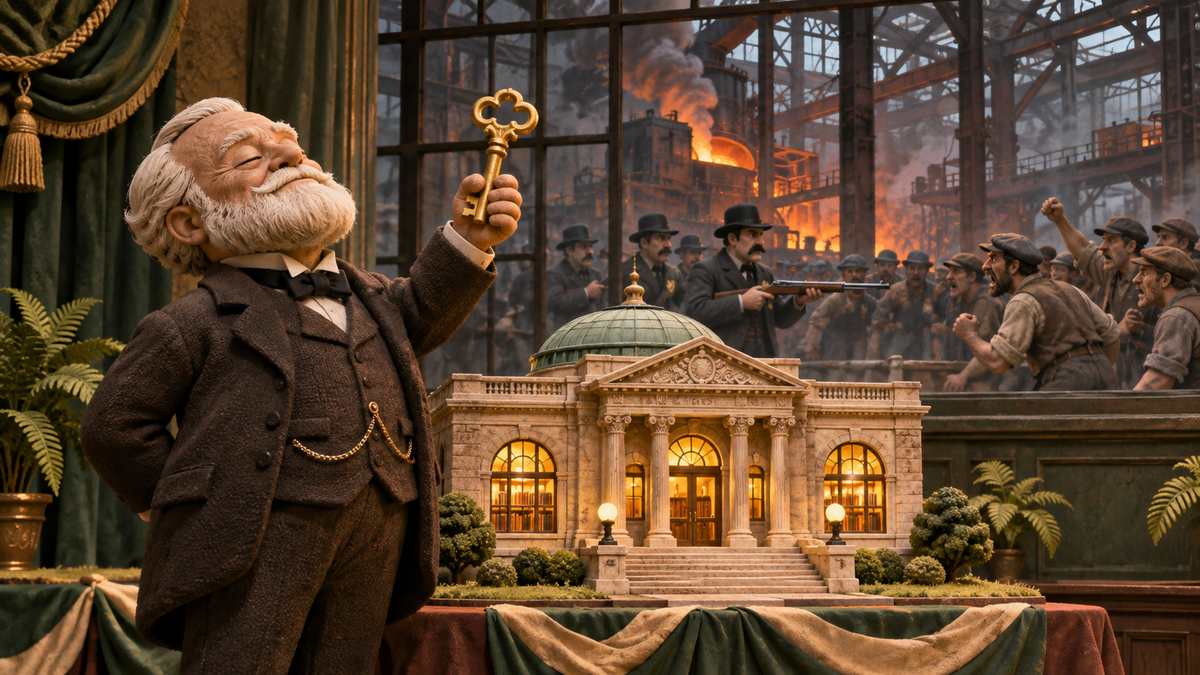
Carnegie is practically the poster child for the benevolent industrialist. He made a staggering fortune in steel, then spent much of it building libraries, concert halls, and other civic institutions. His philanthropy was genuinely transformative.
He also presided over one of the ugliest episodes in American labor history.
In 1892, workers at Carnegie's Homestead steel mill in Pennsylvania were locked in a bitter labor dispute. Carnegie's lieutenant, Henry Clay Frick, was determined to break the union. When negotiations collapsed, Frick brought in hundreds of armed Pinkerton agents to take control of the mill.
The resulting confrontation left ten people dead.
And where was our benevolent industrialist during all this?
Vacationing in Scotland.
Now, before anyone suggests that Carnegie was simply an absentee owner who didn't know what his nasty manager was doing, the historical record tells a different story. Carnegie supported Frick's preparations and followed the confrontation through their correspondence.
He managed to keep his physical distance from the unpleasantness, if not his responsibility for it.
And years later, the great philanthropist was back dedicating civic amenities to the community.
How lovely.
The library and the Pinkertons were products of the same capitalist empire.
Sweaty's Corner doesn't have a marketing budget or an algorithm pushing it into anyone's feed. It has readers who share it. If this one landed, sending it to someone who'd get something out of it — or subscribing so the next one finds you directly — genuinely moves the needle.
What actually made capitalism behave?
The capitalism Sarah remembers wasn't born from some collective awakening of the industrialists' conscience.
It was the product of decades of political struggle.
At the turn of the twentieth century, America was wrestling with the consequences of largely unrestrained industrial capitalism. Monopolies, dangerous working conditions, child labor, company towns, violent strikebreaking, and enormous disparities of wealth.
The Progressive Era began imposing meaningful constraints. Antitrust laws and enforcement, workplace safety regulations, workers' compensation, and new institutions like the Federal Trade Commission.
The 1911 Triangle Shirtwaist Factory fire, which killed 146 workers, helped galvanize workplace safety reform. Apparently, relying upon the good intentions of factory owners hadn't worked particularly well.
Then came the Great Depression and the New Deal, which dramatically expanded the federal government's role in protecting workers.
The Wagner Act of 1935 strengthened the right to organize and bargain collectively. The Fair Labor Standards Act of 1938 established federal minimum wage and overtime protections and restricted child labor.
And after World War II, a powerful labor movement helped ensure that a larger share of America's extraordinary economic growth reached the people doing the work.
This wasn't a perfect arrangement. Plenty of Americans, particularly Black workers and women, were excluded from portions of the prosperity.
But it was a hell of a lot better than the Gilded Age.
And one shouldn't overlook the fear factor.
The French Revolution was barely a century old when Carnegie was running his steel empire. The European revolutions of 1848 and the Paris Commune of 1871 were even fresher memories. Then came the Bolshevik Revolution in 1917, providing a rather dramatic demonstration of what might happen when the ruling class pushed its luck too far.
I suspect the thought of angry workers fashioning guillotines from the barons' own steel wasn't entirely comforting.
Not every reform came from fear of revolution, of course. But the wealthy had ample reason to take labor unrest and political upheaval seriously.
The restraints on capitalism weren't gifts from the capitalists. They were achievements won by people who recognized that capitalism needed restraining.
Then we started taking the restraints off
And here is where Sarah's nostalgia becomes particularly ironic.
The conservative movement spent much of the postwar era attacking the very institutions that made her remembered capitalism possible.
The counterattack began early, with the Taft-Hartley Act in 1947 restricting organized labor's power. But it gathered considerable momentum in the 1970s and 1980s.
Enter Ronald Reagan, patron saint of modern American conservatism.
Reagan didn't invent the campaign against organized labor, but he certainly gave it a tremendous boost. In 1981, when the air traffic controllers went on an illegal strike, Reagan fired approximately 11,400 of them.
The strike was illegal, and Reagan had the legal authority to act. But the public defeat of PATCO sent a powerful signal about the federal government's willingness to confront unions1.
Meanwhile, corporate America continued its efforts to weaken labor protections, reduce regulatory burdens, and increase the freedom of capital.
Not every economic change since then can be laid at Reagan's feet. Globalization, automation, and the rise of the digital economy have transformed the nature of work.
But the weakening of workers' bargaining power was also the result of deliberate political choices.
Which brings us back to Sarah.
She's right that the digital economy has changed the relationship between capital and labor. AI may accelerate that transformation dramatically. And she's right to be concerned about concentrated wealth and monopoly power.
But her picture of an earlier capitalism, where enlightened industrialists generously supported the communities that sustained them, misses the central lesson of American economic history.
Those industrialists didn't simply decide to be better citizens.
They lived under constraints built by progressive reformers, organized labor, and governments willing to exercise power on behalf of ordinary people.
And when those constraints weakened, business interests had greater freedom to pursue their own priorities.
Sarah is looking back fondly at the results of progressive reform while giving the capitalists much of the credit.
Capitalism didn't lose its conscience.
We dismantled much of what made it behave as though it had one.
1: I wrote about this here:
 Geoff Anderson