The Voters Didn't Get the Memo
The progressive left has a plan for transforming the Democratic Party. Unfortunately, the rest of the Democratic electorate has its own ideas.

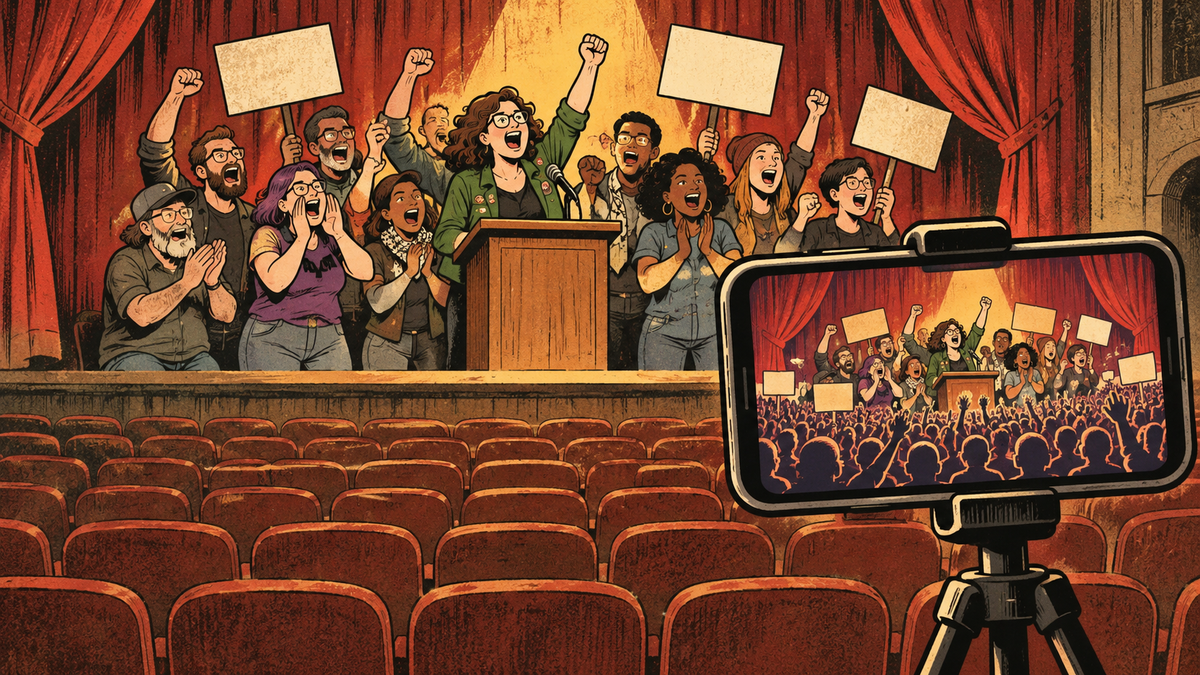
Table of Contents
I spend a fair amount of time on Bluesky and Substack Notes, and since the Democrats' remarkable midterm performance, I've been treated to a nearly continuous stream of outrage over the impending elevation of Hakeem Jeffries to Speaker of the House.
You would think the Democrats had just suffered another humiliating defeat.
Instead, they won. Bigly, as our president might say.
But apparently they didn't win correctly.
On November 18, House Democrats voted 251–11 to nominate Jeffries. Assuming the January floor vote goes as expected, he'll be the first Black Speaker in American history — a milestone that might ordinarily warrant at least a moment of celebration.
Not in certain corners of the online left.
For weeks, a movement had been building to draft Congresswoman Ayanna Pressley to challenge him. Petitions, breathless posts, podcasts, exhortations to call your representative. The petition eventually collected more than 150,000 signatures.
There was just one small problem.
Nobody had bothered to secure the candidate.
Pressley never announced she was running. She never indicated she wanted the job. She was negotiating with Jeffries over the new majority's agenda. Then she voted for him.
And some of the people who had spent weeks enthusiastically promoting her turned on her — selling out, caving, betraying the movement, assorted other bullshit.
Kristoffer Ealy documented the spectacle in a wonderfully exasperated essay, comparing it to gathering 150,000 signatures in support of taking Halle Berry to the prom, then becoming furious when Berry declines the invitation she never received. Derek Beres also weighed in on the racialized attacks aimed at Jeffries. Criticism of his record, including his relationship with AIPAC, is entirely legitimate. Calling a Black politician a monkey is something else.
But the part that really got me was the expectation that Pressley somehow owed these people a candidacy. She was drafted without her consent, declined to participate, and was punished for making her own political decision.
What the actual fuck?
The internet is not the electorate
I understand the temptation to believe your feed represents the larger political universe. When practically every post is denouncing Jeffries or demanding Schumer's head, it starts to feel like consensus.
Your feed is a representative sample of exactly one thing: the people who wind up in your feed.
A Pew Research Center survey released November 19 found that 38% of Democrats and Democratic-leaning independents view Jeffries favorably, versus 26% unfavorably.
Another 35% had never heard of him.
Let that sink in. More than a third of the Democratic coalition doesn't know who the guy is. The fuckery is happening in a bubble inside a bubble.
Schumer is another story — the dissatisfaction there is real and broad — and I'm not arguing voters are thrilled with Jeffries either. But there's a considerable gap between dissatisfaction with a politician and the existential outrage consuming my feed. The progressive activist wing, energetic and organized as it is, is one faction of a coalition that also includes labor, Black voters, suburban professionals, and plenty of people who fit no ideological category at all. They vote Democratic for different reasons, and they aren't obligated to adopt whatever issue happens to be dominating the discourse this week.
First contact with the voters
There's an old observation attributed to the Prussian strategist Helmuth von Moltke (roughly paraphrased): no battle plan survives first contact with the enemy.
In politics, the voters aren't supposed to be the enemy. Sometimes you have to wonder whether everybody got that memo.
Take Medicare for All. September 2026 KFF polling found 66% of American adults favored the general idea. Substantial support. Hardly fringe. Then come the details: mention higher taxes and support falls dramatically; mention eliminating premiums and deductibles and it climbs back. People aren't voting for slogans. They're weighing costs and consequences. Infuriating, I know.
Same with Israel. Democratic skepticism of unconditional American support has moved well beyond the activist left. But wanting foreign policy to change is not the same as making Gaza or AIPAC the overriding issue in every election. Someone can strongly oppose bankrolling Netanyahu while worrying more about groceries, housing, or whether their health insurance premium is about to explode.
That isn't moral indifference. It's life.
The problem isn't that the voters failed to understand the plan.
It's that the plan failed to account for the voters.
And if your response to that discovery is to call everyone corrupt, cowardly, or insufficiently committed, you aren't expanding your coalition. You're shrinking the number of people willing to listen to you.
Sweaty's Corner doesn't have a marketing budget or an algorithm pushing it into anyone's feed. It has readers who share it. If this one landed, sending it to someone who'd get something out of it — or subscribing so the next one finds you directly — genuinely moves the needle.
1994 wasn't a hashtag
I've written extensively about the long transformation of the Republican Party, from Goldwater through Reagan to the politics that produced Trump. The crucial turning point was 1994: Gingrich and the Contract with America were the public arrival of a movement that had spent decades building organizations, recruiting candidates, launching media outlets, and raising money. The Tea Party came later. Then Trump.
Nothing sudden about it. And it sure as hell wasn't accomplished by getting a petition to trend.
The revolutionaries became politicians. The horror.
AOC arrived in Congress as an insurgent, knocked off an entrenched incumbent, and brought real energy to the progressive wing.
And then something terrible happened.
She became a politician.
She built relationships. Negotiated. Compromised. In July 2024, the national DSA withdrew its endorsement over Israel-Palestine — substantive disagreements, but the broader tension was unmistakable: an insurgent had acquired institutional responsibilities, and parts of the movement hated how she exercised them. There's something fundamentally strange about demanding that progressives win office and exercise power, then treating the compromises power requires as proof of betrayal.
Even Bernie Sanders, decades spent as the independent outsider, gets it: chaired major committees, negotiated legislation, endorsed Democratic nominees. Yet some people now propose that the 85-year-old replace Schumer as Senate leader. After all the talk about generational change, we're solving the leadership problem with an 85-year-old?
Sanders isn't seeking the job — he's backing Chris Van Hollen. Apparently even Bernie knows that leading a diverse caucus takes more than being its most recognizable ideological advocate.
They wanted revolutionaries in Congress, and they're perpetually surprised when the revolutionaries become members of Congress.
The Manchin-and-Sinema strategy, but from the left
And then there's Hasan Piker, who after the election complained that Democrats won too many seats. His logic: with a ten-seat majority instead of forty, a small socialist caucus could have exercised enormous leverage.
He even used the word bully.
Mathematically, he's right about the leverage — Manchin and Sinema demonstrated it repeatedly. But the strategy depends on the rest of the coalition winning enough seats for a majority, yet not so many that the faction loses its veto. That's a peculiar way to evaluate a landslide.
The new DSA-backed members won real elections, several beating incumbent Democrats — genuine organizational strength. But all six won districts Democrats already held. They changed the caucus's composition; they didn't flip the Republican seats that created the majority. That doesn't invalidate their wins. It complicates the claim that the larger coalition should subordinate itself to their priorities. And a veto isn't a governing program: six members can block legislation, not pass their own.
The other side of this arithmetic produced a delicious little spectacle in the Senate. Before the midterms, there was considerable speculation that John Fetterman could be the pivotal vote in a split Senate — Roll Call gamed it out in October.
Then Democrats won 56–44.
Suddenly Fetterman-as-kingmaker looks a lot less compelling. Somewhere, Nelson Muntz is pointing and laughing.

That's the risk of building your strategy around being the indispensable holdout. The power lasts exactly as long as the arithmetic makes you indispensable.
When compromise becomes betrayal
One distinction I don't want to lose: the progressive left isn't just angry posting. DSA chapters and their allies recruit candidates, knock doors, organize tenants and workers, and win elections — the boring, difficult work of building actual power. And there's nothing wrong with demanding more from leadership; Schumer's record deserves scrutiny, and Jeffries isn't owed unconditional support because the caucus nominated him overwhelmingly. A coalition needs internal dissent.
Pressley herself demonstrated how it's done. She used the interest around her potential candidacy to negotiate with Jeffries over legislative priorities. She didn't have to become speaker to influence what the next speaker does.
That's politics. Actual fucking politics.
Yet for some supporters it was unacceptable because it lacked the dramatic showdown they'd been promised. Which is the recurring dynamic: attack the establishment, receive enthusiastic reinforcement from the faithful, interpret every compromise as proof of sellout. Rose Twitter ran on it. AOC gets it. Pressley's getting it now.
The interesting question is what happens when the causes start winning. Medicare for All is a mainstream debate topic; criticism of Israel policy has moved well beyond the socialist left. Do activists claim the wins, build workable policy, and persuade more voters? Or do the standards keep shifting so the establishment stays permanently illegitimate?
Because when opposition to your own coalition outranks the things you organized to achieve, grievance stops being a means to an end.
It becomes the product.
Burning it down to teach everyone a lesson
And now, barely two weeks after an extraordinary midterm victory, people on Bluesky and Substack Notes1 are declaring they won't vote Democratic in 2028.
Because Hakeem Jeffries is going to become speaker.
Seriously?
The new Congress hasn't even convened. The majority hasn't legislated, conducted oversight, or demonstrated anything. And already the threats to walk. We've seen this movie — Bernie-or-Bust, 2016 — though most Sanders voters ultimately backed Clinton, and I doubt everyone threatening 2028 will follow through either; social media is full of people whose political commitments last until the next outrage.
But the underlying theory deserves a look: withhold support, punish the establishment, force it to adopt your priorities.
Maybe. Or maybe you help produce a government even less sympathetic to those priorities, while the politicians you hoped to discipline decide your faction is unreliable — and the people who actually suffer are the ordinary people whose interests you claim to represent.
Withholding support isn't a magic lever. It's a choice with consequences, and the consequences rarely confine themselves to the people you want to punish.
Want a more progressive Democratic Party? Fine. God knows there's plenty to criticize. But you have to persuade the people who make up the Democratic Party — build relationships, recruit candidates, win elections, negotiate, take partial victories, and occasionally accept that somebody who disagrees with you isn't necessarily an enemy.
You don't get to skip that work because your Bluesky feed agrees with you.
And if your answer to every setback is threatening to burn down the coalition, sooner or later people will wonder whether you were ever interested in building one.
Go ahead, make my day and subscribe. Always free.
1: And I presume on all the other socials, Facebook, Instagram, Threads, Twitter (I refuse to call it by what Elon named it) as well but I am not there.