
Facts Not in Evidence
The clean sheet doesn't exist. The tab is coming due. And the people who ran up the bill are very busy pretending they didn't.

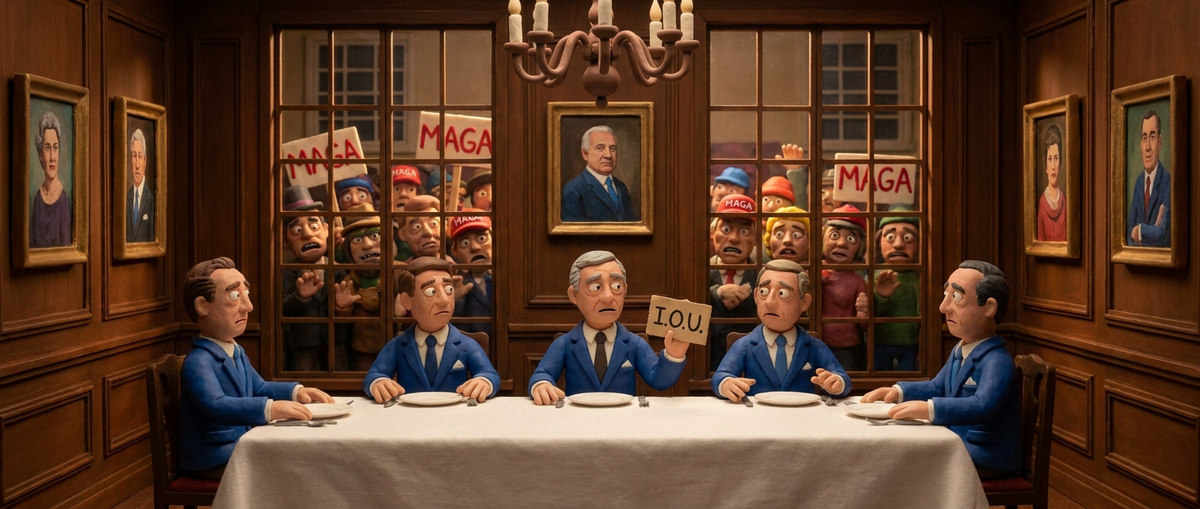
There is a genre of political commentary that has been running hot since roughly January 2025, and it goes something like this: MAGA is a Trump-specific aberration, the fever will break when he leaves the scene, and the Republican Party will have the opportunity to rebuild itself on something resembling a coherent conservative foundation. The establishment will reassert itself. The adults will return to the room. The nightmare ends and the restoration begins.
This is fan fiction. Compelling fan fiction, written by people who really want it to be true, but fan fiction nonetheless.
The restoration fantasy, to borrow a phrase from Perry Mason, relies on facts not in evidence. And the facts that are in evidence point somewhere considerably less comfortable.
The Coalition That Never Actually Worked
Start with the foundational myth: that there was a healthy, functional Republican Party that Trump corrupted and hijacked. This requires a selective and somewhat heroic reading of recent history.
The pre-Trump Republican Party was losing the popular vote in presidential elections with grinding consistency. It was running on a policy agenda - entitlement cuts, endless foreign engagement, trickle-down economics - that its own base had already quietly rejected. The donor class wanted one thing. The voters showing up in the primaries wanted something else entirely. That tension didn't begin with Trump. Trump was the pressure release valve on a boiler that had been building for thirty years.
The Country Club Republicans, the Chamber of Commerce wing, the capital class that actually writes the checks and staffs the think tanks - they never had the votes to elect a dog catcher on their own. They knew this. The whole project of modern conservatism since the 1960s has been the careful assembly of coalition partners who could provide the electoral mass that the establishment alone couldn't generate.
The establishment didn't build a coalition. It made a series of Faustian bargains, and the devil has finally shown up to collect.
The Bargains, In Order
The Southern Strategy was the original sin. Nixon's team understood that the Democratic Party's embrace of civil rights had created a massive pool of resentful white Southern voters with nowhere to go. The decision to go harvest them was deliberate, documented, and successful. It also meant inviting racial resentment into the coalition as a load-bearing structural element. You can't do that and then express surprise, fifty years later, that racial resentment has become load-bearing.
The Religious Right's entry in the late 1970s and 1980s was the second bargain. Jerry Falwell's people got cultural legitimacy, the promise of Supreme Court seats, and a megaphone. The Chamber of Commerce crowd got their tax cuts and deregulation. It was a workable arrangement as long as everyone was getting something. The Court seats finally came through with the Dobbs decision, and the establishment discovered that winning on abortion didn't demobilize the religious base. It disoriented it. The grievance was the point, not the resolution. Winning left them without a purpose, and a coalition partner without a purpose is a coalition partner looking for a new one.
MAGA is the logical terminus of this process. The working class white voter who had been promised for decades that their economic and cultural anxieties would be addressed, who kept receiving a promissory note instead of payment, eventually stopped accepting the note. Trump didn't manufacture that voter. He found them, correctly read what they wanted, and gave it to them - or at least performed giving it to them convincingly enough that it didn't matter.
The Fantasy Requires Forgetting All of This
The pundit restoration narrative requires you to believe that these coalition partners - the racial resentment vote, the religious right, the economic nationalist working class - can be reassembled under a more respectable management after Trump. That the establishment can take back the wheel.
This is where the fantasy runs hardest into the wall. As I wrote earlier, roughly 40 percent of the American electorate has shown itself to be genuinely durable Trump support across multiple cycles and crises[1]. That's not a glitch. That's a revealed preference. The people in that coalition have material and cultural interests that are not served by a return to pre-Trump Republican governance, and they know it. They lived under it. They didn't like what they got.
The establishment can write checks. It can fund think tanks and hire consultants and staff campaigns. What it cannot do is move those voters, because those voters have correctly identified that the establishment's policy agenda was never actually for them.
The Pendulum Isn't Doing What You Think It's Doing
There's a related piece of received wisdom that deserves some pressure: the idea that the electorate oscillates between chaos and competence, and that after a sufficient period of exhaustion with chaos, voters reach for the safe and stable option.
Biden was the test case for this theory, and the results were not encouraging. He won in 2020 because Trump was the alternative, not because Biden was compelling. The entire Democratic coalition was organized around a negative - stop this specific person. The moment that negative was removed, the coalition's internal contradictions became the story. He governed competently by most measurable standards, managed a historically difficult economic environment, and got blamed for the residuals of a pandemic that had technically resolved on his watch. Then he got pushed out by his own party.
The electorate isn't oscillating between chaos and competence. It's oscillating between flavors of intensity, with exhaustion interludes that keep getting misread as an appetite for normalcy.
The information environment won't allow the exhaustion phase to last long enough to produce the reset the restoration crowd is counting on. By the time a safe, competent, boring Republican - your Burgum, your Youngkin - has been in office eighteen months, the ambient outrage machinery has reconstituted itself and the "safe" choice looks like a sellout or a failure or both. The Biden playbook is not an encouraging precedent for this theory.
The Demographic Math Makes It Worse
The replacement problem for the religious right coalition is real and not getting enough attention. That cohort is aging. The motivating issues have either been won (Court seats), shifted in salience, or in the case of abortion, started actively working against Republican interests with the general electorate. The young conservative cohort that's replacing them is not particularly religious in the traditional sense. It's more libertarian-coded or more nakedly nationalist, neither of which maps cleanly onto the Chamber of Commerce agenda that the establishment wants to return to.
So you have a rump establishment that can write checks but can't move votes, and a MAGA-successor movement that can move votes but is genuinely ungovernable by the people who used to run the apparatus. The idea that some figure emerges to reconcile these things is the restoration fantasy in miniature. As the succession horse race looks increasingly like a tribute band competition, the establishment's preferred candidates keep discovering that political competence is not the same thing as political authenticity, and the base can tell the difference.
The Honest Prognosis
What the evidence actually points toward is a prolonged and ugly civil war inside the American right, with the establishment losing most of it. Not a reset. Not a restoration. A slow, painful renegotiation of what the Republican coalition is actually for, fought out over multiple election cycles, with the establishment's institutional advantages gradually eroding against the numerical weight of the base it spent fifty years cultivating and can no longer control.
The useful historical parallel isn't the Republican Party of the 1950s magically reasserting itself. It's the Democratic Party after the 1960s. That rupture took the better part of twenty years and some genuinely brutal losses to work through, and the party that came out the other side was considerably different from the one that went in.
The pundit class has been confidently wrong about this coalition at every turn. They missed 2016, underestimated 2020, didn't see 2024 coming. Expecting them to be right about the post-Trump restoration, when the structural evidence is running this hard against them, requires a faith in their analytical track record that the analytical track record simply does not support.
The clean sheet doesn't exist. The tab is coming due. And the people who ran up the bill are very busy pretending they didn't.
1 - Yes, I wrote and scheduled this about 10 days before publication, and as of today, RCP's aggregate has Trump under 40% for the first time at 39.7% approval. That is not a "collapse" that a lot of the pundit class is hyping.