
God's Precinct: Why American Politics Is Actually a Denominational Dispute
Our politics look an awful lot like the messiness of the main branches of religion in this country, are there solid parallels? Start of a series

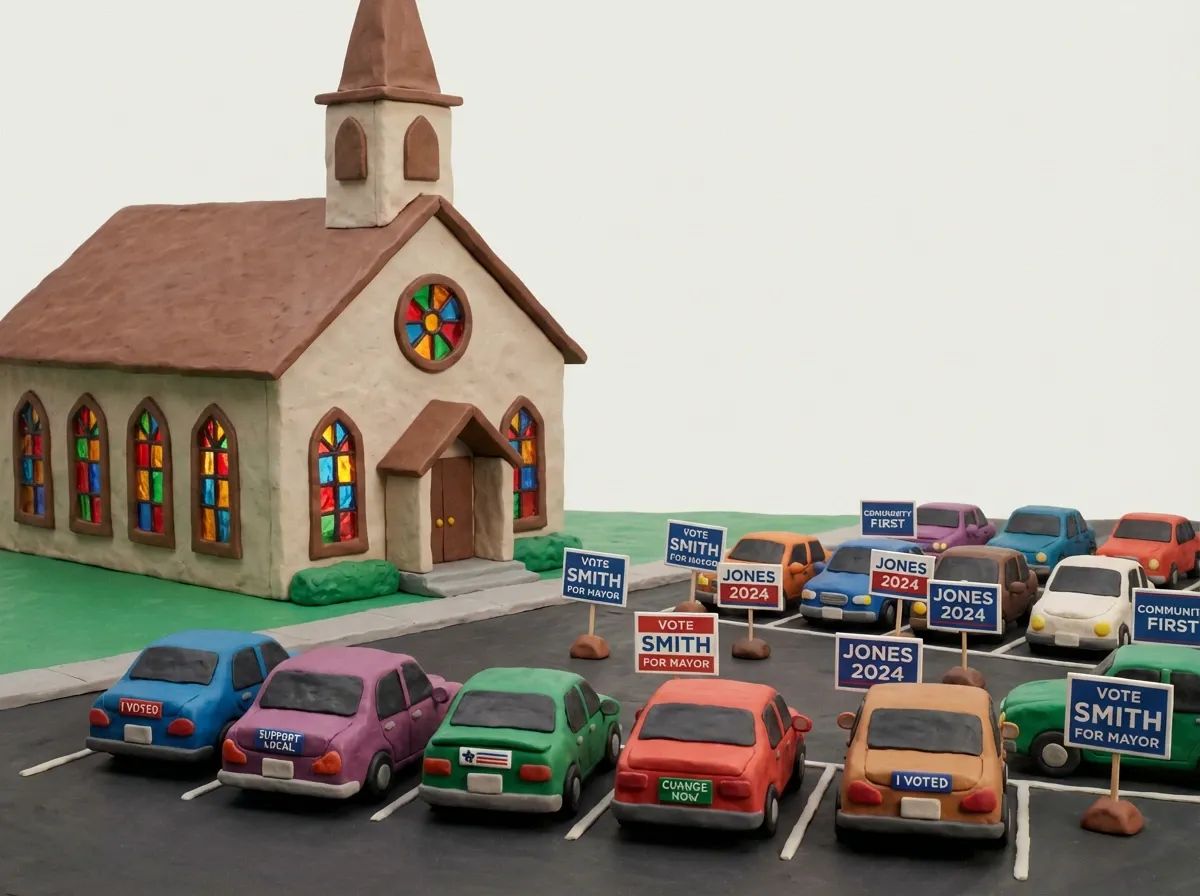
I was walking my dog Cerberus (or familiarly "Cerbie") – rescued, already named, the name fits; in Greek mythology Cerberus was the three-headed guardian of the underworld, and "kerberos" literally translates to "spot" – on a weekday morning, cycling through a backlog of podcasts I'd been meaning to get to.
Two of them, back to back, hit in a way that struck me.
The first was a conversation between what I'd describe as a traditional evangelical Christian and someone who identified as an orthodox Christian. It wasn't about religion per se, but what stood out to me was that their lived faith experience came through in the discussion. What I could hear clearly was the tension underneath the conversation – two people who nominally shared a faith, a set of texts, and a broad tradition, who were nevertheless talking past each other in ways that went beyond mere misalignment. There was something almost territorial about it. They weren't just debating doctrine. They were negotiating who got to define the tradition.
The second podcast was a lapsed Catholic talking with a Jewish guest. Different dynamic entirely – more fluid, more self-aware about the distance from the institution – but again, I found myself noticing the structural things rather than the theological ones. The way the lapsed Catholic described his relationship with the Church: not fully out, not fully in, a complicated loyalty to something he'd largely walked away from but couldn't entirely dismiss.
I filed both of these away as interesting, and kept walking.
About a block later, it hit me. I'd heard this before. Not in any religious context. But in every political conversation I'd had for the last decade.
Let me be clear about what I am before I go any further, because I think it's relevant to why this framing makes sense to me when it apparently hasn't occurred to people who are steeped in both religion and politics. (or perhaps had occurred to them, and dismissed as "well, duh")
I don't have a faith tradition. I didn't grow up in one. I'm an outsider to organized religion in the way that someone who didn't grow up speaking a language is an outsider to it – I can observe the structure, I can hear the patterns, but I don't have the fluency that comes from immersion. The people who do have that fluency, I'd argue, are often the worst equipped to see what I'm about to describe. When you're inside the water, you don't notice it's wet.
What I see, from the outside, is this: the Democratic Party is structured like American Protestantism, and the Republican Party is structured like the Roman Catholic Church. And once you see it, you can't unsee it, and a hell of a lot of things that seem like political mysteries start to make a sort of structural sense.
This is not a spiritual argument. I'm not making any claims about faith, or God, or whether any of this is good or bad. I'm making an organizational argument. The analogy works because both political parties and religious denominations are fundamentally solving the same problem: how do you hold together a large group of people who share foundational values but disagree, sometimes violently, about what those values mean in practice? The answers these institutions have arrived at are different, and those differences explain a lot.
American Protestantism is, structurally, a mess[1]. That's not an insult. It's the natural consequence of what Protestantism is – a tradition organized around the idea that individuals can read the foundational texts and arrive at their own conclusions about what they mean, without requiring an institutional authority to mediate that reading. The result, historically, has been fragmentation on a staggering scale. There are thousands of Protestant denominations in the United States. Some of them agree on almost nothing except the most basic salvific claims. Some of them think the others are going to hell. All of them believe they're the ones reading the texts correctly.
And yet. When something external threatens the broader tradition – when the culture shifts in a way that challenges shared foundational commitments – these fractious, quarrelsome denominations can find temporary common cause. They've done it repeatedly throughout American history. Historians call it the Great Awakening, and there have been several. A charismatic figure or an urgent cause generates enough heat to temporarily unify the factions, they win something or lose something together, and then they go back to arguing with each other.
The Democratic coalition operates on exactly this logic. It's a big tent because the underlying premise is pluralist – multiple readings of the same foundational commitments are tolerable, even valuable. The result is a coalition that contains, without much apparent discomfort, democratic socialists and moderate suburbanites who would have been Rockefeller Republicans forty years ago. They agree on the texts. They disagree, sometimes ferociously, about what the texts require. And when you watch them fight with each other – which they do constantly and publicly – it looks like dysfunction from the outside, but it's actually the expected behavior of a decentralized tradition that has never had a central authority capable of enforcing doctrinal discipline.
The Catholic Church, by contrast, is an institution that has spent two thousand years solving the problem of how to maintain doctrinal coherence across enormous geographic and cultural diversity. The answer it arrived at was hierarchy: a clear chain of authority that defines what the tradition means, can discipline deviations, and can consolidate around a single position when the institution needs to present a unified front. This does not mean Catholics agree on everything. There are Catholic liberals and Catholic traditionalists and various flavors in between, and the Church has had its own spectacular internal crises. But the institution has a mechanism for resolving those crises that Protestantism doesn't: someone is ultimately in charge, and what they say goes. (gee, does that sound familiar or what)
The Republican Party, particularly in its post-2016 form, runs on exactly this logic. The internal diversity is real – there are libertarian-leaning Republicans and social conservatives and defense hawks and MAGA populists – but the mechanism for resolving internal disputes has increasingly been hierarchical rather than democratic. You fall in line. The leader defines the doctrine. Deviations are disciplined. And the result, whatever you think of it, is an organization that can move coherently in a single direction in a way the Democrats structurally cannot.
Over the next several posts, I'm going to go deeper on each of these parallels – and a few others that I think are worth examining. The revival dynamic and why it's the only thing that has ever temporarily unified the Democratic coalition. The Catholic Counter-Reformation and what it suggests about where the current Republican consolidation ends up. The candidate question, which is really a theological question dressed up in political clothing: what does a revival figure actually have to do, and are any of the names currently in circulation capable of doing it?
I'm doing this as an empiricist, not as a partisan. I'm not arguing one model is better than the other – they're adaptations to different problems, and they have different failure modes. The Protestant model produces factionalism and incoherence. The Catholic model produces rigidity and, eventually, schism. American political history is largely the story of these two organizational logics colliding with each other, and with circumstances that neither was designed for.
Cerberus finished his business and we went home. The podcasts kept rolling.
1 - the tale of David French's essential excommunication from his Southern Baptist sect after he dared to adopt a young child from Africa is emblematic. Yet he still is steeped in the church that tossed him out for a black adopted child and his lack of reflexive support for Trump and MAGA.
 Share on Bluesky
 Share on Threads
 Share on Facebook
 Share on Mastodon
 Share on Reddit
 Share on Email