
You Loved to Hate It Until You Needed It (Spirit Air)
The Spirit Airlines obituary nobody earned the right to write

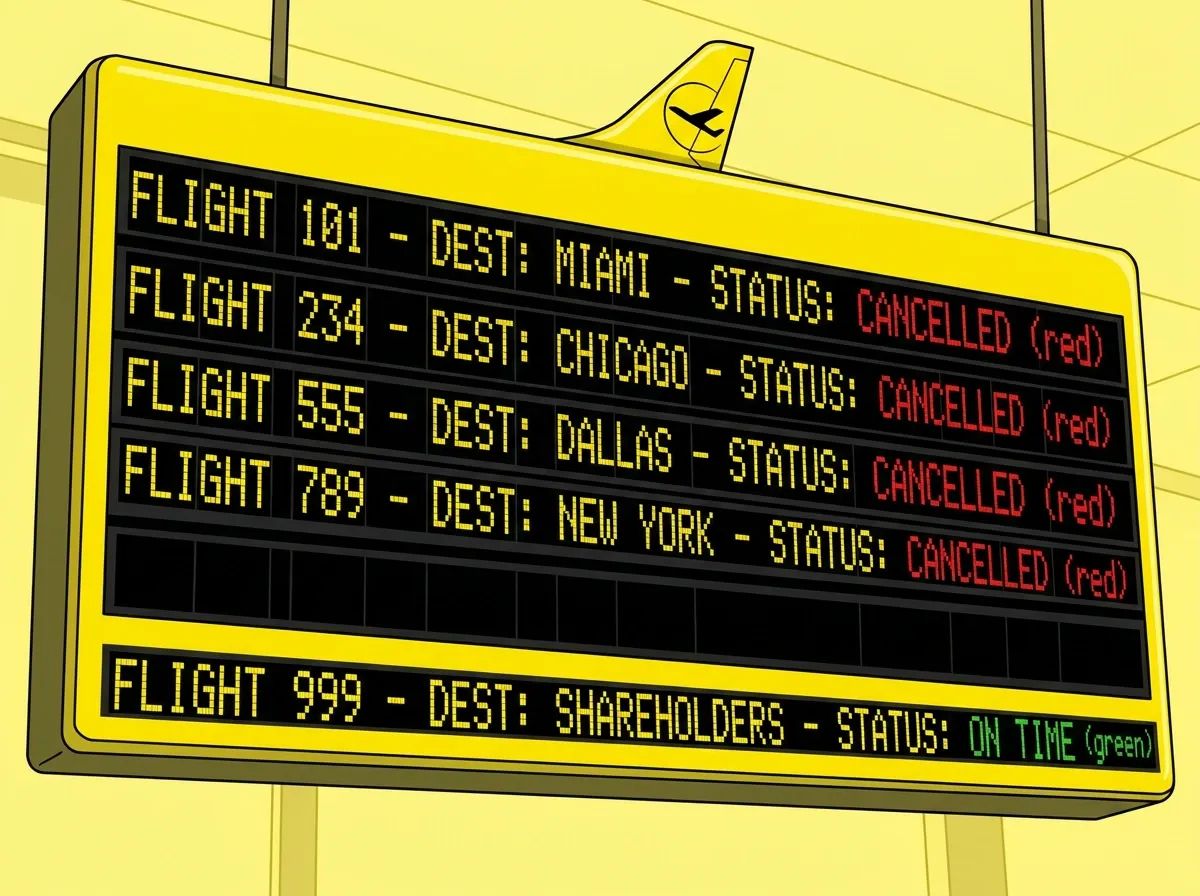
At 3am on Saturday, May 2nd, the yellow kiosks at airports across the country flickered to life one last time to deliver a message that approximately 17,000 employees and several million ticketed passengers did not want to read: Spirit Airlines had ceased global operations, effective immediately.
And thus ended 34 years of the airline that everyone loved to shit on, right up until the moment they needed a $79 fare to Fort Lauderdale.
Let's be honest with each other for a second. You know who flew Spirit. You probably flew Spirit. The snark about the fees and the seats and the general vibe of flying inside a flying Greyhound bus with wings was a participation sport enjoyed primarily by people who were booking Spirit tickets with one hand while typing the jokes with the other. The airline was the butt of a decade of "you get what you pay for" commentary from people who were, in fact, getting exactly what they paid for and knew it. Cheap. It was cheap. That was the whole point.
So when the kiosks went dark and the takes started flying — and oh, did the takes fly, the one thing Spirit kept running after the planes stopped — the sudden discovery that Spirit served a vital market function was a little rich coming from the same crowd that had been forwarding Spirit horror stories for years like they were proof of something.
They were proof of something. Just not what people thought.
What Spirit Actually Did (That Had Nothing To Do With Your Flight)
Here's the thing about ultra-low-cost carriers that gets lost in the "my seat didn't recline" discourse: the most important thing Spirit did for you probably happened on a flight you took on a completely different airline.
When Spirit entered a route, the major carriers had a choice: match the low fare tier or watch price-sensitive travelers walk. They mostly matched. Not enthusiastically, not generously, but enough to keep a floor under what you'd pay on American or United flying the same city pair. Spirit's presence on a route wasn't just about Spirit's passengers — it was a competitive anchor that kept the majors at least nominally honest.
That anchor is now gone. The rescue fares the majors are offering right now — capped around $200, announced with great fanfare by Transportation Secretary Sean Duffy at a press conference at Newark that was, let's be clear, a political performance and not an economic policy — are a PR gesture. They last until the news cycle moves on. What happens to fares on Spirit's former routes six months from now, when nobody's watching and Duffy's moved on to the next photo op, is the actual question. And nobody in power is particularly interested in answering it.
The Bailout That Was Never Going To Work
The Trump administration's proposed rescue was $500 million for a 90% stake in the airline. Let that sink in for a moment. The government would have owned nine-tenths of Spirit Airlines — a carrier that hadn't turned a profit since before COVID, had filed for bankruptcy twice in two years, and was being crushed by fuel costs spiking from the war in Iran. In exchange, the existing bondholders would have been subordinated, meaning they'd have gotten in line behind the government on any claims.
Shockingly, the bondholders said no.

This was framed in some corners as the bondholders being the villains of the piece. It was not. The deal structure was designed in a way that made rejection rational. If you're a creditor and someone offers you a deal where you get subordinated to a new senior claimant while your recovery prospects stay roughly the same or get worse, you vote no. That's not greed, that's arithmetic. The deal failed because it was structured to fail, or at minimum structured by people who didn't particularly care whether it succeeded.
Trump, for his part, handled the situation with characteristic precision: "Well, we're looking at it — but if we can't make a good deal, no institution's been able to do it. I'd like to save the jobs." Inspiring stuff. A man at the pinnacle of his powers.
Commerce Secretary Howard Lutnick delivered the news that there was no deal by calling the Spirit CEO directly. One imagines the call was brief.
The Warren Problem
Elizabeth Warren is getting roasted right now for having celebrated the DOJ's block of the JetBlue-Spirit merger in 2023. The argument being: if that merger had gone through, Spirit would still be flying. Therefore Warren killed Spirit Airlines.
This argument is cleaner than it deserves to be.
The DOJ's case against the merger wasn't purely ideological chest-thumping. There was a legitimate concern that JetBlue, post-acquisition, would have converted Spirit routes upmarket, eliminated the lowest fares, and used Spirit's gates and slots to go punch at Delta and American rather than to maintain a genuine budget option. The consumer harm argument had real substance. JetBlue is not Southwest. It is not even a particularly healthy airline. Two carriers with razor thin margins, overlapping routes, integration costs, and zero fuel hedging capacity don't automatically become one robust carrier. They sometimes become one larger fragile carrier with a fuckton of acquisition debt on top.
Would a merged JetBlue-Spirit have survived the Iran fuel shock? Maybe. Maybe not. The honest answer is we don't know, the people saying they know are wrong, and the people using it to score points on Warren know they're being a little full of shit about it.
That said: blocking the merger without a theory of what happens to Spirit if it fails is, in fact, a problem. You don't get to blow up the lifeboat and then act surprised when people drown. That's a fair criticism and Warren should sit with it, even if the "she killed Spirit Airlines" framing is a wee bit too cute.
The Flight Attendants Said It Best
When the Association of Flight Attendants sent word to its members at 3am that Spirit was ceasing operations, it included a line that landed harder than anything the politicians managed:
"While the country has had a blast making Spirit the butt of the joke, we've built a strength together that could withstand anything that anyone throws at us." — Association of Flight Attendants, 3am May 2, 2026
Seventeen thousand people lost their jobs. Most of them were not executives or shareholders. Most of them were the people handing you your $4 bag of pretzels on the flight you were complaining about on Twitter.
The market ate them and moved on. Sean Duffy held a press conference. Trump said he'd like to save the jobs. Warren is taking incoming fire.
The cheap seat is gone. The takes, unfortunately, keep flying.
Next: How both parties spent 45 years congratulating themselves for a deregulated airline market that turned into a four-carrier oligopoly — and why the Southwest you remember from the 90s became the company that flew Hawaiian Air out of the inter-island market and then bought the corpse.