The Man Who Made Everything: Roger Corman and American International Pictures
More on the trash cinema ecosystem: The man that is the epicenter of the phenomena and the AIP studio that defined the genre

In the mid-1950s, a young Stanford engineering graduate and Korean War veteran named Roger Corman figured something out that the entire Hollywood studio system had missed: the movie business was not primarily in the business of making movies. It was in the business of selling tickets. And if you understood that distinction clearly enough, the movie itself was almost incidental.
This insight — which sounds cynical and is actually a form of clarity — produced one of the most extraordinary industrial careers in the history of American film, and a studio, American International Pictures, that functioned for roughly two decades as the most important lab for popular cinema in the country. More directors, writers, and actors got their first real shot through Corman and AIP than through any comparable operation. The list reads like a fever dream: Francis Ford Coppola. Martin Scorsese. Jack Nicholson. Peter Bogdanovich. Jonathan Demme. James Cameron. Ron Howard. Robert De Niro. Bruce Dern.
Not one of them will tell you it was comfortable. That wasn't the point.
How AIP worked
Samuel Arkoff and James Nicholson founded American International Pictures in 1954 on a principle they called the ARKOFF formula, which Arkoff later codified in his memoir: Action, Revolution, Killing, Oratory, Fantasy, Fornication — the elements that sell tickets to young audiences. The formula was deployed backward from the finished product. They would start with a title and a poster concept, pre-sell the distribution rights to regional theater chains, collect enough cash to cover production costs, and then make the movie.
This is the part that doesn't get enough credit: AIP was essentially running a pre-sales model a decade before anyone had that vocabulary. They were financing production through distribution commitments before a single frame was shot. The movie had to be profitable before it existed, which concentrated the mind wonderfully.
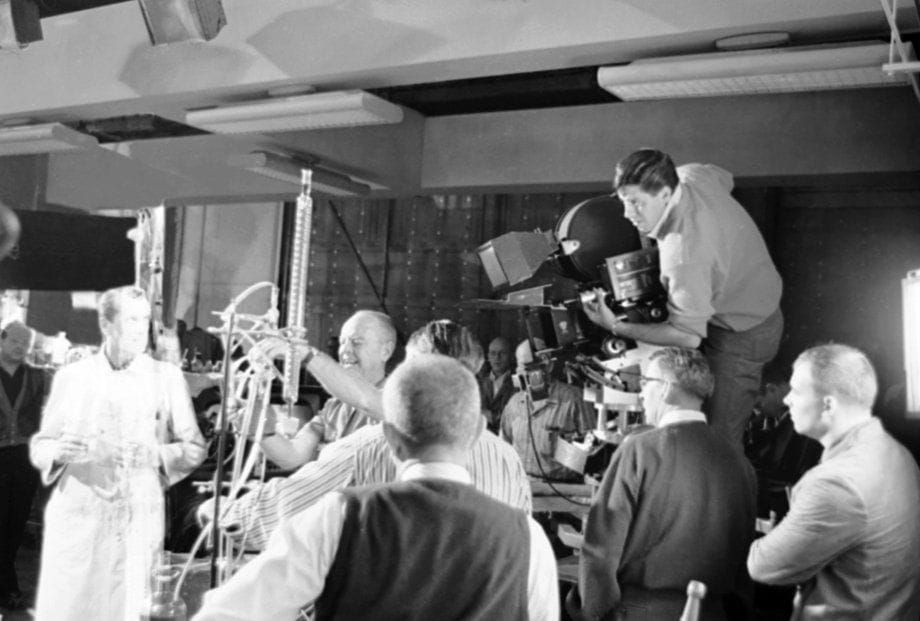
Corman slotted into this operation as its primary production engine. He made his first picture, Monster from the Ocean Floor, in 1954, for six days and $12,000. By the late 1950s he had refined his method to something close to a system. He would scout locations exhaustively and then design the shoot around what was available for free. He would run multiple productions simultaneously, using the same sets, the same crew, sometimes the same actors in different costumes. He would cannibalize his own footage mercilessly — a shot of a building exterior from one film would appear in three others.
The speed wasn't just an economic necessity. Corman understood that speed itself was a competitive advantage. If a major studio decided to make a picture about juvenile delinquency, it would take two years from greenlight to release. Corman could have three juvenile delinquency pictures in theaters before the majors finished their first casting session.
The Poe cycle and what it proved
In 1960 Corman made a film that quietly demonstrated something important about what the exploitation apparatus was actually capable of.
House of Usher, based on the Poe story and shot in fifteen days with Vincent Price, was not the kind of film AIP had been making. It had genuine production design — beautiful widescreen cinematography by Floyd Crosby, real Gothic atmosphere, a Price performance of controlled intensity that's still worth watching. It cost roughly $300,000, which was extravagant by AIP standards. It made $1.4 million in its initial domestic release.
This launched an eight-film cycle of Poe adaptations that ran through 1964 and represents Corman at the peak of his powers. The Masque of the Red Death (1964) is the most accomplished — shot in England using leftover sets from other productions, with cinematography by Nicolas Roeg, it is a genuinely beautiful film that holds up against anything the prestige cinema of its era produced. The constraint that had always been Corman's engine — limited time, limited money — turned out to produce interesting aesthetic results when pointed at material with real literary substance.
The Poe cycle also confirmed something about Price that mainstream Hollywood had failed to notice: that here was an actor of real intelligence and range, capable of playing genuine menace and genuine pathos, who was being wasted on the margins of the industry. Corman understood Price's gifts and used them. Price returned the favor by giving the AIP pictures more dignity than their budgets deserved.
The school
The more durable legacy, though, is the people Corman trained.
The Corman method had a specific pedagogy, which was: here is a very small amount of money and a very short amount of time, now make something. The constraints were genuine — no safety net, no do-overs, no reshoots — and they forced young filmmakers to develop judgment fast. You couldn't afford to wait for the perfect setup. You had to know what you needed, get it, and move.
Coppola directed Dementia 13 for Corman in 1963, essentially as payment for Corman taking him to Europe on another production. Bogdanovich directed Targets in 1968, famously using leftover Karloff footage from a Corman picture. Scorsese made Boxcar Bertha in 1972, after which John Cassavetes told him he'd "just spent a year of his life making a piece of shit" — which is true, but it taught Scorsese to control a production, which made Mean Streets possible.
James Cameron was fired from his first Hollywood job as a miniatures director on Battle Beyond the Stars (1980), one of the late AIP space-opera productions trying to cash in on Star Wars, and went back to driving trucks for a while. He returned and eventually directed second unit on several Corman productions, learning the technical vocabulary that would make The Terminator possible on its shoestring budget.
Jack Nicholson appeared in something like nine Corman pictures before Easy Rider made him famous. He was not the lead in most of them. He was the guy who showed up, hit his marks, delivered his lines with more intelligence than the script deserved, and got paid. The discipline that produces that kind of professionalism — showing up, doing the work, not waiting for better material — is not nothing.
The legacy
Corman produced over 500 films. He directed 56. He never won a competitive Oscar (the Academy gave him an honorary one in 2009, which felt slightly like the establishment acknowledging a debt it had been slow to pay). He is ninety-seven years old as of this writing and still, reportedly, working.
What he built was not just a studio or a body of films. It was a functional alternative to the development system that Hollywood ran — a place where the only way to learn was to do, where failure was immediate and consequential, and where success meant you'd be given another chance to do it again, slightly faster and for slightly less money.
The films themselves range from genuinely great (The Masque of the Red Death, The Intruder, A Bucket of Blood) to skillfully entertaining (Little Shop of Horrors, the biker pictures, most of the Poe cycle) to purely functional (everything else — the product that filled the drive-ins Thursday through Sunday and whose main virtue was existing and being on time). Almost none of them are boring. That, in the end, may be the most honest thing you can say about the entire enterprise: Roger Corman made films that were alive, even when they were cheap, even when they were rushed, even when they were, by any objective measure, not very good.
For a certain kind of movie lover, that turns out to be enough. For me, it's more than enough. It's the whole point.
Now, on to the series: First up is the early B-movie SciFi, trick photography, rubber suits, and incessant scare tactics.
 Share on Bluesky
 Share on Threads
 Share on Facebook
 Share on Mastodon
 Share on Reddit
 Share on LinkedIn
 Share on Email