Never Trump Isn't a Conversion. It's a Business Model
The people who claim to be saving democracy have made a very comfortable living not quite doing that.

I have to apologize, I have been on a tear lately, and it has been hyper-critical of the folks at The Bulwark, and Lincoln Project/Lincoln Square. I am just getting tired of their criticism of the Democrats for not listening to them, and yet they are making bank. I will try to get less negative in the future
The recen humble-brag of The Bulwark reporting that they have 1M free subcribers (tbh - I thought they were way above that) and how they are a "media" company first really got under my skin, hence this post...
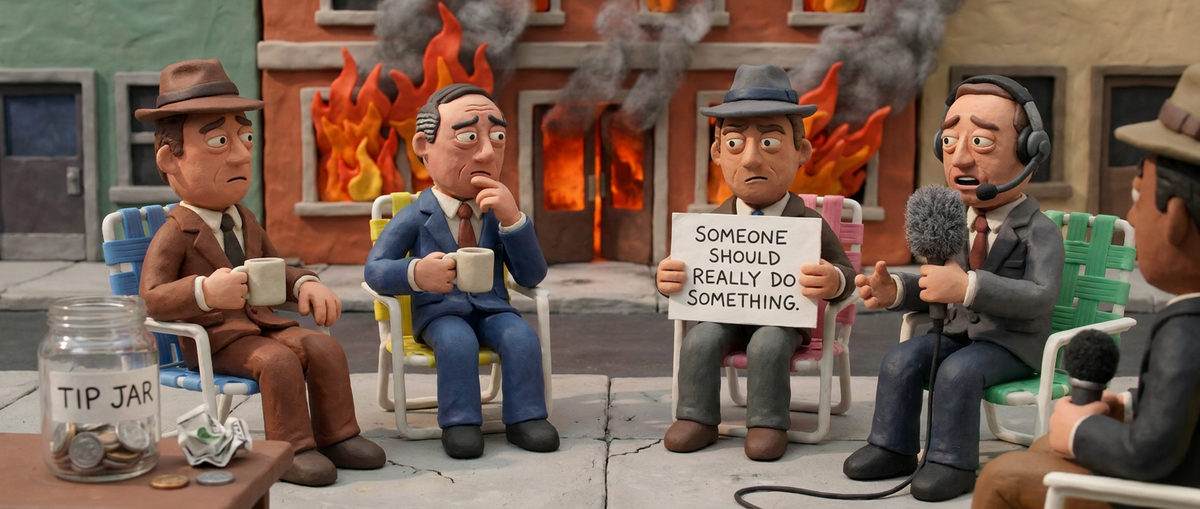
Let's start with a simple thought experiment. You work alongside someone for twenty years. They helped build the thing you're both part of. They recruited the donors, ran the strategy, wrote the messaging, cashed the checks. Then one day a genuinely dangerous man takes over the organization, and your colleague walks out, stands on the sidewalk outside, and starts telling anyone with a microphone that the organization has gone to hell and someone needs to stop it.
Good for them, right? Moral clarity. Better late than never.
Except they never actually join anything else. They just stay on the sidewalk. And they've monetized the sidewalk remarkably well.
That is the Never Trump movement in its entirety, and it's time to say that clearly.
The roster is familiar by now. Bill Kristol, the architect of the Iraq War and the man who looked at Sarah Palin and saw a viable national figure, now holds court as a defender of democratic norms. David Frum, who coined "Axis of Evil" and helped build the rhetorical infrastructure for twenty years of foreign policy adventurism, is now your Resistance uncle at The Atlantic. Charlie Sykes spent decades as a conservative talk radio host in Wisconsin helping build the very media radicalization machine he now spends his days lamenting. Steve Schmidt ran John McCain's 2008 campaign, introducing Sarah Palin to the national stage, and has since built a subscription newsletter where outrage about the very Republican Party he helped build will cost you a monthly fee to access. In addition to being the publisher of The Bulwark, Sarah Longwell runs a polling and research organization while hosting approximately four podcasts about why everyone else isn't doing enough.
These are the people who want – nay demand – a seat at the adult table for whatever comes next. And the tell is in everything they've done to position themselves for it.
The "Small 'c' Conservative" Costume
The universal self-description in this world is some variation of "I'm still a conservative, just a small 'c' conservative." It gets deployed with the reverence of someone explaining they only drink single-origin pour-over, the implication being that their conservatism is artisanal, Burkean, fundamentally different in character from the MAGA stuff. Thoughtful. Principled. Old school.
Edmund Burke was actually skeptical of ideological abstraction and believed in the accumulated wisdom of institutions built over generations. Fine. What these people mean when they invoke that tradition is, roughly: lower marginal tax rates, residual hawkishness on foreign policy, and a vague preference for "fiscal responsibility" that nobody applied when their party was running up deficits under Bush and then Trump. That's not Burkean conservatism. That's the GOP donor class preference set wearing a tweed blazer.
The "small 'c'" framing is doing enormous psychological work. It provides retroactive absolution. If you were always a different, more refined kind of conservative, then you weren't really complicit in what the party became. You were a principled outlier who finally had to leave. This is psychologically useful but historically suspect. These people ran the campaigns, built the donor networks, cultivated the evangelical coalition, and in some cases pioneered the very tactics of racial resentment politics and anti-institutional rhetoric that MAGA then operationalized at scale.
Because here's what genuine Burkean conservatism, applied honestly to the last four decades, would actually require them to reckon with: they were the radicals. Supply-side economics was a revolutionary ideological project imposed on the American economy against the accumulated wisdom of decades of policy. Neoconservative foreign policy was explicitly about remaking the Middle East at gunpoint, which is about as far from Burkean prudence as you can get while still wearing a suit. The deliberate cultivation of talk radio as a radicalization pipeline, the Southern Strategy's long-term rot, the Moral Majority coalition that was always going to curdle into something authoritarian eventually - none of that looks like reverence for inherited institutions in retrospect.
They built the machine. Trump just took the keys and mashed the accelerator.
The Test They Keep Failing
Here's the thing about genuine conversion: it's falsifiable. You can tell if it's real because it requires you to sacrifice something.
Liz Cheney has politics that are hard right on most things and she's not someone you'd call a Democrat. But she lost her seat, lost her standing in her party, and has declined the comfortable media career that was waiting for her. You can disagree with everything she believes and still recognize the shape of actual conviction. She paid a real price.
The Never Trump media class has paid approximately nothing. What they have sacrificed, if we're being precise, is one revenue stream, which they promptly replaced with a different and in several cases more lucrative one. Oh sure, they lost friends and colleagues. Big fuckin' deal.
The martyrdom narrative is consistent across the cohort. They'll tell you, with genuine feeling, about the consulting contracts that dried up, the Republican donor networks that went cold, the Washington dinner party invitations that stopped coming, the professional isolation. Some version of "I lost everything" is essentially a genre requirement at this point. And look, some of that is probably true. Republican campaigns stopped returning calls. Certain doors closed.
But watch where they went instead. The Lincoln Project - founded by Schmidt, Rick Wilson, Reed Galen, John Weaver, and George Conway among others - raised north of $90 million during the 2020 cycle alone. A substantial and well-documented portion of that money flowed back to firms owned and operated by its founders:
The Lincoln Project didn't leave the consulting business. It found a new set of clients - liberal donors terrified of Trump - and billed them with the same enthusiasm it had previously billed Republican PACs. The clients changed. The invoices did not stop.
Schmidt specifically deserves the forensic colonoscopy here. After the Lincoln Project collapsed in a cascade of financial questions and the John Weaver harassment scandal, a lesser grifter might have taken a beat. Schmidt did not take a beat. He built The Warning, a Substack pulling over 178,000 subscribers where his urgent, ongoing warnings about the collapse of American democracy are available to you for a small monthly fee. The second home at the seashore may or may not still exist - we don't have his Zillow history - but the revenue did not stop. It just got rebranded as resistance.
Kristol runs The Bulwark, which is a legitimate media operation with real editorial standards and real subscribers, funded largely by liberal donor money including significant support from Reid Hoffman. Sykes podcasts for The Bulwark. Longwell runs Defending Democracy Together and the Republican Accountability Project (whose website, as of this writing, returns a server timeout - accountability, it turns out, has an expiration date), both of which are nonprofit entities with real budgets and real staff. Frum has the full Atlantic platform behind him. These people are not suffering. They are, in the vocabulary of the industry they came from, fully booked.
The professional network loss is also worth examining closely, because what actually happened is a swap, not a sacrifice. The Republican donor class went cold. The liberal professional donor class – Reid Hoffman, the usual suspects in Silicon Valley and on the coasts – went very warm, very fast. MSNBC discovered they book well. The Atlantic publishes them. The conference circuit in Aspen and Sun Valley still wants them on panels, just different panels. The zip codes at the seashore may have changed. The seashore did not disappear.
The most clarifying question you can ask any of them is simple: why haven't you registered as a Democrat?
The answers are instructive. The most common is "I'm more valuable as a conservative voice making the case to other conservatives," which sounds principled but is functionally identical to "I retain more influence and market value by staying outside the tent." The other common formulation is "I can't endorse everything the Democratic Party stands for," which is a standard that no actual Democrat applies to themselves. Democratic coalition members disagree with their party constantly. They join anyway, because politics is coalition building, not ideological purity.
An actual convert accepts accountability. They do unglamorous work. They knock on doors for candidates whose entire platform they don't fully share. They lose arguments inside the coalition and accept the outcome. They stop being commentators and become participants.
None of them have done this. And that choice – at every fork in the road, choosing the media platform over the party registration, the pundit credential over the precinct captain role – is the tell. The behavior is perfectly explained by "maximize influence from outside any accountable coalition." It is not well explained by "I genuinely believe democracy is under existential threat."
The Chicken Little Problem
The content itself keeps circling back to democracy. The health of institutions. The erosion of norms. The threat to the republic. It is, without question, their organizing principle, and it is, without question, almost entirely failing to move the electorate they claim to be trying to reach.
This is Chicken Little dynamics with a structural explanation underneath. The sky has been falling, according to this cohort, since June 2015 when Trump descended an escalator. That's a decade of sky-falling warnings, and for most people's material reality, the sky has remained substantially intact. The rent is still due. The insulin is still expensive. The school is still the same school. Democratic erosion works slowly, then suddenly, and the "slowly" phase looks like normalcy to anyone not watching the institutional architecture for a living.
Abstract institutions don't bleed. And the Never Trump world has spent a decade asking the working class to be more outraged about things they cannot feel than about things that are actively breaking them.
The problem is that this entire cohort lives at the level of institutional politics. Former operatives, consultants, lawyers, media figures. Democracy is their professional ecosystem. Its health is their livelihood in a very literal sense. So when they say democracy is the issue, they're not wrong exactly, but they're also people for whom democratic dysfunction is the most personally legible threat. They feel it in ways a nurse in Akron or a warehouse worker in Fresno cannot.
And here's where the business model critique bites hardest. "Democracy preservation" is a content category that is enormously productive for podcast revenue, Substack subscriptions, and conference invitations among the professional and donor class that consumes this material. It works perfectly for the actual audience they're serving. It just doesn't work for the broader electorate. If you're optimizing for adjacency and revenue rather than genuine political change, that is a feature, not a bug.
What They Actually Want Back
Strip away the democracy framing and what you find, pretty consistently, is a restoration project dressed as a reform project.
The economic orthodoxies are almost entirely intact. Nobody in this cohort has done serious reckoning with the forty-year track record of trickle-down economics – the wage stagnation, the hollowing of the middle, the concentration of wealth that produced the conditions for a demagogue to exploit. They diagnosed the fever without asking what broke the immune system.
The foreign policy adventurism is even less examined. The neoconservative strain running through this world never faced accountability for Iraq, for the democracy promotion project that burned through trillions. Their critique of Trump's foreign policy is largely that he was insufficiently committed to the project they were insufficiently skeptical of.
And the cultural tells are the sharpest indicators of all. Watch what happens when the conversation moves from same-sex marriage – a battle that's over, which makes defending it cost nothing – to trans recognition, to genuine structural reckoning with racism, to immigration as anything other than a "messaging problem" for Democrats. The framing shifts immediately to Democrats are being politically stupid by caring about this. Which is a very clean way of expressing cultural disapproval while maintaining plausible deniability. The advice always lands in the same place: do less for the people at the margins. That is a suspicious coincidence that recurs too reliably to be purely tactical.
What they want is to excise the MAGA nightmare and return to the pre-2015 Republican project - Reaganite economics, muscular foreign policy, a cultural settlement that stops somewhere around 2012. The party back, or failing that, enough influence over whatever replaces it to keep the fundamental architecture intact.
The Electorate Won't Cooperate
The deeper problem for all of them is that the electorate has shifted in ways that make the restoration fantasy structurally incoherent.
The Republican coalition was always a sliver of country club donors and chamber of commerce types underwritten by the Southern Strategy's racial resentment, the religious right's moral panic, and a working class that was told it was one more tax cut away from prosperity. The "respectable" Republicans were always outnumbered within their own coalition. Trump didn't corrupt it. He revealed its actual composition by stopping the management act.
The voters the Never Trump cohort needs to retake any version of a center-right movement are the voters who think they're the problem. There's no path there. And the mythical moderate suburban voter who wants Reaganite economics without the racism doesn't exist in the numbers required to constitute a governing coalition. The math only ever worked with the ugly parts included.
So what you're left with is a group of very media-savvy former Republican operatives with large platforms, no party, no real constituency, and a very detailed set of opinions about what Democrats should do differently.
They want a seat at the adult table in a room they no longer have a constituency in, offering ideas the electorate has largely rejected, funded by an audience that is mostly looking for sophisticated permission to feel worried.
The fraying that's currently visible between this cohort and the actual Democratic coalition is the predictable endpoint of a coalition of convenience built around a single negative. You can hold a coalition together against something. Holding it together for something requires shared interests, and the interests here were never actually shared. They were temporarily aligned against a common threat.
That alignment is running out. And when it does, what remains is exactly what this always was: a very comfortable arrangement for people who are very good at finding comfortable arrangements, funded by an anxious donor class, consumed by a professional class audience, changing very little, and positioned to continue not changing very little for as long as the threat they're defined against remains useful.
Which, come to think of it, gives them every incentive in the world to make sure it does.
If you've found this useful, the subscribe button is free. Unlike some people's democracy content.