The Barnacle Archetype
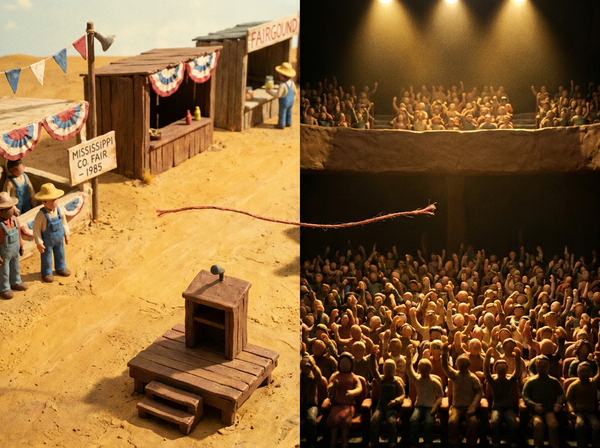
Donor-class preferences enter the All-In podcast as private consensus, exit as public analysis, and arrive at the policy table already formatted for legislative language. It's not a debate show. It's a credibility laundromat with a Spotify deal.

PayPal Mafia, Part 2: The Amplification Machine
Every network needs a broadcast layer. The PayPal Mafia built theirs by accident and then institutionalized it deliberately, in the form of a podcast called All-In, hosted by four men who together have enough money to buy a mid-sized country and enough mutual agreement to make the whole arrangement feel, to the casual listener, like a debate show. It is not a debate show. It is a donor-class focus group with production values and a Spotify deal, and it has been more effective at laundering Silicon Valley's political priors into mainstream discourse than anything the network produced intentionally.
This post is about the broadcast layer: who runs it, how it works, and what it costs the rest of us.
I. The Franchise
The All-In podcast launched in 2020, ostensibly as a casual conversation between four friends who happened to be extraordinarily wealthy. The four: David Sacks, Jason Calacanis, David Friedberg, and Chamath Palihapitiya. Their self-assigned nicknames — "the dictator," "the world's greatest salesman," "the rain man," "the Sultan of Science" — tell you roughly everything you need to know about the register of self-regard the show operates in. Each episode runs two to three hours. The topics skew toward technology, economics, and politics. The format is four men who broadly agree on most things arguing about the degree to which they agree, with occasional controlled dissent that resolves, within the episode, in consensus.
The show's claimed independence is its primary asset. These are not official spokespeople for any political party or investment portfolio. They are friends having a candid conversation. This framing survives only if you don't look at the overlapping financial interests, the shared political donors, the Signal chats — the one from Post 1 of this series — that workshopped the same arguments you'll hear on the pod the following week, or the fact that the "candid conversation" reliably reaches the same conclusions about regulation, taxation, and government that you'd expect from four men whose combined net worth exceeds the GDP of several sovereign nations.
The reach is real regardless. The show gets millions of downloads. It is covered seriously by the tech press. Its arguments circulate into the broader political conversation via clip culture and the X accounts of hosts who each have millions of followers. When the Signal chat was floating arguments about California's wealth tax being socialism and civilizational sabotage last year, those arguments were already formatted for the All-In audience. The private panic and the public broadcast are the same operation, at different compression levels.
II. Sacks: The Doctrine Builder
David Sacks is the only All-In host who is PayPal Mafia proper. He joined Confinity as COO before the eBay acquisition, worked inside the machine long enough to absorb its culture and walk out with enough capital and credibility to matter, and has since built a career on a specific and coherent ideology that is more disciplined than Musk's chaos and less apocalyptic than Thiel's theology but shares the same foundation: regulatory capture is the enemy, disruption is the good, the state is the problem, and the people running things now are doing it wrong.
The founding document of Sacks's public persona is a piece he wrote in March 2020, in the early weeks of COVID lockdowns, arguing that shelter-in-place orders were destroying the economy and that the cure was worse than the disease. He was wrong about the public health tradeoffs in ways that subsequent mortality data made clear, and he has never substantially updated the original argument. The piece made him a hero to the libertarian-contrarian circuit and established the persona: the man willing to say the uncomfortable thing that the consensus didn't want to hear. That persona has been his most durable asset.
From there: All-In as the platform, Craft Ventures as the financial base, and then, in January 2025, the White House. Trump appointed Sacks as AI and crypto czar — a special government employee designation with a 130-day service cap. In that role, Sacks shepherded the GENIUS Act, a stablecoin regulatory framework, through to passage. He did not finish the CLARITY Act, the broader crypto market structure bill that was his other stated priority. When his 130 days expired in March 2026, he rotated onto the President's Council of Advisors on Science and Technology as co-chair — a promotion, despite the unfinished mandate, which is the kind of outcome that is available to people who are in the network and not available to people who aren't.
The conflict of interest thread running through Sacks's government service has never been fully resolved. He held or had recently held investments in cryptocurrency and stablecoin ventures at the time he was writing cryptocurrency and stablecoin regulation. The standard government ethics process applies to special government employees, but the short-term nature of the SGE designation creates gaps that have been widely noted by good-government advocates and widely ignored by the people with the authority to do something about them. Sacks disclosed what he was required to disclose. Whether what he was required to disclose was sufficient to the actual conflict is a different question, and one that the administration has not found it necessary to answer.
What Sacks does for the PayPal Mafia that Thiel doesn't and Musk won't is provide a coherent doctrine that sounds like policy analysis rather than grievance. Thiel gives you theology and democracy skepticism. Musk gives you chaos and a timeline. Sacks gives you a PowerPoint — structured arguments, economic frameworks, regulatory critique that sounds like it was written for a Congressional hearing rather than a CPAC audience. This is the specific value he adds to the network: respectability coating over the same underlying priors. On All-In, he is the one who makes the donor-class consensus sound like it was reasoned from first principles.
III. Calacanis: The Barnacle Archetype
Jason Calacanis is not PayPal Mafia. He was a tech journalist and blogger in the early internet era, made his first real money through early angel investments — including Uber, where a small early check turned into generational wealth — and built a career at the intersection of tech commentary and seed investing that does not fit neatly into either category and benefits from the ambiguity. His name appears on the list of members in the Signal chat from last fall. His voice is one of the four on All-In. His presence in the inner circle of the Silicon Valley political moment of 2025-2026 would puzzle anyone who tried to explain it purely in terms of his professional accomplishments.
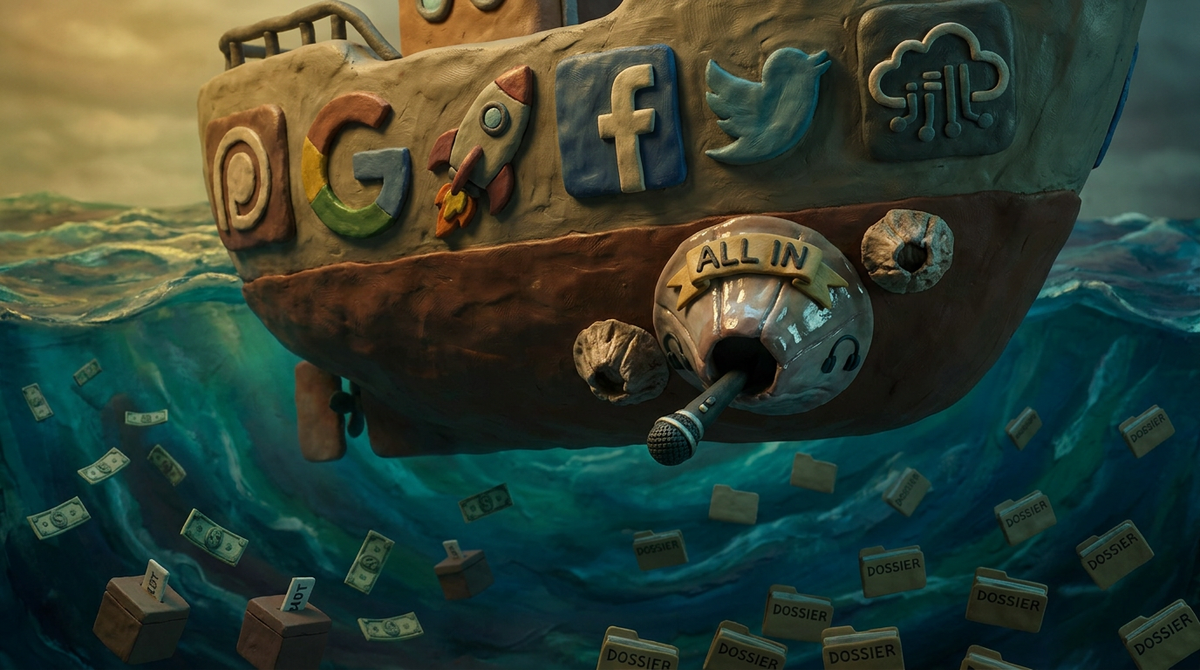
This is the barnacle archetype, and it requires some care to describe precisely, because the barnacle is not a failure. A barnacle is a highly successful organism. It attaches to a larger organism, extracts nutrients from the surrounding water that the larger organism moves through, and is extremely difficult to remove once established. Calacanis found the hull — the Sacks and Thiel network — attached at the waterline, and has been carried along ever since, performing the function of barnacles everywhere: making the surface rougher for anyone swimming nearby while going wherever the ship goes.
His specific function in the network is attack dog and amplifier. When the All-In hosts collectively decide something needs to be said aggressively — a politician needs to be threatened, a journalist needs to be dismissed, a regulatory proposal needs to be characterized as confiscation — Calacanis is reliably the voice who says it loudest and least carefully. The principals maintain a degree of remove. He does not. When Rep. Ro Khanna tweeted support for the California wealth tax last year, it was Calacanis who immediately characterized it as confiscation and illegal and certain to destroy the state, while Garry Tan worried about civilization. The attack dog function is valuable precisely because it gives the network's actual power players distance from the aggression. Calacanis performs the id. Sacks performs the superego. The target still gets hit.
The Uber investment is worth dwelling on for a moment, not because it's illegitimate — it isn't — but because it illustrates how the barnacle attachment works. Calacanis got into Uber early because his network, built on tech commentary and proximity to the PayPal circle, put him in rooms where Travis Kalanick was pitching. The investment compounded because Uber compounded. The credibility from the Uber outcome opened doors to more investments, more podcast reach, more political proximity, which opened more doors. At no point in this chain does "Jason Calacanis built something" appear as a node. The compounding is real. The substrate it's compounding on is social capital accumulated through proximity, not through building.
None of this is unique to Calacanis. The barnacle archetype is common in every industry where networks compound faster than individual achievement does. What makes him the purest instance in this particular ecosystem is the completeness of the attachment: his public identity, his investment thesis, his political positioning, and his media platform are all downstream of the same hull. If the Sacks-Thiel network moved to different waters, Calacanis would presumably follow.
IV. The Chorus
Friedberg and Chamath are worth naming briefly, because the All-In foursome doesn't make sense with only two characters.
David Friedberg runs The Production Board, an agricultural technology investment firm, and provides All-In with its sciency veneer — he's the one who reaches for data and biological analogies when the conversation needs to sound empirical. His actual contribution to the political project is modest; his contribution to the podcast's credibility as something other than political advocacy is significant. When Friedberg says something sounds reasonable, it sounds like a scientist said it rather than a donor. That's the function.
Chamath Palihapitiya is the most complex of the four and the most revealing about the limits of the barnacle analogy. He was an early Facebook VP — not PayPal — and joined the network through the venture capital ecosystem rather than through the founding team. He built Social Capital, made substantial returns including a prescient early investment in Slack, and then became the primary public face of the SPAC boom of 2020-2021, taking multiple companies public through special purpose acquisition vehicles at valuations that proved, in most cases, to have been optimistic. Retail investors who bought those SPACs at the heights largely lost money. Chamath did not lose money at the same rates, because his economics as the SPAC sponsor were different from the economics of investors who bought in later. He has not addressed this asymmetry with anything resembling accountability and has instead pivoted to AI investing while maintaining the "contrarian outsider" personal brand that his role in the SPAC boom should have put under more pressure than it did.
His specific contribution to All-In is the "scrappy immigrant who made it" narrative — he's from Sri Lanka, came to North America as a child, worked his way up, and frames his political positions through that lens. The framing survives on the show largely because nobody pushes back on the gap between the "outsider" identity and the insider reality of a man who is worth several billion dollars, sits in the Signal chat with Brin and Andreessen, and has structured financial products in ways that extracted value from the people most vulnerable to believing the outsider story.
V. The Machine
Put it together and you have something more sophisticated than a political action committee and more durable than a Super PAC. The All-In broadcast layer takes the network's actual political preferences — formed in group chats, Signal chains, and private dinners — and converts them into apparently independent commentary that circulates into the mainstream political conversation with the credibility of financial expertise attached to it. The arguments that appeared in the California tax fight Signal chain in the fall last year were All-In arguments by the following week. The "debanking" narrative — the claim that financial institutions have been weaponized against conservative-adjacent tech figures — was workshopped on All-In for months before it became a DOGE talking point. The framing of AI regulation as existential threat to American competitiveness was an All-In through-line for two years before it appeared in the executive orders Sacks was helping draft.
This is the amplification machine's actual output: not content, but credibility laundering. Donor-class preferences enter as private consensus, exit as public analysis, and arrive at the policy table already formatted for legislative language. The PayPal Mafia spent twenty years building the companies. The All-In podcast spent five years building the narrative infrastructure to protect them. The barnacle attached at exactly the right moment, and the hull went exactly where it needed to go.
Thanks for reading Sweaty Spice. Subscribe for free to receive new posts and support my work.
Like what you've read? Do me a solid and share with friends, and on the socials!