
There is no "Buckley Moment" Coming
History has three ways this ends: the extremists win, the party dies, or everyone pretends to make up and don't. Pick your favorite, because 'grow a spine' isn't on the menu.


A Democratic National Convention comment section is a strange place to find the most honest political analysis of the year, but that's where this one started.
I. The Comment That Won't Let Go
Responding to David French's piece on the postliberal right, a commenter going by Biker laid out something worth sitting with. Democrats cannot defeat MAGA. The party brand is too toxic in the places that matter, the DNC too incompetent to fix it, and even a Democratic win doesn't touch the thing that actually needs fixing. Only a Republican movement can do that, and it can't be a return to Romney-style economics either, because that's part of what produced MAGA in the first place. French agreed with the first half. MAGA doesn't die until it's defeated inside the GOP, because as long as it controls a major party, it's never more than one election from power.
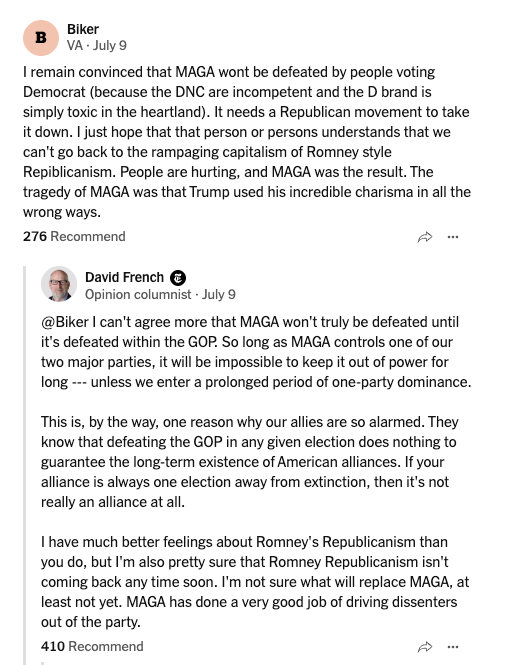
That's correct as far as it goes. It leaves the actual question sitting there unanswered. Has a major American political party ever done this? Has one ever looked at a captured extremist faction inside its own coalition and successfully cut it out, cleanly, and gone back to being a functional, coherent party afterward?
The honest answer, once you go looking, is no. Not once. And more recently, not on the left either, which is the part nobody invoking the Buckley model wants to sit with.
II. The Myth Everyone Cites
Ask anyone what the model for this looks like and they'll point you to William F. Buckley excommunicating the John Birch Society from conservatism in 1962, the moment National Review is supposed to have made the movement respectable by driving out the conspiracy theorists. It's the story pundits reach for every time they call on today's GOP to find its backbone.
The trouble is the story is mostly myth. Buckley wrote a sharp editorial calling Birch Society founder Robert Welch a man "far removed from common sense." That happened, and it's real. What didn't happen is everything the legend implies came after. There was no mass exodus from the Birch Society. National Review was one voice inside a much larger movement, without the power to excommunicate anyone from it. When Barry Goldwater actually captured the Republican nomination two years later, it wasn't Buckley's respectable conservatism that dominated the movement. It was the Birchers. The editorial was real. The purge? Not so much.
III. Three Precedents, Zero Clean Wins
Widen the lens past Buckley and the pattern doesn't improve.
The Whig Party never even attempted a purge. Slavery split the coalition into anti-slavery Conscience Whigs and pro-South Cotton Whigs who could not be held together any longer. Rather than expelling either side, the party dissolved entirely, in about two years. A Whig president occupied the White House as late as winter 1853. By fall 1855 the party was effectively extinct, its members scattered into the new Republican Party and the nativist Know-Nothing movement. No cleanup. Just collapse.
The Dixiecrats are the closest thing to a genuine schism the two-party system has actually produced, and even that one didn't resolve the way it's remembered. In 1948, national Democrats pushed through a strong civil rights plank over Southern objection, 651½ to 582½. Only 35 of 278 Southern delegates actually walked out, most of them from Mississippi and Alabama, while the majority of Southern Democrats stayed and voted no instead of bolting. The walkout faction founded the States' Rights Democratic Party, ran Strom Thurmond for president, won four states, and lost. Within four years, most of their leadership had quietly rejoined the Democratic Party, unpunished and unexcluded. Thurmond himself didn't become a Republican until 1964, sixteen years after the walkout that was supposed to have settled things.
Fought and lost. Never fought, and shattered instead. Walked out and came crawling back, on its own terms, on its own schedule. Those are the only three outcomes on record.
IV. It Was Never About Willpower
The instinct is to read all three as failures of nerve, parties that just needed more courage than they had. I don't think that's right, and I think it's the more comfortable explanation, because it implies the fix is simple. Find braver Republicans. The refrain you hear about the YOLO Senate Caucus, Tillis, Cassidy Cornyn, and Thomas Massie in the House being untethered and freed to go against Trump, yeah, they're still cowering toadies (ok, well Massie is showing some fight, but it is all demonstrative.)
Look again at what each party actually needed from the faction it couldn't expel. Goldwater couldn't disavow the Birchers because Birchers were his volunteers, his donors, his votes in the states where his campaign lived or died. National Democrats took the Dixiecrats back because the Solid South's electoral votes were not optional. The Whigs didn't even get the option of choosing, because holding either faction meant losing the other outright.
In every case, the faction controlled something the rest of the party needed more than it needed its own coherence. That's not a failure of will. It's a structural fact about coalition politics, and it has never once yielded to somebody finally getting serious about it. Whatever version of that dependency exists inside today's GOP is not smaller than it was in 1948 or 1964. It's total. The Birchers and the Dixiecrats needed to be courted by party elites who still held the levers. MAGA doesn't need courting. It deposed the elites who would have done it, and it did that eight years ago.
V. It's Not Just the Right
Here's the part that makes this harder to write off as a one-sided argument about conservative rot. It's worth noting that French himself is a useful witness to Section II, not just a commentator on it. He's written that he grew up tracing his own political origin to Goldwater's 1964 convention line about extremism in defense of liberty being no vice, that something about the zeal in those words spoke to him as a young man. That's a first-person confirmation, from someone who lived it, that the Birch-dominant moment wasn't a footnote. It was formative for an entire generation of the movement that came after it.
French's actual argument in that piece goes further than the history, though. He argues both sides have swapped virtue-by-ideology for virtue-by-character, but that only Democrats still have a functioning floor. His example is Graham Platner, the Maine Senate candidate whose supporters defended him through an alleged Nazi tattoo and a sexting scandal, right up until a former girlfriend's rape allegation surfaced. At that point, French notes, the party said enough, and Platner withdrew.
He's right that the floor held. He's wrong that it tells you much about the party having one on a reliable basis, because the two other available comparisons complicate the claim in opposite directions.
Al Franken didn't get a deliberative floor at all. He got a stampede. When multiple women accused him of groping or forced kissing in November and December of 2017, more than half the Senate Democratic caucus called for his resignation within about 24 hours of the last allegation landing, before any ethics investigation concluded. He resigned effective January 2018. The relitigating started almost immediately and never really stopped. Joe Manchin called it the most hypocritical thing he'd ever seen. By 2019, multiple Democratic senators, and Franken himself, said out loud that they regretted how fast it happened. That's not a party enforcing a considered standard. That's a party moving at the speed of Twitter and living with the hangover for years.
Andrew Cuomo is the opposite failure mode. He resigned as governor in 2021 after New York's attorney general documented harassment allegations from nearly a dozen women, and by any measure that should have been disqualifying. It wasn't, at least not permanently. He announced a comeback bid for New York City mayor in March 2025, was the frontrunner, and led primary polling into June. The party establishment didn't stop him. Voters did, twice, in two different election formats, handing Zohran Mamdani a decisive primary win and then an eight-point general election win after Cuomo tried again as an independent with Trump's own endorsement in tow.
Put the three side by side and French's "Democrats have a floor" claim turns into something less flattering and more interesting. The floor isn't institutional. It's electoral, and it only shows up when something breaks through badly enough that voters themselves impose it, at the ballot box or in a primary, months or years after the party's own machinery had already shown it was willing to look away. That's not a party gatekeeping its own extremism. That's a party mostly following pressure instead of leading it, which happens to be exactly the description that fits the GOP's relationship to MAGA too, just with a different outcome so far.
VI. Nobody Comes Out of This Looking Good
Which brings us to the part of the Platner story that actually confirms the whole thesis of this piece, live, in real time, on the other side of the aisle.
Once the allegation that finally moved the needle surfaced, the reaction from Platner's loudest online defenders wasn't contrition. It was escalation. Naked Capitalism ran a piece framing the withdrawal as an "establishment machine" operation aimed at destroying "the agenda on which he was elected," casting the Maine party's response as nasty insiders grabbing factional power rather than people trying to win a Senate seat, and naming the party's top donors by name as the real culprits. The Lever ran Matt Stoller's essay making the same case, framing the episode as corporate Democrats weaponizing Platner's demise to delegitimize the party's own anti-establishment left. Ken Klippenstein's own piece after Platner's primary win argued the party's real message to voters was that the electorate couldn't be trusted, pointing to Cuomo and Janet Mills as the kind of candidate the establishment preferred instead.
Worth being honest about who's saying this. Klippenstein spent the run-up to the rape allegation calling Platner's critics "smoothgroins," a real-life-Ken-doll insult aimed at anyone who thought a Nazi tattoo and a sexting scandal were worth pausing over. Stoller dismissed the same concerns as "Dem HR lady politics," which is a genuinely strange hill for a man who has spent two decades building a serious reputation on antitrust and monopoly policy to plant a flag on. Stoller's actual body of work, the Amazon and Google cases, the Goliath book, the monopoly-power-as-democratic-threat argument, is good and worth defending on its own terms. None of that requires sneering at HR departments or deciding that concern about an abuse allegation is a symptom of corporate wokeness. That's a newer habit, and not as new as Platner either. Stoller's been calling "woke" language authoritarian and aristocratic for years now, well before this particular campaign gave him a live case to test the theory on. Worth its own piece someday, the specific mechanism by which a genuinely sharp antitrust guy talked himself into treating a rape allegation as a front in the culture war. Not today's problem, but a real one.
The point for this piece isn't Stoller specifically. It's the pattern he's currently the best example of. A faction that loses a fight over its own extremism doesn't get chastened. It reframes the loss as proof the enforcers were illegitimate all along, and comes out the other side more hostile to the institution than before. That's the Birchers not accepting Buckley. That's the Dixiecrats treating the 1948 plank as an attack rather than a vote they lost fair and square. It just used to take these factions years or decades to fully process that reaction and act on it. Now it takes about a news cycle, because nobody needs the party's permission to say so out loud to a large audience anymore. The disintermediation that let Trump go around the RNC works exactly the same way for Stoller going around the DNC. Same mechanism, different studio.
VII. Two Generations, Minimum
If MAGA resolves anything like these precedents resolved, it isn't resolving on an election cycle. It's resolving on a generational one.
The Dixiecrat bloc didn't find its final political home until 1964, sixteen years after the walkout that was supposed to be the reckoning. The Whig-to-Republican realignment took most of a decade just to sort itself into stable new coalitions, and it only got there by way of a party dying first. Neither timeline maps onto the next midterm or even the next two-term presidency. They map onto the slow turnover of who's actually voting, who's actually running for office, and which fights the next cohort of political operatives decides are still worth having.
So when people ask what it looks like for the country to feel normal again, the honest answer isn't a policy win or a single decisive election. It's watching the current bloc either outlast the party that currently hosts it, the way the Birchers outlasted Buckley, or watching the party fracture the way the Whigs did rather than ever really contain it. Neither is the tidy redemption arc the "GOP needs a Buckley moment" crowd keeps selling every few years, and the last month of Democratic politics is a live demonstration that the underlying mechanism isn't a Republican pathology. It's what happens to any coalition once a faction can bypass institutional mediation entirely and answer directly to its own audience instead.
Two generations minimum isn't pessimism. It's just what the data points actually say, and none of them, on either side, include a shortcut.
Like what you've read, but not able to switch to paid? Why not buy me a coffee instead! All money goes to help defray the expense of running the site.