
No Undo, Part 1: The Honest Assessment of What We've Lost
Before anyone sells you a recovery plan, you need to understand what's actually broken. Spoiler: it's a lot, and some of it isn't coming back.

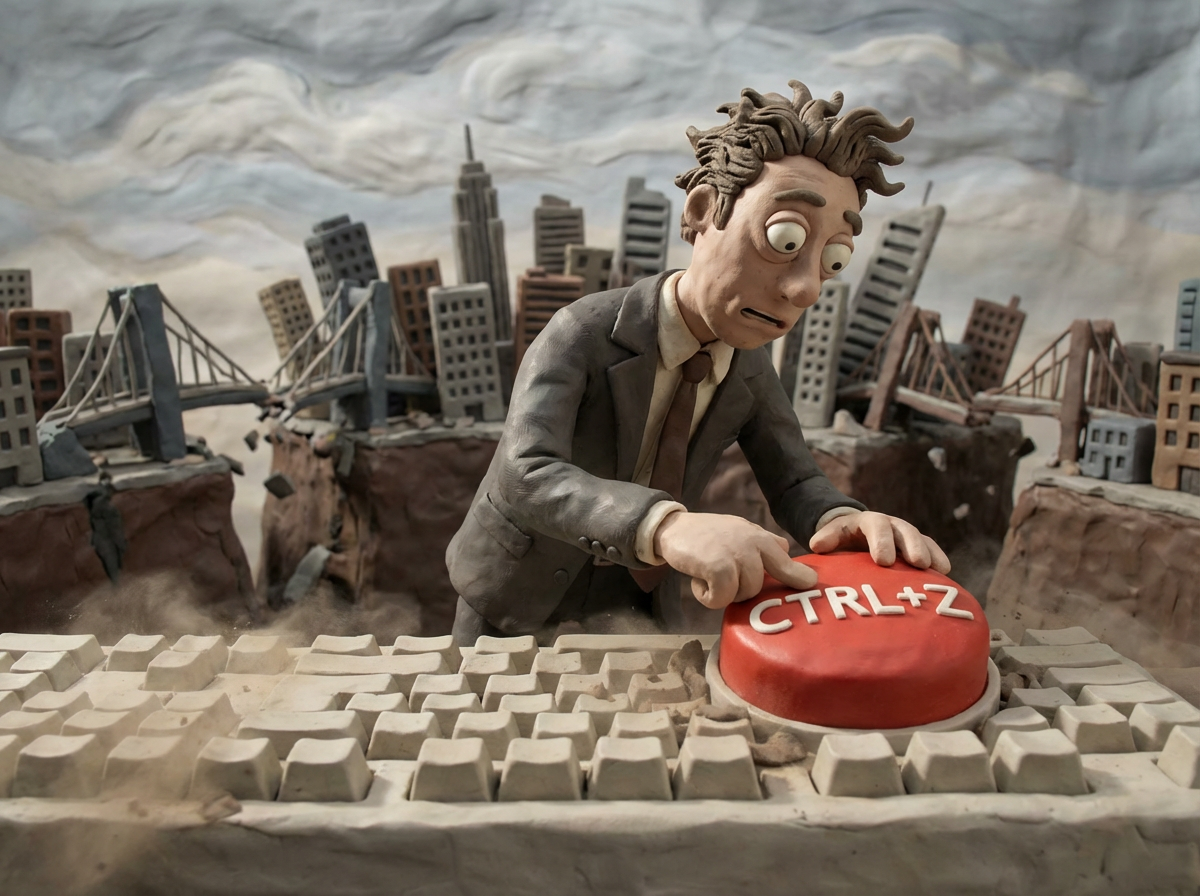
Whenever I comment on some premise online about how whatever is the hot item of the day that "this is who we are" people get pissy with me, saying they didn't vote for this. But the reality is that whatever this great middle and left are, it wasn't enough to prevent the second Trump term, and that the confluence of events are why we are here.
Let's talk about what we actually broke.
Not in the cable-news sense, where every controversy is a five-day story (at best) before the scroll moves on. I mean structurally. Systemically. The kind of damage that doesn't show up in a single news cycle but sits in the foundation of the house, wet and rotting, until the floor gives out.
Trump is either gone or going. However it happens, whether he finishes the term, whether JD Vance inherits the keys, or whether 2029 brings a course correction at the ballot box, the conversation about what comes next has already begun. And it's being dominated by people who have a vested interest in making you believe that recovery is simpler, faster, and more returnable to factory settings than it actually is.
The Never-Trumpers want their Republican Party back, the Reagan party of the 1980's. The centrist Democrats want to restore the pre-2016 consensus. The foreign policy establishment wants to dust the cobwebs off the old playbook. And every single one of them is either delusional, lying, or planning to rebuild in their own image and calling it restoration.
This piece is not about optimism. I don't do optimism. I am a product manager, I deal with the reality as it exists. This is about the starting line. Because you can't map a route back if you won't honestly and objectively look at where you're standing.
The Visible Wreckage: What We Know
Some of the damage is documented. We can see it happening in real time, which is almost worse, because we watched it happen and couldn't stop it.
The judiciary. This one will outlast everything else, and I mean everything. Federal judges serve for life. The appointments made across two terms are a generational infection. We're not talking about conservative jurists in the tradition of a Sandra Day O'Connor, someone with a coherent legal philosophy you could at least argue with. We're talking about avowed ideologues, some of whom couldn't answer basic procedural questions at their confirmation hearings, who are now on the federal bench for the next thirty to forty years. The Supreme Court is already restructured for a generation. Minimum. This doesn't undo when a Democrat (hopefully) wins in 2029. This is baked in, full stop.
The Department of Justice. The independence of the DOJ from the White House was always a norm, not a law. It was a guardrail built on the assumption that no president would be brazen enough to just... not follow it. That assumption is gone. The DOJ has been used as a political instrument, period. Rebuilding that institutional independence, even under the best possible next administration, will take years of careful, deliberate work, and it will take a Congress that gives enough of a shit to pass statutory protections that make it harder to do this again. Betting on that Congress? I'm not.
The intelligence community. The purges here are going to cost us in ways we probably won't fully understand for a decade. Experienced analysts, people with decades of institutional knowledge and source relationships, gone. Replaced in some cases with loyalists, in other cases just leaving vacuums. Intelligence isn't a machine you can reboot. It's a network of human relationships, institutional trust, and accumulated expertise. You can't rebuild that with a hiring class. And the damage to relationships with foreign intelligence partners, the Five Eyes, NATO allies, the quiet bilateral arrangements that don't make the papers, runs deep. Some of those partners have already started building redundancies that don't route through Washington.
The military. The purge of senior officers who wouldn't play ball, combined with the politicization of military leadership, is going to haunt readiness and morale for years. The professional military has a culture of political neutrality that is genuinely one of America's better institutional traditions. That culture has been stressed in ways that will take a long time to recover from, assuming the next leadership even prioritizes recovering it, which is not guaranteed under a Vance administration or a MAGA-adjacent Republican successor. And the damage of the removal of women and senior leaders of color is not the rebuke of DEI that Hegseth and Trump believe, it weakens both the fabric of the line officers, as well as removing dedicated, qualified people.
The Hidden Rot: What We Won't Know Until Later
Here's where it gets uncomfortable, because some of what's been done is deliberately obscured. Bureaucratic rule-making is not sexy. It is, however, extraordinarily effective as a tool for permanent damage, because it happens below the visibility line.
What are we likely to find when someone finally turns on the lights?
Regulatory rollbacks buried in agency rulemaking that will take years to identify, challenge in court, and reverse. Environmental protections, financial regulations, worker safety standards, all subject to quiet administrative evisceration that doesn't generate outrage the way a tweet does but has far more durable consequences.
Classified agreements and side deals. This one keeps me up at night. What was promised, and to whom, in exchange for what? The Iran surrender terms we saw in public were embarrassing enough. What were the backchannels? Were there even backchannels? What did the conversations with Putin actually contain? What agreements were made with Gulf states, with China, with others, that we will only learn about when some foreign diplomat writes their memoir in 2034?
The dismantling of the administrative state's institutional memory. When career civil servants are pushed out or demoralized into leaving, they take decades of accumulated knowledge with them. The forms still get filed. The processes still nominally run. But the people who knew why the processes existed, and what they were designed to prevent, are gone. The scope of the civil service exodus is going to be studied by public administration scholars for a generation.
And frankly: we don't know the full scope of what the intelligence community was directed to do domestically, and at whom. That shoe has not yet dropped.
The Starting Line
Anyone selling you a quick recovery is peddling false hopium. The damage to the judiciary is generational. The institutional knowledge that walked out of the intelligence community and the State Department is not coming back. The norms that were shattered don't automatically reassemble when a new president takes the oath.
What can be reclaimed? Some things, and we'll get into that in Part 2. The tone of American foreign policy can change on day one. Trade relationships can be rebuilt, carefully. The DOJ can be reoriented. A new administration can stop the bleeding.
But the honest framing, the one that the Never-Trumpers and the Restoration Caucus on both sides don't want to say out loud, is this: we are not going back to 2015. We are not going back to 2008. That world is gone.
Part 2 takes on the bigger canvas. The alliance collapse. The nuclear order that is quietly fracturing. And the progressive left's remarkable gift for handing the right exactly what it needs, right when the right needs it most.
What say you? Drop your thoughts below and continue the conversation!
 Share on Bluesky
 Share on Threads
 Share on Facebook
 Share on Mastodon
 Share on Reddit
 Share on Email