No Undo, Part 2: The World Has Moved On Without Us
The allies are rapidly building a post-America order. The nuclear world is getting more crowded. And the progressive left is gearing up to do what it does best: snatch defeat from the jaws of opportunity. What a time to be alive!

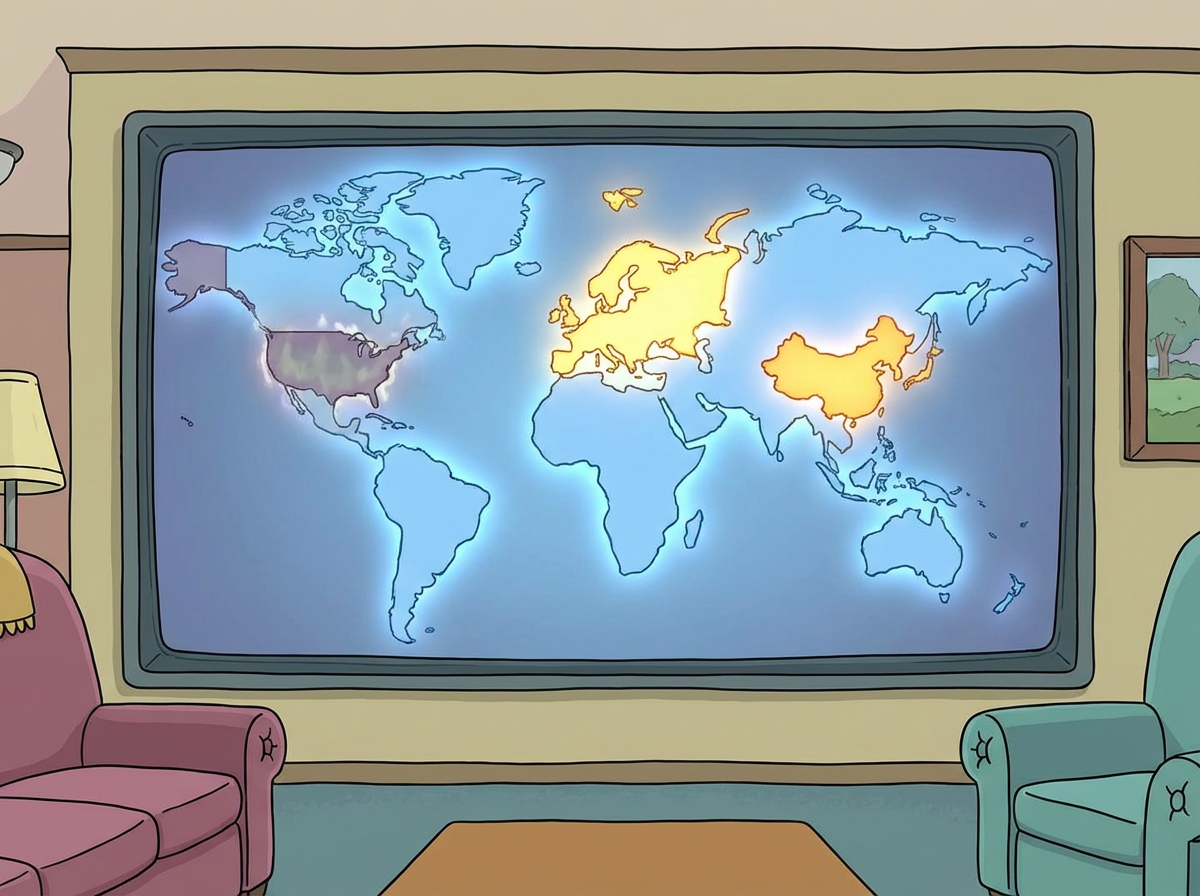
This is Part 2 of a two-part assessment. Part 1 covered the domestic wreckage: the judiciary, the DOJ, the intelligence community, and the hidden rot we won't fully understand for years. This part takes on the world stage, the nuclear order, and the political left.
The Alliance Collapse: This One Doesn't Come Back
I need to be direct in a way that a lot of commentariat is dodging, because the truth is bad for the narrative that America can press the reset button on its global standing.
It cannot.
The post-WWII order, in which American power, American credibility, and American consistency served as the organizing principle of global security, is done. Not wounded. Not weakened, not waning. Done. Finito. Kaput. And this isn't simply or only because Trump was erratic. It's because the world watched the American electorate return him to office after they'd already seen what he was. That's the signal that landed; the lesson that they've learned. It's not just Trump himself. The fact that Trump was possible, and we did it twice.
Europe is not waiting around. France and the UK have already formally coordinated on nuclear policy and operations, with Macron extending the French nuclear umbrella explicitly to seven European allies in March 2026. Germany, which spent eighty years as a constitutionally pacifist state, is now the world's fourth-largest military spender. Defense manufacturing capacity across Europe is expanding at three times the pace seen in 2020.
If your intent was Germany re-militarizing, congratulations, you've
They are building a post-America Europe. Not because they want to. Because they watched us torch the alliance and concluded, rationally, that they had no choice.
Foreign Affairs put it plainly earlier this year: for the first time in eight decades, Europe stands alone. Eighty years. That is the entire lifespan of the modern world order.
The practical timeline is sobering. Europe will need until the early 2030s to develop the critical defense enablers required to deter Russia without the United States. Air and missile defense alone could take five to ten years. The intelligence gap, satellite systems, trained analysts, targeting infrastructure, runs deeper still and is harder to close quickly. They're working on it. They are not waiting for permission.
Can there be rapprochement? Some. Possibly. Trade relationships are durable because economics reasserts itself. Intelligence sharing can be rebuilt cautiously, if the next American administration demonstrates sustained reliability over years (multiple 4-year administrations, minimum), not just good intentions in the first hundred days. Military interoperability can be partially restored.
But the fundamental question that every ally asks has changed permanently. The question used to be: "Will America be there?" The question now is: "Can we afford to find out?" Every serious defense planner in Paris, Berlin, Warsaw, and Tokyo is designing systems and alliances that assume the answer is no. You do not reverse that posture with a summit and a handshake. It took decades to build that trust. It will take decades (or realistically, generations) to rebuild it, if it can be rebuilt at all. And that's assuming the next American president doesn't pull the same shit again, which, given the structural forces that produced Trump in the first place, is not a safe assumption.
My take: Unless the MAGA strain is put down hard, and soundly defeated electorally across multiple consecutive cycles, this is not a high probability outcome. Alas, our electoral system is wired to keep it close, and MAGA will win sometimes.
The Nuclear World We're Entering
This is the part that should sober everyone up regardless of where they sit politically. And it was 100% foreseeable.
The nuclear order that held, imperfectly but genuinely, since Hiroshima is now fracturing. The United States, over seventy-plus years, used its security umbrella to give countries a reason not to build their own bombs. Japan. South Korea. Germany. Australia. Poland. Saudi Arabia, probably. The calculation was simple: you don't need nuclear weapons because we have them and we have your back.
That calculation is being revisited in real time. The Bulletin of the Atomic Scientists put it starkly in their 2026 Doomsday Clock statement: conversations in South Korea and Japan have raised the specter of nuclear proliferation among countries that have traditionally sheltered under the US umbrella. This is not fringe politics. These are serious discussions in serious capitals by serious people who have done the math.
The math is brutal. If you're South Korea watching Trump undermine every alliance commitment while treating North Korea as a negotiating partner, the rational conclusion is that you need your own deterrent. Same logic applies to Poland, staring across at Russia with dwindling confidence in Article 5. To Japan, watching China's nuclear arsenal expand aggressively while American extended deterrence commitments grow increasingly ambiguous. To Saudi Arabia, which watched the Iran deal collapse and has to figure out what American guarantees are actually worth on the open market right now.
Meanwhile, New START is gone. The last major bilateral arms control agreement between the United States and Russia expired in February 2026 with no replacement on the horizon. The architecture of nuclear restraint that took fifty years to construct has largely unraveled.
And here is what should genuinely frighten people: we are entering a more proliferated nuclear world while simultaneously operating existing arsenals on launch-on-warning protocols. That means a president has minutes, not hours, to decide whether an incoming signal is real. In a world with more nuclear states, fragmented intelligence relationships, and broken communication channels between adversaries, that is an extraordinarily hazardous place to be. We navigated the Cold War partly through good judgment and partly through dumb luck. We are now rebuilding the conditions for catastrophic miscalculation with fewer guardrails and more players at the table.
The honest answer to whether this can be repaired: not fully, and not fast. Even a perfect, trustworthy, consistent American foreign policy over the next twenty years might not be enough to convince South Korea or Poland that they don't need their own deterrent. Ask North Korea how easy it is to give up nuclear weapons once you've decided you need them.
My Take: The genie was always partly out of the bottle, this is going to fully get that genie in the open. Any repair will require accepting more nuclear states. If you want me to go more into what it takes to go nuclear, drop me a note. My degree is in physics, and I can explain what it takes, and why this proliferation is going to be very difficult to prevent or reverse.
The Progressive Left: The Gift That Keeps on Giving
I have to be cautious here, because this is going to generate emails from both directions.
I am not a conservative. Never have been. I am left of center, and I have plenty of overlap with much of what the progressive left wants. The progressive left are right about a lot of things, including things that were politically costly to be right about. The moral case on economic inequality, healthcare, and climate is sound. I am genuinely sympathetic to a lot of what they're trying to do.
But the progressive left has a recurring, almost tick-tock habit of winning the argument and then immediately doing something that hands the cultural initiative back to the right. And in the post-Trump moment, when the task is building a coalition broad enough first win, and then to actually govern and sustain, that habit is going to be a serious problem. It is not hyperbole to say that the cultural wins racked up by the progressives during the Obama administration were an opening that Trump grabbed by the pussy.
The examples are not obscure. The defund the police conversation was not wrong in its diagnosis but was catastrophically wrong in its framing, and the people pushing that framing were warned repeatedly and didn't care. The result was a Republican gift that they are still unwrapping years later. The campus response to Gaza, where I have sympathy for significant parts of the underlying critique, was conducted in ways that were genuinely alienating to a lot of people who might otherwise have been reachable, thus making it trivial - not just for bad-faith actors but for reasonable observers - to raise legitimate questions about where the line was. And the progressive left's relationship with fiscal and monetary reality is, to put it charitably, an ongoing work in progress[1], in a way that makes swing voters nervous and gives the right an opening they are always eager and ready to exploit.
What give me night terrors: In the post-Trump vacuum, on the Democratic side, the progressive left will be the loudest, most organized, most energized faction.[2] They will push hard on ideological purity in candidate selection and platform. They will primary moderates. They will set conditions. And the result may be a Democratic Party that is morally coherent yet uncompetitive in exactly the states it needs to win.
What we've learned from the two Trump victories is that the MAGA coalition[3] does not need to be a majority to either win, or remain dominant. It needs the opposition to be fragmented, purist, and unappealing to the fifteen percent of the electorate that actually decides elections. The progressive left, bless their hearts, is historically excellent at making that happen.
I am not advocating to abandon progressive values. It's a call to think hard about sequencing, coalition-building, and the difference between being right and being effective. And, to have some humility. Because the Progressive Left's instincts are to rub the Right's noses in their defeat. That hardens the centrists and the right against them and fuels an over-correction backlash. Ultimately, if the answer to Trump is a Democratic Party that can't win Michigan or Wisconsin or Pennsylvania, then we haven't fixed the problem. We've rebranded it. Badly.
So What Now?
The world has moved on. The allies are not waiting. The nuclear order is being rebuilt in a more dangerous configuration. The domestic institutions are damaged in ways that will take years, in some cases decades, of sustained and deliberate effort to repair. And the political coalition that would need to do that repair is currently at risk of talking itself out of the electoral majority it would need to govern.
What can actually be reclaimed? The tone and direction of American foreign policy can change quickly. Trade relationships can be rebuilt with patience. The DOJ can be reoriented by leadership that actually wants to restore its independence. The bleeding on the administrative state can be stopped. A new administration can re-enter arms control conversations and at least signal that the United States is a serious interlocutor again.
But the honest assessment, the one nobody selling a comeback narrative wants to lead with, is this: the Pax Americana is over. The post-WWII security architecture is being replaced in real time by something more fragmented, more dangerous, and less predictable. Decades of patient alliance-building, institution-building, and norm-setting were liquidated in the service of a political moment. Some of that can be recovered. Some of it cannot.
Anyone who tells you otherwise is trying to sell you something. Probably themselves.
Agree? Disagree? Join the conversation below!
1 - The MMT position that they flirt with is just bonkers. I am not an economist, but that is really fantasy
2 - part of me wants to watch a cage-match between the vocal progressive (far) left and the Never Trump coalition. Both want their preferred vision for the Democratic party, but in reality the Democratic party is a big messy coalition and not easy to collapse either on the right or the left.
3 - make no mistake, it isn't a movement that will go away when Trump shuffles off the mortal coil, but it is a full on MAGA coalition that has hardened, and if someone tells you that it will fade once Trump is gone is fooling themselves.
 Share on Bluesky
 Share on Threads
 Share on Facebook
 Share on Mastodon
 Share on Reddit
 Share on Email