One Laser ...
The 1960 hierarchy was written down and voted on. Everything that did the real sorting afterward had no author.

A professor told me once that the Stanford Linear Accelerator Center spent more on research in an hour than our department had for a year.
This was San Jose State, sometime around 1986. I was a physics major. He was not making a joke and he was not, so far as I could tell, bitter about it. He said it the way you'd report the weather, and then he went back to teaching optics.
I've tried since to check the arithmetic. SLAC doesn't make a mid-eighties operating figure easy to find — the lab ran $383 million in 2017, and in my window it was building the Stanford Linear Collider, which puts the era somewhere in the low nine figures. Call it fifteen thousand dollars an hour and you're probably in the neighborhood.
But the number is the least interesting part, and I want to get that out of the way early, because the number is where this argument usually goes to die.
An hourly comparison only works if both institutions have a research budget to compare. We didn't have a small one. We had a structurally absent one — and not by accident, not by neglect, and not because anybody in San Jose was doing worse work than anybody in Menlo Park.
We didn't have one because somebody wrote down in 1960 that we weren't supposed to.
The Last Time Anyone Wrote It Down
The California Master Plan for Higher Education divided the state's public system into three tiers with explicitly different missions. The University of California got the doctoral programs and the research mandate and, with them, the federal money that follows a research mandate around. The California State Colleges got teaching and master's degrees. The community colleges got everyone else and got them close to home.
It was a genuinely visionary document and it worked. It also did something people rarely acknowledge: it wrote the hierarchy down, argued about it in public, and put names on it.
That's the last time anything in this story was visible.
Thirty-odd miles up the peninsula from my optics lab was an institution that had been assigned the research mission by policy. I was at one that had been assigned the teaching mission by the same policy. The gap between us was not a quality signal, not a market outcome, and not a verdict on anybody's ability. It was an allocation, made by a commission, ratified by a legislature, and then left to compound for a quarter century while everyone stopped looking at it.
Every sorting mechanism after 1960 operated without a document, without a vote, and without an author. Which is what makes them so hard to fight.
Reagan, and the Part That Actually Mattered
Ronald Reagan won the governorship in 1966 running substantially against a university.
Not against a policy, not against a budget — against Berkeley, and specifically against the students at Berkeley, whom he characterized as beatniks and radicals and worse. He'd been in regular contact with the FBI about UC President Clark Kerr during the campaign, because Kerr had declined to discipline the protesters the way Hoover wanted. Three weeks after taking office, at the first Board of Regents meeting he attended, Kerr was fired. The Chronicle called it a big win for the new governor.
At that same meeting: a proposed ten percent budget cut and a proposal to charge tuition — which California had never done to its own residents, and had reaffirmed in writing it would not do. When Berkeley said it couldn't absorb the cut, his people floated the idea of selling off the rare book collection. In May of 1970 he shut down all twenty-eight UC and Cal State campuses during the Cambodia protests.
He lost the tuition fight. This matters, and people who tell this story badly skip it. The Legislature refused him. What happened instead is that in 1970 the Regents imposed a hundred-and-fifty-dollar "educational fee," and a state senator named Albert Rodda said on the record at the time that this was tuition with a costume on. The fee language survived for decades afterward while the number climbed.
So he lost the vote and won the argument, which is the more durable of the two. Policies get repealed. Premises don't. And when an institution starts lying to you about what it's charging you for, the fight is already over.
The premise itself got stated out loud, in a newspaper, by his own adviser. On October 29, 1970, six days before the election, Hoover economist Roger Freeman — on loan from the Nixon White House — held a press conference defending the record. The Chronicle ran it under the headline "Professor Sees Peril in Education." Freeman said "We are in danger of producing an educated proletariat." He called it dynamite. He argued they had to be selective about who was allowed through.
That is the entire policy, stated without euphemism by someone who thought he was defending it. The objection was never fiscal. The objection was that education had become cheap enough that the wrong people were getting it, and that people with analytical training and time on their hands are difficult to govern.
Price as a filter. Not a side effect. The mechanism.
I'll give Freeman the complication he's owed: he also said his reference point was Germany and that he had watched it happen. Born in Vienna in 1904, out after Hitler. He'd seen a society come apart at close range and concluded the danger had been an oversupply of educated people with nothing to do. That's not a country-club reactionary. That's something considerably stranger and sadder, and it doesn't make the policy better.
Why This Isn't a History Piece
The reason to rehearse all of this in 2026 is that the template is still in service.
Reagan converted celebrity directly into executive power without ever holding office. He ran against institutions rather than on a program, and the first institution he ran against was a university. He organized politics around resentment with named targets — the beatniks, the students, later the welfare queen. He had a gift for a phrase that did the work of an argument and saved everyone the trouble of having one. And he was underestimated for years by people who mistook the genial affect for the operation underneath it.
Any of that sound familiar?
But the comparison gets lazy fast, so let me hand the objections over before somebody else does. Reagan had a real apprenticeship: two terms running the largest state in the union, and before that years as president of the Screen Actors Guild, which is actual labor negotiation against actual adversaries. He worked through his party rather than hollowing it out. He had a coherent ideological project with think tanks and journals and a bench of people who genuinely believed it. And critically, he accepted constraints — he lost the tuition vote and then went around it lawfully, through a board that had the authority to act. He did not tell anyone the vote was fake.
So the honest version isn't that Reagan was an early draft of what came later. It's that Reagan built the template and installed the premises — public goods are costs, universities are adversaries, the beneficiary should pay — and what we have now is that same template with the institutional constraints removed and the ideological project replaced by a man.
Every tuition bill in this state still runs downhill from a Regents meeting in January of 1967.
The Machine That Broke the Base
Proposition 13 passed in 1978, and the way it wrecked the California State University is not the way people assume. There's no line item that disappeared. CSU was never funded by property taxes.
What happened is structural. Property tax revenue fell by roughly sixty percent in the first year, which converted K–12 and the community colleges from locally funded to state funded. They landed in the general fund. Which meant that from 1978 forward, my department was competing for the same dollars as every elementary school in California — an opponent with vastly more political constituency and a far better story.
The state's accumulated seventies surplus papered over this for a few years. It ran out right about the time I enrolled. Also competing for that same general fund through the eighties: a prison construction program that would grow the incarcerated population five hundred percent over the following two decades. Somebody was getting capital budgets. Then in 1988 — the year I graduated — Proposition 98 gave K–12 a constitutional claim on the general fund, and the pecking order stopped being a habit and became law.
Nobody voted to defund a physics department. Every individual decision in that chain was defensible on its own terms. That's the thing about it.
What It Looked Like From Inside
We had one laser. A helium-neon, bolted to a bench in the optics lab, and everyone signed up for time on it. That wasn't poverty so much as period — diode lasers didn't get cheap until CD players dragged the cost curve down in the nineties. But it did mean that the entire optics curriculum for the entire department ran through a single instrument.
The digital lab used a KIM-1, a single-board 6502 machine that was already a decade old when I met it. No assembler. You looked up opcodes in a table, worked out your branch offsets by hand, and keyed in hex one byte at a time. Miss a byte? Start over.
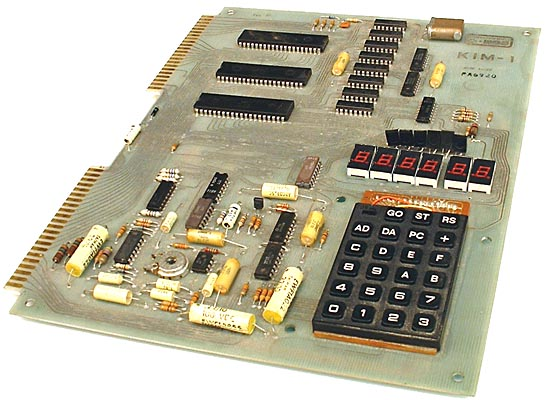
That lab was taught by a very old man who had worked on the Manhattan Project. He drank a lot of cheap scotch, he photographed his students at the start of the term because he could no longer hold the faces to the names in the roster, and he was extremely fond of the word egregious. That is nearly everything I retained from two semesters, and it has outlasted the coursework by forty years.
Partial differential equations were taught by a Russian émigré in a classroom in the business building, because physics didn't have a room of its own at that hour. The class after ours was marketing.
Follow the Transfer
The business school did not use computers in that era. It didn't need to. It was the cheapest product on campus — a room, a chalkboard, high enrollment, essentially no capital cost — which under enrollment-driven funding made it a net revenue generator.
That margin went to engineering. Engineering had the enrollment boom, the industry partners, the equipment donations, and the placement numbers, which in San Jose in 1985 meant Lockheed and IBM and HP and every fab in the valley. Engineering also had the computer lab.
Physics was neither the earner nor the recipient. Physics was overhead.
So we were guests. The lab ran terminals — not computers, terminals — wired to a shared PDP-11/70 running RSTS/E, and one of the machines wasn't even on campus; it was reachable over an X.25 link to another CSU a few hundred miles away, a connection about as reliable as a candle in a hurricane. You had an account. You had a quota. You scheduled your time. The good hours went to the majors, and at the end of a semester the guests got what was left, which is how I came to know that room at three in the morning.
Four levels of sorting: the state system put CSU below UC, the campus put engineering above physics, the funding formula put the earner above both, and the department that owned the terminals set the queue. The person at the bottom of all four is the one who can't sleep.
The Filters Nobody Designed
Here is what I actually want to argue.
The 1960 hierarchy was explicit, debated, and written down. Every mechanism that did the real sorting afterward was invisible, unauthored, and never once discussed as a value judgment:
Enrollment-driven allocation, which rewards programs that consume no capital and starves the ones running instruments.
The service-department reframe, under which physics stops being justified by what physics is and starts being justified by how many engineers it processed.
Scheduling priority, which is not a policy anywhere but decides who gets the machine at a usable hour.
Assembly-first curricula, which select for tolerance of clerical bookkeeping rather than aptitude for programming, and which washed out an enormous number of people who would have been good at the job.
I was one of them, incidentally. A MACRO-11 course ended my ambitions as a programmer, and I want to be precise about what happened there, because I had arrived better prepared than the room — I'd hand-assembled 6502 and I knew Boolean logic cold when almost nobody else in that lab did. The PDP-11 has a claim to being the most humane assembly language ever designed. It wasn't the language. It was a course sequence that measured a thing that wasn't the job.
A filter nobody designed is far more durable than one somebody did, because there is no author to argue with and no vote to reverse. It just sits in the formula, quietly deciding who continues.
The Column Where I Concede
Three things, so nobody has to point them out to me.
Scarcity produced real goods. Every person in that room watched the helium-neon demonstration, attentively, because there was one. The three a.m. computer lab was a genuine community and I still remember people from it. Both effects are real. Neither is a defensible reason to underfund anything. Manufacturing attention through deprivation is a terrible way to produce either.
My advantage was unearned. I arrived knowing Boolean logic because there had been a computer in my house and time to take it apart and a household where dismantling an expensive object was tolerated rather than punished[1]. That's money, space, and permission. Most of the people queuing at three in the morning had none of the three, and the thing I keep calling my preparation was substantially my address.
The era was not better. My student ID number was my Social Security number, printed on rosters taped to hallway walls and on exams left in a box outside an office. That wasn't safe; it was merely not yet exploited. The buildings were unlocked at six in the morning and that was wonderful, and it ended because of liability insurance and the Clery Act rather than because anyone decided against it. My most expensive textbook ran eighty dollars, which is about $230 now — cheaper than today, but not cheap.
Public Capital In, Private Wealth Out
Step back far enough and the loop closes on itself.
The tuition-free University of California — the one Reagan considered a discipline problem — built the cyclotron, discovered the transuranium elements, put four names on the periodic table, and managed Los Alamos and Livermore for the federal government for decades. It did the expensive, unprofitable, fundamental work that no private actor will fund because there's no product at the end of it.
Thirty miles away, a private university converted the downstream into an economy.
That economy produced enormous wealth. The wealth became property values. In 1978 the property taxes on those values were capped, which removed the revenue base underneath the public system that had generated the science in the first place. And by 1986 a physics student in San Jose was doing his entire optics curriculum on a single laser while a federal lab up the road spent his department's annual budget somewhere between breakfast and lunch.
None of that required a villain. It required a funding formula and about twenty-five years.
The Chalkboards
The thing I remember best is the four minutes between classes.
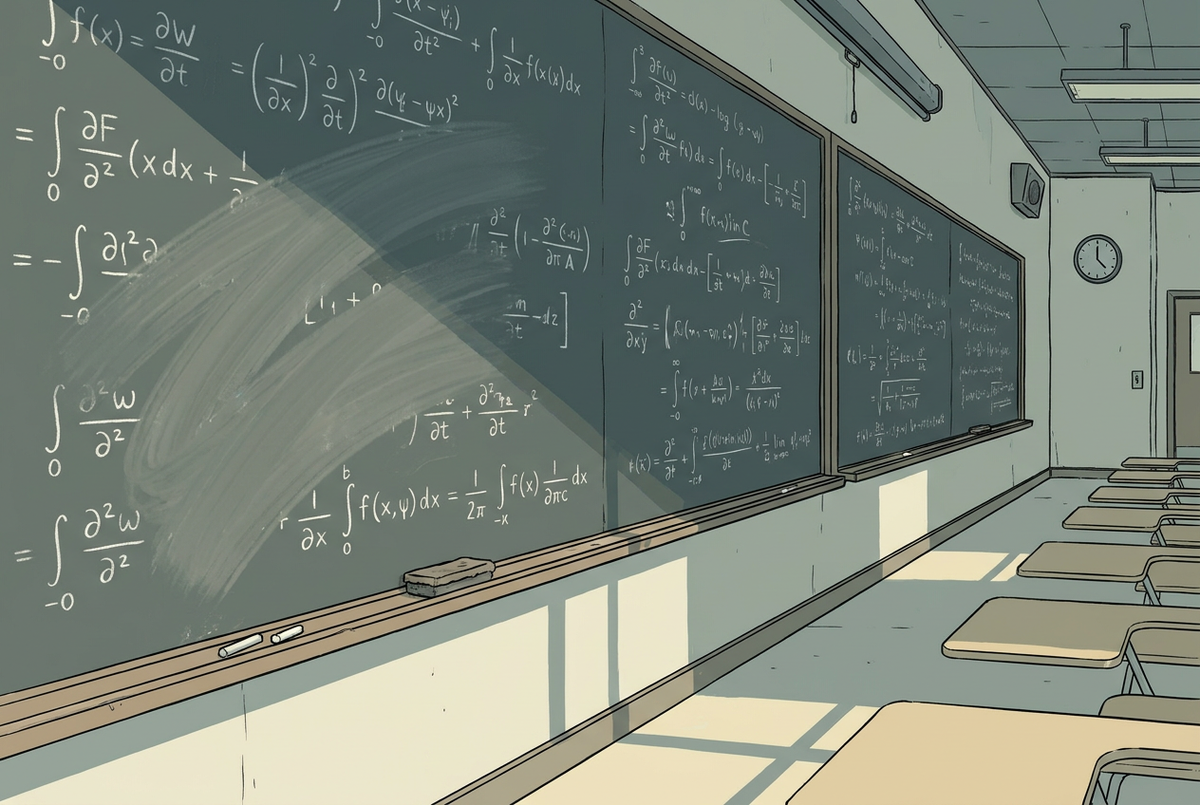
Our PDE[2] section would let out, and we'd file into the hallway, and the marketing students would file in past us to a room where every board was still covered edge to edge in Greek letters. Nobody had erased them. It never occurred to anybody to erase them.
We didn't have a room. For the length of a passing period we had that one completely, and the people who actually owned the building had to wipe the walls down before they could start.
You can still see chalk after you erase it. It ghosts.
Like what you've read, but not able to switch to paid? Why not buy me a coffee instead! All money goes to help defray the expense of running the site.
1 - Ok, I was punished, and my paper route money had to go to fixing it.
2 - for the non-physicists, this is Partial Differential Equations, basically how you solve most of the universe. It was a bastard of a class, but it also was the keys to the kingdom