Sacks of Mail, Rooms of Men
The mail said groundswell. The room of businessmen who'd already funded one broadcast said something more like a plan. Book One closes with Reagan's actual declaration of candidacy.

This is the close of the first "book" of three that I am assembling on the myth of Ronald Reagan. In this, we runup to his election as Governor of California.
The number most repeated about the October 27 broadcast is one million dollars. That's roughly what came in, by mail and phone pledge, to the Goldwater campaign within days of Reagan's half hour on television, and it has stood ever since as proof that Reagan didn't manufacture a movement so much as catch one already airborne.
Three weeks later, on the quieter side of the same ledger, a handful of Los Angeles businessmen, several of them the exact men who'd raised the money to buy that airtime in the first place, sat down and gave the moment a letterhead. They called it Friends of Ronald Reagan.
The Same Six Men, Now With Stationery
The kitchen cabinet stops fundraising for other people's campaigns and starts organizing its own candidate.
Friends of Ronald Reagan formed in November 1964, inside two weeks of the broadcast, and the roster reads like a callback rather than a new cast. Henry Salvatori, whose money and whose Goldwater operation put Reagan on the air in the first place, is there. So is Holmes Tuttle, the Ford dealer whose name recurs across three decades of Reagan's career as a fundraiser, an appointments gatekeeper, and eventually a cabinet-selection voice. A.C. "Cy" Rubel, the retired Union Oil chief executive, Justin Dart of Rexall Drug, Alfred Bloomingdale, and tire manufacturer Leonard Firestone round out the group historians now shorthand as the kitchen cabinet.
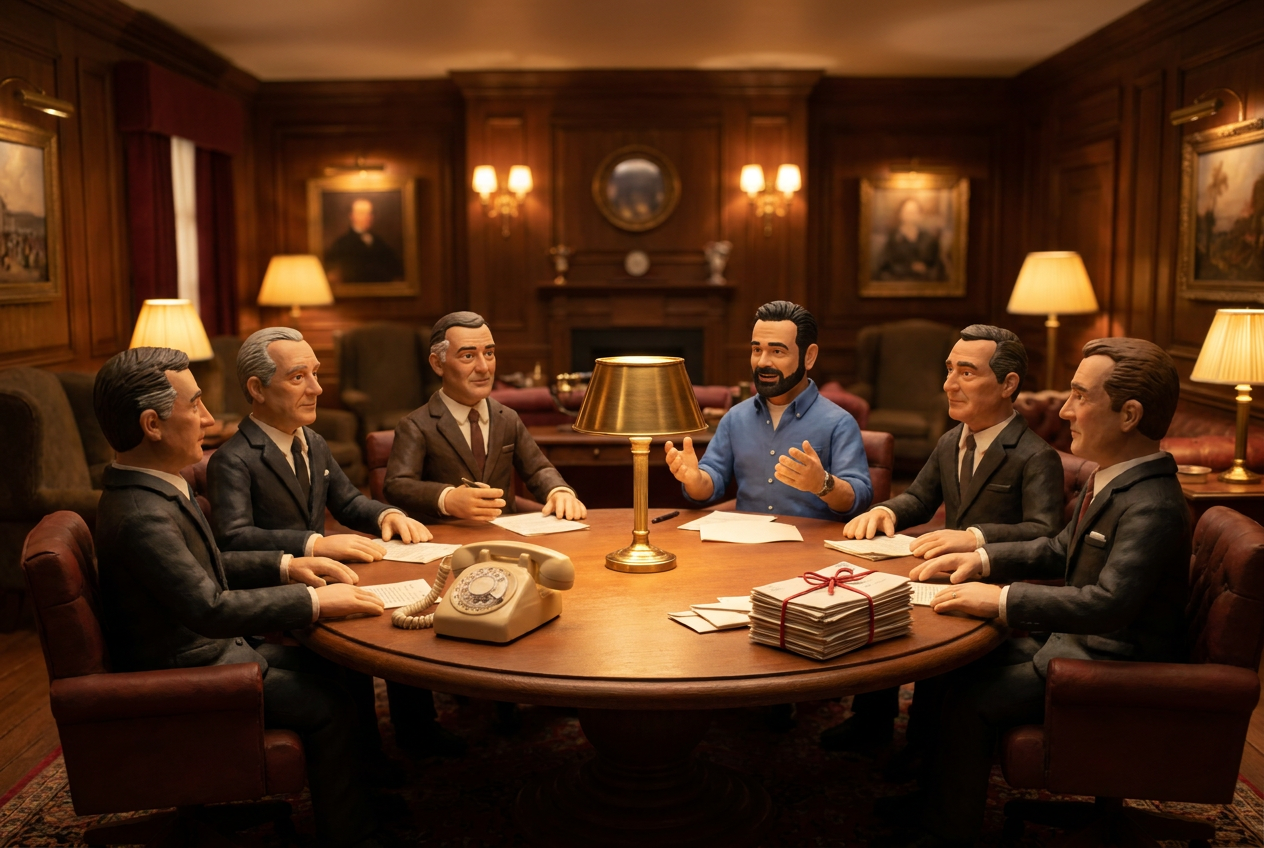
Nothing about this was spontaneous. These were men who moved in the same rooms, sat on the same boards, and had already demonstrated, eleven months earlier, that they could put real money behind a message on short notice. What changed in November 1964 wasn't the group. It was the object. They stopped buying airtime for somebody else's candidate and started building the infrastructure for their own.
Sweaty's Corner doesn't have a marketing budget or an algorithm pushing it into anyone's feed. It has readers who share it. If this one landed, sending it to someone who'd get something out of it — or subscribing so the next one finds you directly — genuinely moves the needle.
The Recommendation Nobody Saw Coming
The professionals get hired, and the professionals turn out to have worked for the other side.
A Reagan candidacy needed something the kitchen cabinet couldn't supply out of its own Rolodex: campaign professionals who knew how to run a modern statewide race rather than write checks for one. According to Stuart Spencer's own account, the recommendation came from an unlikely direction. Barry Goldwater told Reagan to hire those sons of bitches, Spencer-Roberts.
The joke, if it is one, is that Spencer-Roberts had spent the spring of 1964 running Nelson Rockefeller's campaign against Goldwater in the California primary, built substantially around the argument that Goldwater was too unstable to be trusted near nuclear weapons. They lost, narrowly, undone as much by a badly timed birth announcement reopening questions about Rockefeller's recent remarriage as by anything ideological. But they'd impressed people on the way down, including apparently Goldwater himself.
This is worth sitting with rather than smoothing over. The same conservative infrastructure that treated the primary as an ideological reckoning had no trouble, months later, hiring the firm that had just tried to defeat its own nominee. The operation ran on competence first. The purity was for the newsletters1.
Manufacturing the Amateur
The pitch built to cover for the résumé Reagan didn't have.
Spencer's actual contribution wasn't strategy in the conventional sense. It was a frame. Reagan had never held office, never run a campaign, never sat through a legislative session. Rather than disguise that, Spencer built the entire candidacy around it, positioning Reagan not as a career politician but as a private citizen reluctantly stepping forward, deliberately pitched, in Spencer's own later description, as someone one step ahead of the electorate, not twenty, rather than a policy expert lecturing down to it. The campaign paired it with a slogan, the "creative society," built as a direct answer to Lyndon Johnson's Great Society, small enough to fit on a bumper sticker and vague enough to mean whatever a given voter needed it to mean.
Anyone who sat through Episode 3 of this series has already met this move. The GE Theater years spent a decade teaching Reagan that a persona is a product built by other people's labor and then worn convincingly by the person selling it. The citizen-politician frame is the same mechanism relocated from a soundstage to a campaign. The amateur wasn't the absence of packaging. The amateur was the package.
Reluctant, or Playing Reluctant
The part of the record that refuses to resolve cleanly.
Here the story gets genuinely uncertain, and the honest move is to say so rather than pick a side. By at least one contemporary account, Reagan told people directly that running had never appealed to him, and there's no strong reason to assume that was theater. He had a business relationship with MCA and General Electric's collapse behind him to think about, a household income built on acting work he'd need to walk away from, and by every account a wife who had opinions about uprooting a settled life for a campaign with no guaranteed payoff.
At the same time, the kitchen cabinet did not organize a formal support committee, recruit a top-tier consulting firm, and commission private polling on behalf of a man who had given them a flat no2. Whatever ambivalence Reagan felt was real enough to be reported and specific enough to be quoted, and it coexisted the entire time with a machine already assembling itself around him with his visible cooperation. Both things were true at once. The record doesn't offer a cleaner answer than that, and manufacturing one here would be a lie in the shape of a tidy ending.
January 4, 1966
The frame Spencer built becomes the words Reagan says out loud.
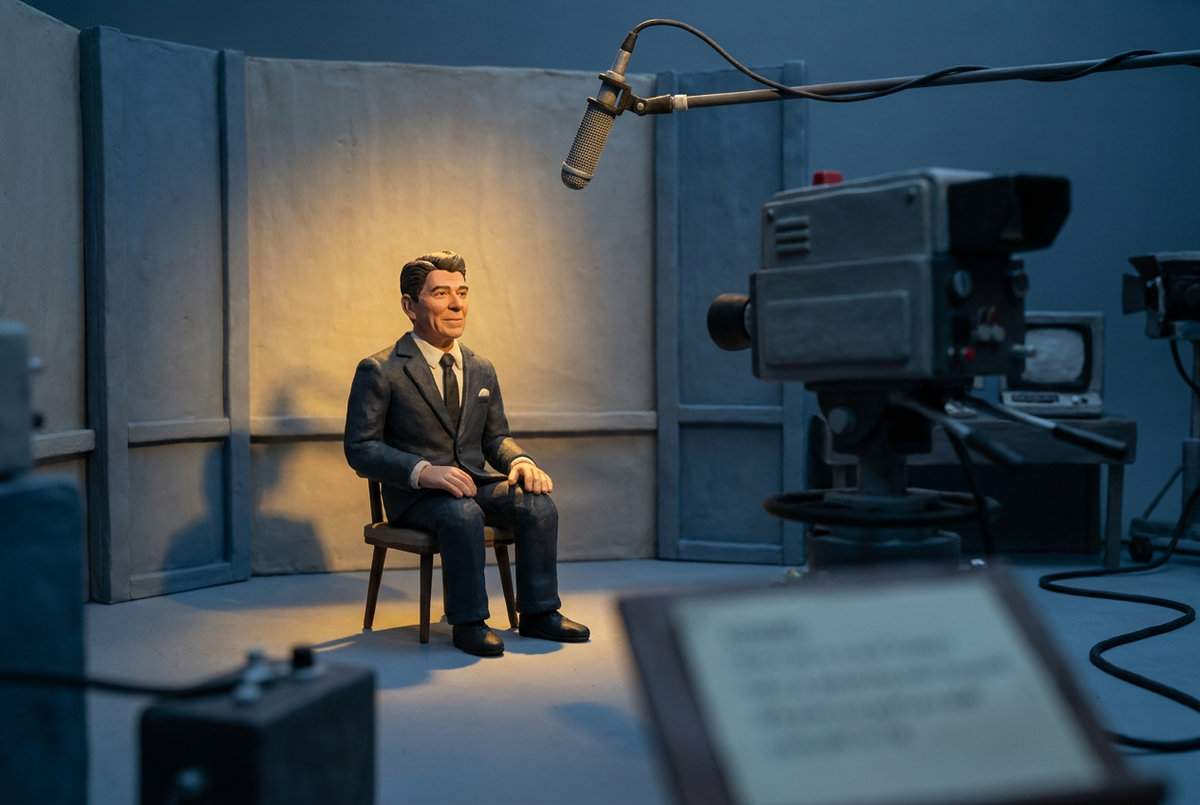
The formal declaration came as a taped television announcement on January 4, 1966, and it used, almost verbatim, the language Spencer had been building for over a year. Reagan told viewers directly that while he'd never held public office, he could lay claim to being a citizen-politician. Fourteen months after a speech he gave on somebody else's behalf, for somebody else's campaign, he was reading, in his own name, the pitch a political consultant had built around his lack of a résumé.
Nobody in that taping session, least of all Reagan, was thinking about a run for president. The actual target, as far as the record shows, was the sitting governor, Pat Brown, and the actual near-term opponent was San Francisco's moderate former mayor, George Christopher, standing in Reagan's way in the Republican primary. Within weeks, Brown's own campaign would start quietly working to help Reagan beat Christopher, on the calculation that Reagan would be the easier man to run against in November, a bet that history does not treat kindly. That's Book Two's problem to sort through, not this one's.
What belongs here is smaller and, I'd argue, more interesting. The mail and the money in November 1964 read like weather, something that simply happened to Reagan, like an El Niño pattern. The room of men giving it a name three weeks later was not weather. It was work, done by people who had already done it once and knew exactly how.
This is Book One, Episode 6 of The Fulcrum, a series on Ronald Reagan as the pivot point the modern American right still turns on. Catch up on the whole series, published as it drops, at The Fulcrum.
Keep the lights on
Like what you've read, but not able to switch to paid? Why not buy me a coffee instead! All money goes to help defray the expense of running the site.

1 - This is eerily reminiscent of the current landscape of political consults and their ilk. I would call them prostitutes, but that would be deprecating to sex workers the world over.
2 - no fucking shit. I am not buying the coy act.