These Fucking Guys: Substack and the Original Sin (pt 1)
My history with Substack, fleshed out, and the realization that the founders are really pieces of human filth. The first of three posts (three founders) on these fucking guys, and how a noble idea gets ratfucked in Silicon Valley.

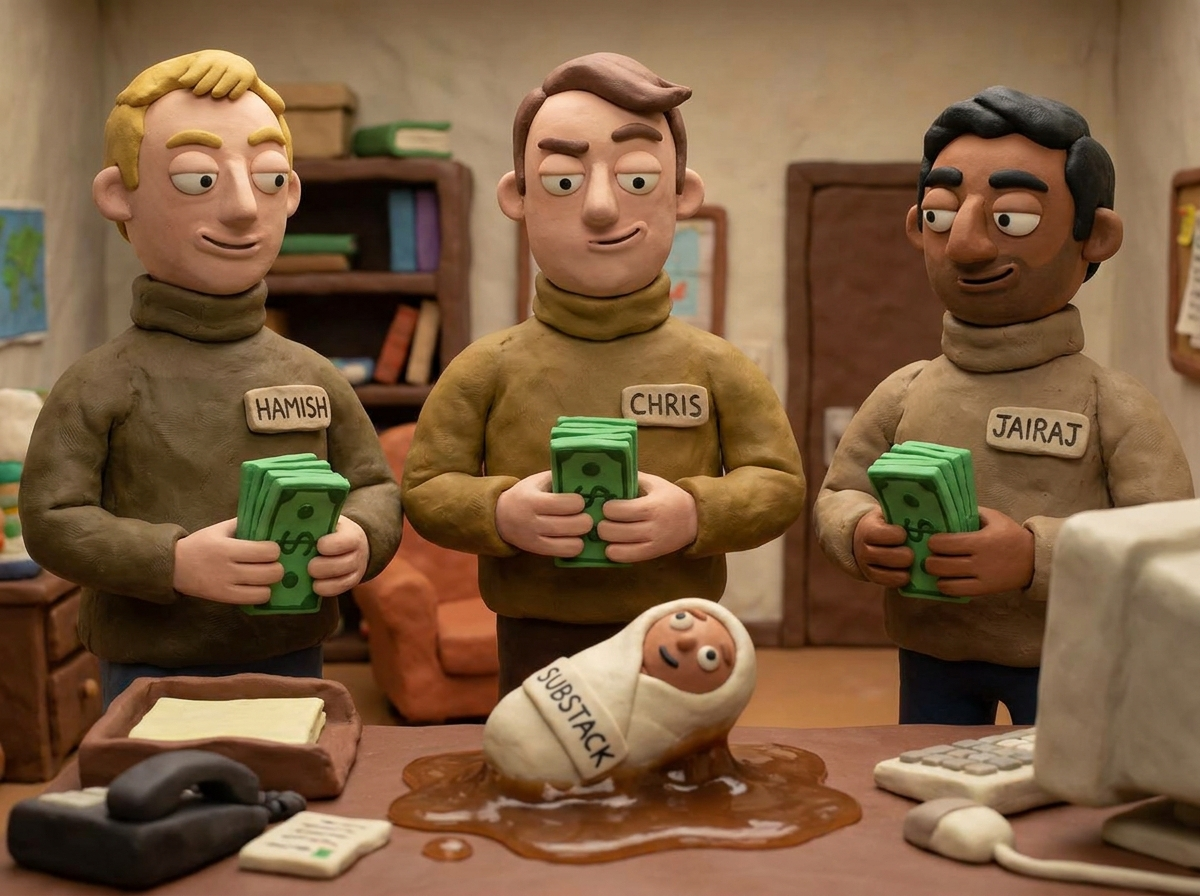
In this three part series I flambé the founders at Substack because I think they are truly shitty people who are just in it to make bank.
What I do not want people to take from this is that I am shaming people who remain there. It is true that if you are building and monetizing an audience, Substack is the best game in town at the moment. I realize that not everyone can afford to move to a property that isn't tainted by their skeevy ethics, and that they need this cash flow to live. No shame intended.
Let me introduce you to three guys you've probably been giving money to without fully understanding who they are: Chris Best, Hamish McKenzie, and Jairaj Sethi. The founders of Substack. These fucking guys.
In 2017, they launched with a genuinely good idea. Scratch that, it was a great idea. Writers own their audience. You bring the words, they handle the plumbing – publishing, payments, email delivery – and they take 10% of whatever you monetize. If you don't charge, they don't take anything. The pitch was clean: no ads, no algorithm shoving garbage in your face, just writers and readers and a direct financial relationship between them. Revolutionary, almost.
Hamish McKenzie, who is literally a former journalist, wrote the founding manifesto. One of the lines that aged like warm milk poured under the seat of your car in the desert: "we know that the media can't be saved by algorithm."
He wrote that. In 2019. I want you to put a pin in that.
In 2019, Andreessen Horowitz led a $15.3 million Series A, and Marc Andreessen reportedly told CEO Chris Best: "You're gonna do to media what venture capital did to software." Most people heard that as a compliment. They should have heard it as a warning. What venture capital did to software was strip-mine it for returns and subordinate every other purpose to shareholder value. But hey. Free money. Sign here. Soul not necessary.
For a few years, it more or less worked. Writers came. Readers followed. The newsletter economy had a genuine moment. The no-algorithm promise held, more or less, because Substack was functionally just email with a payment layer on top.
Then came April 2023. Substack launched Notes – a Twitter-style feed where users could post short takes, quote each other, surface content from across the network. Elon Musk, who had just purchased Twitter and was busy destroying it one impulsive decision at a time, immediately lost his mind. Twitter blocked Substack links, made them unlikeable, redirected searches for "Substack" to "newsletter." It was a full toddler tantrum. I mean a real Trump tossing ketchup situation.
Here's the delicious part: Andreessen Horowitz had invested $65 million in Substack and $400 million in Musk-era Twitter. Marc Andreessen was literally on both sides of that pissing match. His fingerprints were on the weapon and the wound simultaneously. Cool. Totally normal venture capital stuff.
And while we're on the subject of Marc Andreessen: in July 2024, he and his a16z co-founder Ben Horowitz publicly endorsed Donald Trump and followed it up with roughly $39 million in combined donations to pro-Trump efforts. The same guy who holds board influence over the platform where you publish your independent journalism wrote a nine-figure check to the guy actively dismantling press freedom. That's not a conflict of interest. That's a fucking worldview. And it's the worldview sitting in the room when Substack decides what gets amplified and what quietly dies in the algorithm.
Substack promised you independence. The man with a board seat at your publisher bought the presidency. Cool platform, guys.
But forget the Musk drama for a second, because it's a distraction from the real thing that happened. Notes wasn't just a feature. It was a strategic declaration. The moment Substack launched Notes, it stopped being email infrastructure and became a social network. (read that again) And social networks have a content moderation problem. They always do. Every single one. Without exception.
The founders knew this. They chose it anyway. Money, amirite?
Because the algorithm – the thing that decides who gets discovered, who gets recommended, who lands in front of new readers – is also the engine that makes Substack's business model actually scale. And scaling is what the investors were clamoring for.
McKenzie had written that the media can't be saved by algorithm. Then he built one. Yeah, this fuckin' guy.
That's your original sin. Not the Nazis, not Andrew Tate, not any of the specific shit that would come later. The sin was making a promise they didn't intend to keep, taking VC money that guaranteed they couldn't keep it, and then acting surprised when everyone noticed.
Next up: what the algorithm actually did with all that power.
 Share on Bluesky
 Share on Threads
 Share on Facebook
 Share on Mastodon
 Share on Reddit
 Share on Email