
The Actor Who Wasn't Quite a Star
A lifeguard chair, a dead wire, a line about losing your legs that became his memoir's title. The making of Ronald Reagan starts long before anyone was watching.

It begins. This is going to be a long series, broken into three arcs on the life and impact of St. Ronald Reagan. This is from the first phase of this project, the early years through his acting career.
This will have 5 or 6 posts, in total, and cover roughly until his political awakening in 1964.
This has been rattling around my mind for quite some time, and I have been jotting notes into a file on my desktop for more than a decade at this point. Everytime I hear someone refer to Reagan as a force for good, or the patron saint of modern Conservatism, I die a little inside. This long stretch will explain why I respond like that.
Oh, and this is post # 1,000 a fitting milestone!
It is the ninth inning at Wrigley Field, the Cubs and the Cardinals tied at nothing, and twenty-three-year-old Dutch Reagan is sitting in a studio in Des Moines describing a game he cannot see. He gets his information in five-letter bursts off a telegraph line: S1C, strike one called. B2, ball two. He turns each burst into a full sentence, a windup, a pitch, a call. Then the operator's hand stops moving.
The wire is dead. Reagan does not tell his audience that. He has Billy Jurges foul one off. Then another. Then a long one into the box seats that just misses a souvenir. He keeps a batter alive at the plate for the better part of seven minutes, inventing a baseball game in real time, until the machine starts clicking again and hands him back the truth: a routine popup, first pitch. He picks up exactly where the wire left off, and the audience never knows the game they heard for those minutes never happened.
The story survives in more than one version, and the versions do not agree. In an interview decades later with a hometown radio host, Reagan named Billy Jurges as the batter and Dizzy Dean on the mound. In his own memoir, he told it with Augie Galan at the plate instead. The date, the exact length of the fictional at-bat, even which Cub was standing in the box, shift depending on which Reagan is telling it and when. What never changes is the skill on display: the ability to make an invented version of events feel more alive than a truthful one would have.
A Salesman's Son and a Preacher's Daughter
Before the microphone, there was a household that gave him reasons to need one.
Ronald Wilson Reagan was born February 6, 1911, in a small apartment above a general store in Tampico, Illinois, the second son of Jack and Nelle Reagan. Jack was a shoe salesman, gregarious and often out of work, and an alcoholic; one of Ronald's clearest childhood memories was dragging his passed-out father in from the snow. Nelle held the family's religious life together, an active member of the Disciples of Christ, and staged amateur church theatrics that gave her son his first stage before he had any other one. The family moved through a string of Illinois towns chasing Jack's work before settling in Dixon in 1920.
Seventeen and Already Persuasive
The skill shows up before the ambition does.
At Eureka College, Reagan played football, joined the drama society, and in November of his freshman year, 1928, was chosen to deliver the speech at a student rally protesting the administration's proposed budget cuts. He was not a senior with something on the line. He was seventeen, new to campus, and picked to speak anyway. Eureka's own historians record a strike organizer's explanation for that choice as plainly as anything in the record: he believed, and he made you believe. The strike held for five days. The college president resigned a month later.
He believed, and he made you believe.
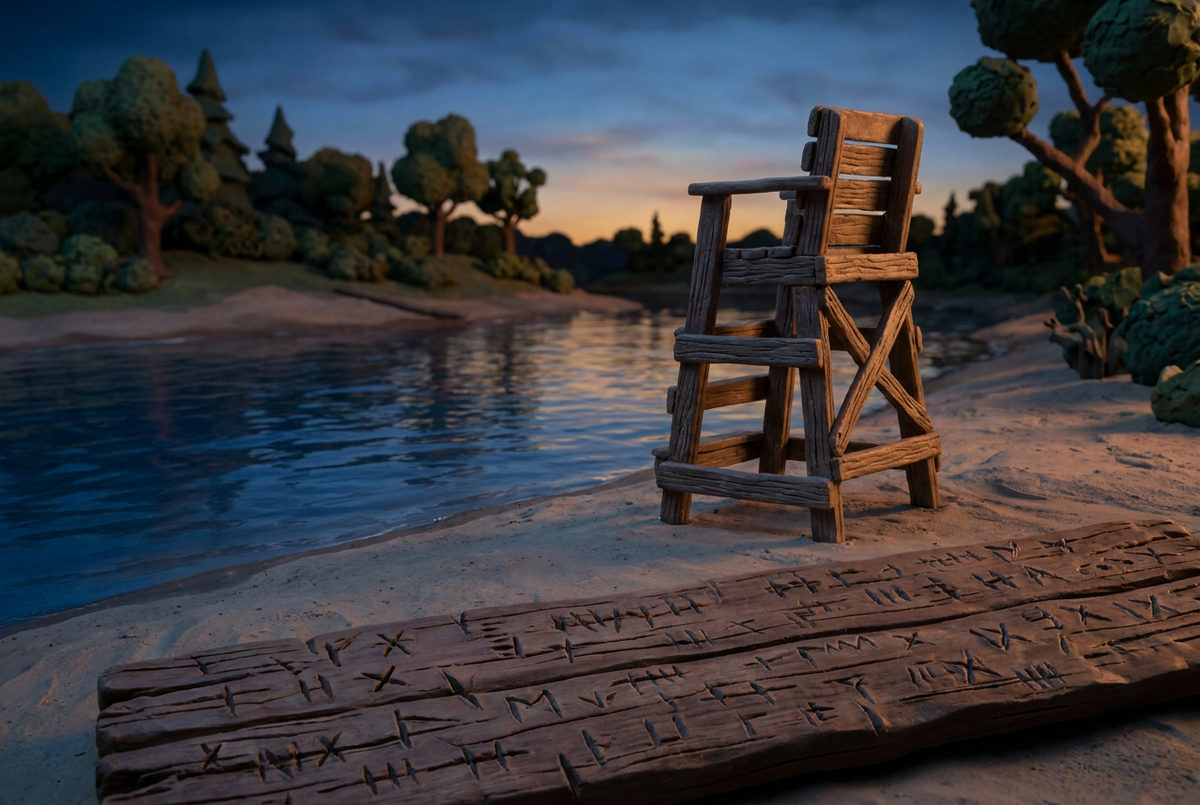
He spent his summers before and during college as a lifeguard at Lowell Park on the Rock River, a job he held for seven consecutive seasons starting in 1926. He is credited with 77 rescues over that span, a number that isn't only Reagan's own later boast: the Dixon Daily Telegraph was tracking his save count in real time as early as 1928, and a rescue log with 77 carved notches survived long enough to be authenticated and put on museum display decades before he ran for anything.
Sweaty's Corner doesn't have a marketing budget or an algorithm pushing it into anyone's feed. It has readers who share it. If this one landed, sending it to someone who'd get something out of it — or subscribing so the next one finds you directly — genuinely moves the needle.
The Voice That Could See a Game It Never Watched
Two radio jobs taught him to build a believable reality out of nothing.
After graduating Eureka in 1932, Reagan talked his way into announcing jobs first at WOC in Davenport and then at WHO in Des Moines, eventually becoming the station's lead sports voice. His specialty was the Cubs recreation broadcasts: sitting in a studio hundreds of miles from Wrigley Field, translating a telegraph operator's coded shorthand into a full, colorful, invented-in-the-moment account of a game he could not see and had no way to verify beyond the next five letters on the ticker. He did this for hundreds of games. It was, functionally, sustained live fiction sold as fact, performed under time pressure, night after night, years before anyone paid him to act.
A Warner Bros. Contract, by Way of an Old Friend
The break wasn't discovery. It was a referral.
In the spring of 1937, Reagan traveled to Southern California to cover the Cubs' spring training. While there, he looked up Joy Hodges, a singer he'd known from the WHO days who was now working in Hollywood. Hodges connected him to her own agent, Bill Meiklejohn, who arranged a screen test at Warner Bros. The studio offered him a seven-year contract starting at two hundred dollars a week, roughly three times his radio salary. His first film, fittingly, cast him as a radio announcer.
Over the next several years he became a steady Warner Bros. contract player, mostly in B pictures, the low-budget second half of a double bill. He later summed up his own place in the studio's hierarchy without much editorializing: "I was the Errol Flynn of B movies," he said, and meant it as description rather than complaint.
The Gipper and the Man Who Lost His Legs
The two roles that came closest to changing his ceiling.
Two roles stood above the rest. In 1940's Knute Rockne, All American, he played the dying George Gipp, and the film gave him a nickname he carried the rest of his life. Two years later, in Kings Row, he played a young man who wakes from surgery to discover a sadistic doctor has amputated both his legs for no medical reason, and the line he delivers on waking, "Where's the rest of me?", became good enough to serve, decades later, as the title of his own autobiography.
"Where's the rest of me?"
Reagan and most critics who reviewed the film agreed it was his best work. It did not make him a star of the first rank. Studio chief Jack Warner's later assessment of where Reagan actually sat in the Warner Bros. firmament, delivered years afterward when Reagan ran for governor, was blunt: "Jimmy Stewart for Governor. Ronald Reagan for Best Friend."
Fort Roach
The war took him out of leading-man contention and gave him a different kind of job.
Reagan was commissioned a reserve cavalry officer years before Pearl Harbor and was ordered to active duty in April 1942. Poor eyesight got him classified for limited service only, which meant no overseas deployment. One version of his physical exam has an Army doctor telling a colleague what would happen if they sent him into combat anyway: "you'd shoot a general," with the reply that he'd miss.
He was transferred to the Army Air Forces and assigned to the First Motion Picture Unit at the old Hal Roach Studios in Culver City, a base its own personnel nicknamed Fort Roach. This was not make-work. The unit was staffed almost entirely by film industry professionals and produced more than four hundred training and propaganda films over the course of the war, some of which played in actual theaters. Reagan spent the war years there, in uniform, narrating and appearing in Army films instead of Warner Bros. pictures.
The Straw Hat in Vegas
He came home to an industry, and a country, that had moved on without him.
Reagan came out of the war to a new Warner Bros. contract, reportedly worth a million dollars, signed in August 1945, at almost exactly the moment top wartime tax brackets were still sitting near ninety percent. The math on the contract looked better on paper than in his bank account. Worse, the pictures he returned to didn't work. His three 1947 releases, Stallion Road, That Hagen Girl, and The Voice of the Turtle, did nothing to restore the momentum he'd had before the war. His marriage to Jane Wyman ended in divorce in 1948.
The decline continued through the early 1950s. Warner Bros. eventually dropped him. Offers thinned to almost nothing. At the bottom of it, with a second family to support, a ranch mortgage, and bills that didn't care what his contract used to say, Ronald Reagan took a job emceeing a Las Vegas nightclub act, straw hat, bow tie, a job by every account he hated.
It was 1954. He was forty-three years old. Whatever he had been building toward since a Dixon lifeguard chair and a Des Moines radio booth, it did not look, from where he was standing, like it was going to be politics.
Series: The Fulcrum, Book 1 - The Actor, Episode 1 - The Early Years
Keep the lights on
Like what you've read, but not able to switch to paid? Why not buy me a coffee instead! All money goes to help defray the expense of running the site.