
This Fucking Guy: Bari Weiss
She built her brand on being exiled by institutions. Now she runs one, and the exile routine turned out to be the entire business model.

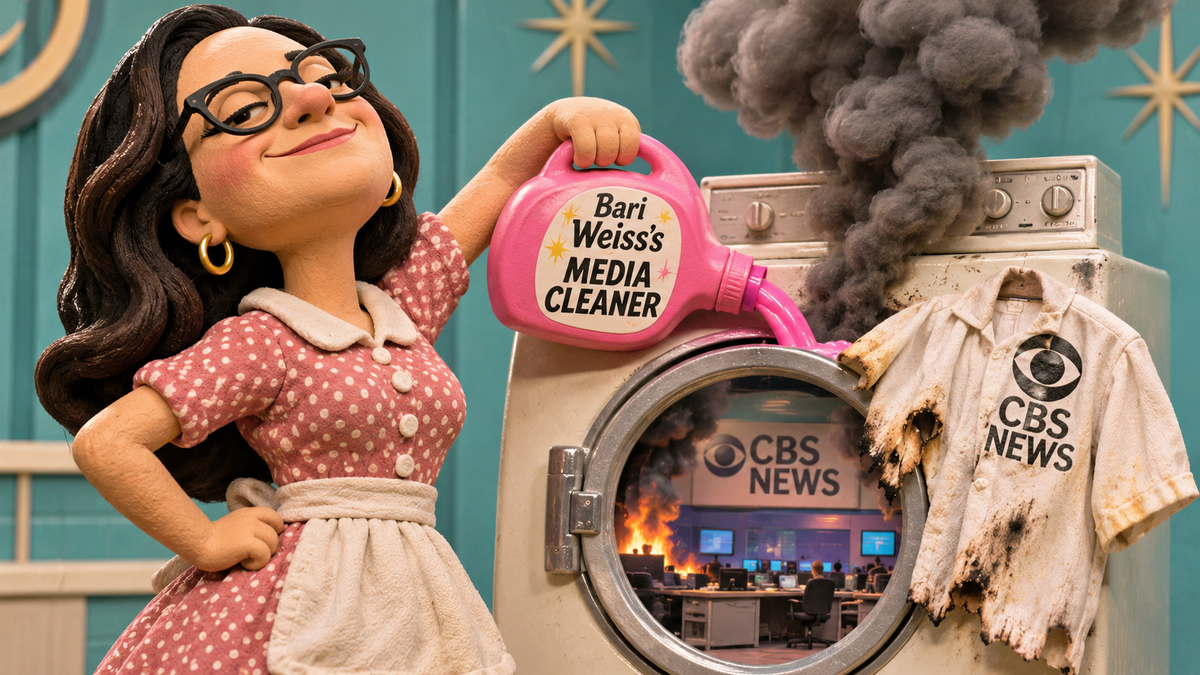
I was doing some archaeology in my notes recently, and stumbled across some thoughts I'd jotted down about The Free Press and its founder, Bari Weiss, way back in the day.
That sent me down a rabbit hole. And boy howdy, what a rabbit hole.
I had been vaguely aware of Weiss's career, her rather spectacular departure from the New York Times, and the emergence of The Free Press as a refuge for people who considered themselves victims of the ideological conformity of mainstream journalism.
But I hadn't really connected the dots. And now that she's running CBS News, with the network's crown jewel, 60 Minutes, being systematically dismantled around her, it seemed like a good time to revisit the record.
Because here's the thing about Bari Weiss: for most of her professional life, she's been telling anyone who will listen that America's great institutions have become intolerant of dissent, hostile to independent thinking, and obsessed with enforcing ideological conformity.
She made a lucrative career out of it.
Then somebody handed her the keys to one of those institutions.
And wouldn't you know it? Suddenly dissent is a problem.
The Grievance That Started It All
We have to go back to Columbia University in 2004.
A pro-Israel advocacy organization called the David Project released a documentary, Columbia Unbecoming, accusing faculty in Columbia's Middle East studies department of intimidating students who supported Israel.
Among the students promoting the allegations was a nineteen-year-old Bari Weiss, who helped establish Columbians for Academic Freedom. The campaign sought action against professors accused of mistreating students, particularly Joseph Massad.
This became a national controversy, with accusations of antisemitism, academic intimidation, and political persecution flying around.
Columbia eventually convened a faculty committee to investigate.
Its 2005 report found no evidence of antisemitic statements by the faculty members under investigation, nor evidence that students had been penalized academically for their political views. It did identify one credible incident in which a professor exceeded acceptable bounds when responding to a student.
So, not a complete exoneration of every professor. But hardly the sweeping indictment of a department that the campaign had suggested.
Weiss rejected the narrowness of the findings, arguing that the investigators had failed to address the larger atmosphere of intimidation.
And there's an important distinction here. Students should absolutely be able to challenge professors without fear of retaliation. Antisemitism is real, including in academic settings. None of that is in dispute.
But the episode also reveals an early characteristic of Weiss's public career: a willingness to take a conflict inside an institution, frame it as evidence of a much broader ideological failure, and carry that argument into the national discourse.
That's not inherently illegitimate. Sometimes institutions deserve precisely that treatment.
The interesting question is whether Weiss applies the same standard when she's the one exercising authority.
Keep that question in mind.
Sweaty's Corner doesn't have a marketing budget or an algorithm pushing it into anyone's feed. It has readers who share it. If this one landed, sending it to someone who'd get something out of it — or subscribing so the next one finds you directly — genuinely moves the needle.
The Persecuted Insider
After Columbia, Weiss proceeded to build an impressive establishment résumé.
The Wall Street Journal editorial pages, followed by the New York Times opinion section in 2017.
Not exactly an exile wandering the wilderness, begging somebody to publish her forbidden thoughts.
But at the Times, her criticism of the paper's culture became increasingly pointed. After the controversy surrounding Senator Tom Cotton's 2020 op-ed calling for military intervention against protesters, Weiss described an internal ideological civil war.
Then came her resignation.
And good lord, what a resignation.
In her public letter to publisher A.G. Sulzberger,1 Weiss accused colleagues of bullying and harassment, described an environment hostile to independent thought, and charged that the newspaper had effectively surrendered editorial authority to the ideological demands of Twitter.
She alleged that colleagues had called her a Nazi and racist, mocked her in internal communications, and that management had failed to protect her.
I am not going to pretend that I can adjudicate everything that happened inside the Times. Some of those allegations may well be true, and workplace harassment isn't acceptable simply because somebody holds opinions you dislike.
But consider what happened next.
Weiss left one of the most prestigious jobs in American opinion journalism, published a resignation letter that became a national cause célèbre, and built an independent media business around the proposition that mainstream journalism had lost its way.
The Free Press was born out of that opportunity.
And it was enormously successful.
The publication attracted a substantial audience, prominent financial backing, and people dissatisfied with the ideological orthodoxies they perceived in traditional media.
Good for her. There's nothing wrong with starting a competing publication and demonstrating that an audience exists for something different.
My problem isn't that Weiss criticized the Times. Lord knows the Times has earned plenty of criticism.
My problem is what happens when you build your identity around principles that become rather less convenient once you're in charge.
The Free Press and the Famine That Wasn't Supposed to Be
One of the more revealing examples of The Free Press's editorial approach came from its coverage of starvation in Gaza.
In May 2025, Michael Ames published "The Gaza Famine Myth," questioning claims of famine and arguing that journalists and humanitarian organizations had presented misleading statistics and evidence.
Then in August, Free Press reporters Olivia Reingold and Tanya Lukyanova published an investigation into photographs of starving Palestinian children appearing in major news outlets.
They found that children featured in the photographs had preexisting medical conditions, including serious developmental and physical illnesses. The reporting suggested that these conditions provided important context missing from the original coverage.
Now, determining whether a photograph has been presented accurately is legitimate journalism. If a child's medical history materially affects the interpretation of an image, readers should know that.
But there was a rather significant problem with the implication.
Having an underlying medical condition does not make somebody immune to starvation.
Quite the opposite, in fact.
People who are already medically vulnerable are often the first to suffer catastrophic consequences when food, medicine, and specialized nutritional support become unavailable.
This isn't some obscure medical insight. It's pretty basic stuff.
On August 22, 2025, just four days after The Free Press investigation appeared, the internationally recognized IPC food-security system formally confirmed famine in Gaza Governorate.
That determination concerned population-wide conditions, not the diagnostic histories of a dozen photographed children.
The Free Press defended its reporting, arguing that other news organizations had omitted important context.
Then reporter Maha Hussaini, working with Ryan Grim at Drop Site News, did something rather important.
She contacted the families.
Hussaini, herself facing displacement during the Israeli military offensive, located relatives of three children whose cases had been highlighted in the controversy.
Their accounts described children who had been managing serious medical conditions before food shortages and the collapse of access to treatment caused dramatic deterioration.
The medical conditions were real. So was the starvation.
And those two facts weren't contradictory.
Drop Site's investigation challenged the interpretation advanced by The Free Press, not necessarily every piece of medical information its reporters had uncovered.
What makes this particularly galling is that The Free Press had been celebrating its work as a triumph of rigorous journalism over the supposedly careless mainstream press.
But the additional reporting complicated the neat little debunking narrative.
The problem wasn't that The Free Press investigated the photographs. It should have.
The problem was treating evidence of medical vulnerability as though it somehow diminished evidence of starvation.
That's not the sort of careful skepticism that Weiss claims to champion. That's a failure to follow the evidence beyond the point where it becomes inconvenient.
And remember, this was the publication whose editorial philosophy was about to be introduced into one of America's most consequential news organizations.
The Miracle Cure for CBS News
In October 2025, David Ellison's Paramount Skydance acquired The Free Press for a reported $150 million and installed Weiss as editor-in-chief of CBS News.
The Free Press was reportedly generating approximately $20 million in annual revenue.
That's roughly seven and a half times revenue.
A handsome payday, especially for a media business operating in an industry where everyone else seems to be trying to figure out how to keep the lights on.
And along with the acquisition came the remarkable appointment of Weiss to the top editorial position at CBS News.
A woman whose experience consisted primarily of opinion journalism, editing, and building a digital publication was suddenly responsible for one of the oldest and most storied broadcast news organizations in America.
She had never run a television newsroom.
But apparently that wasn't a disqualifying consideration.
Ellison praised her independence, principles, entrepreneurial drive, and editorial vision.
Which sounds remarkably like the kind of corporate word salad that people who rail against DEI hiring practices love to mock when it's used to justify an appointment they dislike.
I can almost see the infomercial.
It's two in the morning. David Ellison appears in a blue polo shirt, standing beside an enormous stained white shirt labeled CBS NEWS.
Ordinary detergents have failed! Decades of accumulated institutional grime! Ratings problems! Audience distrust! Liberal bias!
But wait!
Introducing BARI WEISS, the revolutionary new media-cleaning formula!
Just pour directly onto the newsroom. No need to measure. No experience necessary.
Watch as years of accumulated journalism simply dissolve!
And for a limited time, we'll throw in an ideologically sympathetic ombudsman, controversial new editing requirements, and an assortment of newsroom departures!
Operators are standing by.
The stain didn't come out.
The shirt caught fire.
The Principles Meet the Newsroom
When Weiss arrived at CBS, she circulated ten principles intended to guide the network's journalism.
Among them were commitments to factual reporting, ideological diversity, equal scrutiny of both major political parties, and pursuing important stories regardless of their popularity.
A perfectly reasonable collection of aspirations.
I would happily endorse most of them.
But principles are easy to write down. Particularly when you're the one issuing them.
The real test comes when the journalism conflicts with the preferences of management, ownership, or powerful political figures.
And that test arrived almost immediately.
In December 2025, Weiss abruptly delayed a 60 Minutes investigation into the treatment of Venezuelan migrants sent by the Trump administration to El Salvador's notorious CECOT prison.
The report, by correspondent Sharyn Alfonsi, had already undergone editorial and legal review and was scheduled to air.
Weiss argued that the piece required additional reporting and a fuller account of the administration's position.
Alfonsi believed the intervention was political.
The disagreement was significant. A news editor is entitled, indeed obligated, to demand additional reporting when a story isn't ready. And journalists are not automatically right simply because their editors disagree with them.
But consider what followed.
The segment finally aired on January 18, 2026, with additional administration statements and updates, but with its central reporting largely intact.
The administration had declined to provide the on-camera interviews Weiss had originally sought.
So what precisely had justified the extraordinary last-minute intervention?
CBS maintained that the report needed additional work. Alfonsi and other critics saw an effort to make the journalism more acceptable to an administration whose conduct was being scrutinized.
I can't independently establish Weiss's motive. But the decision, the timing, and the eventual broadcast certainly raise questions.
And the questions only grew louder.
Sweaty's Corner doesn't have a marketing budget or an algorithm pushing it into anyone's feed. It has readers who share it. If this one landed, sending it to someone who'd get something out of it — or subscribing so the next one finds you directly — genuinely moves the needle.
The Ticking Clock
By late May 2026, Weiss's campaign to remake 60 Minutes had moved well beyond arguments over individual stories.
CBS fired executive producer Tanya Simon, a veteran of the program, along with correspondents Sharyn Alfonsi and Cecilia Vega.
Weiss installed Nick Bilton, a journalist and documentary filmmaker without traditional broadcast newsroom experience, as the show's new executive producer.
Anderson Cooper had already elected not to renew his contract, citing a desire to spend more time with his family. Other prominent CBS personnel had departed under different circumstances.
Not all these departures can fairly be called firings, much less attributed to a single cause.
But the May overhaul was unmistakable.
It was also astonishingly disruptive to a program whose credibility and institutional knowledge had been built over decades.
Then Scott Pelley decided he'd had enough.
At a June 1 staff meeting introducing Bilton, Pelley confronted the new executive producer over the firings and questioned the qualifications of both Bilton and Weiss.
He accused Weiss of "murdering 60 Minutes."
Strong words from someone who had spent decades working for CBS.
The next day, Pelley was fired.
Bilton's termination letter accused Pelley of a hostile public confrontation and an unwillingness to work collaboratively with the program's new management.
Weiss subsequently told staff that the newsroom required trust and mutual respect, and said management had tried unsuccessfully to repair the relationship.
Pelley disputed that account.
Now, I'm not going to suggest that Pelley was some shrinking violet politely requesting a meeting to discuss workplace concerns. By all accounts, it was a confrontational exchange, and he knew exactly what he was doing.
But here's where the whole thing becomes genuinely extraordinary.
Bari Weiss built a career arguing that institutions should tolerate uncomfortable dissent.
She complained about ideological conformity, oppressive workplace cultures, and the suppression of opinions that challenged the prevailing orthodoxy.
And now, when one of the most experienced journalists in her own organization publicly challenged her leadership, the result was termination.
Tell me again about the importance of tolerating dissent.
Pelley's subsequent public statement went beyond complaints about personnel decisions.
He alleged that management had instructed him to introduce false or unverified assertions into politically sensitive reporting. He also claimed that politicians had been allowed to influence the selection of correspondents conducting interviews.
Those are serious accusations.
CBS denied political interference, describing its editorial involvement as the ordinary exchanges between management and journalists that occur in every newsroom.
And that defense deserves to be reported. Editors are supposed to edit.
But there is a considerable difference between challenging a reporter to substantiate a claim and pressuring that reporter to include claims the reporter considers unsupported.
The public record does not establish every detail of Pelley's allegations. What it does establish is a remarkable breakdown in confidence between the leadership of CBS News and some of its most experienced journalists.
A breakdown serious enough that management fired the journalist who publicly challenged it.
And I can't help wondering:
If Bari Weiss had publicly challenged the leadership of the New York Times in an all-staff meeting, and had subsequently been fired, what would her resignation letter have looked like?
Would she have accepted the explanation that she was insufficiently collaborative?
That her confrontation was disrespectful?
That management simply needed people who supported its vision?
Somehow, I doubt it.
Meanwhile, in the Executive Suite
All of this is happening under the ownership of David Ellison, whose father Larry is a billionaire Trump ally, and whose corporate ambitions extend well beyond CBS.
The Ellisons have been pursuing a roughly $111 billion acquisition of Warner Bros. Discovery, which would also place CNN under Paramount's corporate umbrella.
And the relationship between Paramount, its ownership, and the Trump administration has become the subject of serious scrutiny.
Remember that Paramount agreed to a $16 million settlement of Trump's lawsuit over the editing of a 60 Minutes interview with Kamala Harris.
That settlement preceded regulatory approval of the Skydance takeover of Paramount.
Then, in January 2026, Trump made an extraordinary boast to CBS anchor Tony Dokoupil, suggesting that Dokoupil owed his position to the president.
In May, Semafor's Ben Smith pressed CBS managing editor Charles Forelle about whether Weiss's appointment had been part of an arrangement to make the network's coverage more favorable to Trump.
Forelle explicitly denied that proposition.
But when Smith asked about Trump's claim to have secured Dokoupil's job, Forelle deflected the question back to Trump.
Not exactly a comforting exchange for anyone concerned about editorial independence.
In July, a Paramount shareholder filed suit in Delaware, alleging that the Ellisons had offered improper benefits to Trump, including promises concerning CNN's editorial direction, to secure approval of the Warner transaction.
Those are allegations, not findings. The complaint relied substantially on publicly reported information rather than firsthand evidence of a secret bargain.
Separately, twelve states brought an antitrust challenge to the merger. A federal judge issued a temporary restraining order in July, and the companies subsequently agreed not to close the transaction while the litigation proceeded. A trial was scheduled for March 2027.
The corporate and legal questions are substantial, but they do not independently prove that Weiss took orders from Trump or the Ellisons about individual stories.
Nor do they need to for the central point here.
Weiss is operating inside a corporate structure whose owners have enormous financial incentives tied to government regulatory decisions.
That is precisely the sort of environment in which editorial independence matters most.
And instead of inspiring confidence that the newsroom can resist those pressures, her tenure has produced public disputes over editorial interference, the departures of experienced journalists, and the firing of one of the network's most recognizable correspondents after he challenged management.
Quite the achievement for the woman hired to restore trust in journalism.
The Irony Is Almost Too Perfect
I have no objection to someone challenging established media organizations. They deserve it. The New York Times isn't sacred. CBS isn't sacred. And the journalism profession has plenty of institutional habits worth examining.
Nor do I think the old hands at 60 Minutes were necessarily right about every decision. Experience is valuable, but it doesn't grant immunity from criticism, changing audience expectations, or the need to adapt.
The decline of traditional broadcast news is real. CBS needed to find ways to reach new audiences. Weiss was entitled to propose a different approach.
But if you're going to spend your career demanding that institutions live up to certain principles, you should expect people to apply those principles to you when you acquire institutional power.
That's the bargain.
And this is where Bari Weiss has become such a fascinating, and infuriating, figure.
For years she portrayed herself as someone brave enough to challenge powerful institutions.
Now she's running one, backed by enormously wealthy owners, exercising substantial authority over the careers of journalists whose work and reputations predate her arrival by decades.
And when those journalists challenge her, suddenly the conversation is about professionalism, collaboration, and respect for management.
Funny how that works.
It turns out that defending dissent is considerably easier when you're the dissenter than when you're the person being dissented against.
I started this little excursion wondering how a college activist became one of the most powerful figures in American journalism.
After following the record from Columbia to the Times, through The Free Press, and finally to the smoking wreckage of 60 Minutes, I think the more interesting question is what she actually believes about the freedom to challenge authority.
Because the answer seems to depend rather heavily on who holds that authority.
The system isn't persecuting Bari Weiss.
It keeps promoting her for saying it is.
1 - of course this C-word has a website that is her name. For fuck's sake, how insufferable. I bet she savors the smell of her flatulence too.


