The Cronkite Moment Isn't Coming: Why This Hole Is Deeper Than the Last One
People keep waiting for the moral shock that turns the tide. That's not how this works anymore. And there's a reason Republicans aren't losing any sleep over it.

In the first part of this series, we laid out how we got here: John Roberts' career-long project to make the Voting Rights Act unconstitutional, completed last week with the Callais decision. If you haven't read that one, go do that. I'll wait.
For those of you who did, here is the question that keeps me up at 3am staring at the ceiling: how the fuck do we correct this? Because the mechanisms we used last time to pull out of this particular spiral are not available. And the people telling you otherwise are either naive, self-interested, or both.
How It Worked Last Time
The Civil War ended in 1865. The Thirteenth, Fourteenth, and Fifteenth Amendments were ratified by 1870. And then the federal government essentially shrugged, cut a deal with Southern Democrats, withdrew the troops, and let a fucking century of apartheid happen[1]. Reconstruction's failure wasn't ideological, it was structural and political. Northern Republicans wanted Southern electoral peace more than they wanted to keep dying for Black civil rights in a war that was, technically, over.
What finally broke the logjam a hundred years later was not a spontaneous moral awakening. It required a specific and almost unrepeatable confluence of forces.
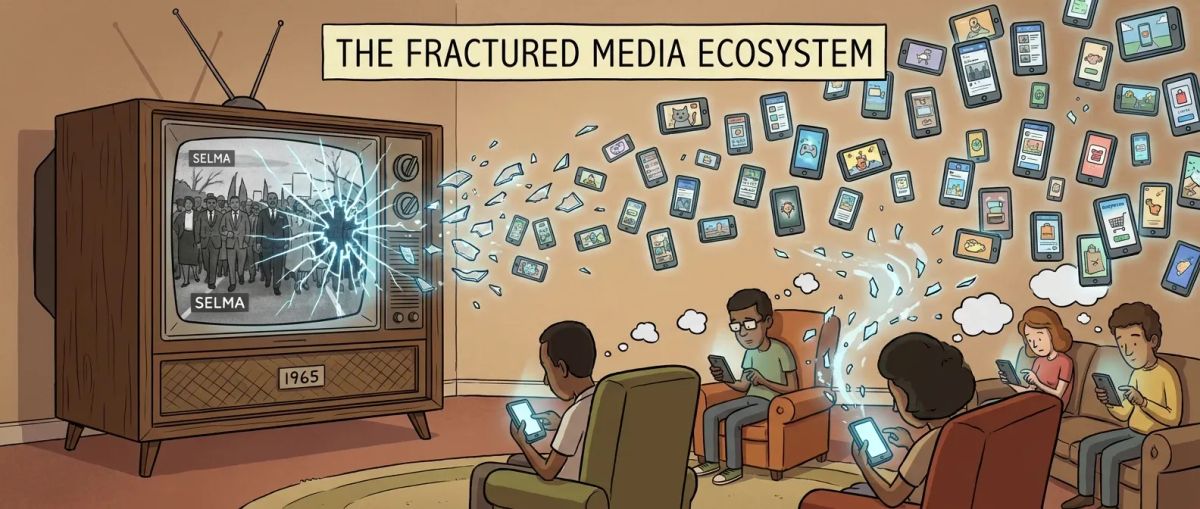
The first was the nationalization of the media. For most of American history, you could run a police state in Alabama and the people in Ohio and Wisconsin would never see it. Walter Cronkite changed that. Network television, beaming into 90% of American homes, carried footage of Alabama state troopers wielding whips, nightsticks and tear gas rushed the group at the Edmund Pettus Bridge and beat them back to Selma into living rooms that had never confronted the physical reality of what segregation actually looked like in practice. The moral shock was genuine and it moved people who were not ideologically committed to maintaining Jim Crow but who simply hadn't known. Ignorance, in that case, was addressable.
The second was Cold War geopolitics. Jim Crow was a propaganda catastrophe for the United States during the contest with the Soviet Union for influence in newly decolonizing nations across Africa and Asia. The State Department was actively aware that footage of American apartheid was being broadcast by Moscow Radio into Africa and Asia. There was a genuine national security argument for cleaning it up, separate from and in addition to the moral argument.
The third was a traumatized Congress and a legislatively aggressive president, post-Dallas, who knew how to use the moment and did.
None of those three things exist right now. Not even approximately.
The Information Problem Is Not Solvable
The closest thing to a modern Cronkite moment was George Floyd. That video spread everywhere, across every platform, in every demographic. It genuinely moved people. Polling in the summer of 2020 showed in 2020 that 52% of Americans believed the protests would improve Black lives. By 2025, only 27% say they did. BLM support dropped from 67% to 52%. Almost half of Americans now feel emotionally drained just thinking about race issues. And most damningly, 72% say the whole racial reckoning produced no meaningful change for Black people.
And then the Republicans reframed it. Not the underlying issue, mind you. The framing. They took "defund the police," a slogan that meant roughly "reallocate some municipal budget priorities[2]," and turned it into "these people want to let murderers into your house." They took the statue removals and turned them into "they're coming for Jefferson and Lincoln." They took "anti-racism" and turned it into "they want to make your children hate themselves for being white."
And it worked.
By 2021, Republicans were winning on crime in Virginia. By 2022, Latino men were moving toward the Republican Party in numbers that should have terrified Democratic strategists more than it apparently did. By 2024, the realignment was visible across multiple demographic categories that the Democratic coalition had assumed were locked in.
The lesson here is brutal: a viral moral moment in a fractured media environment doesn't just mobilize the people you want it to mobilize. It mobilizes the opposition with equal or greater efficiency. The identity threat research is unambiguous on this. When a significant segment of the population feels that their group's cultural centrality and status is under attack, they consolidate around that identity with a ferocity that overrides other political preferences. The BLM moment triggered exactly that response in exactly the people Democrats needed to hold.
And the really uncomfortable part? A lot of those people are not traditional racists. They don't consciously wish harm on Black Americans. What they feel is displacement, the sense that their culture, their values, their claim to a particular American identity are being condemned and overwritten. Republicans understand how to speak to that with surgical precision. Democrats, by and large, do not.
The Suppression Math
Here is what makes this moment structurally different from Reconstruction's failure and structurally more durable than the pre-Civil-Rights period.
Last time, the suppression was largely a regional project. The South ran its apartheid. The North had its own racism, but it was more informal and less legally codified. The federal government retained theoretical authority over the states, and when it finally chose to exercise that authority, it had the constitutional tools.
What is being built right now is a legal architecture specifically designed to prevent the exercise of that authority. The Roberts Court has spent decades narrowing congressional power under the Reconstruction Amendments. Callais doesn't just gut Section 2 of the VRA. It also narrows what "appropriate legislation" under the Fifteenth Amendment actually means, making it harder for a future Congress to simply rewrite the VRA and try again. The Court has, with apparent deliberateness, built a cage around congressional remediation authority.
Meanwhile, the practical electoral consequences compound. In ten Southern state legislatures, Republicans could potentially gain over 190 seats currently held by Black Democrats in majority-minority districts. Those are not just legislative seats. That's the pipeline of candidates, the donor network infrastructure, the institutional relationships that produce the next generation of political leadership. Eliminate those districts, and you don't just lose the current officeholders. You hollow out the system that produces future ones.
Senate malapportionment already structurally over-represents rural, predominantly white states. The House gerrymandering enabled by Callais amplifies the partisan advantage at the federal level. State-level redistricting does the same below that. And the courts, which should be the corrective, are now the instrument.
It is a self-reinforcing loop, and no, it is not hyperbole to call it that.
The One Corrective: Demography, (Eventually)
There is a plausible mechanism for change. It is slow, uncertain, and requires the suppression infrastructure not to outpace it. But it exists.
The United States is getting less white, not because of immigration alone but because of generational turnover. The cohorts aging out of the electorate are disproportionately white and non-college. The cohorts entering it are disproportionately diverse and, critically, multiracial in ways that make the old binary categories increasingly unstable.
More specifically: the Callais decision's logic doesn't just apply to Black majority-minority districts. It exposes Latino, Asian-American, and Native American opportunity districts too. In Texas, Arizona, Nevada, and Florida, Republicans need a significant slice of Latino votes to win statewide. If the suppression of Latino political representation in state and congressional maps provokes serious, durable Latino political mobilization, the coalition math in those states gets complicated in ways that threaten Republican statewide viability. That's a big if, because Latino political mobilization has historically been uneven and Democrats have repeatedly fumbled the relationship. But the structural incentive is there in a way it isn't for Black voters in Alabama, whose statewide influence is simply being eliminated by map.
The more honest framing, though, is this: demographic change works on a thirty-year timeline. The suppression infrastructure is being rebuilt right now, in 2026, in response to an election happening in November 2026 and a presidential race in 2028. The Republicans are building for the next cycle. Demographics work across the next generation. That is a mismatch that should scare the hell out of anyone doing the math honestly.
What We're Actually Looking At
Legal scholar Kareem Crayton put it plainly: "The court interred the Voting Rights Act without having the dignity of showing up and having a funeral." That's not hyperbole. That's a precise description of what happened.
The people peddling hope here, the ones who say that Republicans have overreached and the correction is coming, are not wrong that overreach eventually produces backlash. They're wrong about the timeline and wrong about the mechanism. The overreach of Shelby County in 2013 did not produce a political correction. It produced twelve more years of voting restriction, capped by Callais. The overreach of Dobbs hasn't yet produced a Congress capable of restoring federal abortion protections. Backlash moves slower than damage.
What we are actually looking at is a period of democratic recession that, unlike the Jim Crow era, is operating without a homogenized media ecosystem capable of generating moral shock, without a Cold War geopolitical incentive to clean it up for foreign audiences, without a traumatized Congress looking for something redemptive to do, and with a legal architecture specifically designed to foreclose the remedies that worked last time.
That is not forever. Demographics are real. Political coalitions do shift. The Republican coalition has its own internal tensions, particularly as the economic consequences of various policy decisions land on working-class voters who were promised something different. The overreach may eventually produce a corrective.
But if you're sitting around waiting for the Cronkite moment that makes the middle suddenly give a damn about Black voting rights in Louisiana, you are going to be waiting for a very long time. The mechanism doesn't exist. The infrastructure for converting moral shock into durable political change was eaten by the algorithm and what replaced it is optimized for outrage, not action.
The path out runs through demography and coalition, not through a video that goes viral and changes minds. It runs through 2030 redistricting after census counts that reflect a changed population. It runs through Latino political mobilization in states where Republicans genuinely cannot afford to lose it. It runs through the long, grinding work of building political power in the places it's been stripped from, even when the legal tools to do so are being systematically removed.
That is a bleak assessment. I know. But you can't map a route out if you won't look honestly at where you're standing.
And right now, we're standing in the rubble. And the Republicans seem intent on bouncing the rubble for the forseeable future.
1 - when Adolph fucking Hitler uses the treatment of the blacks in America as a blueprint for his treatment of Jews, you know you're fucked up.
2 - I know this pisses the progressive left off, but if you have to explain your slogan, you are fucking failing at the messaging game.