The Empty Creel Party
The beard is not vetting. A launch video is not a governing record. And a Senate race is a catastrophically expensive place for a first background check. The finale of The Empty Creel: stop waiting for saviors and build the fucking bench.


The next Obama is not a pipeline. The beard is not vetting. And the Senate should not be anyone's first background check.
Part One of this series was about the last gettable Republican: he's been gotten, the creel is empty, and it's time to stop fishing that stretch of river. Part Two was about the Never Trumpers who came aboard and grabbed the wheel.
Which leaves the obvious question hanging over the whole series: if the growth isn't coming from defectors, and the defectors shouldn't be steering — where does it come from?
It comes from the boring answer. The one nobody wants to fund. It comes from building candidates, from the bottom, on purpose, over years. And if you want to understand why Democrats keep failing to do that, you could not have scripted a better illustration than what just happened in Maine.
I. Where the fuck is everybody?
Every few years, the Democratic Party looks around in alarm and asks where all the candidates went.
The Senate seat is open. The governor is retiring. The presidential field looks old, bloodless, or both. And the whole apparatus — donors, strategists, pundits — asks the question like the bench is a naturally occurring resource that should have replenished itself while everyone was busy with presidential years.
Then begins the hunt for a miracle. Surely somewhere out there is a charismatic veteran, farmer, prosecutor, astronaut, small-business owner, or Rhodes Scholar who can be introduced to the country on Tuesday and sworn into high office eighteen months later.
Preferably with a good launch video.
And apparently nobody is expected to ask why the party didn't know this person existed five years ago.
A political bench is not discovered during an emergency. It is built before one.
II. The creel was never meant to hold one trophy fish
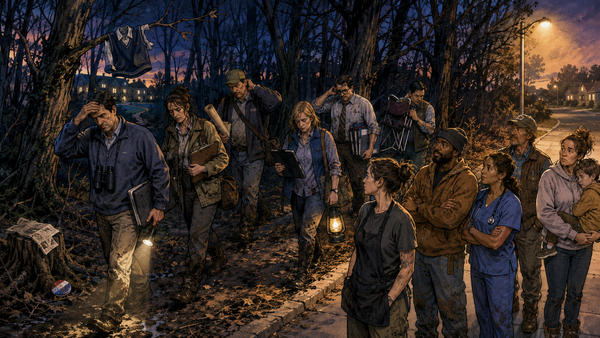
A creel — the whole conceit of this series — is not designed to hold one mythical fish. It holds the accumulation of a day's work. A healthy party's creel is full of city council members, county commissioners, school-board members, mayors, state reps, local party chairs, and — this part matters — losing candidates who outperformed their districts and learned something.
Most of them will never be senators. That's not a bug. That's how a pipeline works. Volume in, scrutiny applied, and a smaller number of genuinely gifted politicians emerge at the top — tested, scarred, and known quantities.
Exceptional candidates should emerge from abundance. They should not be the substitute for abundance.
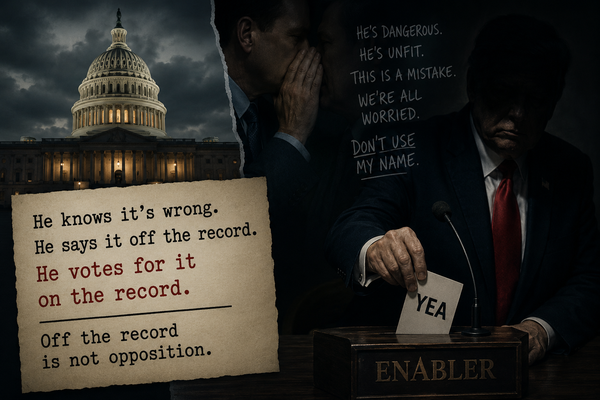
The Democratic approach too often runs it backwards: ignore most local races, let county organizations wither, and then, when a marquee seat opens, conduct a desperate national search for someone exceptional enough to overcome the missing infrastructure.
III. Maybe run a candidate
In huge swaths of the country — everywhere outside the metro strongholds, really — Democrats don't contest. Republican officeholders run unopposed. County parties get funded like a rounding error. The national party shows up every four years asking for a presidential vote and vanishes in between. And the only version of "Democrat" a lot of voters ever encounter is the caricature on Fox News.
Every uncontested race costs more than the office. It costs voter contact, volunteer recruitment, donor development, local press relationships, message testing, campaign staff development, and the simple knowledge of which kinds of candidates connect with which kinds of voters.
An empty ballot line is not just a lost election. It's a forfeited organizing opportunity.
This doesn't mean spending equally everywhere or pretending every race is winnable. It means recognizing that a candidate who moves a district from 28 percent to 41 percent may have accomplished more, organizationally, than a safe-seat incumbent coasting to reelection. You cannot disappear from a county for twenty years and then parachute in with a Senate candidate promising to understand its people.
IV. Losing is not a contagious disease
Candidates get good the way everybody gets good at everything: reps. Knocking doors. Botching the speech, then not botching it. Handling a hostile question without stepping on a rake. Raising money. Hiring staff. Taking a punch and filing the lesson away.
Which means a first campaign is often a test, not a verdict. Republicans figured this out generations ago — they ran people in hopeless terrain for cycles, built organizations, and were standing there ready when the ground shifted.
Democrats, too often, do the opposite. A promising candidate loses once, and the donors evaporate, the consultants take the next call, and the activists go hunting for a new exciting prospect.
The party treats losing candidates as spoiled inventory rather than partially trained talent.
No, not everyone who loses should run again — some people lose because they're bad at this, and that's also useful information. But the evaluation should be: did they outperform the district, grow the volunteer base, keep message discipline, learn anything? A candidate who loses well can be worth more than one who wins a seat no Democrat could lose.
V. There was only one Obama
Handle this one carefully, because it's the founding myth of the whole dysfunction.
Barack Obama did not materialize from the ether. He served in the Illinois Senate. He lost a congressional primary. He built relationships and developed as a politician. Then he went from freshman senator to president at unprecedented speed, riding a once-in-a-lifetime combination of rhetorical genius, discipline, biography, Iraq, timing, and a country exhausted by Bush.
The proper lesson: an extraordinarily gifted candidate can occasionally skip stages.
The lesson the party actually absorbed: the way to build a national candidate is to find someone charismatic enough to skip stages.
Obama was proof that exceptions exist. He was not a workforce-development plan.
The fantasy survives because it's so convenient. Why cultivate fifty state legislators — years, money, tedium — when one brilliant newcomer might just solve the problem? A once-in-a-generation talent became standard operating procedure.
VI. The candidate was cast, not developed
Here's the analytical center of the thing. Modern candidate recruitment has become casting for a prestige television series. The candidate must embody a story the party — or its loudest faction — wants to tell.
For establishment Democrats, the archetype is the veteran-prosecutor with rolled-up sleeves, a tasteful fleece, and a biography that reads as service plus competence. West Wing casting.
For the online left, it's the union organizer or farmer in a work jacket with rural roots, open hostility to billionaires, and — crucially, we'll get there — the beard. A Carhartt catalog with class consciousness.
Both camps believe they're rejecting artificial politics. Both are often just responding to an aesthetic designed to reassure their own subculture.
The establishment wants a candidate who looks like competence. The online left wants one who looks like authenticity. Neither appearance is the same thing as readiness.
And the biography becomes a shortcut around the questions that actually matter: Has this person ever run anything? Can they retain staff? Do colleagues trust them? Can they take criticism? Have they ever built a coalition, explained a trade-off, exercised judgment when nobody was applauding? What will opposition research find?[1]
VII. Yes, the beard matters
Let's give the beard its moment, because the beard is doing so much work.
The beard is not merely facial hair. It is a policy document written in keratin. It says: not consultant-made. Works with his hands. Knows what things cost. Can talk to rural voters. Masculine, but not that kind of masculine. Culturally normal, economically left. Owns practical footwear. Has possibly split firewood this month.
For a certain progressive audience, those signals are evidence — proof that here, finally, is the candidate who can win back working-class voters without compromising an inch of economics.
But aesthetics are projection surfaces. People see in them what they desperately want to find.
A cultural signal can earn a closer look. It cannot substitute for the look.
VIII. The Senate should not be your first background check
Which brings us to Maine, and I want to be careful here, because the point is the system, not the man.
Graham Platner's appeal was real and easy to understand. Oyster farmer. Combat veteran. Economic populist with working-class credibility and rural fluency, furious at oligarchy, blessed with a launch video so good it did 2.5 million views in a day and a million dollars in nine days. He wasn't a candidate. He was an answer to an argument — walking proof that a bearded populist could crack the working-class code.
People got emotionally invested before the normal work of vetting had occurred. And then the vetting happened anyway, in public, at scale: the old Reddit posts, the staff exodus and the NDAs, the reporting about his relationships, and finally, in July — weeks after he'd won the primary with 72 percent of the vote, more primary votes than any Democrat in Maine history — allegations of sexual assault from a former girlfriend. Allegations he categorically denies. Every senator who'd endorsed him un-endorsed. The DSCC walked. He withdrew.
The candidate was not developed. He was discovered, cast, branded, and fired toward a Senate race — and the Senate race turned out to be his first background check, first performance review, and first hostile-media exercise all at once.
That's too much beta testing for one election.
And here's the part that should make the whole party sit quietly and think about its choices: look at who replaced him. Troy Jackson. A logger from Allagash who first made news in 1998 blockading the Canadian border over paper-company labor practices, then spent two decades in the state legislature and became Senate president.[2] Working-class credibility, populist economics, rural fluency — every single thing Platner was cast to signify, except Jackson carries it with twenty years of votes, fights, compromises, and colleagues who know exactly what he is. He wasn't discovered. He was developed. He was standing there the whole time.
Local office wouldn't have magically exposed everything about anybody — no system catches every bad outcome. But repetition creates opportunities for scrutiny and evidence. A Senate race is a catastrophically expensive place to run the first meaningful test, and Maine Democrats are now spending the most winnable cycle they'll get against Susan Collins finding that out.
IX. Govern something
Why do the lower rungs matter so much? Because campaigning reveals whether a candidate can make promises. Governing reveals what happens when the promises collide with reality.
A city council member has to approve or reject actual housing, negotiate actual budgets, face actual angry residents, and choose which services get funded knowing every option disappoints someone. A state legislator has to assemble votes and defend compromises. A mayor has to hire competently, manage a crisis, and own the outcome.
That experience doesn't just make safer nominees — it makes better public servants. It teaches the difference between slogans and administration, activist consensus and public consensus, moral clarity and inflexibility.
It also builds armor. A candidate with no record is an abstraction opponents can fill with anything — socialist, radical, defund-the-police, whatever polls worst that cycle. A candidate with a record is a person.
It's hard to turn someone into a socialist cartoon when half the district knows her as the woman who got the fire station rebuilt.
And local races are how the endless electability arguments — the ones from Part Two — actually get settled. "That kind of candidate can't win here" is a hypothesis. Local elections are how parties test hypotheses: with ballots, not pundit confidence or consultant mythology. A candidate who wins reelection has demonstrated something. One who loses narrowly in hostile territory has demonstrated something. One who collapses under scrutiny has demonstrated something early, when the lesson costs a county seat instead of the U.S. Senate.
X. Unicorns are great for fundraising
So why does the party keep savior-hunting when the development model is right there? Because the incentives all point the other way.
Candidate cultivation is slow, decentralized, unglamorous, hard to monetize, and produces no viral moments. A sudden discovery, on the other hand, is a bonanza for the entire national ecosystem: consultants get a campaign, organizations get a fundraising vehicle, media get a protagonist, activists get a symbol, donors get excitement, pundits get a theory of the race.
Building a county party is tedious. Discovering the next Obama is content.
And the consultants have their own conflict baked in. The professional hired for one election is rewarded for raising money, generating attention, and winning this race — not for telling a promising novice to run for city council first and come back in six years.
"You should spend four years on the county commission" is probably sound advice. It is also a terrible invoice.
Once a candidate embodies the story everyone wants told, skepticism reads as betrayal of the story. Nobody has to be acting in bad faith. The incentives do the work.
XI. Stock the stream
Enough diagnosis. What does the actual system look like?
Contest far more local and state offices. Identify community leaders before the marquee races open. Train candidates in fundraising, communications, and management. Preserve campaign data and volunteer networks between cycles instead of burning them down every November. Support credible candidates after losses. Evaluate performance against district fundamentals, not vibes. Do the opposition research early. Build real pathways from local office to state office, and promote people on demonstrated ability rather than sudden national enthusiasm.
And run someone even when they'll probably lose — not with national money dumped in for symbolism, but with basic support and genuine intent, because a credible losing campaign forces the incumbent to defend a record, recruits volunteers, builds name recognition, and normalizes the Democratic label in places it's become an epithet. Sometimes the first job of a candidate isn't to take the office. It's to make the party exist again.
One qualification, and it's important: not everyone must climb every rung. People enter politics from the military, from labor, from law, from business, and some of them are legitimately ready to move fast.
A ladder should permit exceptional people to climb quickly. It should not be replaced by a trampoline.
Rung-skipping should be an exception justified by evidence — not the default response to a bench the party never built.
XII. Stop fishing only for trophies
The Democratic Party doesn't need to stop looking for exceptional candidates. Exceptional candidates are useful. Occasionally one changes the country.
But exceptional candidates should be the product of a healthy ecosystem, not the emergency substitute for one. The party needs thousands of competent, ethical, resilient, good-enough politicians doing useful work and getting better — not a standing search for people who can each save it single-handedly. Competence scales. Charisma doesn't.
Democrats did not run out of political talent. They stopped building the systems that recognize and develop it.
That's the thread through all three parts of this series. The supply of gettable Republicans is exhausted, so stop fishing the woods. The refugees who already came aboard don't get to steer, so hands off the wheel. And the growth the coalition needs has to be grown — in city councils, county commissions, state houses, and losing campaigns that teach more than they cost.
Contest the city council seat. Run for county commission. Keep the organization alive after the loss. Let people learn to talk to voters, manage staff, take a punch, and govern something. Fill the creel with competent politicians, and a few of them will turn out to be extraordinary.
Fish only for trophies, and most days you come home with an empty basket, a sunburn, and a very expensive story about the one that got away.
Ask Maine.
This is Part Three of The Empty Creel, a series on where the anti-MAGA coalition's growth actually comes from. Part One, on the last gettable Republican, is here. Part Two, on the Never Trumpers at the helm, is here.
Like what you read? Subscribe to Sweaty's Corner. Always free. If you can't do paid, buy me a coffee — it keeps the lights on and the receipts coming.
1 — The establishment version of this failure is its own rich tradition, by the way. For every oyster farmer launched too fast from the left, there's a glossy veteran-with-a-fleece who turned out to have never managed anything larger than a Kickstarter. Casting is bipartisan within the party. That's the problem.
2 — And before anybody writes the sequel: Jackson is not a savior either. He's a guy with a record, twenty years of it, which is the entire point. Records can be evaluated. Archetypes can only be believed in.