The Grievance Entrepreneurs
*When the fight becomes the product, winning is beside the point.*

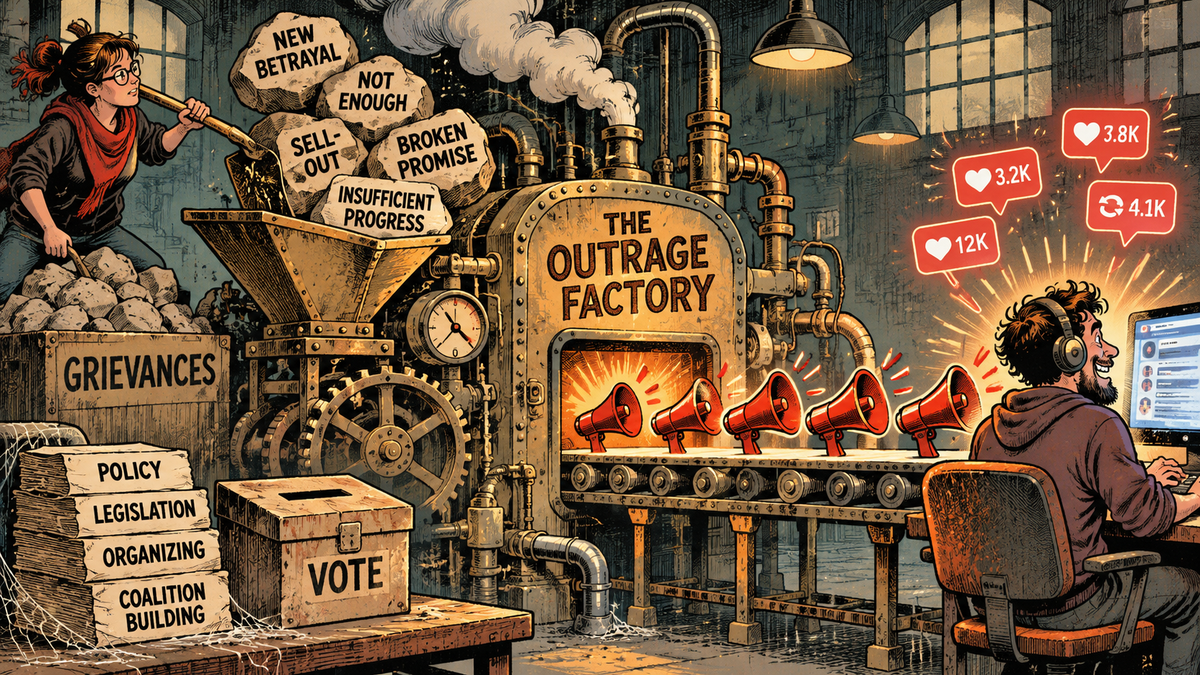
Table of Contents
I remember the Bernie Bros from 2016. Not fondly.
What struck me wasn't that they disliked Hillary Clinton — there were plenty of legitimate reasons to disagree with her politics, her judgment, her record. I wasn't expecting everyone on the left to fall in line and sing kumbaya.
It was the misogyny. The casual, sometimes breathtakingly overt misogyny coming from people who considered themselves the enlightened, progressive alternative to the Democratic establishment. And when they weren't attacking Clinton herself, they were busy explaining why anyone who supported her wasn't really progressive.
You could agree with someone on nine issues out of ten, and the tenth became the one that defined you. Never mind that you both wanted expanded healthcare, stronger labor protections, a fairer economy. Insufficiently enthusiastic about Bernie Sanders? You were part of the problem.
That habit stuck with me. It turned into a recognizable political culture on Twitter — Rose Twitter, the self-identified socialists with the little red rose in their profiles.
Let me get the distinction out of the way: most Sanders supporters weren't Bernie Bros. Most weren't spending their days harassing Clinton voters or explaining why women had failed to understand their own interests. Sanders had genuine appeal, brought millions of young people into politics. But the loudest, most obnoxious faction dominated the conversation. And while the rest of us watched the Democratic Party struggle to defeat Donald Trump, this crowd spent an astonishing amount of energy policing the ideological credentials of people ostensibly on its own side.
That was ten years ago. I'm not convinced the underlying fuckery has gone anywhere.
The Revolution Meets Joe Biden
Fast-forward to April 2020. Sanders had lost another primary, Joe Biden was the nominee, and Donald Trump was seeking four more years in the White House.
Sanders understood the stakes. On April 13 he endorsed Biden, because whatever their disagreements, another Trump administration wasn't going to advance the progressive agenda.
His former national press secretary, Briahna Joy Gray, was having none of it. In an April 23 interview reported by Axios, she made her vote contingent on Biden backing Medicare for All, student-debt cancellation, medical-debt cancellation, and a wealth tax.
That's some list.
I don't object to the goals. Universal healthcare is a legitimate objective. Student debt is a real problem. Wealth inequality deserves far more attention than it gets. But there's a difference between advocating for policies and demanding them as the price of your support. Presidents don't get to enact a wealth tax by proclamation, or wave a wand and replace the healthcare system. Congress exists. The courts exist. Tens of millions of voters, inconveniently, have opinions. Biden couldn't have guaranteed Gray's demands if he'd embraced every one of them.
And he was already moving. Four days before the Sanders endorsement, he proposed lowering the Medicare eligibility age to 60 and expanding student-debt relief. Not the Sanders platform — not close — but movement toward the progressive wing.
Gray dismissed it as inadequate. Fine, that's her prerogative. But here's what I kept wondering: what, exactly, was her theory of leverage?
In a negotiation, you have something the other side wants. You make demands, assess the response, and decide whether the deal on the table beats walking away. Gray had an audience and a platform. What she didn't have was a warehouse full of Democratic votes to deliver. Sanders supporters' votes mattered, sure. That doesn't mean she controlled them.
And what did success look like? A halfway position? A public option? A bigger student-debt proposal? Her public stance gave no indication that any intermediate offer would do. And if the complete package was the only acceptable answer, this wasn't bargaining.
It was an ultimatum. Issued by someone who wasn't on the ballot, didn't have to assemble a congressional majority, and wouldn't be responsible for implementing anything she demanded.
Sanders took a different route. He joined Biden's unity task forces, which produced joint recommendations that July. Not the whole Sanders platform — they weren't supposed to be. They were an attempt to find common ground between two constituencies that disagreed about important things.
You know, politics.
One approach created a way to exercise influence inside a governing coalition. The other conditioned support on demands the candidate couldn't unilaterally fulfill. Only one of those had a plausible relationship to actually achieving the policies both sides claimed to want.
There Are No Cheat Codes
What irritates me about this strain of online politics is the impatience with the actual work of building power. It's as if someone watched a Quake Done Quick speedrun, where a master player finds every shortcut and exploit, and concluded American politics should work the same way. Skip the boring levels. Straight to the final boss.
Except the people who complete those speedruns actually understand the game. Politics doesn't have that shortcut.
The conservative movement spent decades building the institutions, donor networks, and grassroots machinery that transformed the Republican Party. Goldwater's 1964 landslide loss wasn't the end of that project; Reagan wasn't the beginning; Trump inherited an enormous amount of machinery other people spent decades constructing. There were setbacks and unintended consequences — Trumpism wasn't the inevitable destination of everyone who built it. But the infrastructure existed.
And before anyone suggests the left doesn't understand organizing: bullshit. The labor movement, civil-rights organizations, women's groups, environmental groups have done decades of thankless work. Today's progressives have built real organizations, recruited candidates, won elections. The problem isn't a shortage of organizing. It's that one corner of online culture behaves as though broadcasting the demand is the same thing as building the constituency to deliver it.
Those are very different activities. One requires persuading people who don't already agree with you. The other can be done entirely among people who do.
Which brings me to my working theory.
The Grievance Is the Product
For a certain kind of online political personality, the reward isn't the policy outcome.
It's the grievance. The outrage, the retweets, the applause from an audience carefully assembled around a shared understanding of who the villains are.
I don't think these people want to lose elections. They can celebrate a win, even help produce one, and sincerely want the policies they advocate. But winning isn't what keeps the machine fed. A politician makes a concession? Not enough. A progressive wins office? Let's examine how they've already betrayed the movement. A partial policy victory? Why not the whole thing?
The individual complaints are often legitimate — that's what makes this tricky. A student-debt program really can leave people behind. A healthcare compromise really can be insufficient. But when every accomplishment is instantly subordinated to the next disappointment, the conversation loses any connection to progress. The grievance becomes renewable.
And social media is very good at feeding that. A 2021 study of moral outrage on Twitter — 12.7 million tweets, plus controlled experiments — found that positive feedback encouraged subsequent expressions of outrage. The platforms don't just host political anger; their rewards encourage people to keep performing it.
That doesn't mean every rose-emoji account is deliberately milking an audience, or that progressives are uniquely susceptible. The retromingent MAGA ecosystem practically runs on perpetually replenished indignation. But it does explain how an online community can develop an appetite for conflict that political accomplishments never satisfy.
Because the incentives differ. An organizer needs to recruit and persuade. An elected official needs to assemble majorities and turn objectives into decisions. An online commentator needs an audience.
Those incentives can align — commentary and activism have contributed enormously to political change. But they can also diverge. A commentator whose audience expects to hear that Democrats have betrayed the cause again has a problem when Democrats actually accomplish something useful. Acknowledging the win interrupts the narrative. Finding the next betrayal keeps it going.
Political objectives supply the subject matter. Outrage supplies the product. Audience approval supplies the reward.
That's the grievance entrepreneur. Not someone who secretly wants failure — someone for whom dissatisfaction stays a source of influence whether or not the movement makes progress.
What Happens When the Revolutionaries Become Politicians?
Consider Alexandria Ocasio-Cortez. She arrived in Congress in 2019 after beating Joe Crowley in a primary, an extraordinary upset that made her one of the most recognizable figures in the progressive movement. Young, articulate, media-savvy, and uninterested in the traditional niceties of congressional politics. The online left loved her.
Then something inconvenient happened: she became a member of Congress. And Congress, for all its dysfunction, is an institution where you have to make choices. Build relationships. Negotiate. Prioritize. Decide whether a partial victory is worth taking. Work with people you dislike.
In July 2024, the national Democratic Socialists of America withdrew its conditional endorsement of AOC over disagreements involving Israel and Gaza.
The details matter — this involved substantive disputes and messy internal politics, not just internet cranks enforcing purity, and the New York City DSA kept endorsing her. But the episode illustrates the dilemma. Here was a politician who helped make democratic socialism part of the national conversation, built real influence in Congress, and stayed substantially aligned with progressive goals. None of it spared her a fight over whether she still deserved the movement's approval.
I'm not arguing for lifetime ideological immunity for former insurgents. Hold them accountable. But accountability means evaluating what officials actually do, what alternatives existed, and what outcomes resulted. If the standard is whether they followed every instruction from the movement that elected them, we've wandered into a very different conception of representative government.
A movement should want its elected officials to exercise judgment. Otherwise, why the hell bother electing them?
Apparently, Arithmetic Is Betrayal
In the run-up to the 2026 midterms, I found myself arguing with people on the progressive left about Democratic candidates in difficult Republican territory. One recurring flashpoint was transgender rights, especially the fights over transgender athletes.
The people I argued with wanted candidates to take positions they regarded as non-negotiable. I pointed out that these candidates have to persuade electorates far more conservative than the ones in safe Democratic districts.
That's not a claim that transgender people don't deserve rights, or that candidates should throw vulnerable people under the bus. It's the recognition that there's a difference between having an objective and having the power to accomplish it. You want the policies? You need enough elected representatives to govern. And getting them elected takes more voters than the ones who already agree with you.
My reward for this observation? I was called a traitor. Apparently arithmetic is now ideological betrayal.
Look, there are principles worth defending when they're unpopular, compromises that shouldn't be made, and somebody has to push politicians who'd otherwise do nothing. But there's a difference between drawing a principled line and refusing to acknowledge the consequences of drawing it. A Democrat running statewide in Iowa faces a different environment than one running in a safe New York district — different electoral constraints — and recognizing that isn't abandoning every progressive value.
Compromise is not weakness, dammit. Sometimes it's the necessary work of making democratic government function. And sometimes an imperfect victory puts you in position to accomplish something an immaculate defeat never could.
Who's Keeping Score?
The strange thing is that political movements never finish their work. There's no final election where everyone collects their winnings and goes home. Every victory creates new problems; every defeat changes the terrain.
So there will always be legitimate reasons to demand more. But that also means a political culture organized around grievance can sustain itself indefinitely — there's never a reckoning where the audience has to ask what all the indignation actually accomplished.
A candidate can lose because they weren't progressive enough. A candidate can win and become instantly suspect because they compromised to get there. A government can deliver something useful and be told it's inadequate and no one deserves credit. And the commentator moves along to the next controversy.
I don't expect politicians to be applauded for showing up, and I don't want activists to stop demanding better. I want to know what the demands are supposed to produce. What's the plan for converting an enthusiastic online audience into enough votes to govern? What institutions are being built? Which compromises are acceptable? What accomplishments count? And if the answer is that nothing short of the complete revolutionary program will do — how, exactly, do we get there?
I keep coming back to the people who called me a traitor for suggesting Democrats need to win elections. They were absolutely convinced of their righteousness.
Fine. Righteousness doesn't pass legislation. Somebody has to organize, persuade, negotiate, win, and govern — the work that doesn't earn a thousand likes and a standing ovation from the usual suspects. And when somebody manages to accomplish something, maybe we could recognize the accomplishment before finding the next reason to denounce them.
Because if every victory is just an interruption between grievances, I have to wonder whether we're still talking about a political movement.
Or an audience looking for its next show.