The Hate Was Never New, Just the Bandwidth
Kathy Sierra got doxxed and death-threatened in 2007, seven years before Gamergate, with none of today's algorithmic muscle. The hate wasn't invented later. Someone just built better plumbing for it, and found out outrage pays the bills.

I. - The Setup
Picture it if you will: San Jose State University, 1988. B.Sc. in Physics. Roughly seventy students in the program. Two of them were women.
I'd like to tell you this was some kind of statistical anomaly, a weird blip specific to one department at one commuter school in the South Bay. It wasn't. It was just physics being physics, and physics in 1988 being exactly as hostile to women as every other hard science and engineering discipline in the country, which is to say: not officially hostile, nobody was posting signs on the department door, just quietly, structurally, comprehensively hostile in the thousand small ways that add up to "don't bother."
I didn't think much about it at the time. I was twenty-something and mostly concerned with why the fuck I put off taking Thermo/Stat Mech until my last semester, problem sets and remaining on the Dean's List. It's only decades later, looking at data that has nothing to do with physics at all, that the number comes back around and taps me on the shoulder.
I have now spent a decade of my professional life responsible for Cisco certifications, including the CCNA, which is more or less the gold standard entry credential for early-career networking. No degree required. No admissions committee. No discretionary human being deciding whether you get to sit for it. You study, you show up, you pass a standardized technical exam or you don't. It is about as close to a pure meritocracy as a credentialing system gets in this country.
The gender split on CCNA holders is currently under 10 percent women.
Forty years. A physics classroom in San Jose to a certification exam that didn't exist until years after I graduated. Same number, near enough. And I push hard, personally and professionally, on the outreach and access work meant to move that number, because I actually give a damn about the answer, not just the optics of caring.
Which is the thing I want to sit with for a minute, because there's a very popular story right now about why fields like this skew the way they do, and the story goes something like: DEI mandates and diversity hires have flooded once-meritocratic professions with unqualified people, at the direct expense of qualified men who did everything right and got pushed aside for it. It's a hell of a story. It's got a villain, a victim, and a tidy grievance that requires no self-examination whatsoever.
It also cannot explain a single data point I've just given you.
II. - The OG: Kathy Sierra
Before there was Gamergate, there was a woman named Kathy Sierra, and if you were paying attention to tech in 2007, you remember exactly what happened to her, because it was the first time a lot of people realized the internet could actually kill someone's career, and nobody in charge particularly cared.
Sierra was, by any normal professional measure, exactly the kind of person the tech industry claims to want more of. A respected programming instructor. A popular blog, Creating Passionate Users, that people in the industry actually read for actual insight. She was good at her job and visible about it, which turned out to be the entire problem.
Anonymous posters on a group blog started in on her. It escalated, the way it always escalates, from criticism to something else entirely: doctored images of her next to a noose, another of her being strangled, comments explicit about wanting her dead. Someone published her home address and her Social Security number. She canceled a major conference appearance. She shut down her blog. She disappeared from the public internet for years, which is exactly what was intended.
The guy who eventually bragged about doxxing her went by the handle weev. He gave an interview to Mattathias Schwartz for the New York Times Magazine in 2008, and I want you to sit with his stated motive for a second because it is the whole rotten thesis of this post compressed into one sentence.
He said he did it because he was tired of her "whining" about the abuse.
Not because she was wrong about anything. Not because she'd made some factual error worth correcting. He did it because a woman with a public platform complained about being threatened, and that complaint itself was the offense. Schwartz's piece also mentions, almost as an aside, that weev spent several minutes of the same interview holding forth on the Federal Reserve and "about Jews." Nobody involved seemed to think that detail was worth following up on at the time. In retrospect it was the whole ballgame.
Because weev didn't stay a quirky internet weirdo who happened to say something ugly once. He went on to do federal time on an unrelated hacking charge, got the conviction vacated on appeal, and from there worked his way into becoming a webmaster for the Daily Stormer, one of the flagship neo-Nazi sites of the modern internet. In 2016 he was behind a mass mailing of white supremacist flyers to unsecured networked printers at universities across the country. The Southern Poverty Law Center names him, alongside Andrew Anglin, as one of the "primary innovators" in how the far right learned to weaponize online trolling as a recruitment and organizing tool.
So the guy who kicked off this entire genre of behavior in 2007 wasn't a one-off. He is a direct, documented thread connecting a woman's harassment out of her career to the exact alt-right trolling infrastructure that would later feed Gamergate, then Milo, then the pipeline we're all still living downstream of. This wasn't a bad apple. It was a proof of concept, and he kept building on it for the next decade.
Here's what I need you to notice about the 2007 timeline, before any of that later infrastructure existed. There is no Twitter mob mechanic yet worth speaking of. There is no algorithmic feed deciding this deserves amplification. There is no hashtag to organize under. This is just guys on a blog, doing it the artisanal way, and it was still enough to end someone's public career.
Sierra actually came back briefly in 2014, right in the middle of Gamergate, and wrote something I think is one of the more underappreciated pieces of internet history. She said the most dangerous moment for a woman with online visibility isn't when she says something controversial. It's the moment other people are visibly listening, following, liking her work. Success itself is the provocation. She called Twitter, by then, "a hate amplifier," and noted that what used to take weeks to mobilize now took minutes.
She is, in other words, the one person with the most direct standing in the world to diagnose exactly what changed between 2007 and 2014. Her diagnosis wasn't that men got meaner. It's that somebody built better plumbing, and weev was one of the plumbers.
III. - Wave 2: The Platforms engage
So how does a guy with a grudge and a blog in 2007 turn into a coordinated harassment campaign with its own hashtag, its own media strategy, and the ability to extort advertisers by 2014? The honest answer has less to do with human nature getting worse and everything to do with a business model that needed feeding.
Facebook rolled out News Feed in 2006 and spent the years after refining it into something that no longer just showed you what your friends posted, but ranked and served you whatever was statistically most likely to keep you looking at the screen. Twitter followed a similar arc, growing from a niche status-update app into a mass platform where retweets and favorites weren't just a nice feature, they were the entire currency. By the time you get to 2012 or so, both companies had fully committed to what's politely called "engagement optimization" and less politely called: figuring out exactly which emotional buttons keep a thumb from putting the phone down.
It turns out the answer to that question is not "wholesome content that makes people feel good about their fellow man."
The answer is outrage, threat, and tribal conflict, because those trigger a response evolution built into us for very different circumstances than doomscrolling in bed at eleven at night. A pile-on generates ten times the replies of a nice compliment. A harassment campaign generates infinite scroll. None of that was a bug the platforms discovered and regretted. It was the revenue model, working exactly as designed, and every dollar of ad money that ever mattered to these companies flowed from precisely that mechanic.
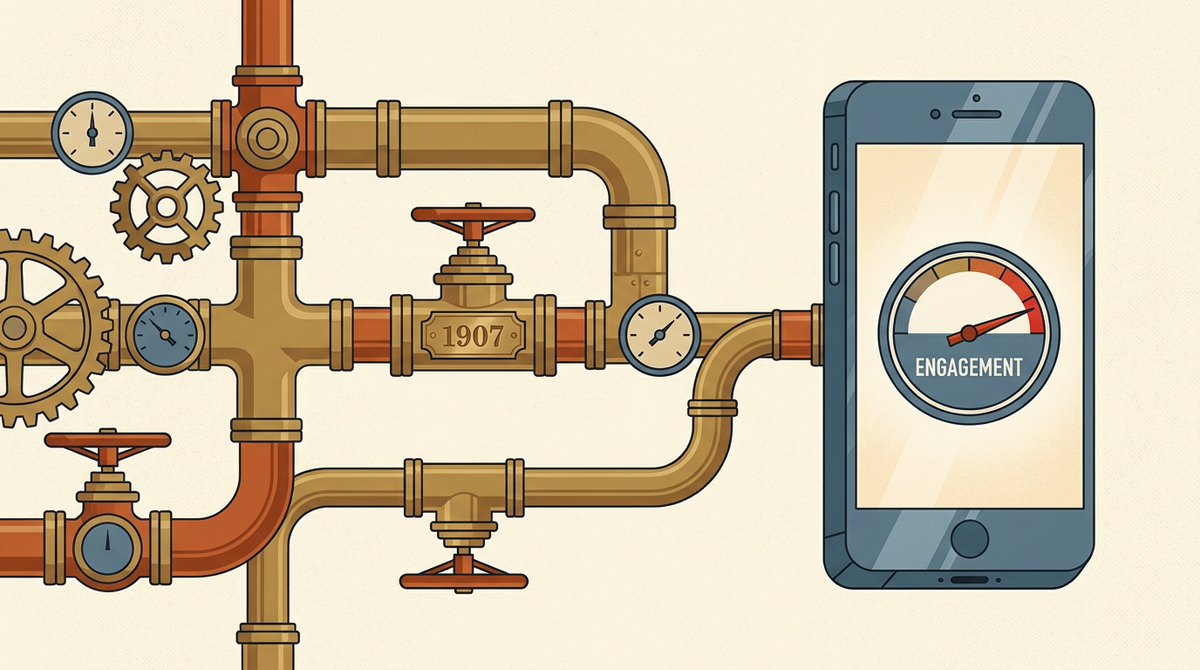
It's worth pausing here on how thin the alternative business model actually was. Facebook spent real money trying to sell you physical hardware, the Portal video-call device chief among them, presumably hoping people would rather buy a $150 screen than keep doomscrolling on the one already in their hand. It never came close to mattering financially. The entire company's fortune, then and now, rested on one lever: keep the eyeballs glued, sell the attention to advertisers. There isn't a second knob to turn. Outrage is simply the cheapest fuel there is for that furnace, and platforms built their entire architecture around burning as much of it as they could get their hands on.
Anita Sarkeesian sits right in the middle of this transition, and her case is the bridge between the Sierra era and the Gamergate era. In 2012, she launched a Kickstarter to fund a video series examining sexist tropes in games. It was modestly ambitious, entirely reasonable, and funded roughly ten times over within days. That success alone triggered a harassment campaign, death threats, rape threats, threatening phone calls, the whole grim inventory, but the delivery mechanism was already visibly different from Sierra's experience five years earlier. This wasn't a hate blog anymore. It was organized activity flowing through platforms that were, by then, actively built to reward exactly this kind of coordinated pile-on with algorithmic reach.
By the time Gamergate ignites in 2014, the plumbing Kathy Sierra diagnosed is fully installed and load-tested. The only thing left to prove was how far it could scale, and how much damage it could do once it started targeting institutions instead of individuals. That's Section IV.
IV. - Gamergate
By August 2014, all the infrastructure was sitting there, fully built and fully tested, waiting for someone to point it at a bigger target than one individual woman. Eron Gjoni obliged.
Gjoni was an ex-boyfriend of game developer Zoe Quinn, and after their breakup he wrote several thousand words of aggrieved, meticulously detailed blog post accusing her of infidelity, framed as a matter of public concern rather than what it actually was, which was a jilted man doxxing his ex with extra steps. He posted it to gaming forums, got banned within hours for what any reasonable moderator would call obvious harassment, and then simply reposted it himself on WordPress, where 4chan picked it up and ran.
What followed wasn't just a repeat of the Sierra playbook at higher volume. It was a genuine tactical escalation, and this is the part that should bother you more than the raw ugliness of the harassment itself, because it shows premeditated organizational thinking rather than just an angry mob doing what angry mobs do. Gamergate didn't stop at threatening the women involved, Quinn, and later Anita Sarkeesian, and game developer Brianna Wu, who left her own home after receiving threats specific enough to include a weapon and an address. It moved on to institutions. When a Gawker writer made an offhand joke mocking the movement, organizers didn't just flood his replies, they went after Gawker's advertisers directly, and got Adobe to pull its ad spend. When a writer at Gamasutra published a piece arguing that traditional "gamer" identity was fading, the same playbook got Intel to pull its sponsorship.
Sit with that for a second, because it's the real innovation Gamergate contributed to this whole ugly genealogy. Weev and his 2007 cohort could ruin one woman's life through sheer sustained cruelty. Gamergate figured out how to threaten a media company's revenue, using the exact same engagement-optimized platforms we just discussed, which means the harassment mob and the platforms' ad-sales departments were, however unintentionally, working the same lever from opposite ends. One side generated the outrage, the platform monetized the attention it generated, and the outrage machine discovered it could point that same monetization dependency at anyone who criticized it. It's an almost perfectly closed loop.
And Gamergate didn't stay contained to gaming, because it was never really about gaming. It became a training ground, in the most literal sense, for a generation of media operators who watched what worked and scaled it up. Milo Yiannopoulos built a substantial chunk of his early Breitbart career directly covering and cheerleading Gamergate, treating it as a proof of concept for a much larger audience of aggrieved young men who could be organized around resentment and pointed at a target.
Steve Bannon's own history with this is worth adding here rather than leaving as an aside. Years before Breitbart, he spent about a year and a half as vice chairman of a Hong Kong gaming company that did "gold farming," hoarding in-game World of Warcraft loot to resell for real money. That company got run out of business by an army of gamers who flooded it with harassment, much of it racist. Most executives would take that as a lesson in caution. Bannon took it as market research. In his own words to biographer Joshua Green, these were "rootless white males" with "monster power," and when Gamergate erupted years later he recognized the exact same energy, except this time he owned a media platform built to point it somewhere useful. He hired Milo specifically as the bridge, later explaining it to Green without a shred of euphemism: "I realized Milo could connect with these kids right away. You can activate that army. They come in through Gamergate or whatever and then get turned onto politics and Trump."
That is not a journalist's inference about dog whistles or subtext. That is the man himself, on the record, describing a harassment mob as recruitment infrastructure.
So here's where this leaves us. The impulse itself, the raw desire to destroy a woman for the crime of being visible and successful, was already fully formed in 2007, before any of this technology existed to weaponize it. What changed between Kathy Sierra and Gamergate wasn't the psychology. It was the delivery system, and the delivery system existed because outrage was the only fuel these companies ever found that reliably kept people looking at a screen.
Weev proved individuals were vulnerable. Gamergate proved institutions were too.
And a man who'd already lost a company to this exact mob was sitting there, taking very careful notes on how to point it at a country instead.
V.- Gamergate Aftermath: The world will never be the same
From there the line to the present isn't speculative, it's just tracing a pipe that was laid on purpose. The aesthetic and grievance structure Gamergate perfected, aggrieved young men, a villain to blame for their stalled status, a charismatic media figure translating internet-native anger into something that reads as ideology, became the template for the broader manosphere that exists now. Andrew Tate is Milo with a nicer car and a worse philosophy degree, running the same play, activating the same audience, selling the same externalizing story: your problems are not yours, they belong to women, immigrants, or whatever version of "woke" is convenient that week.
And the political result of a decade of that pipeline running uninterrupted showed up exactly where you'd expect it to. Young men swung toward Trump in 2024 by margins that stunned people who were still modeling the electorate as if it were 2012. That's not a mystery if you've been paying attention to the infrastructure rather than the vibes. It's a demand-side story with a decade of supply-side investment behind it.
It's worth remembering, too, that none of this started with Gamergate, it just found its business model there. Go back far enough and you get to Samuel Alito objecting to Princeton's eating clubs admitting women, a small, personal, very Ivy League version of the same status displacement that shows up decades later as a much larger and much uglier phenomenon involving death threats instead of club memberships. The scale changed. The complaint didn't. Somebody who used to get the job, the spot, the club membership, the girl, simply by virtue of being a man now has to compete for it, and a nontrivial number of men experience that as an injustice rather than as, you know, actual fairness finally showing up to the party.
Which is really the thing sitting underneath every section of this piece. The impulse is old. Weev had it. Alito had a version of it decades earlier in a very different register. What changed across fifty years wasn't the resentment, it's who built the machinery to monetize it, organize it, and eventually hand it a seat at the table in the West Wing.
VI. - Wrapping it all up
So back to San Jose State, 1988, two women in a physics program of seventy, and the forty years since.
I run Cisco certifications now, including the CCNA, which is about as close to a pure meritocracy as any credential in this country gets. No admissions committee. No discretionary human deciding who's worthy. No pipeline of legacy connections or old-boy referrals greasing the skids. You study the material, you sit for a standardized technical exam, and either you know how to subnet a network or you don't. The exam does not care about your gender, your last name, or who you had lunch with.
The gender split among CCNA holders is still under 10 percent women.
Sit with that next to the physics classroom for a second, because the two numbers are separated by four decades, an entire technological revolution, and not one meaningful percentage point of progress.
If the "DEI ruined a meritocracy" story were true, that story needs a meritocracy that existed before the ruining. This is that meritocracy.
It's been sitting right here the whole time, unmolested by quotas, untouched by any HR department's diversity mandate, and it has produced the exact same lopsided outcome as an undergraduate physics program in the Reagan administration.
I push hard on this, professionally and personally, because I actually want the ratio to move, not because I need a talking point about representation. And what I've learned pushing on it is that the barrier was never at the exam. Nobody fails the CCNA because a proctor doesn't like her. The barrier is everything upstream of the exam: who gets told this is a viable path before they're twenty, who has an uncle or a father or a mentor who normalizes network engineering as a career, who gets steered toward it in a classroom instead of quietly steered away, and who spends four years of a technical education getting talked over, second-guessed, and held to a standard of proof her male classmates never have to meet. None of that shows up on the exam. All of it shows up in who ever sits for it.
That's the inconvenient truth sitting underneath every stop on this piece: Weev complaining about a woman's "whining," Bannon recognizing an army of resentment and building it a highway to the White House, Alito's Princeton grievance decades before either of them, all the way down to a stubborn number in a technical field with no ideological dog in this fight whatsoever. The hostility was never a reaction to some new unfairness done to men. It's the same old fence, rebuilt in every decade with whatever materials happen to be lying around, and lately those materials have been very, very good ones.
The fence in 1988 was social. The fence today runs on an ad-engagement algorithm and a certification pipeline nobody's fixed in forty years. Same fence. Better contractor.
Like what you've read, but not able to switch to paid? Why not buy me a coffee instead! All money goes to help defray the expense of running the site.