This Fucking Guy: Jeff Bezos
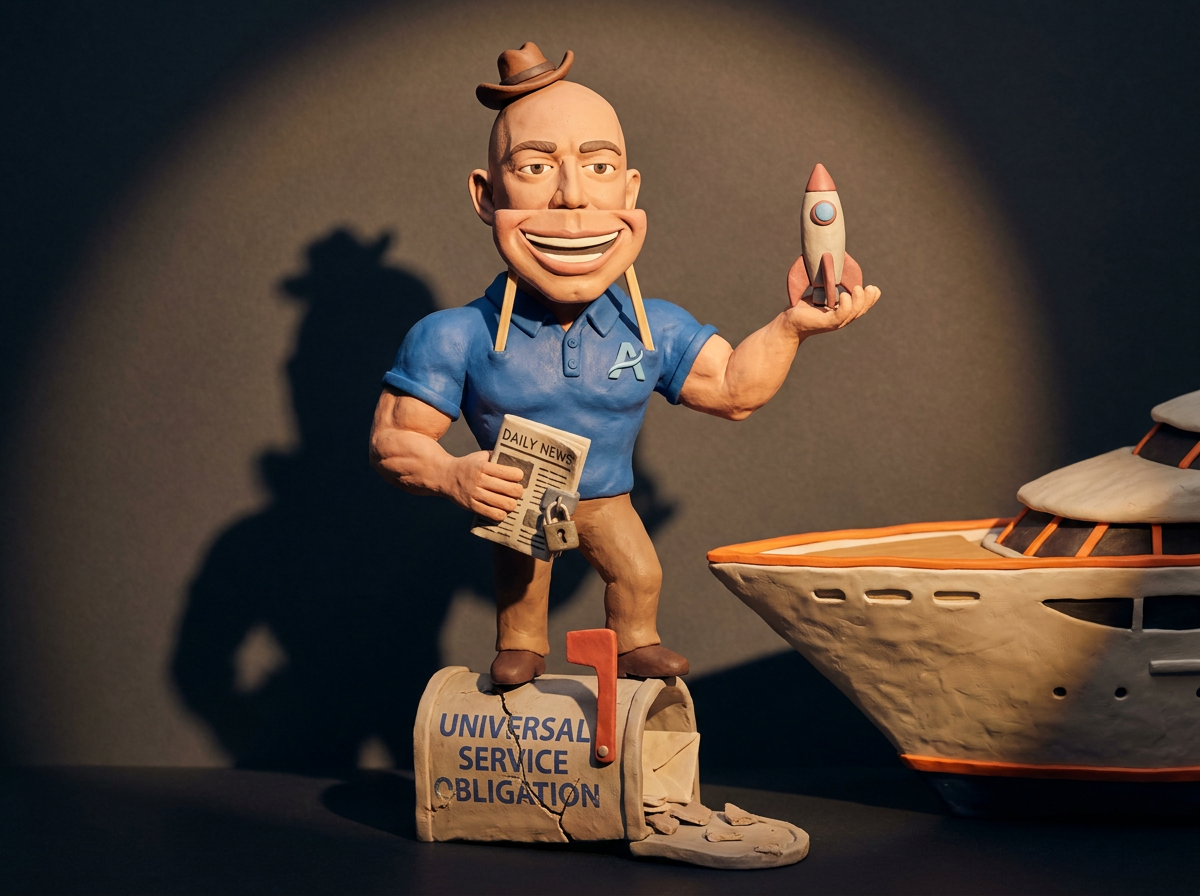
The Amazon logo smiles A to Z — delightful, frictionless, friendly. Then Bezos got unlimited money and no brand consultants, and built a rocket the entire internet immediately recognized as a penis with Peyronie's disease. The logo lies. The rocket does not.

Billionaire Victims Club, Vol. 3
On the morning of February 4th, 2026, employees of The Washington Post were told to stay home. Layoff notices went out by email. A third of the entire newsroom was gone by noon — the sports desk eliminated, the international desk decimated, the Ukraine bureau chief let go, one war correspondent notified while she was in an active war zone. Among those laid off: Caroline O'Donovan, the Post reporter who covers Amazon. The company that is the primary source of Jeff Bezos's $284 billion net worth had, at the direction of Jeff Bezos, just fired the journalist whose job was to cover Jeff Bezos's company.
The Post's former executive editor Martin Baron, who ran the newsroom for eight years and won eleven Pulitzer Prizes while doing it, did not mince words about what had happened: "Bezos is not trying to save The Washington Post. He's trying to survive Donald Trump." That sentence is the thesis of this post, and also a fairly clean summary of Jeff Bezos's entire public career: relentlessly optimizing for survival, at whatever cost, and calling it vision.
I. The Logo
Look at the Amazon logo. Not for the first time — actually look at it.
The arrow beneath the wordmark runs from the lowercase 'a' to the lowercase 'z,' curling upward at the right end into what the brand consultants will tell you is a smile. A to Z: we sell everything. Smile: we're delightful. Two messages, one mark, maximum efficiency. This is the public face of Jeff Bezos — the grinning promise of frictionless commerce, the friendly disruptor who just wants to get you your stuff faster.
Now consider what Bezos chose to build when he had unlimited money and no brand consultants in the room telling him what things should look like. When Blue Origin's New Shepard rocket launched on July 20th, 2021, carrying Bezos, his brother, an 82-year-old aviation pioneer, and a Dutch teenager into suborbital space, the internet had one reaction, and it was unanimous. George Takei posted "Oh myyy. That…shape." Jon Stewart prepared a short film. Actor Ethan Embry observed that "everything he touches ends up overtly phallic." The rocket — which Bezos had been building for twenty years, with unlimited capital, with the finest aerospace engineers money could hire — looked, without ambiguity or charitable interpretation, exactly like a novelty item you'd find in a Times Square gift shop, with a slight upward curve suggesting what the medical literature would classify as Peyronie's disease.
There is a through-line between the logo and the rocket. The logo smiles. The rocket does not lie. Everything between them is Jeff Bezos's story.
II. The Luck Audit
The garage myth runs as follows: Jeff Bezos quit his Wall Street job, wrote a business plan on a road trip from New York to Seattle, opened a bookstore in a garage in Bellevue, and built the largest retail operation in human history through sheer will and customer obsession. Every word of that is technically true and almost entirely misleading.
The seed capital for Amazon was $245,573 wired by his parents from their retirement savings — a quarter-million dollars of someone else's financial security used to fund a startup before it shipped a single book. That's not bootstrapping. That's intergenerational risk transfer, which is a different and much more honest way to describe it.
The "quit his Wall Street job" framing erases what the Wall Street job actually was. Bezos was Senior Vice President at D.E. Shaw, one of the most sophisticated quantitative hedge funds in the world, before he turned 30. He was not a cubicle drone who caught lightning in a bottle. He was a senior executive at a quant fund, with a Princeton engineering degree, a Rolodex of the most analytically rigorous financial minds of his generation, and an institutional understanding of how to model arbitrage opportunities and optimize them to their limits. That last part matters more than any of the rest for understanding how Amazon actually works.
The "road trip where he had the idea" framing erases what actually prompted the trip: Bezos read a statistic that web usage was growing at 2,300% per year and decided to drive west before anyone else got there first. That is not a vision. That is a well-trained quant identifying a mispriced asset, then moving faster than everyone else to capture the spread. Which is, to be fair, enormously valuable and impressively executed — it just isn't the creation myth of a dreamer who believed in books.
What none of the myth mentions: Amazon Web Services, the cloud computing division that now drives more than 60% of Amazon's operating income, was built by solving Amazon's own internal infrastructure problem. It was not a vision. It was a solution to an operational bottleneck that Bezos then realized he could sell to everyone else. The product that makes Amazon worth $2.4 trillion was a side effect of Amazon needing to manage its own servers.
III. The USPS Play
This is where the D.E. Shaw training pays off, and where the self-made mythology collapses entirely.
Amazon built the logistics backbone of its retail business on the back of the United States Postal Service — a public institution operating under a universal service obligation to deliver to every address in America, including the rural ones no private carrier will touch at a profitable rate. Amazon didn't just use USPS. It ran a twenty-year, systematically optimized extraction operation against USPS's pricing model, and it did it with the precision of the quant fund veteran at its helm.
The mechanism is called postal injection: large shippers pre-sort packages and drop them directly at local post offices for last-mile delivery, bypassing the USPS's upstream network almost entirely and paying only for the final leg. Amazon built a network of more than twenty package sortation facilities specifically to inject packages as deep into the postal system as possible, minimizing the portion of the USPS network it actually used while still paying rates calculated on the assumption of using more of it. A Citigroup analysis found that if delivery costs were allocated fairly, each package would cost at minimum $1.46 more to ship. Multiply that by the roughly one billion packages Amazon was routing through USPS annually at peak volume, and the arithmetic of the arbitrage becomes visible: a billion-dollar-plus annual spread, built into the pricing model, extracted with the consistency of a firm that had modeled every variable.
And that's the floor. A D.E. Shaw-trained quant running an operation at this scale doesn't stop at the identified spread. He runs every optimization available. Postal workers have noted for years that Amazon's USPS drop-offs skew toward the heavy, bulky, low-margin packages — the kind that take up van space, slow down routes, and cost the most to handle — while Amazon's in-house logistics network keeps the light, high-velocity packages that are cheap to move and easy to process. You get the profitable loads; the public institution absorbs the expensive ones. This isn't an accusation. It's exactly what a quant would do with a captive counterparty operating under a universal service mandate that prevents it from walking away.
For rural America, the arrangement has a specific shape: USPS's legal obligation to deliver everywhere — the same obligation that made it useful to Amazon in the first place — meant it had to absorb the rural routes that no private carrier would cover at anything close to the rates Amazon was paying. Amazon used the public infrastructure of universal service to reach customers it couldn't profitably reach on its own, for two decades, at rates that didn't cover the true cost of doing so.
Now Amazon has spent $4 billion building its own rural delivery network. Having used USPS's infrastructure to establish rural market presence, it is pulling 20% of its USPS volume under a new agreement signed this April — down from a relationship worth $6 billion in annual revenue to the postal service. One logistics analyst has predicted Amazon will exit the USPS relationship entirely by 2028. USPS, having built its operational and financial planning around Amazon as its largest customer for a generation, has warned it may run out of cash by early 2027. Amazon surpassed USPS as the largest domestic parcel carrier in 2025.
This is not a story about a company that used a public institution. This is a story about a quant who identified a mispriced public asset, extracted maximum value from the spread for twenty years, built replacement infrastructure on the proceeds, and is now exiting the relationship. The public institution is left holding the cost structure it built to serve a customer that no longer needs it.
IV. The Rocket, The Boat, The Wedding
When Bezos stepped back as Amazon CEO in 2021, he deployed his personal freedom with the energy of a man who'd been keeping a list. The rocket launched that July — phallic shape, cowboy hat, "best day ever." The $500 million superyacht followed, the largest sailing yacht in the world, so large it required its own support yacht to carry its support helicopter. Rotterdam's historic Koningshaven Bridge had to be partially dismantled to let it through, which the Dutch eventually declined to do, forcing a route adjustment. In June 2025, he married Lauren Sánchez in Venice, in a multiday celebration estimated at between $46 and $56 million, attended by Oprah, DiCaprio, Kim Kardashian, and Tom Brady, staged at the Venetian Arsenal and the island of San Giorgio Maggiore. It is the kind of wedding that makes Versailles look like it had a budget.
Blue Origin, the rocket company he's been funding since 2000, has spent those twenty-five years finishing second to SpaceX at every meaningful competitive benchmark: reusable orbital rockets, NASA contracts, commercial launch market share, actual revenue. Bezos recently went on CNBC to say that Musk's timeline for space data centers was "a little ambitious." The man whose rocket company came second in a two-horse race is offering timeline critique of the winner. In the meantime, New Shepard has successfully carried tourists to the edge of space and back. It has not been confused with a serious aerospace program by anyone with knowledge of the field.
V. The Post
Bezos bought The Washington Post in 2013 for $250 million and said the right things. It was a civic investment. He believed in the paper's mission. He poured money into it — the newsroom grew 85% at its peak, and it won Pulitzers and broke stories and became again the kind of paper that people actually subscribed to out of something other than habit. Former executive editor Martin Baron ran the newsroom for eight years, and the paper was genuinely excellent during much of that time. Bezos deserves credit for that period, and credit is given here.
Then came 2024. Weeks before the presidential election, the Post's editorial board prepared an endorsement of Kamala Harris. Bezos killed it. He published an op-ed explaining that newspaper endorsements undermine public trust in media — an argument that might have more credibility from someone who hadn't just killed a specific endorsement three weeks before a specific election in which his company had significant regulatory exposure under both possible outcomes. The Post lost 375,000 subscribers, 15% of its digital base, in the months that followed. Bezos and his fiancée sat on the inauguration dais. Amazon donated $1 million to Trump's inaugural fund. In February 2025, Bezos ordered the opinion section reoriented toward "personal liberties and free markets." The opinion editor resigned. Bezos hosted Defense Secretary Pete Hegseth at Blue Origin. Journalist after journalist at the Post wrote letters directly to Bezos, personally appealing to him not to gut the newsroom. He did not respond.
The layoffs came in February 2026. The Amazon beat reporter was among those fired. The guild's statement deserves quoting directly: "These layoffs are not inevitable. Jeff Bezos must immediately rescind these layoffs or sell the paper to someone willing to invest in its future." He has done neither.
Baron's line is the close, because it's already been written better than anything I could: "Bezos is not trying to save The Washington Post. He's trying to survive Donald Trump." Add to it this: Amazon's cloud computing division holds federal government contracts worth hundreds of billions. Blue Origin needs NASA contracts and FAA approvals. Everything Bezos owns is downstream of the regulatory and procurement decisions of an administration he sat behind on the inauguration stage. He bought a newspaper that covers power and turned it into an instrument for managing his relationship with power. The A-to-Z smile. Everything delivered. Some things at a cost you don't see on the receipt.
Next up: Sergey Brin, who built a $200 billion company on a federal research grant and has recently been spending $25 million to make sure you can't tax him for it.
Thanks for reading Sweaty Spice. Subscribe for free to receive new posts and support my work. If you enjoyed this, do me a solid and share.