
Will Win vs. Can Win
Ron Johnson tried to hand fake electors to Mike Pence. The Democratic establishment's real fear that cycle? Mandela Barnes's parking tickets. The electability model doesn't need to be right. It just needs to never be tested.

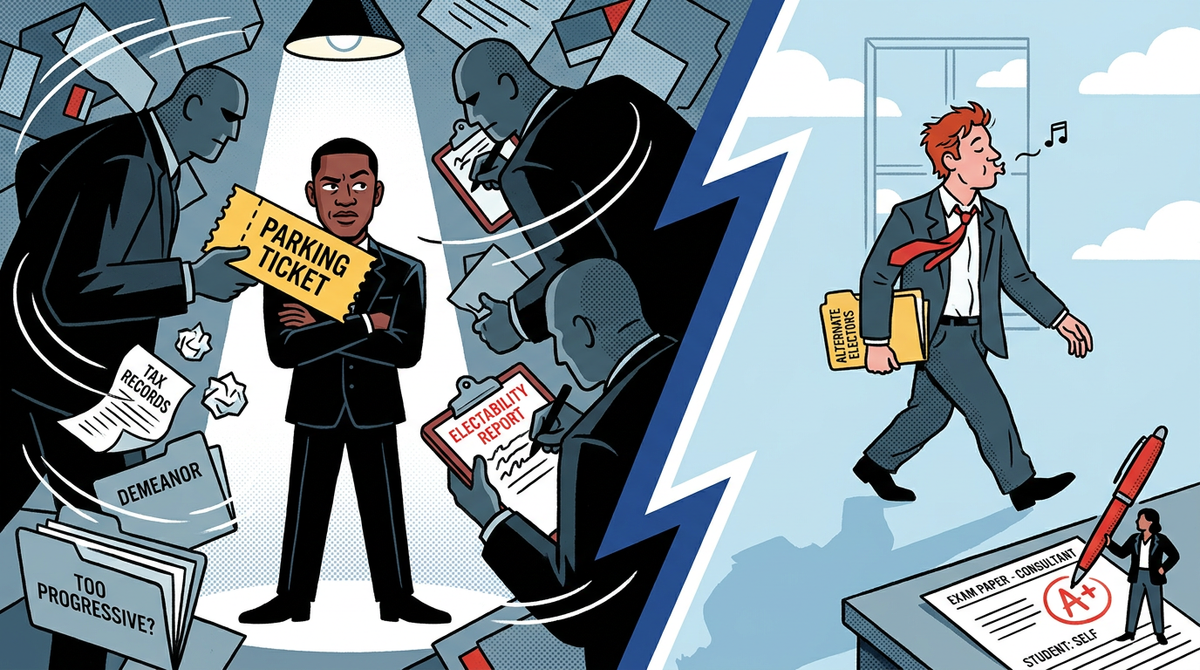
The Democratic establishment doesn't pick candidates who can win. It picks candidates who won't scare people who were never going to help anyway, then blames the base when the safe bet loses too.
Let's start with a timeline, because the timeline is the whole argument.
December 2021: Charlie Sykes, then editor-in-chief of The Bulwark, on the record about a Senate primary that hadn't happened yet. "If Mandela Barnes is the Democratic nominee, then Democrats can take Wisconsin off the board." Not a prediction hedged with uncertainty. A closed case, delivered a full eight months before Wisconsin Democrats had cast a single primary vote.
July 2022, after Barnes had actually locked up the nomination: "Mandela Barnes is the dream candidate for Ron Johnson. The prospect of running against Mandela Barnes was probably one of the factors that actually convinced Johnson to run for a third term."
Sit with the shift in framing for a second, because it's doing more work than it looks like. In the same breath, Sykes admitted the race had been a referendum on Ron Johnson's fitness for office right up until the moment Barnes won the primary, at which point it magically became a referendum on Barnes's fitness instead. That's not an electability analysis. That's a permission slip for Republicans to change the subject, delivered by a guy who gets booked on MSNBC as the reasonable voice of the opposition.
This piece isn't really about Charlie Sykes. He's just the guy who put the quiet part in writing early enough, and often enough, to remember and quote.
Meet the Guy Who Was Somehow the Safer Bet
Ron Johnson: connoisseur of quack medicine, tourism enthusiast, attempted felon.
Before we get to the mechanism, you need to sit with exactly who the "electability" apparatus decided was the safer horse here, because it recontextualizes everything that follows.
This is a man who went on television and floated mouthwash as a COVID treatment. This is a man who described the January 6th mob as people who were "basically law-abiding" and behaved like they were on a museum tour, "if you didn't know what happened," despite the fact that some of them were trying to hang his colleagues. This is a man who held a Senate hearing on vaccine safety seemingly under the impression it had something to do with him personally, because his name is also Johnson, and the vaccine in question was made by a company called Johnson & Johnson. I promise you I am not embellishing that for effect. That happened.
And here's the part that should have ended his career and didn't: on the morning of January 6th, 2021, while Congress was preparing to certify Joe Biden's win, Ron Johnson's chief of staff, a man named Sean Riley, texted a Pence staffer named Chris Hodgson. "Johnson needs to hand something to VPOTUS please advise." Hodgson asked what it was. Riley told him: "Alternate slate of electors for MI and WI because archivist didn't receive them." Hodgson's answer, in its entirety: "Do not give that to him."
That's it. That's the whole scheme, and the only reason it failed is that Mike Pence's staff had more constitutional literacy than Ron Johnson's office did. Johnson's own explanation, once this became public via the January 6th committee, was that his "involvement... spanned the course of a couple seconds." As if seditious conspiracy has a five-second rule, like a Dorito you dropped on the kitchen floor.
This is the guy the suburban-comfort electability model was so terrified of unseating that it spent 2022 obsessing over Mandela Barnes's parking tickets instead.
The Machine That Manufactures Its Own Proof
How "unelectable" becomes true by being said loudly enough, to the right donors, early enough.
Here's the mechanism, laid out plainly, because once you see it you can't unsee it.
Step one: the DSCC, and the pundit-consultant apparatus surrounding it, decides a candidate is too risky. This assessment is not primarily an empirical finding. It's a model calibrated to protect the comfort level of a specific, narrow slice of suburban swing voters, dressed up in the language of hard-nosed electoral science.
Step two: that assessment becomes real. Funding gets deployed elsewhere. Media coverage amplifies the "too risky" frame before the general election has even started. And this is the part that should genuinely piss you off: the opposition's actual attack ad basically writes itself off the concern-trolling. Johnson's campaign ran on the line that Democrats were "uniform in their support for more of the same Biden policies that got us in this mess in the first place: runaway spending, the Green New Deal, defunding the police and abolishing ICE." Sykes wasn't predicting that attack. He was drafting it, months in advance, for free.
Step three: the underfunded, under-defended candidate loses, or loses more narrowly than a properly resourced campaign might have.
Step four: the loss gets cited as proof. Nobody asks what happens if you fund the guy. Nobody runs the counterfactual. The model doesn't have a mechanism for testing itself against a version of events where it didn't get its way, because the model was never actually about prediction. It was about validation.
This is what epistemically sealed looks like in practice[1]. It's the same closed loop that operates on the Never Trump side of the ledger generally, the one where every Democratic win proves the moderate coalition was decisive and every Democratic loss proves the party got too radical, no matter what the party actually did. Barnes didn't lose because Wisconsin rejected him. Barnes lost, in part, because the apparatus that claims to know how Democrats win decided in advance that he couldn't, communicated that decision loudly and often, and then got to be right.
Is "The Center" Even Where They Say It Is?
Forty years of the goalposts moving, and somehow it's always progressives who are asked to be reasonable.
Here's the deeper structural problem underneath all of this, the one that makes this more than a media-criticism post about one Senate race.
Political scientists who track this using actual roll-call voting data have documented what's called asymmetric polarization. The Republican conference has moved substantially further right since the 1970s than the Democratic conference has moved left. That's not a hot take, that's measurable. Which means "the center," as a fixed geographic location that both parties orbit, doesn't actually exist. It's a midpoint between two moving targets, and one of those targets has been sprinting in one direction for four decades while the other ambled a few steps in the opposite one.
Now go look at what Mandela Barnes actually ran on. Ending the filibuster. Expanding voting rights. Overturning Citizens United. These are not fringe, radical, defund-everything positions. They're policy positions that would have been unremarkable mainstream Democratic stances within recent memory. He got processed as dangerously left-wing not because his platform was extreme by any honest historical standard, but because the goalposts defining "acceptable" have been dragged rightward for forty years by the exact same intellectual project that gave us the Reagan "government is the problem" framework and the Laffer Curve voodoo economics that Bush 41 correctly identified and got punished for identifying.
And here's the kicker: the actual polling on actual policy doesn't support the idea that "the center" is where the consultant class keeps insisting it is. Medicare expansion polls with majority support. Minimum wage increases pass by ballot initiative in states that vote Republican at the top of the ticket. Marijuana legalization has clear majority support nationally. If the center is a measurement of what people actually want, it sits well to the left of where the suburban-comfort model keeps insisting it lives. What the model is actually protecting isn't the median voter. It's a specific demographic construct, white, suburban, college-adjacent, moderately affluent, allergic to disruption, and it's mistaking that construct for the electorate as a whole.
The Live Test, Happening Right Now
Barnes is running again. And the tears currently being shed over a Denver primary tell you everything.
This isn't ancient history. Mandela Barnes announced in December 2025 that he's running for Wisconsin governor in 2026. Watch for the exact same cast to run the exact same playbook in real time, and hold this piece up against whatever they say.
And you don't even have to wait for that. It's already happening, three states away, over a completely different race.
Melat Kiros, a DSA-endorsed challenger, just beat fifteen-term incumbent Diana DeGette in the Democratic primary for Colorado's 1st Congressional District, which covers Denver. This follows DSA-aligned wins in New York City and Philadelphia in the same stretch of weeks. NPR is calling it a winning streak. It is one.
Here's what makes this the tell rather than just an interesting footnote: CO-1 is not a swing seat. It is not going to a Republican in November under any plausible universe. The "risk" that Kiros's win represents has nothing to do with losing a general election, because there's no meaningful general election to lose. The risk is entirely about the establishment losing control of a primary it didn't ask for and clearly didn't want.
Which means the freakout currently happening in Never Trump-adjacent spaces is genuinely instructive to watch, because it's tearing their own narrative in half in real time. Sarah Longwell's instinct, going by her focus group framing, is to describe this as voter frustration with the establishment that will presumably pass once things calm down, which is a very polite way of saying she's hoping it doesn't mean what it obviously means. Rick Wilson knows better than to say the quiet part too loudly, because he understands that his own contempt for these voters, if fully vented, backfires against the exact coalition-building project he claims to be running.
But the tears are flowing regardless, because a candidate the apparatus explicitly did not want just won anyway, in a district where their entire "too far left to win the general" argument doesn't even apply. If the concern were genuinely about general election viability, the alarm should scale with how competitive the seat actually is. Instead the exact same panic gets deployed against a Denver seat no Republican is winning as gets deployed against an actual toss-up Wisconsin Senate race. That's not electability analysis. That's discomfort, wearing electability analysis as a costume, and the costume is currently slipping in public.
What "Can Win" Actually Requires
The model doesn't need to be right. It just needs to never be tested.
"Will win," in the language the establishment actually speaks, means "will win our approval." It means a candidate who won't threaten the existing donor arrangement, who reads as safe to the consultant class's suburban-comfort model, who arrives pre-validated by exactly the Never Trump apparatus we've spent two prior pieces taking apart.
"Can win" means something else entirely. It means building a coalition out of the actual electorate as it exists, not the electorate the donor class wishes it still had. It means testing your model against outcomes instead of declaring victory on results the model itself helped produce by strangling the candidate's funding and handing the opposition its own attack ad, in advance, for free.
The Ron Johnsons of the world keep winning re-election. Not because the electability model correctly identified who could beat them. Because the model never had to be right. It just had to never be tested against a fully funded alternative. That's not caution. That's a racket that gets to grade its own homework, and it's been grading itself an A for forty years running.
The model doesn't need to be right. It just needs to never be tested.
That's not a bug. That's the whole business plan.
Like what you read? Subscribe to Sweaty's Corner. Always free. If you can't do paid, buy me a coffee, it keeps the lights on and the receipts coming.
1 - this is what I often call "breating your own exhaust"