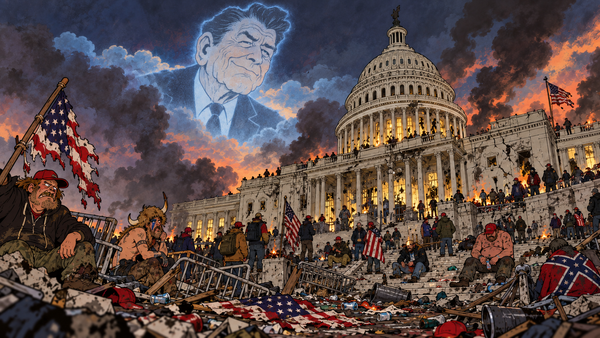
The Liberal Anti-Communist
Before the conservative, before the Republican, there was a man whose father got his job from Roosevelt's own patronage machine. That part never really left him.

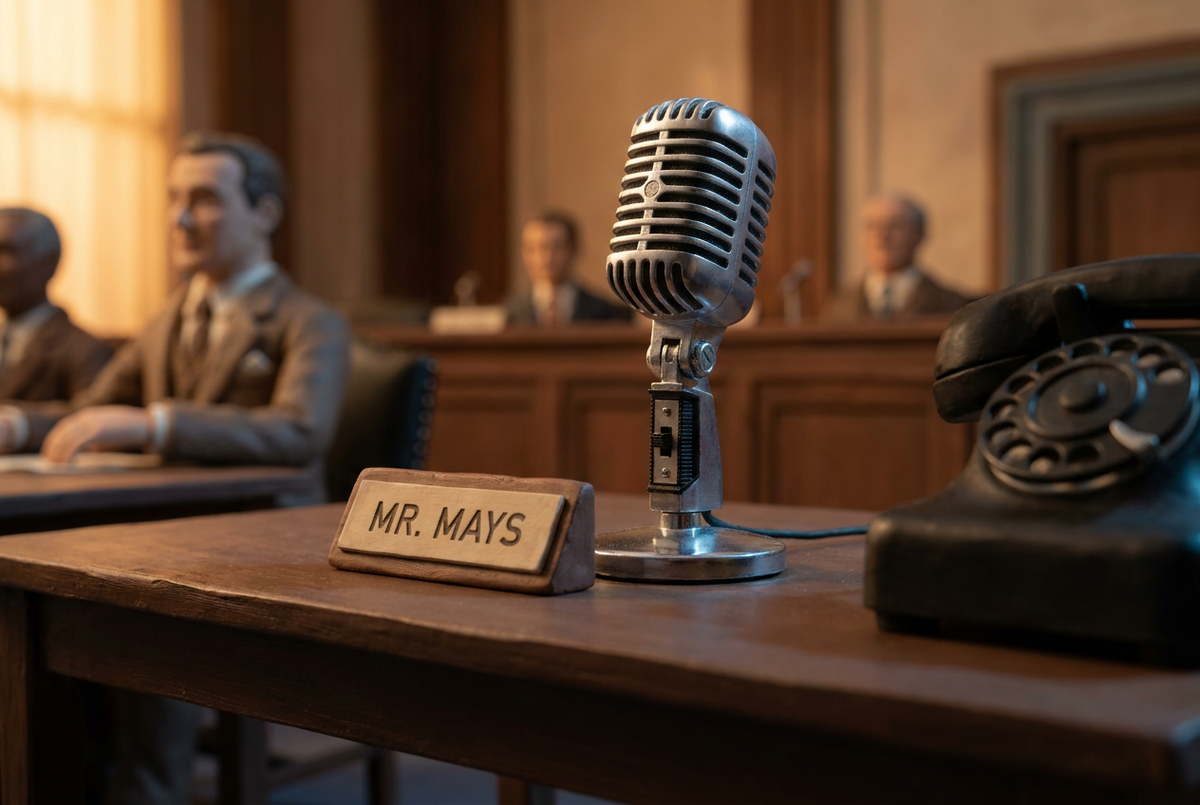
October 23, 1947. Ronald Reagan sits before the House Un-American Activities Committee in Washington, sworn in as a friendly witness and introduced by his title: president of the Screen Actors Guild. A member of the committee wants to know whether the Communist Party should simply be outlawed. Reagan does not say yes.
"I would hesitate to see any political party outlawed on the basis of its political ideology," he tells them. He goes further, arguing that the way to beat communism in Hollywood isn't suppression but democracy itself, full voting rights, an informed membership, the ordinary mechanics of a functioning union. It is, on the record, a genuinely cautious answer from a man the committee expected to be an ally.
What the committee did not know, and would not learn for another thirty-eight years, was that the man giving this careful civics lesson about due process had spent the previous year quietly meeting with FBI agents in his own home, informing on his fellow Guild members. He was not being cynical in either room. He meant both performances. That is the problem this episode sits inside, and it does not get solved by the end of it.
A Family's New Deal Was Never Abstract
Before it was an ideology, it was a paycheck.
Ronald Reagan's Democratic loyalty didn't start as a set of ideas he read somewhere. It started as a job. After Roosevelt's 1932 victory, Jack Reagan, the alcoholic shoe salesman who had spent years scraping by, was named local director of the Works Progress Administration in Dixon, Illinois, work handed to him, by Miller Center's own account, because he'd been rewarded for his Democratic activism. His son Neil got WPA work too. This is worth sitting with before anything else: the New Deal wasn't an abstraction the Reagan family admired from a distance. It was patronage, in the literal, technical sense, a government job that existed because a political party a Reagan had worked for was now in a position to hand one out. Ronald cast his first presidential vote for Roosevelt in 1932, while still at Eureka, and voted for him three more times.
None of that conflicted with anything happening in the parallel story, the one already told: the radio booth, the Warner Bros. contract, the steady B-picture career. Politically, through the late 1930s and into the war, there was nothing unusual about him. He joined the Screen Actors Guild as a member in 1937, the same year Warner signed him, and was elected to its board in 1941. He was, at that point, simply a working actor on his union's board, dealing with minimum-pay floors and studio scheduling, not yet a political figure of any kind.
Popular Front Reagan, Genuinely
He didn't hold his liberalism at arm's length. He joined things. Lots of things.
After the war, Reagan threw himself into Hollywood's left-liberal organizing world with real enthusiasm, not performance. He later described himself, self-mockingly but accurately, as someone who'd gone around blindly and busily joining every organization he could find that would guarantee to save the world. One of those organizations was HICCASP, the Hollywood Independent Citizens Committee of the Arts, Sciences and Professions, a genuine Popular Front coalition of liberals, leftists, and Communist Party members working alongside each other under one roof. Reagan wasn't a suspicious outsider watching this. He was inside it, a believer. At least for a while.
Black Friday
A real labor war, with real Communist involvement and real studio manipulation of the accusation, at the same time.
On October 5, 1945, a jurisdictional strike between two Hollywood craft unions turned violent at the gates of Warner Bros. in Burbank. The Conference of Studio Unions, led by Herbert Sorrell, had roughly a thousand people on the picket line by the time strikebreakers moved in. Cars were overturned. Strikebreakers came armed with chains, hammers, pipes, tear gas, and night sticks; studio security fired more tear gas down from the rooftops; fire hoses were turned on the crowd. More than forty people were hurt.

The studios' response leaned hard on accusations that Sorrell and the CSU were Communist-directed, and those accusations were not invented from nothing. Communist Party members really were active in parts of the Hollywood labor movement in this period. But the charge was also, demonstrably, a weapon the studios reached for to break a legitimate jurisdictional rival, whatever the truth of Sorrell's own politics turned out to be. Both things were true simultaneously: real infiltration, and a real, cynical exploitation of the fear of it. Reagan, still a working actor and now a SAG board member, watched this happen from inside the same industry.
Sweaty's Corner doesn't have a marketing budget or an algorithm pushing it into anyone's feed. It has readers who share it. If this one landed, sending it to someone who'd get something out of it — or subscribing so the next one finds you directly — genuinely moves the needle.
"The Silence That Greeted My Anti-Communist Utterance"
In his own words, and before HUAC ever came calling.
The break came the following year, and it's documented in Reagan's own hand. In an August 12, 1946 letter, he described attending a meeting where his anti-Communist remarks were met with a room gone quiet, very conscious of the silence that greeted my anti-communist utterance. He named names he believed were behind it, including screenwriters John Howard Lawson and Dalton Trumbo, and described himself as one of the liberals now resigning and leaving HICCASP to the Reds.
But the same letters show him trying, at this early point, to hold a distinction that would get harder and harder to maintain as the decade went on: he wanted any resolution to target communism, not communists, wary of language that would let the accusation swallow people rather than ideas. This is 1946 Reagan, more than a year before HUAC, already anti-Communist, already breaking from his former political home, and still explicitly worried about the thing he would later be part of administering.
"Very conscious of the silence that greeted my anti-communist utterance."
An FBI Informant Named T-10
The recruitment had been building for years before it closed.
The FBI had been circling Reagan since at least September 1941, when a Bureau agent, a fraternity brother of his from Eureka, flagged him as a useful potential contact. There were scattered touches after that: agents interviewing him in 1943 about a suspected Nazi sympathizer, a casual exchange of political gossip after a 1945 basketball game. The relationship became formal in late 1946, when agents came to his home on Cordell Drive. They told him the Communists hated him, and relayed a line supposedly spoken at a HICCASP meeting asking what are we going to do about that sonofabitching bastard Reagan. Reagan agreed to start meeting with them periodically. He reported on HICCASP's internal affairs, and at one point walked off with the organization's own minute books, which he passed to his brother Neil, also an informant, at a late-night hamburger stand.
The FBI's internal files eventually gave him a code name: T-10. That identity wasn't confirmed publicly until 1985, through documents obtained under the Freedom of Information Act, four decades after the meetings themselves and well into his presidency. And in the same period he was providing this information, Reagan was on record expressing open skepticism about the entire enterprise he was quietly participating in, asking at one point whether Hollywood was supposed to constitute ourselves as a little FBI of our own to sort out who counted as a Communist. He said this, and he kept meeting with the actual FBI anyway.
The Testimony, and What Came After It
Return to October 23, 1947. This time, follow it forward.
By the time he sat before HUAC, Reagan was SAG's sitting president, elected earlier that year. His testimony that day has survived as a genuine artifact of a man trying to hold two positions that don't sit easily together: real alarm about Communist organizing inside his industry, and real discomfort with indiscriminate accusation as a remedy for it. He told the committee that if it could be proven an organization served a foreign power, that was one matter, but that outlawing a party on ideology alone was something he'd hesitate to see done.
Within a few years, the Guild he led was enforcing a blacklist in practice, regardless of how carefully Reagan had hedged his language on the stand. People lost work on the basis of suspected association, named and unnamed, with functionally no due process attached, the very outcome his own testimony had gestured at worrying about. Reagan's own account of this period, and later biographers', note that he worked in some individual cases to clear names he believed had been wrongly caught up in it. That's not nothing. It also does not undo the mechanism he was, by title, in charge of.
Truman, Taft-Hartley, and a Radio Spot with Hubert Humphrey
In 1948, this was still recognizably the same New Deal Democrat.
Whatever was hardening in Reagan on the anti-Communist front, his domestic politics in 1948 were still standard-issue labor liberalism. He recorded radio spots that year for the Truman-Barkley ticket, sponsored by the International Ladies' Garment Workers' Union, sharing the airtime with Hubert Humphrey. He campaigned against the Republican-controlled 80th Congress by name, criticizing its record on Social Security and civil rights, and he opposed the Taft-Hartley Act specifically for the provision letting states adopt right-to-work laws, a position that put him, in 1948, on the same side of that fight as the labor movement he'd later spend a career warning Americans against.
Fifty Dollars for Helen Gahagan Douglas
Then a switch, with the reasoning left off the record.
By 1950, Reagan's first instinct in California's open Senate race was still to back the more liberal candidate. He gave an early contribution, reportedly fifty dollars, to Congresswoman Helen Gahagan Douglas, a genuine New Deal liberal running against Richard Nixon. Sometime before the race ended, he switched his support to Nixon instead.
The Nixon campaign that year built its entire strategy around implying Douglas was secretly sympathetic to communism, distributing the infamous pink sheet comparing her voting record to a Communist Party member's, and would go on to brand her with a nickname that followed her for the rest of her life. Reagan never fully explained, on any record that survives, exactly what changed his mind between the contribution and the switch. He simply moved, the same year Nixon's campaign was running the most openly red-baiting Senate race in the country, from the liberal in the race to the man who beat her that way.
Reagan was not yet a conservative. He was, by every available marker, still a Democrat, still opposed to right-to-work, still capable of writing a check to a New Deal liberal. But the instinct that made him a friendly witness three years earlier and an FBI informant a year before that had just shown up again, in a completely different arena, choosing the anti-Communist-coded candidate over the ideological ally standing next to him.
Series: The Fulcrum, Book One: The Actor, Episode 2
The rest of this series is landing under The Fulcrum as it publishes.
Keep the lights on
Like what you've read, but not able to switch to paid? Why not buy me a coffee instead! All money goes to help defray the expense of running the site.