
The Long Diminishment
Everyone reaches for Weimar eventually. It's not wrong. It's just not the whole story, and the part it leaves out is the part that actually keeps me up at night.

Prelude: I started this journey after listening to the May 15 Secret Podcast from The Bulwark. In the back of my mind, I was mapping all the ways that our current situation is fucked, and at the bottom, I was seeing the Weimar->Nazi's->Post War reconstruction, and that seemed worth digging into. This is the culmination of the four episodes, the "what the fuck's next" taking the conversation beyond the Sarah and JVL banter, and I'll be honest, it is fucking bleak.
If you are starting here, it is instructive to go back to the beginning: Part 1, Part 2, and Part 3
Let me tell you what's right about the Weimar comparison, and then let me tell you why the part that's wrong is actually the more frightening part.
The structural parallels are real and worth naming plainly. The Weimar Republic was brought down not by a single catastrophe but by a specific combination of conditions: a democracy that had never fully achieved legitimacy in the eyes of a significant portion of its population, an economic collapse severe enough to make extremism feel rational to people who had previously been moderate, and a political mythology — the Dolchstosslegende, the stab-in-the-back — that explained national humiliation without requiring anyone to accept responsibility for it. The myth identified internal traitors as the real cause of Germany's defeat, made the democratic government complicit in that betrayal, and provided the emotional fuel for a politics of revenge.
You can see the American parallel without squinting very hard. The stolen election mythology is the functional equivalent of the stab-in-the-back — a lie that explains the humiliation of losing without requiring the humiliated party to reckon with why they lost, and that identifies internal enemies (Democrats, the media, the deep state, George Soros, pick your flavor) as the true source of the nation's decline. Trump didn't invent that mythology any more than Hitler invented the Dolchstosslegende. Both men inherited existing cultural currents and proved to have an instinctive genius for weaponizing them. The myth precedes the demagogue. The demagogue just knows how to ride it.
The Weimar comparison also captures something real about the role of elite complicity. German conservatives didn't embrace Hitler because they liked him. Many of them found him vulgar and embarrassing. They embraced him because they believed they could use him — channel the populist energy, get the electoral results, and then govern around him once he'd served his purpose. Franz von Papen famously said they'd have Hitler boxed in within two months. The Republican establishment made an identical calculation about Trump in 2015 and 2016, and it has gone equally well.
So yes. The analogy has real purchase. Use it.
Where It Breaks Down
Here's where I want to be careful, because the Weimar comparison, pushed too far, actually obscures more than it reveals — and what it obscures is the specific shape of the danger we're actually in.
Weimar was a new and fragile democracy with essentially no democratic tradition, bookended by Imperial Germany and the immediate trauma of catastrophic military defeat. It was fourteen years old when it fell. American democracy is 249 years old, federally distributed across fifty states with genuinely different political cultures, rooted in a civil society tradition that — however frayed — Weimar simply didn't have. The institutions being eroded here were built over two centuries and have real depth. That doesn't make them invulnerable. It does mean they don't fall the same way Weimar fell.
More importantly: Weimar ended through a specific mechanism that is not available as a corrective for what's happening here. Germany was ultimately stopped — at catastrophic cost, after catastrophic crimes — by a military coalition that could physically overwhelm it. The United States cannot be physically overwhelmed. Nobody is coming. The country that would historically have organized the coalition to restore democratic norms is the country with the problem. That's genuinely new historical territory, and the Weimar frame doesn't help you think about it clearly because Weimar's ultimate corrective was external force. Ours isn't going to be.
The nuclear dimension makes this categorical rather than merely different. Germany was a formidable industrial and military power and it was still stoppable. The United States, with its nuclear arsenal, its geographic position, and its institutional depth, cannot be stopped from the outside. Which means the system corrects from within or it doesn't correct.
The More Accurate Frame
Political scientists Steven Levitsky and Lucan Way have spent decades studying what actually happens to democracies that decline without collapsing — they called it competitive authoritarianism. The definition is precise and worth sitting with: a system in which formal democratic institutions exist and are widely viewed as the primary means of gaining power, but in which the incumbent's abuse of the state creates a significant and structural advantage over opponents. Elections still happen. Votes are still counted. Courts still operate. The forms of democracy are preserved. The substance is hollowed out until the outcome is, if not predetermined, heavily tilted.
Hungary under Viktor Orbán since 2010 was the working model. Orbán didn't seize power by coup. He won elections, rewrote the constitutional rules to entrench his advantages, captured the judiciary, strangled the independent press, redrew the district maps, and built a patronage network dense enough that losing an election became structurally very difficult even when a majority of voters preferred otherwise. Freedom House, the European Parliament, and international legal observers all described what emerged as something that was no longer a functioning democracy in any meaningful sense — while formally retaining every democratic institution.
And then, in April 2026, Péter Magyar's Tisza party won a landslide. Fifty-three percent of the vote. A two-thirds supermajority in parliament. Nearly 80 percent turnout — a record. Orbán conceded and left. Sixteen years of competitive authoritarianism, ended at the ballot box.
I want to be careful about what that means, because it's genuinely important and the temptation to over-read it in either direction is real.
It matters that Hungary is a younger democracy. Post-Communist transition began in 1989 — the democratic muscle memory is thinner, but so is the depth of cynicism about whether elections can actually produce change. Hungarians who voted for Magyar largely grew up after the Communist period and had a living memory of what functional democratic governance looked like before Orbán. That matters for mobilization. Nearly 80 percent of the electorate turned out, which is the kind of number you get when people believe the vote means something.
It also matters that Hungary sits inside the European Union, which had withheld €18 billion in grants pending 27 specific rule-of-law reforms — an external accountability mechanism with a hard financial deadline that created real urgency for Magyar's reform agenda. That external pressure doesn't exist in a vacuum. It helped.
And the supermajority matters. Magyar can amend the constitution. He can repack the courts Orbán packed. He can undo the electoral maps. The accelerators Orbán built into the system to entrench his own position are, with a two-thirds majority, available to run in reverse. Experts caution it's still a cumbersome, time-consuming process, and the question of how Magyar avoids simply becoming another Orbán with a different flag is live and real. But the structural conditions for genuine reversal exist in a way they hadn't a year ago.
Here's what I'd resist, though: the temptation to read Hungary as proof that competitive authoritarianism is always self-correcting if you just wait long enough. The Hungarian reversal required a specific and somewhat unusual set of conditions stacking simultaneously — a charismatic opposition leader who emerged from inside the system itself, a record-turnout mobilization, an external financial lever in the form of frozen EU funds, and a younger democratic tradition whose institutional capture hadn't yet gone as deep as it might. Remove any two of those and the outcome is different.
Now ask yourself which of those conditions exist in the American case.
There is no external accountability body withholding money pending rule-of-law reforms. There is no EU. The Roberts Court, captured over a generation through deliberate legal movement investment and now deployed to foreclose the remedies a future Democratic majority might attempt, has spent decades narrowing the congressional authority that would be needed to reverse course. The gerrymandered maps, the voter ID infrastructure, the weakened Voting Rights Act — these persist across election cycles regardless of who wins the White House. And the American democratic tradition, while far deeper than Hungary's, has been eroding for sixty years through mechanisms we've traced across this whole series, not sixteen.
What the Frog Feels
The thing about competitive authoritarianism — and this is the part that doesn't fit neatly on a protest sign — is that it's individually survivable and collectively catastrophic. Life goes on. The grocery store is still open. People still argue about sports. The Sunday shows still have guests in suits explaining why this particular development is unprecedented and historic and deeply concerning. The country doesn't end. It just becomes, year by year, less capable of self-correction. The floor drops incrementally. Each drop is small enough to absorb. The cumulative distance from where you started becomes visible only in retrospect.
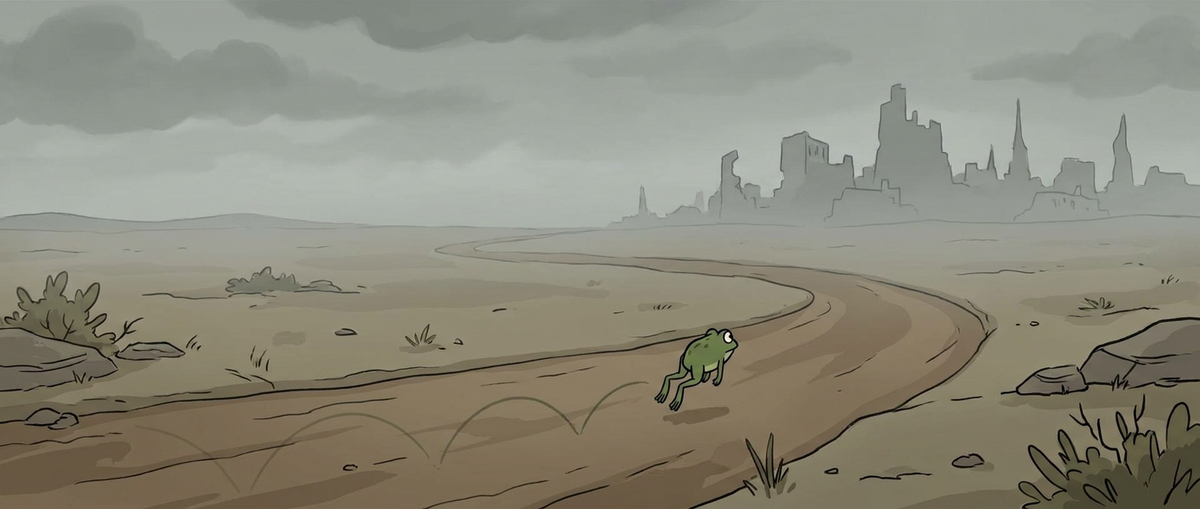
This is your frog, bumping along the ground at each hop. Never getting airborne. Never quite dying. Just progressively lower, in ways that are easy to rationalize at each individual moment and very hard to reverse across the whole arc.
What makes it particularly difficult is that the experience of living through it doesn't feel like the dramatic collapse the Weimar comparison implies. It feels like exhaustion. It feels like every week there's something that would have ended a presidency in another era, and instead it's just Thursday. The slush fund we opened this series with — a president suing his own government and engineering a payout to his political coalition using mechanisms borrowed from legitimate disaster relief — is the kind of thing that, in 2002 or 2012, would have consumed the political oxygen for months. Now it's one of three things that happened this week, and by next week something else will have replaced it.
That normalization is not incidental. It's the mechanism. Each outrage that doesn't produce consequences resets the threshold for the next one. The Overton window doesn't just move — it loses its frame entirely.
What an Honest Assessment Actually Says
Three pieces into this series, we've established that the legal architecture can't prevent bad-faith actors from operating within legitimate mechanisms corruptly. We've established that the persuasion lane is narrower than the people selling hope acknowledge, and the non-voter reservoir isn't the Democratic reserve army it's assumed to be. We've established that the decay of pre-political virtue — the norms, the class culture of civic obligation, the enforcement mechanisms that made enlightened self-interest rational — isn't cyclical. The entropy went up. It doesn't reverse on its own.
Now we're here: the corrective mechanisms that liberal democracies normally rely on are not currently functioning. Electoral accountability has been substantially weakened by the tribal processing that converts economic pain into identity politics. Institutional accountability has been weakened by a judiciary that was captured precisely to foreclose it. Media accountability has been fractured by an information ecosystem optimized for outrage rather than correction. And the external corrective — the outside pressure that has historically helped stabilize democracies in crisis — is simply not available when the country in crisis is the one that used to supply that pressure to everyone else.
The generational replacement argument is real but operates on a 30-year timeline. The demographic change argument is real but operates on a similar timeline. Both require the suppression infrastructure not to outpace them, which is an open question given how quickly the post-Callais redistricting is moving to eliminate the minority political representation that those demographic shifts would otherwise translate into power.
What you're looking at — and I need to be precise here rather than dramatic — is not the end of America. The country will continue. People will live their lives. Elections will happen. Some of them Democrats will win. Some of them they won't. What you're looking at is a prolonged period in which the substance of democratic accountability is progressively hollowed out while the forms are preserved, in which each reform that would actually reverse the trajectory requires a sequence of political conjunctions that has so far not materialized and shows no clear path to materializing, and in which the damage accumulates faster than any realistic corrective can move.
That's the honest map. I wish I had a better one to offer.
What I can tell you is that the people who are pretending the map looks different — who are selling you the wave election, the demographic destiny, the Cronkite moment, the reform package that fixes all of this in the next administration — are not lying because they're stupid or cynical. Most of them genuinely believe it. Belief in the possibility of correction is not the same thing as having a credible mechanism for correction. And at some point, insisting on the former without demonstrating the latter becomes its own kind of problem.
You can't navigate to where you need to go if you won't look honestly at where you're standing. This is where we're standing. The view from here is not good.
This is the fourth and final piece in a series that started with the $1.7 billion slush fund and ended up here.
Want to support me but not ready for a monthly commitment? Why not buy me a coffee.