
Übermensch in a Cubicle Farm - Post 2: The Valley Mythology Machine
The white collars met management with a twist of No California wackiness, and the die were cast.

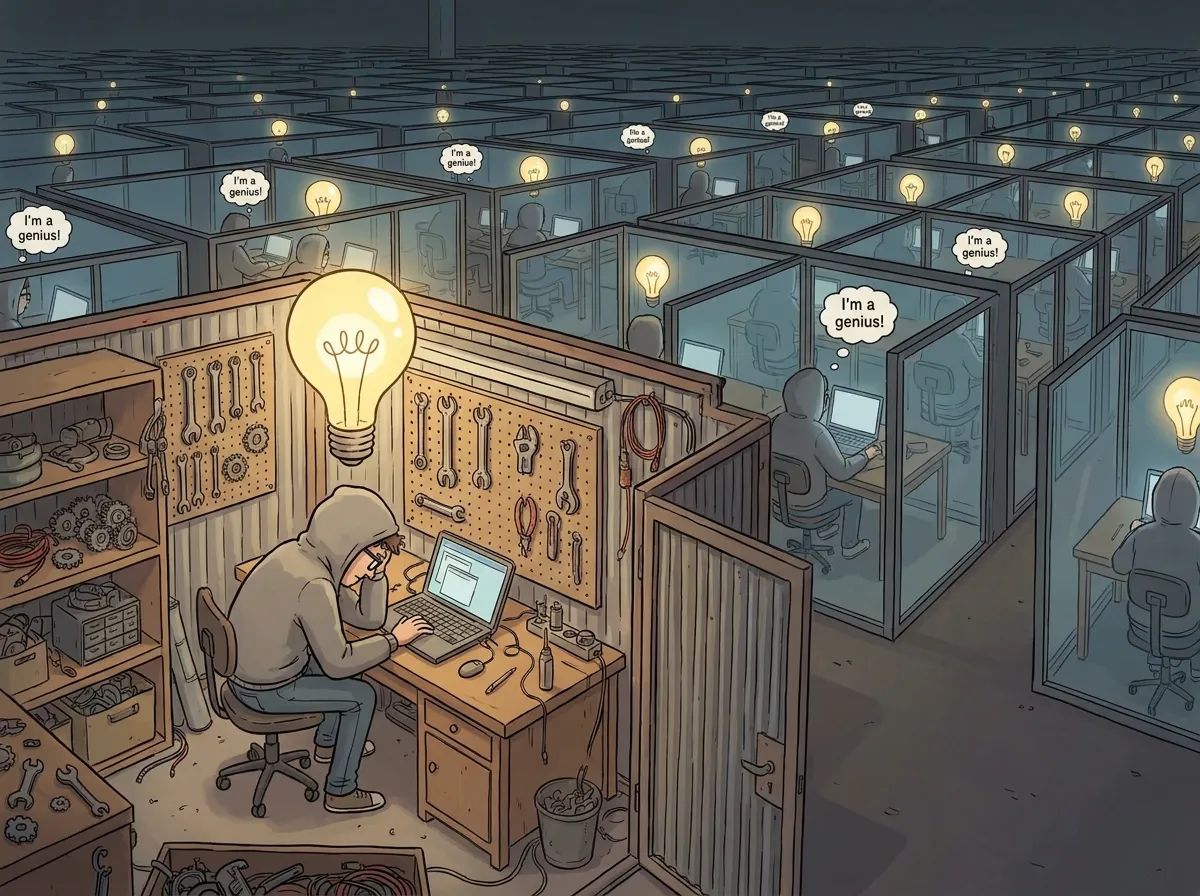
In the first post in this series, we traced the white-collar professional identity back to its roots – the salary vs. wage distinction, the credential racket, the deliberate cultivation of a class of workers who'd do capital's ideological work for free because they'd been convinced they were on capital's side. The architecture was already a century old before anyone in California wrote a line of code.
What happened next was not an improvement. It was an upgrade.
The Strangest Marriage in American Economic History
You have to understand the founding myth, because the founding myth is load-bearing.
In the late 1960s and early 1970s, something genuinely weird happened in Northern California. The counterculture – which was, in most of its forms, explicitly anti-corporate, communal, suspicious of hierarchy, and deeply skeptical of the military-industrial complex – began to make common cause with a strain of libertarian market fundamentalism that, in any other context, would have been its exact ideological opposite.
The Whole Earth Catalog, which Stewart Brand launched in 1968, is the artifact that best captures this fusion. It was a genuine countercultural document that also treated tools, technology, and individual self-sufficiency as paths to liberation. The implicit politics were: institutions are corrupt and limiting, the individual is the locus of agency, and technology is neutral or positive. That's not Abbie Hoffman. That's also not Milton Friedman. It was something new, and it was enormously influential.
The Homebrew Computer Club, founded in 1975 in Menlo Park, ran on the same frequency. The early personal computing crowd was idealistic, anti-establishment, and genuinely believed that putting computers in individual hands was a democratic act. Which, in certain respects, it was. What it also did was establish a founding identity for the tech industry that was simultaneously anti-corporate in affect and radically individualist in its actual politics.
This is the original sin of Silicon Valley's labor politics. The ideology that would eventually prevent generations of tech workers from organizing had a counterculture aesthetic and a libertarian skeleton, and the combination made it almost impossible to argue against. You couldn't call it reactionary. It had Steve Wozniak in it.
Stewart Brand Was More Useful to Capital Than He Knew
By the time Wired magazine launched in 1993, the synthesis was complete and getting louder. The techno-utopian ideology of that era – a genuinely intoxicating brew of Californian futurism, free-market triumphalism, and boundless confidence in technological progress – became the cultural water that tech workers swam in. It felt radical and optimistic and forward-looking, and it had exactly no room in it for collective action.
This was not, to be clear, a conspiracy. The people writing for Wired weren't secretly in the pocket of the venture capital industry, at least not mostly. They genuinely believed what they were writing. That's what makes it so effective as an ideological formation. The best propaganda is the kind where the propagandists don't know they're doing it.
What this culture produced, practically speaking, was a tech worker who thought of themselves as a creative individual operating at the frontier of human possibility, not as an employee. The word "employee" barely existed in the Valley's self-description. You were a hacker, an engineer, a maker, a founder-in-waiting. You were on a mission. The company was a vehicle for the mission.
And you do not unionize the vehicle for your mission. That would be insane.
The 10x Mythology and the Tournament It Runs
The specific mechanism that supercharged all of this was the concept of the 10x engineer. The idea, derived from a badly-interpreted 1968 study by Harold Sackman, is that the best programmers are not incrementally better than average programmers – they are an order of magnitude more productive. Ten times. Maybe more.
This is, as a literal empirical claim, largely nonsense, or at minimum a massive overstatement of variance in actual software team productivity. But as a cultural mechanism, it is a masterwork.
Here's what the 10x myth actually does: it turns the workplace into a tournament. If you believe that there are 10x engineers and that you might be one of them, you have a powerful incentive to prove it through individual output rather than collective organization. You compete, not cooperate. You optimize yourself, not your working conditions. And if you aren't a 10x engineer, you certainly can't admit that, which means you redouble your individual effort rather than acknowledging that the tournament itself might be rigged.
The employer benefits from this regardless of whether the underlying premise is true. A workforce that believes in the 10x mythology is a workforce that has internalized competition with its peers as the primary mode of professional existence. That's very good for employers and quite bad for labor solidarity, which tends to require workers to recognize their shared interests rather than their individual competitive standing.
The Founder Fantasy as Career Architecture
The other thing tech added to the pre-existing professional identity – the thing that the lawyers and the doctors and the accountants never quite had – was the founder aspiration.
In law, you become a partner. In medicine, you build a practice. The apex of the professional escalator is an elevated version of the thing you already are, within an institution that has existed for a long time and will continue to exist after you. It's comfortable, but it's not transformative.
In tech, the escalator was supposed to go somewhere different. The implicit promise was not just good compensation and professional status – it was the possibility of becoming the next Jobs, the next Gates, the next Bezos. Of building something from nothing. Of becoming, not just a successful employee, but a founder.
This is a structurally different psychology, and it matters enormously for understanding why organizing never took hold. You don't join a union when you secretly believe you're going to start the company that disrupts the industry. Unions are for people who have accepted that they are permanent workers. The Valley mythology told you – at every level, right down to the most junior engineer debugging someone else's CRUD app – that you were a temporary worker who hadn't yet found your idea.
Most of them never found their idea. The ones who didn't built the founding class of the feature factory stratum of the industry, doing work that the mythology had not prepared them to recognize as ordinary labor. But that's Post 4's problem.
The Part Nobody Likes to Talk About
Here's where I'm going to break from the standard telling of this story, because there are two mechanisms that undermined the "sophisticated individual negotiator" mythology in ways that are almost never discussed together.
The first is the H-1B visa system. The Valley loved to celebrate the meritocracy of the individual negotiator, the engineer who could write their own ticket. What it was less forthcoming about was the significant portion of its workforce that was structurally captive. H-1B workers, tied to employer sponsorship for their visa status, have sharply constrained ability to change jobs, let alone organize. Their presence in substantial numbers created a labor market floor that made the individual negotiating leverage narrative fictional for a large cohort, while also making collective action structurally harder. This isn't a shot at H-1B workers – it's an observation about how the system was used.
The second is worse, because it was explicit collusion. Between roughly 2005 and 2009, Apple, Google, Intel, Adobe, Intuit, and Pixar operated a set of no-poach agreements that prohibited them from cold-calling each other's employees. No recruiting. No competitive offers. No bidding wars.
Let that settle for a second. The industry that sold its workers on the mythology of the sophisticated individual negotiator in a free and efficient labor market was simultaneously running a cartel to cap what those negotiations could achieve. When the DOJ finally got around to it in 2010, the companies paid settlements and moved on. Steve Jobs, who appears to have been the primary architect of the scheme, was dead before any serious accountability was possible.
The workers, the ones who'd been told they were market-savvy free agents operating in a meritocracy, were owed somewhere between $3,000 and $4,000 each in suppressed wages. The class action settlement worked out to roughly that range. They took it and most of them probably don't think about it today.
The Architecture Holds, For Now
By the mid-2000s, the Valley's ideological machine was running at full capacity. The counterculture aesthetic gave it credibility with people who'd otherwise been skeptical of corporate power. The 10x mythology gave it a tournament structure that made individual competition feel rational and collective action feel naive. The founder aspiration gave workers a psychological exit ramp from their own labor identity. The H-1B system quietly suppressed the floor. And the no-poach cartel suppressed the ceiling, while the mythology insisted the ceiling didn't exist.
It was, in its way, a remarkable achievement. The professional identity that Mills described in 1951 – workers doing capital's ideological work for free – had been turbocharged into something genuinely new. Not just a class of workers who didn't identify as labor, but a class of workers who thought the very concept was beneath them.
That belief is still very much alive. It just got some bad news.
Next: "Golden Handcuffs and Hunger Games" – the material architecture underneath the mythology. RSUs, stack ranking, and the structural engineering of anti-solidarity.