They Forgot to Outlaw Shamelessness
The $1.7 billion slush fund isn't just corruption. It's proof that the founders' whole architecture rested on something they assumed would always be there and isn't anymore.

Let me tell you about the greatest magic trick in American political history, and I don't mean that as a compliment.
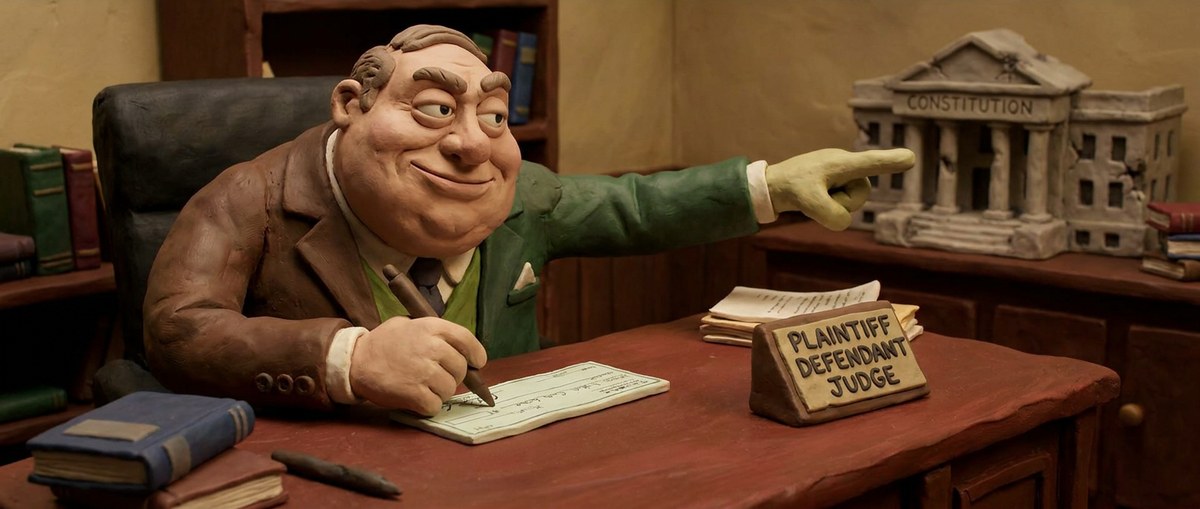
Donald Trump sued his own IRS for $10 billion in February, over the leak of tax returns he had spent years refusing to release voluntarily. The contractor who did the leaking had already been caught, convicted, and sent to prison. Trump, apparently finding criminal justice insufficiently profitable, decided to also extract a civil payout, from himself, directed at himself, overseen by himself. The judge assigned to the case gently pointed out that it was a little strange for a single party to sue itself, noting that the plaintiff and defendants weren't obviously "sufficiently adverse" to each other given that the president of the United States was also the president of the United States.
That should have been the end of it. It was not the end of it.
What it has become is considerably worse. Per ABC News, Trump is now expected to drop the lawsuit in exchange for the creation of a $1.7 billion fund, drawn from the Treasury Department's Judgment Fund, to compensate victims of the Biden administration's alleged "weaponization" of the legal system. The fund would be overseen by a five-member commission. Trump can remove any of those members without cause. The commission has no obligation to disclose its procedures, its deliberations, or the identities of who receives money. Eligible "victims" include the roughly 1,600 people charged in connection with January 6th, people with grievances against the various investigations Trump personally faced, and, oh, entities associated with Trump himself, who is technically barred from directly receiving money but whose associated entities are not explicitly prohibited from filing claims.
It gets better. The fund is expected to wind down just before Trump leaves office. Because god forbid a future president have the discretion to continue paying out a slush fund that was specifically designed to pay Trump's people.
This is, as Representative Jamie Raskin put it, "a shocking new betrayal of the Constitution." That's doing some work as an understatement.
Everything Being Used Here Is Legitimate. That's the Point.
Here is what makes this particular scheme so fucking elegant in its depravity.
The Judgment Fund is a real thing. It's how the federal government pays settlements and court judgments. Legitimate. Victim compensation funds modeled on civil claims processes are real things. The Deepwater Horizon settlement did exactly that, and it was broadly considered a good use of the mechanism. Truth and reconciliation commissions are real things, and in post-apartheid South Africa they were genuinely noble efforts to process historical atrocity. Presidential authority to settle litigation is real. Commission structures with member appointments are real.
What Trump has done is take every single one of these legitimate institutional tools and assemble them into something that would make a mid-tier mob accountant blush. The corruption isn't in any individual instrument. It's in the assembly, the intent, and the complete absence of shame about any of it.
As the Techdirt analysis correctly noted, what we're actually watching is "one team negotiating with itself" over how much of the Treasury it should receive. Trump's DOJ "settled" with Trump. Trump controls the DOJ. There is no adversarial process here. There is a single actor performing the theatrical motions of a legal proceeding in order to extract public money for private use.
And here is the part that should keep you up at night, staring at the ceiling, wondering what kind of country you're living in: it is not, strictly speaking, illegal. [1]
The corruption isn't in any individual instrument. It's in the assembly, the intent, and the complete absence of shame about any of it.
What the Founders Assumed and Why They Were Wrong to Assume It
The people who wrote the founding documents were genuinely smart. They understood human nature well enough to know that you couldn't build a republic on the assumption that everyone in power would be virtuous. That's the explicit argument of Federalist No. 51: "If men were angels, no government would be necessary." Madison's whole design was about pitting ambition against ambition, building a system in which bad actors would check each other's bad actions through the adversarial structure of government itself.
But there was a floor. There was always a floor.
The founders understood they couldn't legislate against everything. Some things, they assumed, you simply wouldn't have to. You would not have to pass a law saying a president couldn't sue his own executive branch and sit on both sides of the settlement, because the person who would do that would never in a million years survive the political consequences of doing it. The social contract, the shared understanding of legitimate behavior, the basic human instinct toward embarrassment when caught doing something that nakedly self-serving — these were the foundations of the republic. The legal architecture was the frame. Civic virtue was the foundation.
They got the frame right. They got the foundation wrong, or more precisely, they didn't account for what happens when the foundation rots.
What the founders didn't anticipate — couldn't anticipate — was a political ecosystem in which there are zero consequences for shamelessness. No shared information environment to make the shame visible. No opposition party with the institutional power to punish it. No cultural consensus that this kind of behavior is disqualifying. No electorate with sufficient buy-in to the idea of institutional legitimacy to register the violation as a violation. The checks they built assume actors who can be embarrassed. Trump has demonstrated, conclusively and repeatedly, that shame is not an operating variable in his political calculus.
And the deeper problem is this: you genuinely cannot write a law that solves this. Legal experts told the New York Times that even if the judge finds the settlement collusive or reached in bad faith, she almost certainly cannot stop the money from changing hands. You could theoretically pass legislation saying the president cannot sue his own agencies, but then the next corrupt actor will preemptively file suits before taking office. You could write tighter disclosure requirements around the Judgment Fund, and the next one will find a different funding mechanism. Corruption is like water. It finds its level. It finds the cracks.
What the founders designed was a corruption-resistant system, not a corruption-proof one. The difference is enormous, and we are living in it.
What the Slush Fund Is Actually For
Greg Sargent at The New Republic got at something important that deserves more attention. This fund isn't primarily about compensating people who feel wronged. It's about coalition management. Paying out the January 6th crowd isn't charity, it's maintenance. It keeps the street wing of the movement persuaded that Trump's wins are their wins, that the corruption flows downhill to them, that their loyalty is a transaction with returns.
Raskin put it plainly: Trump and his lawyers "are figuring out a way to refund the January 6 militia, presumably to get them ready for the next round of battle."
Read that sentence again. Slowly.
This is your taxpayer money being used to retain a paramilitary political coalition for future deployment. The "victim compensation fund" framing is a courtesy offered to people who want a legal hook to hang their objections on. The actual function is a retainer fee.
And it will work, because the people who need to be horrified by this are already sorted into media ecosystems that will tell them it's fake news, Democrat hysteria, or an overdue correction for genuine Biden-era persecution. The people who are horrified by it already were. Nothing has moved. Nothing will move.
This is your taxpayer money being used to retain a paramilitary political coalition for future deployment.
The Geometry of the Problem
Here's the thing about the founders' virtue problem that nobody in the respectable commentary class wants to say plainly.
If the system only functions when the people inside it operate in good faith, and good faith is no longer a binding constraint on the dominant political coalition, then the system doesn't function. Full stop. You can write more laws. You can hold more hearings. You can file more amicus briefs. You can go on podcasts and explain, with admirable precision, exactly how and why what just happened is wrong. None of it matters, because the machinery that was supposed to convert "wrong" into "consequence" has been captured by the people doing the wrong things.
This isn't permanent. Or at least it doesn't have to be. But the path back is longer and uglier than anyone currently in the business of selling hope is willing to describe. The damage accumulates faster than any realistic corrective can move. Each thing that goes un-punished lowers the floor for the next thing. Each norm that breaks without consequence makes the next norm-breaking easier.
The founders built a republic and told us it was ours to keep, if we could. It's a famous line, and we've treated it as a boast for 235 years. It was a warning.
We are, right now, in the business of finding out what keeping it actually requires. And the answer, it turns out, is considerably more than most of us had budgeted for.
1 — Trump himself acknowledged in October 2025 that "it's awfully strange to make a decision where I'm paying myself." That's not a man who doesn't understand what he's doing. That's a man who has correctly calculated that understanding it and doing it anyway are both fine.