The Other Country: How the Obscenely Wealthy Live in a Different Physics
The wealthy are different from us. Most people don't realize how different. Let's dive into this topic, and try to understand people like Musk, Ellison, Zuckerberg, and even Trump are. It's a ride, strap in!

There are two financial systems operating in America right now. You live in one of them. You know its rules intimately — the credit scores, the overdraft fees, the anxiety of a car repair that lands in the wrong week, the mortgage officer who treats you like a supplicant. The other system operates by completely different physics, and the people inside it would like you to continue not knowing it exists.
Here's one small window into that other world: the ultra-wealthy routinely borrow money against their asset portfolios to cover their living expenses. Not because they're broke — their net worth would make your eyes water — but because their wealth is illiquid, tied up in companies and property and instruments that aren't cash. So they borrow. And then, quietly, with some regularity, they don't pay it back. Not fully. Not on time. Sometimes not at all.
If you did that, it would be the financial catastrophe that defined the next decade of your life. For them, it's a rounding error that gets quietly managed, because the bank knows that the relationship — the investment banking fees, the wealth management contracts, the access — is worth more than the loan. The rules that feel like gravity to you are, for them, merely suggestions. Welcome to the other country.
To get a passport to this place, the price of admission is roughly a billion dollars in net worth. Not the $400-500M that gets thrown around — that's comfortable, that's "several vacation homes" money, but it's not untethered money. At a billion, something qualitatively shifts. You cross a threshold where financial anxiety, which hums in the background of virtually every human life on earth, simply... stops. Not because you've solved your problems, but because the concept of a financial problem no longer applies to you.
At this level, you almost certainly have a family office — a dedicated professional operation, staffed by people whose entire job is to make your money grow while you think about other things. And here's the part that should make you put down your coffee: it works. Stocks go up, you make money. Stocks go down, you're hedged, and you make money. The system, once you're inside it with enough mass, becomes self-sustaining in a way that no amount of side hustle content or "passive income" YouTube grifting can approximate. Thomas Piketty spent a whole book explaining the math — returns on capital consistently outpace economic growth — but the lived experience is simpler than the equations: their money works harder than any human being ever could, around the clock, without rest, without error, forever. It just accretes.
The rest of us experience money as a series of decisions, trade-offs, and low-grade anxieties. For them, it's weather. It happens. They observe it.
Now here's where it gets philosophically interesting, or enraging, depending on your mood.
How does a person get to a billion dollars? The honest answer, the one you will almost never hear from the people who got there, involves a specific and underappreciated word: timing. Mark Zuckerberg was talented, sure — he built a social network that exploited human psychology with ruthless elegance. He also started it at the precise moment in history when broadband penetration, smartphone adoption, and advertiser appetite for behavioral data all converged. Move that founding date five years in either direction and Facebook is a footnote. Same grind. Same genius. No billion.
The mythology that the ultra-wealthy tell themselves — and that a compliant culture tells back to them — is that the grind explains the outcome. It doesn't. The grind is necessary but nowhere near sufficient. Survivorship bias does the rest: we tell the stories of the people who worked hard and got lucky, and call it a meritocracy, because the people who worked just as hard and didn't get lucky don't get TED talks.
But the myth isn't just wrong — it's dangerous, because it confers a legitimacy that justifies everything that comes after. If your billion dollars is cosmic proof of your unique genius, then your opinions on monetary policy, AI regulation, immigration, and the proper organization of human society are worth hearing. Never mind that the skills that got you to the billion are almost entirely orthogonal to the skills required to have useful opinions on any of those things. Zuckerberg was good at one thing. That's it. One thing. Everything else is a billionaire cosplaying as a philosopher-king, and a media ecosystem too dazzled by the net worth to say so out loud.
Let's talk about Larry Ellison for a moment, because Larry is a gift.
Oracle — and there's a reason the best acronym in tech is One Rich Asshole Called Larry Ellison — was built on genuine technical vision, yes, but also on litigation so aggressive it became its own business strategy, and on being in exactly the right place in enterprise software at the moment corporations needed to stop managing data on paper. Larry did the grind. Larry also had the timing. Larry now owns 98% of the island of Lanai in Hawaii, sails yachts so large they required the invention of new yacht categories, and has so thoroughly insulated himself from normal human feedback loops that he seems to have genuinely lost the thread of how other people live. Not malevolent. Just... untethered. A man orbiting a planet he used to live on.
What surrounds Larry — what surrounds all of them at this altitude — is a carefully constructed atmosphere of agreement. Yes-men, validators, financial dependents, and hangers-on whose livelihoods are tied to the person at the center. It isn't usually a conscious conspiracy. It's just that the people who push back tend to stop getting invited, and the people who agree tend to keep getting invited, and over time the feedback loop closes and reality starts to drift. Elon Musk didn't just end up in an echo chamber — he purchased one, acquiring Twitter and remaking it as a machine that amplifies his particular pathology back at him at scale. The drift accelerates. The further you get from correction, the more confident you become.
Then there's what they do with the trinkets.
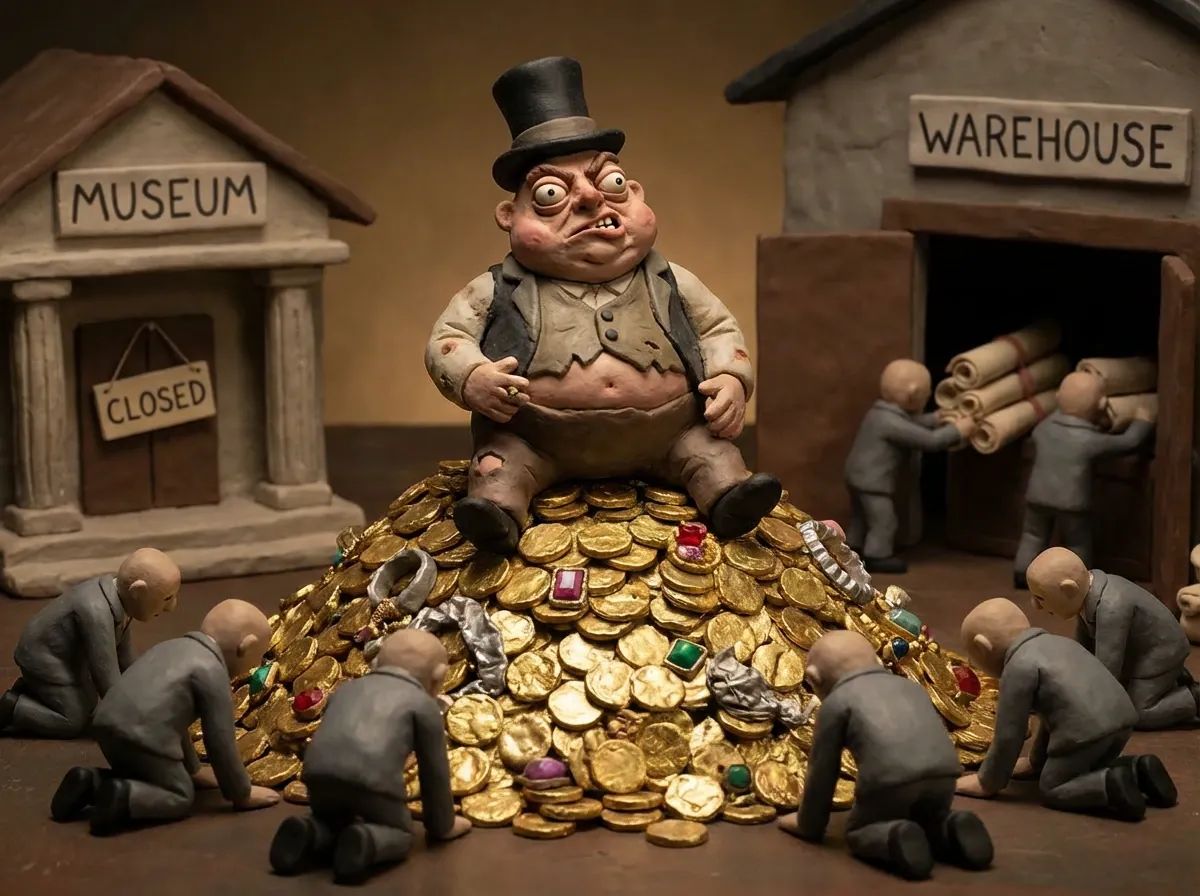
The ultra-wealthy buy art the way the rest of us buy index funds — as a store of value, as a hedge, as an asset class that appreciates quietly while they're not looking. Nothing wrong with that in the abstract. Except that the logical conclusion of treating art as a financial instrument is the Geneva Freeport: a massive, climate-controlled, tax-advantaged warehouse complex holding an estimated $100 billion in paintings, sculptures, wine, gold, and antiquities. Works that were made to be seen, to be argued about, to move people, sitting in the dark in Switzerland because the carrying costs are trivial and the tax advantages are real.
This is what wealth does to culture when left unchecked: it removes it. The art isn't experienced. It isn't shared. It's held. A Modigliani in climate-controlled darkness in Geneva is not contributing to civilization in any meaningful sense. It has been extracted from human life and converted into a number on a balance sheet. The freeport is a perfect metaphor for the ultra-wealthy relationship to society at large: take what's valuable, optimize its storage, and let everyone else sort out what's left.
Which brings us to the part where your grandparents' generation of robber barons actually, inadvertently, understood something the current crop doesn't.
Carnegie built libraries. Rockefeller built universities. Stanford built — well, Stanford. Yes, this was partly reputation laundering. Yes, Carnegie's fortune was built on the Homestead Massacre, where striking steelworkers were shot by Pinkerton agents while he was conveniently on vacation in Scotland. The philanthropy was strategic, self-serving, and often paternalistic — they decided what culture you got to access, which books were in the library, which medical research got funded. Don't romanticize it.
But there was, underneath all of it, a functioning sense of shame. Some dim awareness that the gap between their lives and the lives of the people whose labor built their fortunes required acknowledgment, required a gesture, required something to be handed back. The libraries were real. The concert halls were real. Ugly motivation, real output.
Now look around. We are in an era of spectacular, almost performative shamelessness. The ultra-wealthy of today don't build libraries — they build rockets so they can leave. They don't fund concert halls — they fund super PACs and buy social media platforms and use their wealth to reshape political reality in their image. Bill Gates is the closest thing to the old model, and even Gates-style philanthropy is essentially unaccountable private policy — the Gates Foundation sets global health priorities in developing nations, answerable to no board, no electorate, no one. The generosity is real; so is the control.
The rest are just watching the freeport fill up.
Citizen Kane was supposed to be a warning. Orson Welles made the movie about William Randolph Hearst — a man who inherited wealth, built a media empire, used it to distort reality, surrounded himself with people who told him what he wanted to hear, and died alone in a monument to his own ego — and American culture watched it, called it a masterpiece, gave it a spot in the canon, and then completely missed the point. Kane isn't a tragedy about one man. It's a diagnostic about what unchecked wealth does to a human being, and what that human being then does to everyone else.
The Robber Barons were eventually tamed. Not by their own consciences — by Teddy Roosevelt, by trust-busting, by the blunt instrument of the state deciding that enough was enough. The infrastructure of accountability, once applied, worked.
The question that hangs over everything right now is a simple one: who's playing Teddy?
Because the other country isn't going anywhere on its own.
 Share on Bluesky
 Share on Threads
 Share on Facebook
 Share on Mastodon
 Share on Reddit
 Share on Email