The Whampoa Military Academy of Silicon Valley
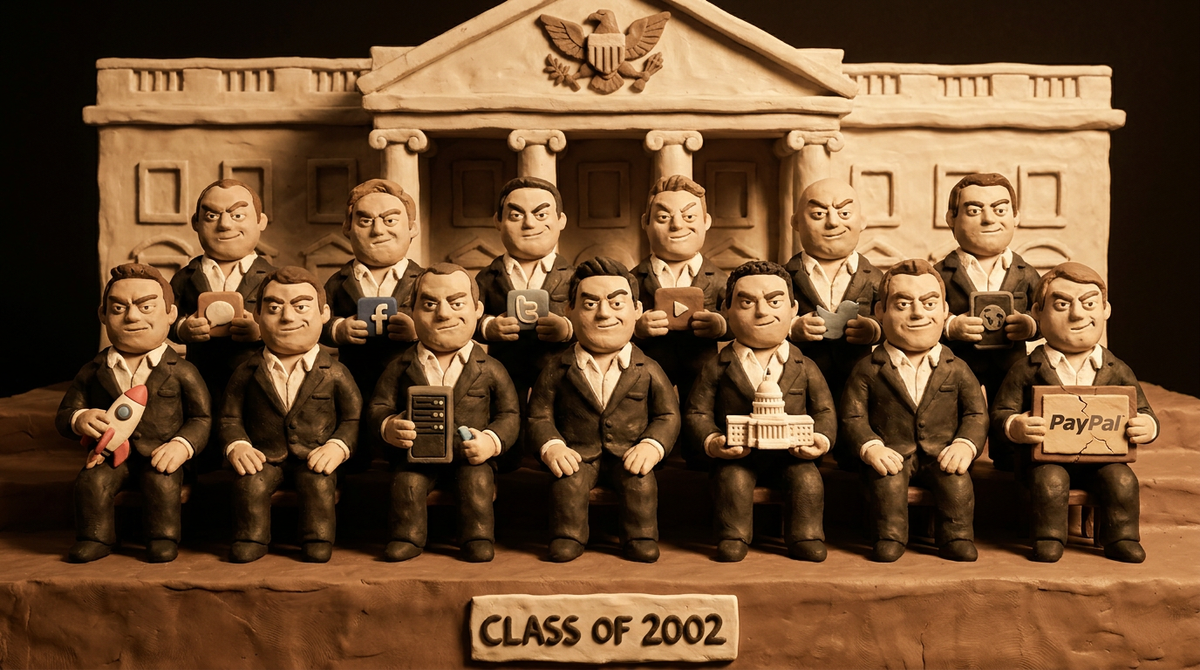
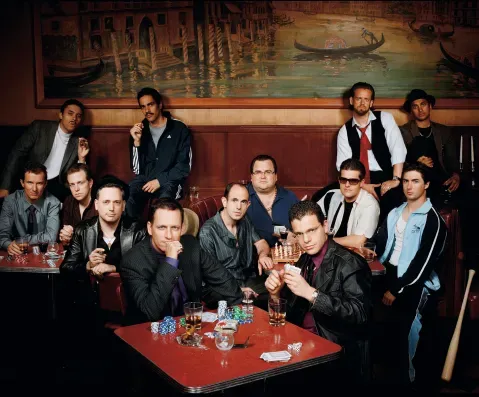
In 2007 thirteen men posed in mafia cosplay for Fortune magazine and called themselves the PayPal Mafia. The photo looks different now. It's not thirteen men performing menace. It's a class photo — of the cohort that just finished taking over the government.

PayPal Mafia, Part 1
In 2007, Fortune magazine ran a feature on a group of former PayPal employees who had gone on to found or fund an improbable percentage of the most important technology companies of the era. To illustrate it, a photographer arranged thirteen of them for a portrait. They wore suits and open-collared shirts and gold chains and posed with the studied menace of men cosplaying as the New Jersey mob. They called it, and themselves, the PayPal Mafia. The photo is now one of the most reproduced images in Silicon Valley history — not because it's a great photograph, but because it is the founding document of a myth, and the myth has been useful enough to sustain two decades of circulation.
The myth is: a group of exceptionally talented people built an extraordinary company, cashed out, and then went off to build more extraordinary things, because talent and vision compound. The true version is more interesting and more useful, because it's about networks rather than individuals, timing rather than genius, and an ideology rather than a collection of independent insights. One founding team, one simultaneous exit at a historically lucky moment, and a shared set of priors that got embedded in everything the network touched for the next two decades — culminating in the most complete formal integration of a private alumni network into the federal government in modern American history.
I. The Fairchild Comparison
The analogy the research keeps surfacing is Fairchild Semiconductor. In 1957, eight engineers left Shockley Semiconductor — William Shockley being the genuinely brilliant, personally impossible co-inventor of the transistor — to found Fairchild. Those eight, who became known as the Traitorous Eight, went on to found Intel, AMD, and the foundational companies of the entire Silicon Valley semiconductor industry. The geography, the culture, the venture capital infrastructure, the engineer-entrepreneur identity — almost all of it traces back to eight men who walked out of one lab in 1957. The PayPal Mafia is the software-internet equivalent: one founding team, one exit, and the downstream companies touch nearly every sector of the digital economy.
The comparison breaks down in one important place. The Traitorous Eight left because Shockley was impossible to work for and they needed to build something better. The PayPal cohort left because eBay bought their company in October 2002 for $1.5 billion and deposited the proceeds into their accounts. The trigger was a liquidity event, not a founding vision. They weren't fleeing toward something. They were rich and available.
II. The Lucky Exit
The $1.5 billion eBay acquisition in October 2002 deserves more scrutiny than it usually gets, because the timing of that exit is the central luck fact of the whole network, the one that never gets acknowledged in the keynote version of the story.
The dot-com bust had wiped out most of the class of 1999-2001. The venture capital market was in a contraction so severe that serious investors were questioning whether consumer internet was a viable category at all. In that environment, a small group of people had pockets full of post-acquisition cash, were not responsible for a failing startup, had the credibility of a successful exit, and were young enough to do it again. That combination — liquidity, credibility, energy, and a market starved for anyone who looked like they knew what they were doing — was not a product of their talent. It was a product of their timing. They cashed out at the bottom of the market and deployed at the bottom of the market. The investments they made in 2003, 2004, and 2005 caught the next wave up. The next wave up turned out to be the smartphone era, the social graph era, the cloud era — the biggest sustained value-creation cycle in the history of human commerce. Being rich and credible and available in 2003 is the single most important thing that happened to the PayPal Mafia, and none of them had any control over it.
It's also worth noting what the $1.5 billion exit was, mechanically. PayPal had grown through a merger between Confinity — Thiel and Levchin's company — and X.com, Musk's company, which the board essentially forced through in 2000 over both founders' active resistance. The fraud detection system that made the company trustworthy enough to handle real money was built by Max Levchin, not by any of the people whose names appear most prominently in the founding mythology. The company that became the seed of the PayPal Mafia was itself the product of a forced merger and an engineering solution that's largely been credited away from its actual author. The founding myth of the founding myth is already a simplification.
III. The Downstream Map
Set that aside and look at what the network actually built, because it is genuinely remarkable on its own terms.
Peter Thiel's $500,000 first check into Facebook in 2004 is the most consequential single investment of the era — not because of the returns, though the returns were extraordinary, but because it connected the PayPal network's capital and credibility to the social graph moment before anyone else understood what Facebook was. Thiel also co-founded Founders Fund with Ken Howery and Luke Nosek, which became the venture capital vehicle for the network's ideological project: backing companies that could "change the world" rather than "incrementally improve it," which in practice meant defense technology, biotech, and adjacent to intelligence infrastructure. Palantir came from the same network, with CIA seed money.
Reid Hoffman built LinkedIn, sold it to Microsoft for $26 billion in 2016, and built the most important professional network infrastructure in the world. Hoffman is the outlier in the political story — he went Democratic, backed Hillary Clinton, funded opposition research on Trump, invested in OpenAI, and publicly clashed with David Sacks over AI regulation in October 2025, Hoffman advocating oversight and Sacks advocating deregulation. The fact that one member of the same founding cohort, with the same exit, the same capital base, and the same shared experience, ended up on the opposite side of almost every political question is the clearest evidence that the rest of the group's drift rightward was a choice, not an inevitability. Hoffman proves the ideology wasn't structural. The others chose it.
Jawed Karim, Steve Chen, and Chad Hurley built YouTube in a garage in Menlo Park in early 2005 and sold it to Google for $1.65 billion in October 2006 — eighteen months after founding, for a company that had never turned a profit and whose legal status vis-à-vis copyright law was, charitably, unresolved. That is the luckiest exit per dollar of effort in the history of Silicon Valley, and it happened because the PayPal network gave them a credibility signal that allowed Google to take the acquisition seriously before YouTube had proven it deserved to exist. The network was, in that specific instance, the product.
Max Levchin, the man who actually built PayPal's fraud detection system, founded Affirm — the buy-now-pay-later company that has since become one of the largest consumer credit platforms in the country, extending credit to people who can't qualify for conventional loans at interest rates that consumer advocates have described as predatory. Levchin is the least politically prominent of the group and the most financially consequential to ordinary people's daily lives, which is a ratio worth noting.
Jeremy Stoppelman built Yelp, which remains independent and occupies the peculiar position of being the one PayPal Mafia company that never found a clean exit, never joined the political project, and mostly just runs a review website. David Sacks built Yammer, sold it to Microsoft for $1.2 billion in 2012, and built Craft Ventures, and we'll get to him in the next post because he deserves the full treatment.
IV. The Ideological Thread
None of this is a conspiracy. The network didn't hold meetings to decide on a shared political program. What it had instead was a shared prior — a set of beliefs so deeply embedded they didn't need to be articulated: that regulatory friction is the enemy of progress, that government is a problem to be worked around rather than a tool to be used, that the founder class has an insight into what the world needs that democratic institutions are too slow and too captured to act on, and that the people holding this set of beliefs are the ones who should be making the decisions. This wasn't unique to PayPal. It was the dominant ideology of Silicon Valley from approximately 1995 to 2015. What the PayPal network did was concentrate it in a small group with enough capital and social infrastructure to make it operational at scale.
The specific tells are in what the network funded. Founders Fund had a famous internal slide deck in the early 2010s that included the line "we wanted flying cars, instead we got 140 characters." The critique wasn't that Twitter was a bad business — it was that it wasn't the kind of transformative bet the network wanted to make. The things the network did want to bet on: space, defense, longevity, AI, biotech, and intelligence infrastructure. Palantir. Anduril. SpaceX. OpenAI, before the Musk departure. The common thread is dual-use technology with government as the anchor customer — which is, viewed from a certain angle, a sophisticated update on the original Oracle playbook. Build the thing governments need, then position yourself as indispensable to the government.
V. The Arc
The political evolution runs in five phases, and it's worth naming them clearly.
Phase one, 2002-2010: building and investing, libertarian-but-quiet. The network was rich and busy. Thiel was the most politically active, funding libertarian causes and the Seasteading Institute, but the mainstream of the group was focused on the next company.
Phase two, 2010-2016: the emergence of Thiel as the vanguard. The Gawker lawsuit, the Clarium Capital losses, the growing hostility to regulatory frameworks, the beginning of the NRx intellectual adjacency. Most of the group was still apolitical in public.
Phase three, 2016: the convention speech. Thiel spoke at the Republican National Convention, endorsed Trump, and paid a price in social capital with the San Francisco tech establishment that he appeared to calculate was worth it. Musk was still publicly hedging.
Phase four, 2020-2024: the full conversion, accelerated by COVID. The lockdown debates, the All-In podcast, the Sacks and Calacanis movement from libertarian-contrarian to MAGA-adjacent, Musk's Twitter acquisition and ideological transformation, the collapse of the distinction between the network's financial interests and its political positions.
Phase five, 2025-2026: formal integration. DOGE, with Thiel's Palantir as the database. Sacks as AI and crypto czar. Howery still an ambassador-level figure from the first Trump term. Musk as the most powerful unelected person in the federal government for six months. PCAST with Brin, Ellison, Zuckerberg, Andreessen, and Sacks as co-chair. The network that started as a group of people with pockets full of eBay money in 2002 is now embedded in the institutional architecture of the federal government.
The Whampoa Military Academy trained the officers who ran the Republic of China. The PayPal Mafia trained — or more precisely, funded and credentialed — the people who are running, or trying to run, this one. The photo from 2007 looks different now. It's not thirteen men cosplaying as the mob. It's a class photo.
Next: The All-In echo chamber, the barnacle archetype, and what happens when proximity to power becomes the product.
Thanks for reading Sweaty Spice. Subscribe for free to receive new posts and support my work.
Like what you've read? Do me a solid and share with your friends and on the socials!